



System Integration Explained: Patterns, Choices, and ROI.
A practical guide to system integration covering patterns, architecture, security, testing, migration, and ROI for modern digital products.
System Integration Explained: Patterns, Choices, and ROI.
You've probably felt this already. A new app looks polished, the team is proud of the launch, and then the friction starts, customer details live in one place, payments in another, reporting in a third, and someone still exports spreadsheets to make the day's decisions. System integration is what turns that scattered setup into one operating environment, so data and workflows can move without constant re-entry, manual reconciliation, or guesswork.
- System integration connects the moving parts, apps, websites, CRMs, payment tools, analytics stores, and legacy back-office systems, so they behave like one product instead of a bundle of disconnected tools.
- The primary job goes beyond connectivity: reliable data flow, valid transformations and operational control when something breaks.
- Patterns matter more than tools, because API-led integration, event-driven flows, ETL, middleware, and iPaaS each solve different problems.
- Good integration is measured by outcomes, like data accuracy, fewer manual reporting steps, and faster recovery from failures.
- Legacy systems don't disappear, so phased migration, testing, and governance are part of the design, not an afterthought.
- The hidden cost is change management, not just licences or middleware, which is why ROI needs to be judged carefully.
What System Integration Really Means in Modern Products
A product team can ship a polished mobile app and still run a fragmented operation underneath it. Customer records may sit in a CRM, payment events may sit in a gateway, and analytics may land in a separate database, so the same information gets translated by hand across teams. That is where system integration matters, because it connects those separate tools so data and workflows move through one operating model instead of being re-entered at every step.
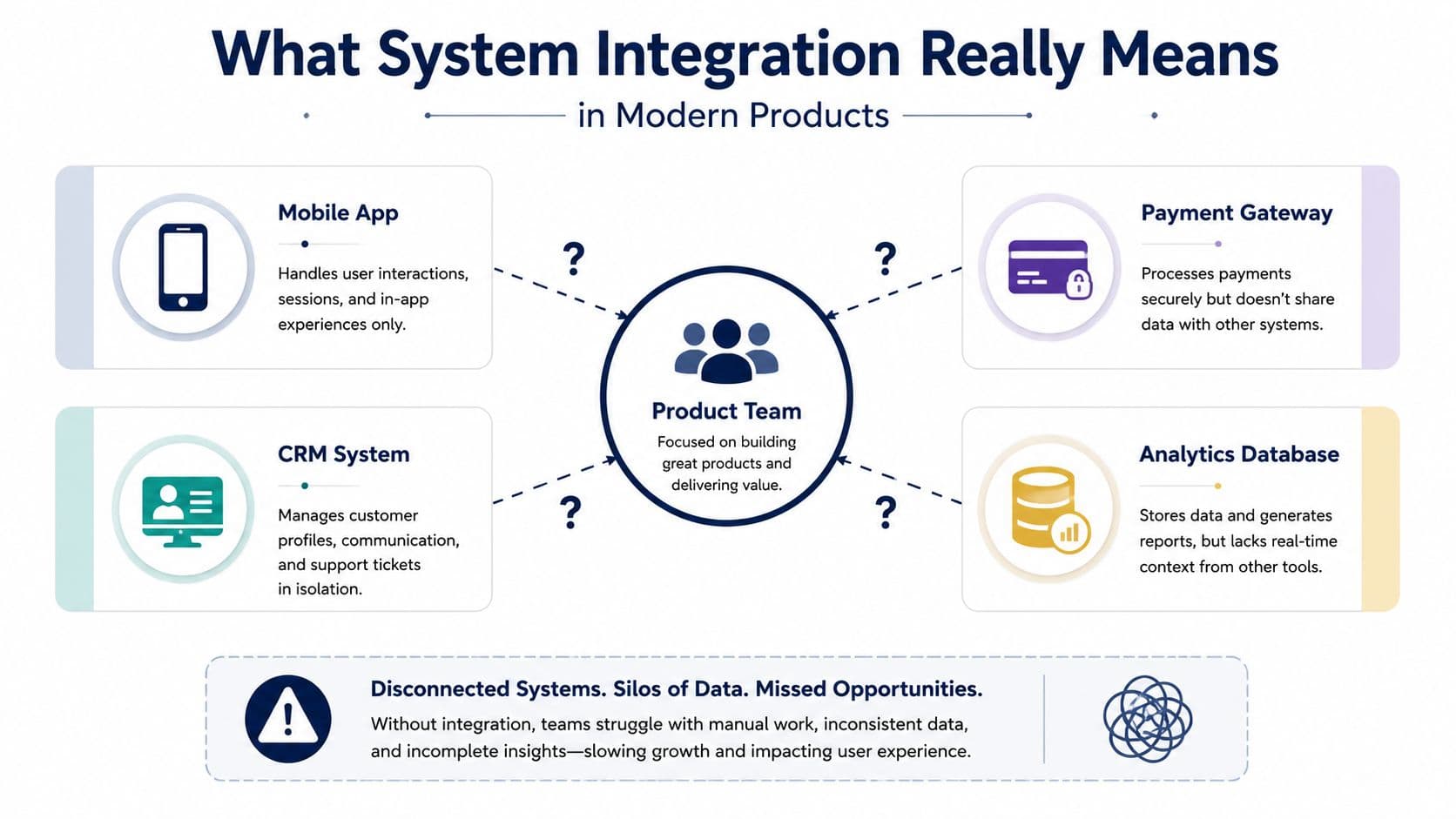
A practical way to think about it
For product teams, integration is closer to building a reliable junction than wiring two apps together. In systems engineering, ISO/IEC 15288 treats system integration as an iterative process that combines implemented elements into complete or partial configurations, while checking the correctness of interfaces between them. That matters because each component may work on its own and still fail once it starts exchanging data with the rest of the estate. The U.S. National Academies frames the same idea as a problem-solving activity that coordinates technology to meet a customer's needs and create systemwide synergy, which is why a good starting point for understanding systems integration is to look at the interfaces, ownership boundaries, and failure modes rather than the tool list.
The market picture shows why this now sits in the centre of product delivery, not at the edge of it. Global system integration market estimates range from about USD 421.4 billion in 2025 to USD 467.0 billion in 2026, with long-range forecasts reaching USD 1,228.6 billion by 2033 and a projected 14.8% CAGR from 2026 to 2033 Grand View Research. Those figures suggest modern products depend on connection work as much as they depend on design and development.
UK delivery teams feel this most sharply in legacy estates. A retailer may still rely on a back-office system that predates the current web stack, a public sector service may need to reconcile data across older records and newer cloud services, and a finance team may have to keep operational controls intact while changing the customer journey. In those settings, the integration decision is an architecture and operations decision that affects data quality, support processes, and the cost of change management.
Practical rule: if a workflow still depends on exporting a file, retyping values, or checking two systems by hand, the product is already carrying integration debt.
That debt shows up as duplicate records, inconsistent reporting, slower incident handling, and more manual work for people who should be spending time on the product itself. It also shows up in ways teams often miss at the start, because every new dependency adds another place where governance, validation, and recovery need to be defined. A system can look fine in a demo and still be awkward to run on a Monday morning.
For teams evaluating their options, the useful question is where the connective layer should live, how much operational control the business needs, and what level of data-quality benchmark the organisation expects before the next change goes live. A clear next step is to map the data sources, workflow owners, and failure points in the stack, then compare those needs with a practical overview of what systems integration covers and the integration approach used in the product journey.
The Five Integration Patterns Every Team Should Know
Different patterns solve different problems, and most real projects use more than one. The mistake is treating integration as a single technology choice, because the right answer for a live customer journey often isn't the right answer for nightly reporting or back-office synchronisation. Strong teams choose the pattern to fit the job.
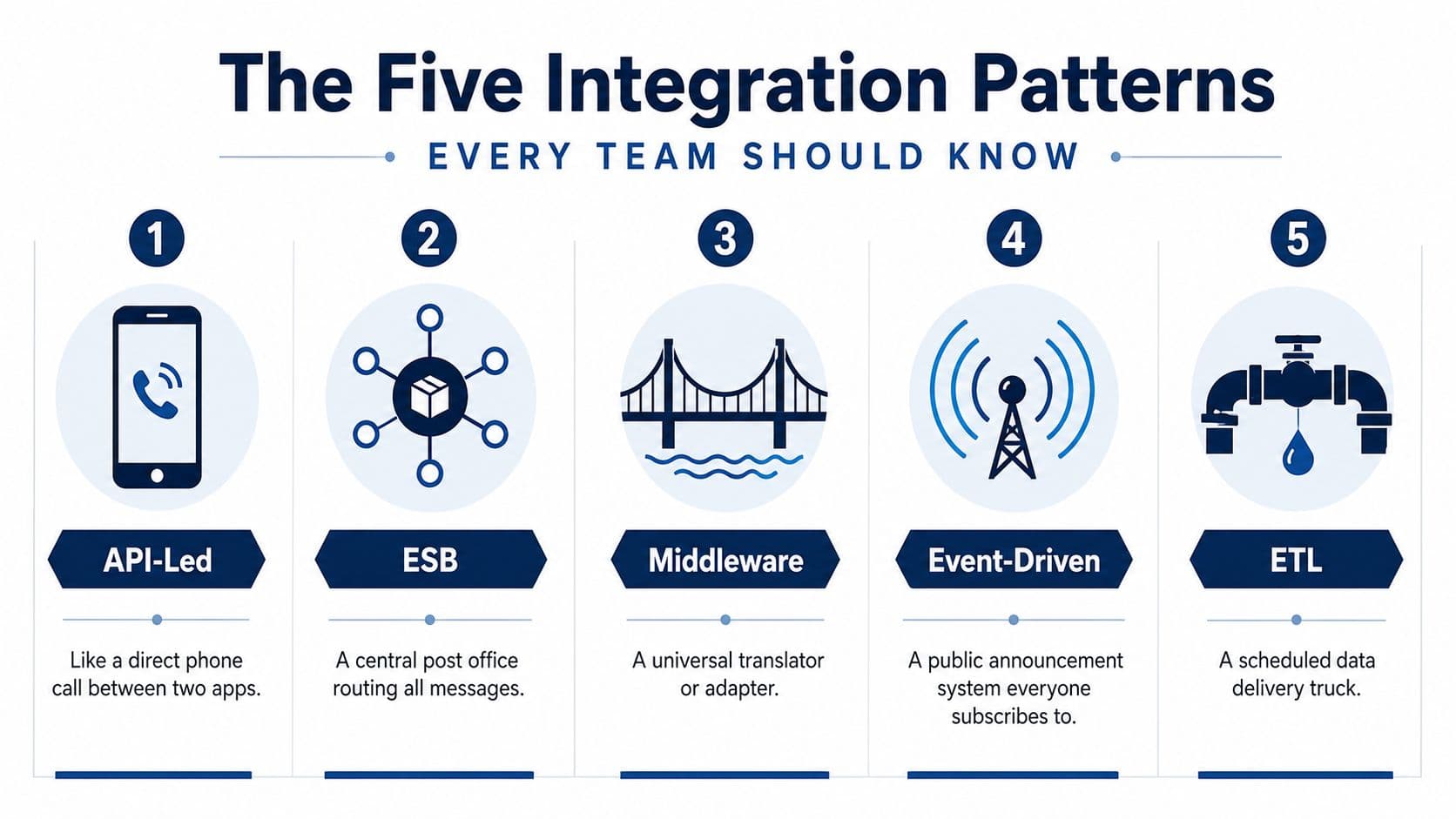
Direct calls, switchboards, and translators
API-led integration is the direct phone call between two systems. It works well when one system needs a specific response from another, especially in customer-facing flows where latency and clarity matter. The failure mode is tight coupling, because every change on one side can ripple into the other if the contract isn't managed carefully. For a plain-English primer on this pattern, Arch's guide to API integration is a useful companion.
ESB, or enterprise service bus, is the central switchboard. It can help when many systems need shared routing and orchestration, but it can also become a bottleneck if everything depends on one hub. Middleware is the universal translator or adapter, useful when two systems speak different formats and need a layer in between. Its weakness is that translation logic can sprawl unless someone owns it properly.
Broadcasts and batch moves
Event-driven integration is the pub-sub broadcast. One system announces that something happened, and subscribed systems react, which is useful when multiple downstream tools need the same trigger without waiting on a direct request. The risk is complexity, because event ordering, retries, and duplicated messages need discipline. ETL is the overnight courier. It's a strong fit for data movement and reporting, especially when business users don't need instant sync, but it can hide issues until the next batch lands.
What matters is how a pattern behaves. A team that can describe latency, ownership, and failure handling usually picks the right pattern faster than a team that starts with a product brochure.
ISO/IEC 15288's view of integration as a recursive process matters here, because mature teams don't pick one pattern and stop. They layer them, test them at each boundary, and treat integration as part of the architecture. For teams that want to compare architectural trade-offs alongside cloud deployment models, Arch's cloud versus on-premise discussion is a sensible reference point.
How to Choose the Right Pattern for Your Product
A UK scale-up launching a new customer app might start with a straightforward answer, use APIs for live interactions and keep reporting separate. That works if the estate is greenfield and the team owns most of the stack. It changes quickly once the same product has to connect to a 15-year-old ERP, a finance team's workflow, and a patchwork of vendor tools that nobody wants to replace in one go.
The four criteria that usually decide it
Transaction volume and latency come first. If users expect an instant response, API-led or event-driven patterns usually make more sense than a batch-heavy design. If the business can wait for a scheduled sync, ETL or a staged orchestration layer can be easier to run.
Existing legacy estate often decides the shape of the work. A clean cloud stack gives you more freedom, while a mixed environment with on-prem systems, older databases, and brittle workflows pushes you towards patterns that isolate risk and reduce change at the edges. That's why integration often starts as an architecture decision, not a tooling decision.
Team capability matters more than most steering groups admit. If your engineers can own contracts, retries, observability, and release control, custom integration can be a strong fit. If not, an iPaaS platform is often the pragmatic answer, especially when the market context shows that iPaaS revenue exceeded USD 9 billion in 2024 and kept climbing from USD 7.8 billion in 2023 and USD 5.9 billion in 2022 oneIO.
Time-to-value is the final filter. If the team needs orchestration fast and doesn't want to build every connector from scratch, a platform can be the shortest path. If the integration is highly differentiated, tightly regulated, or embedded in product logic, custom work can be worth the extra effort.
For a team comparing options, a useful question is whether the problem is “connect these systems quickly” or “create a durable integration capability”. The first points toward a platform, the second usually points toward a more deliberate architecture.
Security, Governance, and Data Quality
Security and governance break in the same places, so they should be designed together. If a team has a lawful basis for sharing data but no documented controls, or strong access rules but no clear minimisation policy, the integration can still fail operationally and politically. In practice, governance sets the rules, and security enforces them while data moves between systems.
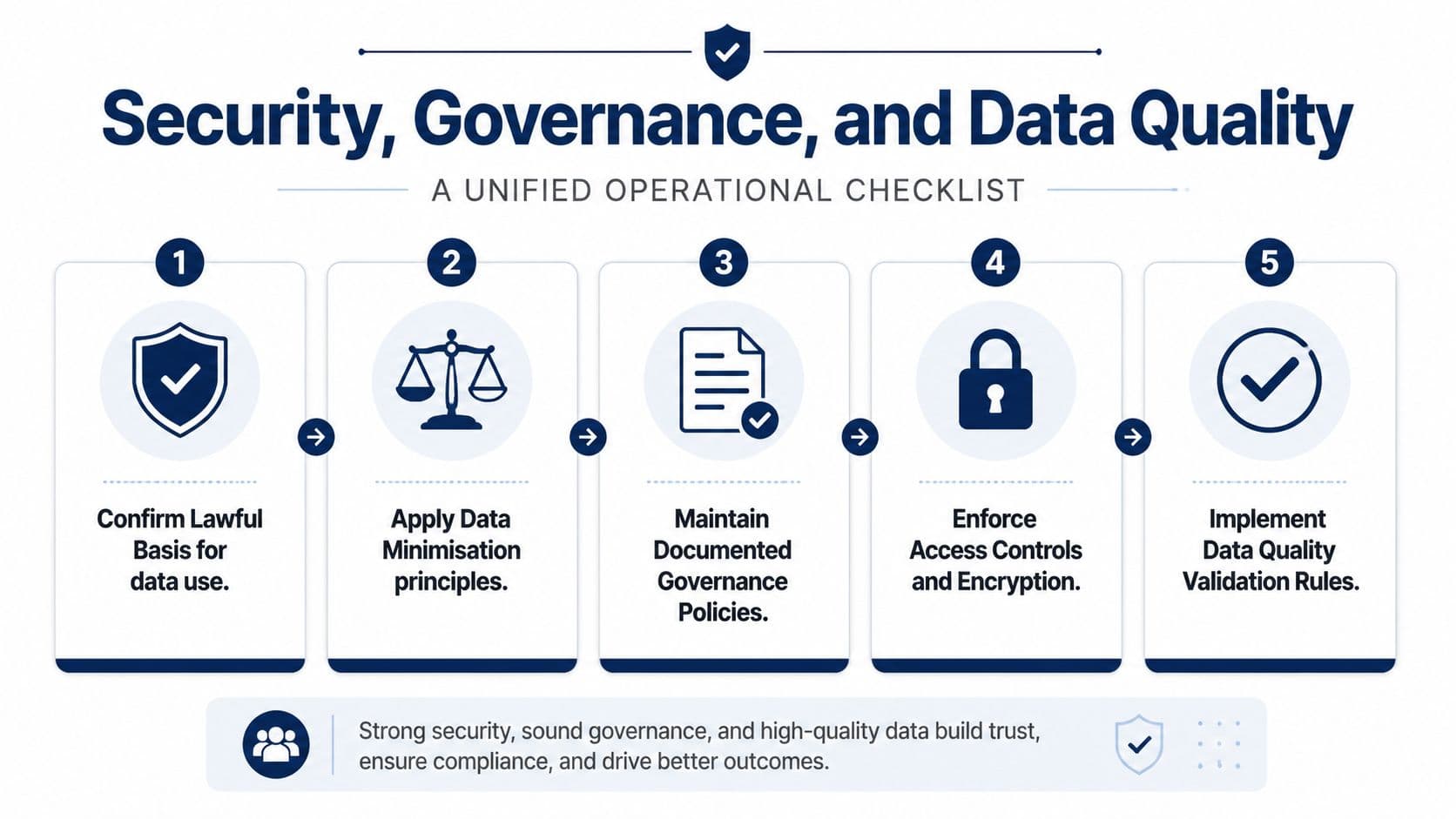
What protects the flow
The technical basics are familiar, but they have to be applied consistently. That means authentication, encryption, least-privilege access, and audit logging on the data that moves between systems, not just on the systems themselves. It also means documenting who can approve a change, who owns the mapping, and what happens when a record fails validation.
The benchmark that tends to matter most is data quality after transfer, not just successful delivery. Integration specialists often define success as about 99.9% data accuracy between systems and a 50% reduction in manual reporting CISIN. That's a useful lens because it shifts attention away from “did the API respond?” and towards “did the right data arrive in a usable state?”
Practical rule: if validation is weak, bad data doesn't stay in one place. It spreads into downstream systems and becomes more expensive to unwind.
The systems-thinking reason this matters is simple. A 2021 SAGE article notes that outcomes like safety, security, and resilience emerge across boundaries, not inside any one component SAGE. That means governance can't live in one application team and security can't be treated as a separate sign-off at the end. They both have to be part of the integration design from the start.
Testing, Deployment, and Migration Without Business Disruption
The cleanest integration plan still fails if the rollout is careless. Profiles, mappings, and transformations matter, and so does the sequence in which you release them. That's especially true in UK organisations with mixed estates, because cloud migration and legacy support usually overlap. Cloud use among UK businesses rose to 45% in 2024 ONS via Panorama Consulting's summary, which suggests many teams are juggling modern and older platforms at the same time.
The rollout sequence that keeps risk down
Start by profiling source and target schemas. If field names, data types, or mandatory values don't align, the integration will fail in ways that are hard to trace later. Once the mapping is clear, define transformation rules and add validation plus error quarantine, so bad records are isolated instead of contaminating downstream systems.
Testing should happen iteratively, not as one final gate. Run integration tests, then performance tests, then failure-path tests, because the system needs to prove it can recover as well as it can succeed. A phased deployment, such as a blue/green or canary release, is often safer than a full cutover when the live service can't afford a surprise.
Migration needs the same discipline. Move data in batches, verify each batch, and keep legacy systems running until the new flow has proven itself. Arch's data migration strategies guidance is relevant here because the core issue goes beyond transfer to preserving business continuity while the source of truth changes.
Monitoring is what keeps the operation resilient after go-live. Alerts, dashboards, and documented escalation paths reduce recovery time when something fails, and that recovery time is often what separates a fragile integration from a dependable one. If the team can't explain who gets paged, what gets rolled back, and how exceptions are resolved, the migration isn't finished yet.
What Integration Really Costs and How to Prove ROI
The expensive part of integration usually isn't the middleware licence. It's the work around it: schema mapping, stakeholder alignment, testing, exception handling, governance, and the long tail of maintenance. Teams underestimate those costs because they're less visible on a budget line, but they take time, coordination, and repeated decisions.
The hidden costs people skip
A business case that only prices the platform is incomplete. Someone still has to reconcile source systems, define ownership for exceptions, support the users who change their process, and maintain the integration when one upstream system changes its schema. If those tasks are ignored, the project can look cheap at approval time and expensive after launch.
A more honest ROI conversation starts with service outcomes. Ask how many manual hours the integration removes, what exception rate is acceptable in production, and which teams stop doing duplicate data entry. More integration doesn't automatically mean better results. If the design adds complexity or weakens accountability, it can make operations harder.
Practical rule: prove value in the language of the business, not the language of the middleware stack.
Integration should be judged on reliability, accuracy, and service responsiveness, not on how many systems it connects. When the result is a cleaner handoff between teams and less manual cleanup, the ROI case becomes much easier to defend.
How Arch Approaches System Integration in Practice
A useful way to see integration decisions is through delivery work, not diagrams. A utilities product might need customer accounts, payment flows, and operational dashboards to stay aligned. A workforce platform might need HR data, scheduling, and compliance records to match in near real time. An AI product might need governed data feeds that are clean enough to trust before anyone talks about model output.
Three patterns that show up in real projects
For a mobile app with live account actions, API-led integration is often the first choice because the app needs quick responses and a clear contract between systems. That same project may still use a platform layer for less urgent workflows, especially if the back office spans several vendors. If the stack is broader and the rollout needs orchestration across multiple tools, iPaaS can keep the integration manageable without forcing the team to build everything from scratch. Arch's mobile app development service and development capability page show the kind of product work where those decisions come up.
For a web platform that touches several internal systems, the main challenge is usually not the front end. It's keeping the business rules consistent when data enters from different sources, which is where phased integration and careful governance matter more than the interface layer alone. That same thinking applies whether the team is building something like Findr, Deploy, or a public-sector style platform such as Edinburgh Council.
For AI, clean inputs matter more than flashy outputs. If the feed is inconsistent, the model may still generate something, but the product won't be dependable. That's why integration and data quality are inseparable in AI delivery, and why services such as Arch's AI offering need governed upstream systems before the clever part can matter. In practice, the same principle shows up in products like H2OiQ and Boiler Juice, where useful outcomes depend on stable flows behind the interface.
If you're mapping your own stack, start with the boundary that hurts most, then choose the pattern that keeps the product stable while reducing operational noise.
If your team is planning a product launch, a legacy migration, or a data-heavy workflow that keeps slipping into manual work, speak with Arch about the integration architecture before you commit to the build. A short conversation can save months of rework, and it's the right time to align systems, governance, and delivery around one product plan.