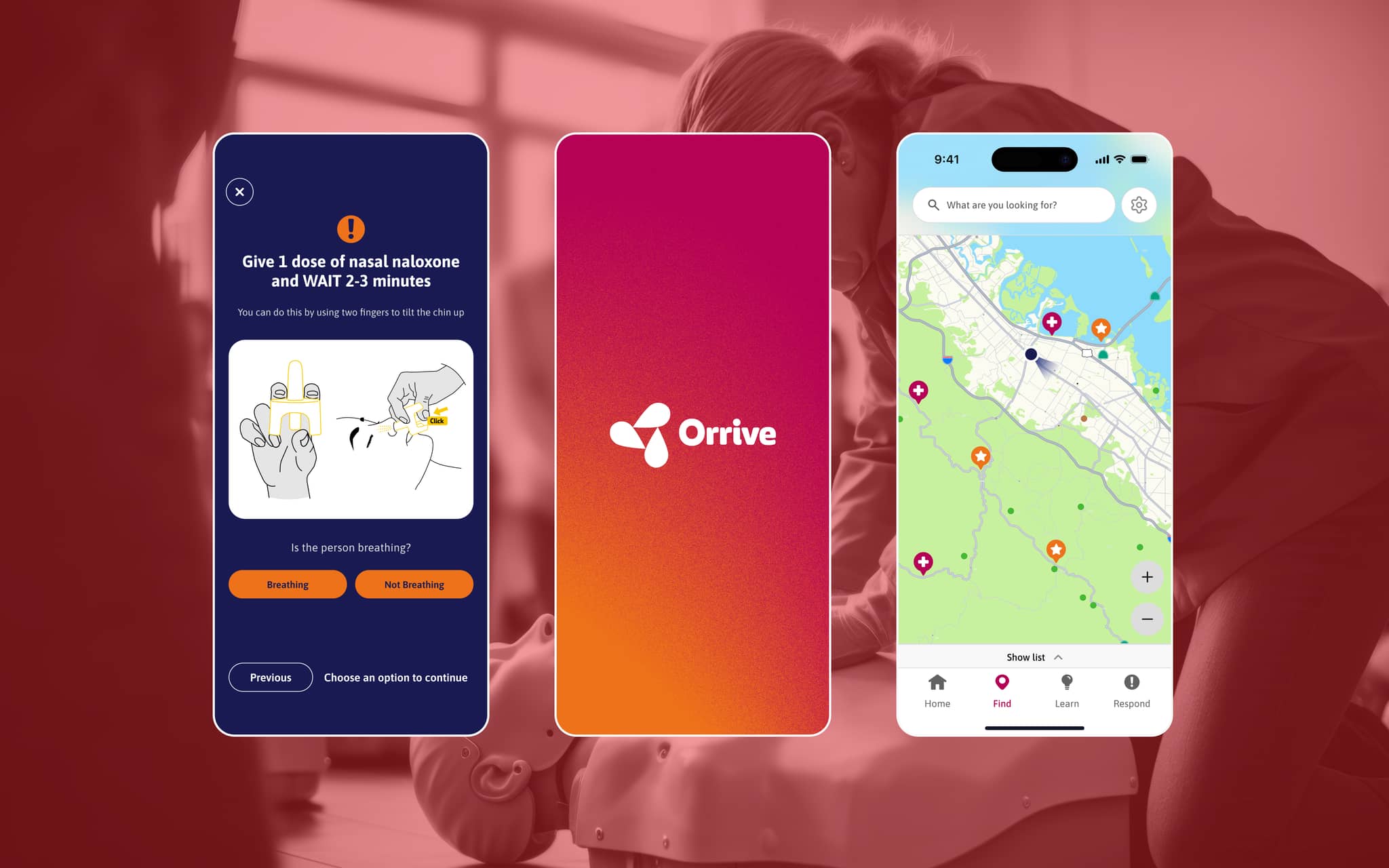
Healthcare software development company hero image

Health Tech App Development UK.

Compliant, clinically safe health apps that can connect to NHS systems. Send us your brief and hear back within one working day.

OVERVIEW

Healthcare Software Development, Done the Compliant Way.

Healthcare app development in the UK means designing, building and launching digital health products, whether patient apps, clinician tools or remote monitoring, that meet NHS standards for clinical safety, data protection and interoperability.


Teams also call this healthtech platform development or healthtech application development.


Arch has built regulated software of this kind since 2005, for the NHS and for private healthcare providers alike. The same NHS-grade engineering bar applies whichever market you serve.


NHS England Digital recorded 41,346,767 all-time NHS App registrations to the end of April 2026, with 14.8 million distinct users logging in that month. Your patients are already comfortable managing care on a phone.


What separates a health app that reaches NHS deployment from one that stalls is compliance, and that is where most of the risk, and most of our work, sits. You can see our development work across sectors, but this page is about the health-specific part.


A short version of the track record behind it:


  • Since 2005, building UK web and app software, health included
  • 197,000+ people in scope of the Turning Point harm-reduction app we built
  • NIHR-backed, the iFell Parkinson's falls app, built with Dr Rosie Morris under an NIHR Advanced Fellowship
  • 4.7 on Clutch, verified independent reviews of our delivery
GET THE CLASSIFICATION RIGHT

Wellness App or Regulated Medical Device? Start Here.

The first strategic question in any healthcare app development project is whether your product is a medical device. Get it wrong and you either over-build a wellness tool or, worse, ship an unregulated device.


A wellness app that tracks steps or logs mood sits outside medical-device rules.


The moment software diagnoses, monitors a condition or informs a treatment decision, it may meet the Software as a Medical Device threshold and fall under MHRA regulation, typically Class I or Class IIa by risk.


Around 90% of medical devices used in Great Britain are CE marked, and in a February 2026 consultation the MHRA proposed recognising CE marking indefinitely alongside the UKCA route, so both conformity marks remain in play.


Regulators are also investing in this space. The MHRA committed £3.6 million over three years to expand the AI Airlock, its regulatory sandbox for AI as a Medical Device, in April 2026.


We classify your product early, tell you plainly which route applies, and build to it. That is engineering guidance, not legal advice.
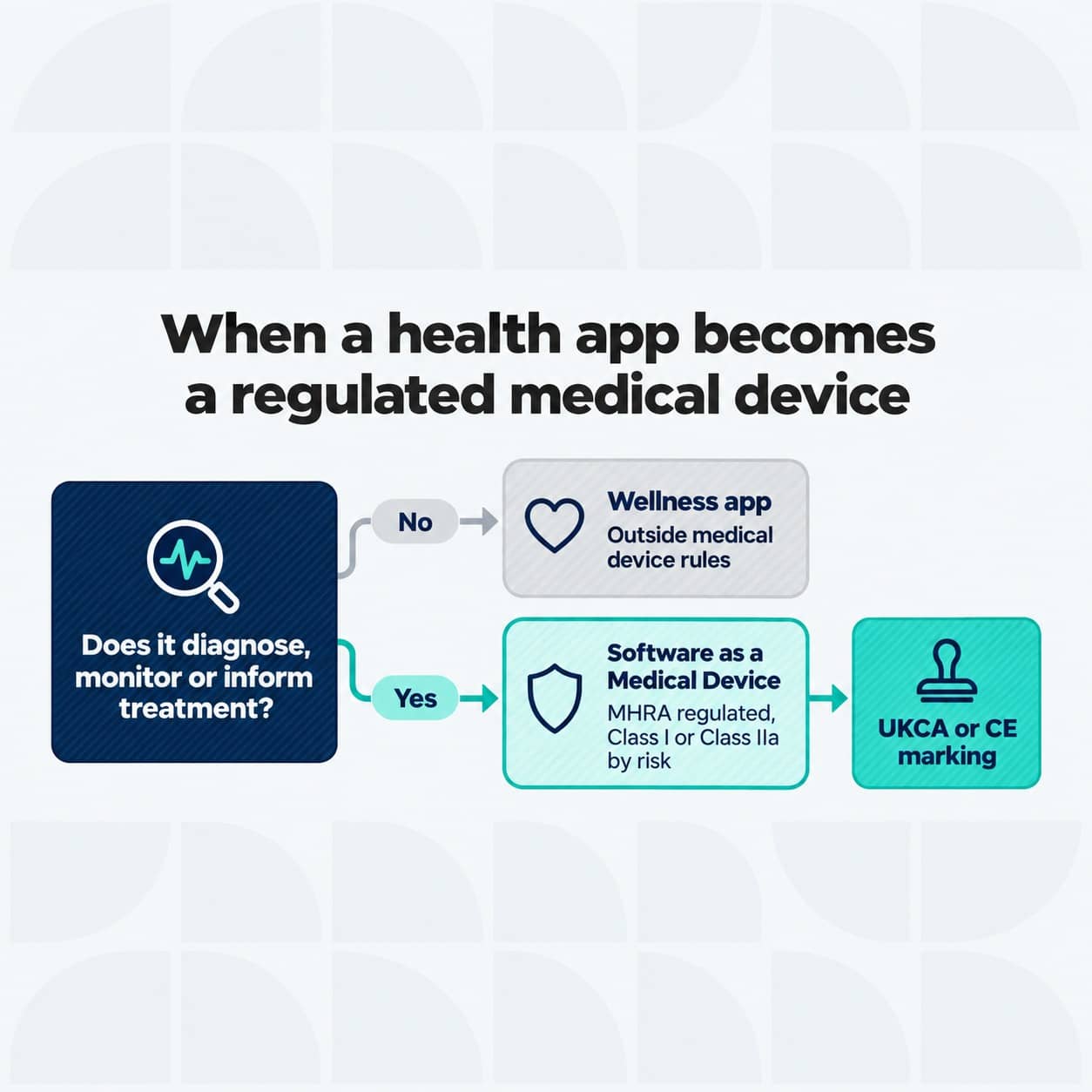
Decision flow for a healthcare app: a wellness app sits outside medical device rules, while software that diagnoses, monitors or informs treatment is a Software as a Medical Device, MHRA regulated at Class I or IIa and UKCA or CE marked

COMPLIANCE BUILT IN

DTAC, Clinical Safety and UK GDPR: The Bar for NHS Deployment.

Buyers vet health tech app development UK partners on regulatory depth. We build the evidence for each framework alongside the product, so none of it is written in a rush before procurement.


Passing DTAC: the five domains we build against


Any app seeking NHS deployment must pass the Digital Technology Assessment Criteria across five domains: clinical safety, data protection, technical security, interoperability, and usability and accessibility. DTAC v2.


0 cut the number of questions by around 25%, and the previous form cannot be used from 6 April 2026. We produce a DTAC evidence pack as we build, so you enter procurement with the answers already written.


Clinical safety by design: DCB0129, hazard logs and a named CSO


Health IT carries clinical risk, governed by the DCB0129 and DCB0160 standards. That means a hazard log, lifecycle risk management and sign-off by a registered Clinical Safety Officer.


NHS England opened a formal consultation on 29 June 2026 to review these clinical safety standards for the AI era. We embed clinical safety into delivery and can provide a registered Clinical Safety Officer as part of the engagement.


GDPR-compliant healthcare app development


Patient data is special-category data. GDPR-compliant healthcare app development UK means privacy by design: a Data Protection Impact Assessment, Caldicott principles applied, the NHS Data Security and Protection Toolkit, and encrypted hosting kept in the UK or EEA.


We work to Cyber Essentials Plus practices and role-based access control, so security is part of the structure from the first build.


Accessible and inclusive by default


Accessibility is one of the five DTAC domains. We build to WCAG 2.


2 AA, write in plain language and design for low bandwidth and offline use, because 1.6 million people in the UK have no internet connection at all, and around 1.7 million households have no laptop, tablet or desktop, per a March 2026 government report.


A health app that excludes the people who need it most will not pass assessment, and should not. Our Turning Point harm-reduction app was built anonymous by design, in plain English and for low cognitive load, for exactly this reason.

INTEROPERABILITY

Healthcare App Development That Integrates: NHS Login, GP Connect, the Spine and FHIR.

Saying that a product integrates with the NHS means little on its own, so we name the systems: NHS Login for patient identity, GP Connect and the Spine for record access, shared care records and IM1, all built on HL7 FHIR R4 so your data is genuinely interoperable.


The government has legislated for a single patient record requiring all NHS providers to share data, with clinician-facing benefits arriving as early as 2027. Building to open standards now keeps your app on the right side of that shift.


Our patient app development UK work carries this through to production, and it draws on the same engineering as our bespoke web applications and cross-platform Flutter apps.
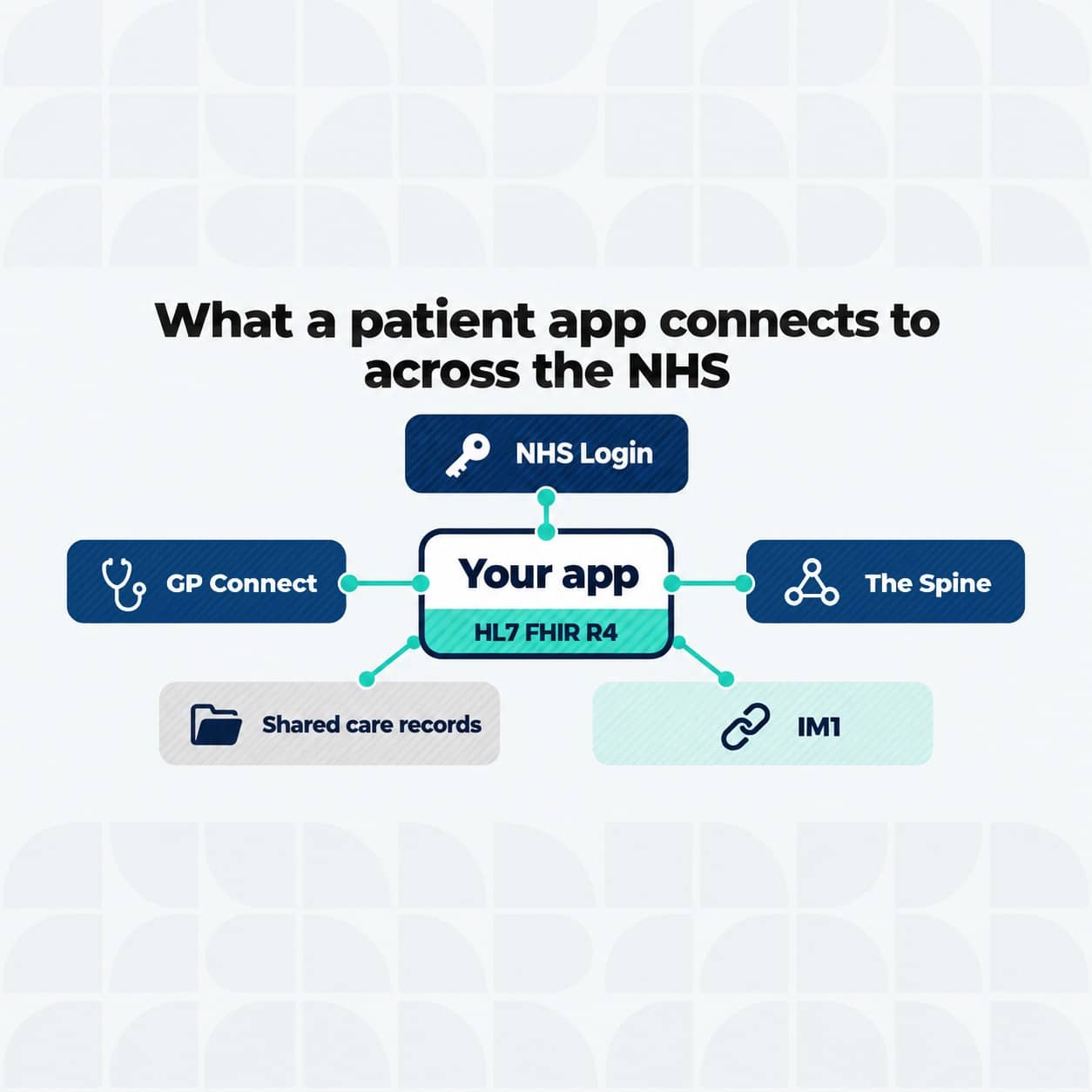
Hub and spoke diagram of NHS integration: a patient app built on HL7 FHIR R4 connecting to NHS Login for identity, GP Connect and the Spine for record access, shared care records and IM1

WHAT WE BUILD

Digital Health App Development UK, Across Three App Types.

Digital health app development UK covers more than one product shape. We build across the three that matter most.


Patient-facing apps and remote monitoring


Self-management, appointments and remote patient monitoring, often paired with wearables.


Public appetite is strong: around three-quarters of the public say they would be happy to use the NHS App for tasks such as booking hospital appointments and choosing a hospital for treatment, per the Health Foundation's March 2026 report on 8,000 members of the public.


See our approach to wearable app development.


Digital mental health tools


Well-designed mental health apps ease real pressure. 2.24 million people were in contact with NHS mental health services at the end of January 2026.


Read our take on digital mental health.


Clinician-facing and AI-assisted tools


Tools that save clinical time, with AI used where it earns its place and kept under governance. The NHS now runs a registry of 19 approved ambient voice technology suppliers, with tools saving up to two to three minutes per consultation.


Our related medical software development work goes deeper.

HOW A PROJECT RUNS

Healthcare App Development From Discovery to Clinical Sign-Off.

1. Discovery and classification


We scope the product, map users and settle the medical-device question early, so you build the right thing to the right standard.


2. Design


Accessible, plain-language UX, tested as a clickable prototype before any production code.


3. Build


Short iterations you can follow, on an encrypted stack hosted in the UK or EEA.


4. Clinical safety sign-off


The hazard log is closed and clinical risk is signed off before anything reaches a patient.


5. DTAC assessment and launch


We hand over the evidence pack, then ship, maintain and improve the app in service.

COST AND TIMELINE

What Shapes the Cost and Timeline of a Health App.

Health tech app development UK projects are priced from scope, not a list.


Compliance scope moves the number more than anything, because a wellness tool, a regulated medical device and an NHS-integrated app are three different jobs. After that it is how many features you launch with, and how much clinical safety and integration work is involved.


One conversation gets you a figure and a realistic timeline. Say where your product sits and we will scope it honestly, including a smaller first release that could prove the idea.

OUR HEALTH WORK

Health Apps We Have Designed and Built.

Discover what services we have to offer.

We offer expert Flutter development, custom app design, cross-platform solutions, UI/UX design and bespoke web design.

FAQ

Healthcare App Development in the UK: Common Questions.

What is health tech app development in the UK?


App work where the regulator is a stakeholder from day one. The practical difference from ordinary development is that clinical safety, data protection and NHS interoperability are designed in from the first workshop, not added before procurement.


What regulations apply to health tech app development in the UK?


The main ones are UK GDPR and the Data Protection Act 2018 for patient data, DCB0129 and DCB0160 for clinical safety, DTAC for NHS procurement, and MHRA rules if your app is Software as a Medical Device. Accessibility to WCAG 2.


2 AA and the NHS Data Security and Protection Toolkit also apply. We map which of these bite for your product during discovery.


How much does health tech app development cost in the UK?


Compliance scope sets the figure first, then feature count and integration depth. We quote each project on what it needs rather than from a price list, and one call is enough for a real number.


How long does healthcare app development take in the UK?


Compliance sets the pace. A focused patient app moves faster than a regulated, NHS-integrated device that needs full clinical risk management, and your dates are set during discovery.


What makes a health tech app NHS-compliant?


Passing DTAC, managing clinical risk to DCB0129 with a named Clinical Safety Officer, protecting special-category data under UK GDPR, and integrating through open NHS standards. The compliance section above walks through each.


What technologies are used in health tech app development in the UK?


We build cross-platform apps with Flutter, back ends on Laravel, and encrypted cloud hosting kept in the UK or EEA, with role-based access control throughout. Interoperability runs on HL7 FHIR R4 to connect with NHS clinical systems.


We choose the stack to fit your product and its compliance scope.

A picture of the arch office with developers working

Work with us.

Got an amazing idea and need a dedicated specialist team to help get it off the ground? Got a thriving business that you’re looking to take to the next level? Get in touch today and see how can work together.