



A Look at Transportation and Logistics Software Development.
Evaluate TMS build-vs-buy choices with real-world deployment data, microservices frameworks, and post-Brexit compliance.

A Look at Transportation and Logistics Software Development.
Logistics systems fail at the seams of integration. While the global transport management system (TMS) market accelerates towards USD 22.5 billion (approximately £16.79 billion), operators face a persistent and costly build-versus-buy dilemma. This paper investigates how technical decision-makers can navigate integration complexity, data residency, and vendor lock-in without falling into common procurement traps.
All market and cost figures in this paper originate from US-based research sources, with GBP equivalents given throughout. Conversions are calculated at an exchange rate of £1 to $1.34, the mid-market rate in May 2026. Readers should verify current exchange rates when making active budgetary decisions.
Many operators find that off-the-shelf platforms carry heavy hidden costs that erode their expected return on investment. By examining real-world deployment data, we provide a balanced architectural framework for custom logistics software development. This guide helps engineering leaders evaluate whether to build a tailored solution or acquire an existing platform.
Key Findings at a Glance
- The European transport management system (TMS) market is valued at £4.25 billion to £4.62 billion for 2025 to 2026, where off-the-shelf SaaS implementations carry realistic first-year setup costs of £110,000 to £300,000 and five-year costs up to £630,000.
- Custom transportation and logistics software development becomes economically viable once an operator manages 50 to 100+ vehicles and processes over 2,000 shipments monthly, as cumulative SaaS transactional fees eventually surpass custom capital amortisation.
- System integration represents 30% to 50% of custom development budgets, making containerised microservices and API-first architectures critical to mitigating legacy data challenges and carrier fragmentation.
- Cross-platform app development using Flutter offers a high-performance, single-codebase solution for fleet management applications, whilst native builds remain appropriate for setups requiring direct, low-level telemetry integrations.
- Strategic evaluation of commercial software must heavily weigh the long-term cost of vendor lock-in, including restrictive data portability, automatic renewals, and compounding transaction fees, which are frequently underweighted during procurement.
Introduction
Your transport management system vendor is selling a fiction. The headline figures of the USD 22.5 billion global transport management system market describe an environment dominated by North American enterprise SaaS adoption. They fail to reflect the operational realities of the UK and European mid-market where operators must navigate distinct regional challenges.
This paper examines what empirical evidence reveals about transportation and logistics software development and architecture. We dissect the critical build-versus-buy decision, focusing on the integration complexities and data structures that dictate project outcomes. By avoiding vendor-sponsored narratives, this analysis isolates the structural factors that determine whether a custom software deployment succeeds or falters.
We provide technical decision-makers and founders with a clear decision-making framework for evaluating proprietary versus bespoke systems. Our goal is to offer a practical understanding of how logistics networks operate in 2026, based on real-world engineering. Through this lens, we explore how modern platforms handle everything from routing optimisation to post-Brexit compliance.
1. The Market Landscape
Evaluating a transportation management system (TMS) forces operators to navigate extreme data fragmentation. Nine separate market research firms publish nine conflicting sets of numbers, leaving buyers without a commercially meaningful benchmark . Resolving this confusion requires distinguishing between what these figures actually measure and the underlying assumptions they carry.
Market Size: Reconciling Nine Sources
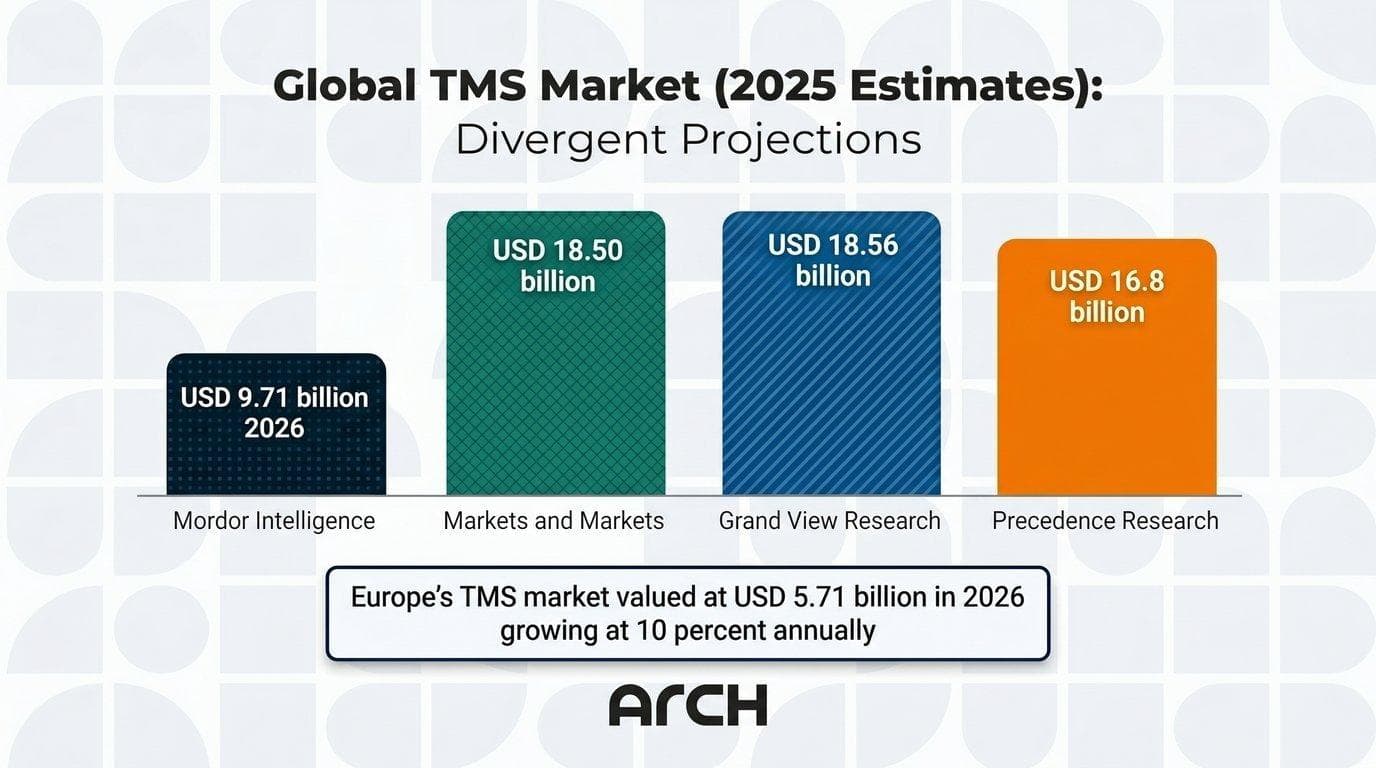
Vendor-affiliated research houses publish widely cited figures, yet their global estimates diverge markedly. For instance, Mordor Intelligence places the global TMS market at £7.22 billion ($9.71 billion) in 2026, growing at an annual rate of 8.93% to reach £11.08 billion ($14.89 billion) by 2031. Conversely, Markets and Markets projects the sector will reach £13.76 billion ($18.50 billion) in 2025 and expand to £27.56 billion ($37.04 billion) by 2030 .
Grand View Research presents an even higher trajectory, estimating the market at £13.81 billion ($18.56 billion) in 2025 and scaling to £50.86 billion ($68.36 billion) by 2033. Meanwhile, Precedence Research and Research Nester forecast a valuation of approximately £35.71 billion ($48 billion) by 2035, driven by an estimated 10% to 12% annual growth rate from a 2025 base of £12.35 billion . The divergence shows how different methodologies can cloud the true scale of the industry.
These discrepancies stem from three major definitional choices made independently by each research firm. Analysts vary on geographic scope by front-loading North American enterprise adoption, whilst others expand product scope to include visibility platforms and fleet management modules. Furthermore, including large-scale systems like SAP TM and Oracle TMS artificially inflates headline numbers compared to standalone platforms.
Applying these broad, global estimates to a localized build-versus-buy decision produces a highly misleading picture of market opportunities. For a UK or European logistics operator managing between 5 and 200 vehicles, the critical metric is the European TMS segment. Market Data Forecast values this specific European market at £4.25 billion ($5.71 billion) in 2025, rising to £4.62 billion ($6.21 billion) in 2026 .
The broader logistics software category reached £13.84 billion ($18.6 billion) in 2025 and is projected to reach £34.82 billion ($46.8 billion) by 2034. This wider framing is far more useful for assessing custom development because it reflects the total addressable spend of logistics businesses. Understanding these boundaries helps operators ground their software strategies in realistic financial parameters .
SaaS TMS Adoption: Where the Established Platforms Sit
Three distinct platform categories dominate enterprise transport management software. Large enterprises typically adopt complex ecosystems from providers such as Blue Yonder, SAP TM, or Oracle TMS. To manage supply chain visibility, operators often layer their systems with specialised platforms like project44 and FourKites.
A recent partnership between FourKites and Blue Yonder integrates real-time visibility directly into the core TMS environment. This consolidation means visibility is no longer a standalone utility, but is instead bundled into broader agreements. Consequently, switching costs rise significantly once an operator commits to a specific vendor ecosystem .
The 2025 TMS Technology Value Matrix by Nucleus Research positioned Blue Yonder in its prominent quadrant, a placement supported by hundreds of verified user reviews. Similarly, SAP commanded the broader supply chain visibility software market, capturing over 10% of global market share in 2025. However, these massive figures describe enterprise adoption at the highest tier of the global market .
Enterprise solutions are built for multinational corporations with thousands of employees and software budgets exceeding £100,000. They rarely reflect the operational realities of firms running 5 to 200 vehicles, where off-the-shelf software penetration remains thin. Generic platforms frequently fail to map to the unique workflows and regulatory requirements of UK logistics operations.
Off-the-Shelf TMS Implementation Costs: What the Figures Actually Mean
The headline subscription rates of SaaS platforms require careful analysis before they can be used in a build-versus-buy calculation. Mid-market vendors typically charge per-shipment transaction fees ranging from £0.75 to £3.00 per freight load booked. For a smaller operator with 10 vehicles completing 10 stops weekly, this translates to roughly £3,900 to £15,600 annually .
However, this transaction-only baseline excludes setup fees, user seat licenses, premium support, and carrier API integration costs. When accounting for software subscriptions, initial configuration, data migration, and staff training, year-one implementation costs for mid-market SaaS deployments range from £110,000 to £300,000 ($150,000 to $400,000). For large ERP-linked deployments, total costs over a three-year contract routinely exceed £750,000 .
For a UK operator with a fleet of 5 to 200 vehicles, the mid-market tier represents the realistic entry point. Combined with ongoing transaction fees, the five-year total cost of ownership typically lands between £260,000 and £630,000 ($350,000 to $850,000). This projection does not account for the standard price escalations that vendors introduce at contract renewal .
Custom Development Viability Threshold
The economic justification for custom software development becomes compelling under three specific conditions. These occur when operational scale surpasses the SaaS transaction crossover point, workflows diverge from rigid software templates, or proprietary routing algorithms yield a distinct competitive advantage. At this stage, standard platforms cease to be cost-effective.
Developing targeted fleet management software generally costs between £5,000 and £26,000 ($7,000 to $35,000) for basic operational deployments. In contrast, building a comprehensive system featuring routing optimisation, driver communication, and carrier API integration ranges from £60,000 to £375,000+. These investments can yield a tailormade asset that fits specialised fleet operations.
Consider a CTO of a 100-vehicle fleet managing 2,150 loads per month, who faces up to £77,000 annually in SaaS transaction fees. That spend can be reallocated to a custom build costing between £60,000 and £150,000, supported by an annual maintenance budget of £7,500 to £22,000. Over a three-to-five-year horizon, this custom asset amortises more favourably than perpetual SaaS subscriptions.
The financial equation shifts even faster for operators handling hazardous materials, temperature-controlled cargo, or oversized freight. Standard SaaS platforms rarely accommodate these complex compliance and handling requirements without extensive manual intervention. Each operational mismatch generates hidden costs in driver administrative hours and exception management.
Operators implementing bespoke systems report achieving a positive return on investment within 11 months in roughly 45% of surveyed cases . While self-selection bias exists among these surveyed operators, it demonstrates that custom builds deliver rapid value when standard SaaS is a poor fit. The technical viability of the project also depends on the nature of the core algorithm.
Building a vehicle routing problem (VRP) solver from scratch is rarely logical when commercial libraries can resolve production-scale instances at a fraction of the cost. Instead, custom development delivers value when the system uses proprietary operational data. This includes historical regional delivery windows and lane-specific carrier costs that commercial solvers cannot access.
UK/EU Specific Context: Post-Brexit Customs and DSR Compliance
Two primary regulatory shifts shape UK logistics today and are frequently overlooked during software evaluations. Post-Brexit customs regulations have increased the administrative load for any operator moving freight across the UK-EU border. The UK now mandates separate customs declarations for both exports and imports, ending the friction-free transport of the pre-Brexit era.
The Customs Declaration Service (CDS) is progressively replacing the legacy CHIEF system as the primary UK customs portal. Because of this transition, integrated customs filing software has evolved from an administrative luxury into a mandatory operational requirement. Operators failing to integrate these filings within their main platform risk severe data fragmentation and compliance delays.
Digital Shared Persistence (DSr) and connected customs frameworks are driving the industry toward automated, real-time compliance verifications. Consequently, any software platform serving the UK market must treat customs clearance as an integrated, core capability. Platforms lacking automated CDS access, Entry Summary Declarations, and Exit Summary Declarations offer only a partial solution for modern trade.
While enterprise suites like SAP TM and Blue Yonder have incorporated CDS integrations, many mid-market SaaS alternatives charge high premiums for these modules. These regulatory demands do not automatically dictate a full custom software build. However, they make it essential that any software strategy prioritises customs integration from day one.
2. The Architecture Landscape
Production logistics software operates under a specific set of constraints that shape its core architecture. High transaction volumes, real-time carrier integration, multi-party data ownership, and demand patterns that peak sharply around seasonal cycles all dictate design decisions. Consequently, evaluating the case for cloud-native versus on-premise deployment becomes a fundamental step for operators seeking long-term operational resilience.
The architectural patterns that have emerged in modern transportation management systems (TMS) reflect concrete operational constraints. Clear empirical evidence reveals a widespread industry convergence on a refined set of patterns that practitioners recognise as fit for purpose. Alongside these established frameworks, a small number of decentralised approaches remain in active, targeted evaluation.
Microservices and Cloud-Native Architecture in TMS
The shift from legacy monolithic TMS platforms to microservices-based architectures is well-documented across multiple industry studies. Detailed domain analyses confirm that a structured reference architecture for microservice systems can be successfully applied to complex transportation management software. This model reflects practical implementations deployed across vendors today.
Microservices architecture has emerged as the baseline standard for modern TMS development, replacing monolithic systems where urbanisation and demand volatility require highly flexible software designs. The fundamental principles of modular product design directly underpin this transition towards component-based scalability.
The primary catalyst for this shift is fine-grained functional decomposition. Core logistics operations like shipping, inventory management, and parcel tracking can be separated into independently deployable services. This modular isolation enables engineering teams to scale routing optimisation, carrier integrations, and real-time tracking units independently without scaling the entire platform.
Container orchestration using Kubernetes is the operational base for these distributed deployments. Practical production logistics infrastructures typically deploy separate object definitions for each distinct microservice to isolate processes. This granular architecture supports independent deployability and helps prevent localised service failures from cascading across the entire transport network.
Integrating serverless components with microservices delivers measurable operational improvements for distinct logistics workloads. Empirical research highlights substantial operating cost reductions and reduced system complexity when processing heavy request volumes with minimal error rates. This hybrid setup is particularly effective for event-driven workloads such as automated shipment status updates and high-frequency carrier rate polling.
A 2022 case study documented the practical migration path from a monolith to a microservices architecture within a complex hazardous materials TMS. The engineering team navigated both technical challenges, such as database consistency and boundary definition, and organisational hurdles like pipeline restructuring. The safety-critical nature of the hazmat logistics domain makes this documented transition a vital blueprint for any organisation planning a similar modernisation.
Control Tower Architecture
A 2025 study examining strategic and operational construction logistics control towers shows they function as centralised hubs that rely on real-time data feeds. The core system architecture requires deliberate decisions around event stream processing, transactional state management, and multi-source integration patterns. These technical foundations support proactive, automated decision-making across volatile freight logistics operations.
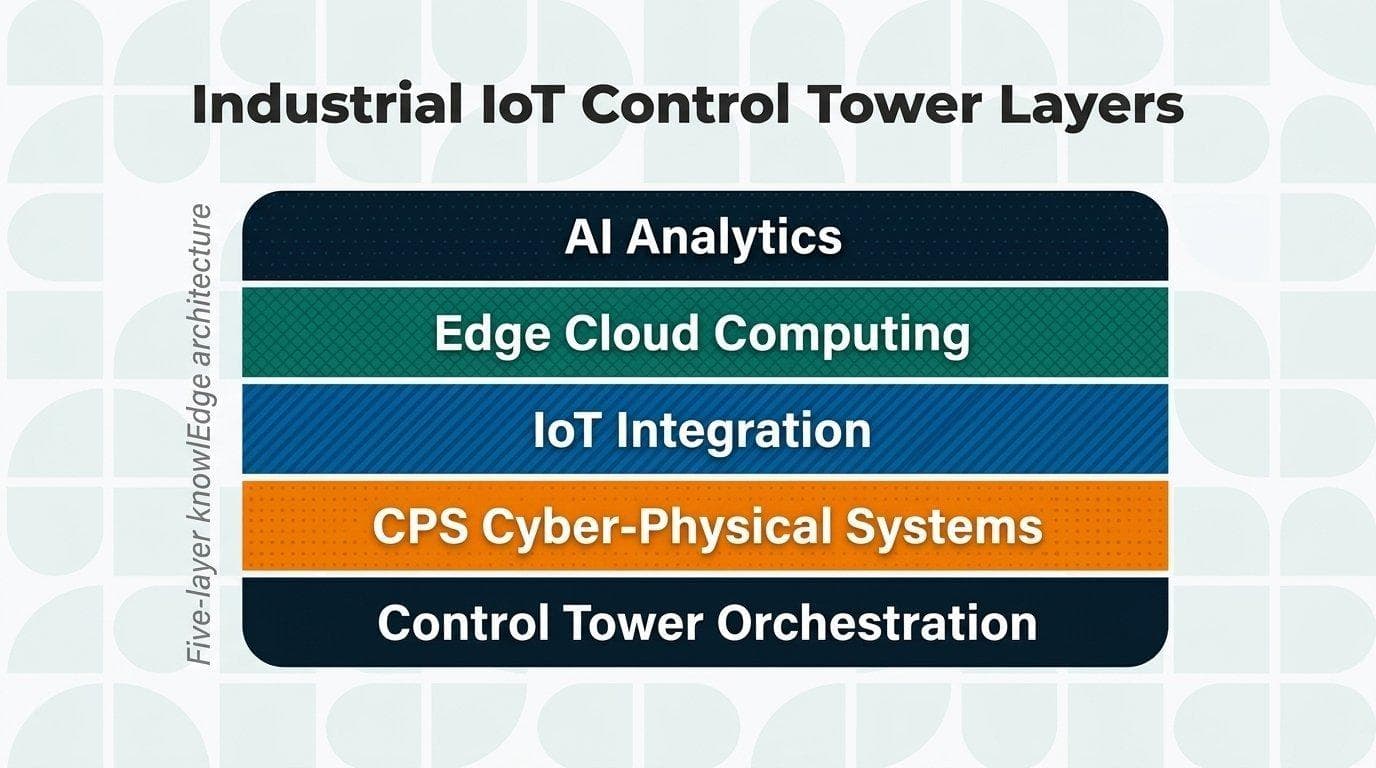
The established reference architecture for service control towers demands layered structures that integrate real-time tracking data, planning optimisation engines, and collaborative stakeholder interfaces. This multi-layered approach reflects how real-world shipping networks operate. By ingesting disparate data from dozens of third-party carriers, the system successfully aggregates complex inputs, matches them against routing algorithms, and renders actionable guidance for dispatch teams.
The five-layer knowledge architecture represents the modern standard in control tower engineering, fully integrating artificial intelligence, edge analytics, and cyber-physical systems. This sophisticated paradigm consolidates real-time transit visibility, predictive machine learning models, and automated exception routing into a unified operations hub.
Smart urban transport systems face substantial complexity stemming from the coordination of highly diverse software frameworks, IoT hardware, and telematics connectivity. The primary technical hurdle within control tower design is not simply data volume. Rather, developers must resolve severe data heterogeneity to present a single, coherent operational truth from hundreds of disjointed legacy formats.
Multi-Tenancy in SaaS TMS
Multi-tenant TMS SaaS platforms must rigorously isolate sensitive tenant data while sharing underlying infrastructure to keep delivery costs low. These architectural choices dictate both long-term hosting expenses and day-to-day software maintenance complexity. Industry evidence shows that multi-tenant architectures range from shared databases with logical application-layer isolation to entirely separate database instances per tenant.
Deciding between logical and physical separation is rarely a purely technical choice. High-compliance enterprise TMS platforms tend to deploy containerised microservices with physical isolation at the database layer to support security and data residency requirements. This approach demands a higher infrastructure budget, but real-world engineering projects show it remains a reliable strategy for avoiding cross-tenant data leaks.
As a consequence, SaaS platforms serving mid-market shippers usually rely on logical database multi-tenancy to keep platform subscription fees economical. Conversely, systems built for global third-party logistics (3PL) providers isolate tenant data on dedicated server clusters. This structural divide creates a tiered marketplace where operators must weigh security requirements against total cost of ownership.
API-First Integration
Integrating custom logistics engines with third-party carrier networks, Electronic Logging Devices (ELDs), and warehouse management systems is a major engineering bottleneck. To mitigate this risk, modern software development teams treat API-first architectures as a mandatory design pattern, with integration endpoints as primary products instead of afterthought interfaces built during final testing.
Standard integration architectures rely on a three-tier model comprising REST APIs for real-time rates, traditional EDI protocols for legacy B2B records, and webhook listeners for instant status events. Despite the rise of modern APIs, Electronic Data Interchange (EDI) systems remain deeply entrenched within logistics networks. Because international supply chains have built their core transactions around EDI, replacing these protocols entirely is seldom economically justifiable.
EDI protocols continue to process essential documents such as Bills of Lading, automated invoices, and customs clearances. For this reason, a resilient logistics software platform must support legacy message formats and modern JSON-based endpoints concurrently. Building custom middleware that translates between these two paradigms prevents data siloes and ensures uninterrupted partner communication.
Production platforms often implement data streaming pipelines using Apache Kafka within cloud-native environments to handle high-frequency location data. This event-driven pattern powers real-time visibility dashboards, allowing fleets to track thousands of shipments simultaneously. A connection-centre model, meaning a single API gateway mapping to diverse carrier networks, simplifies onboarding and lowers long-term integration maintenance.
Section 4 explores integration mechanics in more depth. The takeaway here is that API-first engineering is a design approach, not only an external-facing interface layer: it dictates how internal software modules communicate, which keeps system boundaries clean and maintainable.
Self-Organising Logistics (SOL)
Self-organising logistics (SOL) is an emerging, decentralised architectural pattern that is drawing interest from system architects. Peer-reviewed research indicates that SOL models rely on distributed control and adaptive coordination to manage the volatile, highly stochastic nature of freight networks. This departure from centralised orchestration enables individual shipping nodes to make dynamic routing decisions based on local real-time conditions.
This approach is highly relevant for multi-modal operations where no single partner has full authority or visibility. The architectural requirements call for decentralised control protocols and distributed data processing capable of operating on partial, inconsistent records. By tolerating localised data gaps, this architecture closely mirrors the actual real-world operational friction that fleets face daily.
While the theoretical research base supporting SOL is technically sound, practical deployments in production freight environments remain highly limited. Transitioning to self-organising paradigms demands profound operational and contractual adjustments alongside the software-level overhauls. Consequently, industry confidence in this model remains at a medium tier until large-scale commercial test cases establish a clear baseline of performance.
Legacy TMS Modernisation
Legacy TMS modernisation is a primary engineering hurdle for growing shipping enterprises, yet it remains underserved by objective architectural frameworks. Operators frequently navigate these complex software transitions relying on subjective vendor advice rather than rigorous, empirical benchmarks. This lack of objective research leaves many engineering leaders to rely on trial and error.
Documented modernisation strategies generally fall into three distinct architectural pathways. The first approach is re-platforming, which wraps legacy monolithic systems in API middleware to expose backend capabilities as services. This preserve-and-wrap technique successfully retains complex, battle-tested business logic, though it delivers minimal raw scalability benefits.
The second strategy relies on incremental decomposition, where engineers identify bounded contexts within the monolith and extract them sequentially. This approach ensures the legacy core remains operational during the transition, as demonstrated in the hazmat system migration studies. The third alternative is a complete greenfield replacement, which entails decommissioning the legacy application entirely and moving to a custom-built microservices framework.
Modernisation failures usually stem from underspecified freight requirements and inadequate integration testing between the new TMS and legacy databases. Data synchronisation errors frequently accumulate in background processes when log monitors are left unreviewed. Overlooked integration error logs are a clear warning sign of systemic database corruption that can compromise production reliability.
The migration pathway an enterprise chooses depends on factors extending well beyond the codebase. Teams must carefully evaluate the age of the legacy database, their risk tolerance, and the internal capacity for operational disruption. No single architectural strategy is universally correct, so a tailored discovery process is the way to find the safest path forward.
3. The Computational Core
VRP is the computational heartbeat of a transport management system. Every load that needs a route, every delivery window that needs a schedule, and every vehicle that needs an assignment passes through a solver. The mathematical algorithm chosen by an operator determines what a platform can and cannot achieve.
It also dictates what the platform can promise to deliver within a fixed operational budget. The choice between cross-platform and native development for the mobile component of such systems remains a related architectural decision. For driver and depot apps that need to run on Android and iOS, a single Flutter codebase covers both.
This section examines the fundamental nature of the Vehicle Routing Problem. It explains why this calculation sits at the core of commercial routing software, detailing the variants that matter in practice. It also covers the build-versus-integrate decision that faces any team designing or procuring transport systems.
VRP as the Computational Core
The Vehicle Routing Problem, first formalised by Clarke and Wright (1964), is computationally intractable in its general form. Real-world freight operations introduce strict time windows, vehicle capacity constraints, multiple depots, split deliveries, and driver skill certifications. A platform that handles practical logistics at commercial scale is a routing solver combined with an integration layer.
Taxonomy of VRP Variants
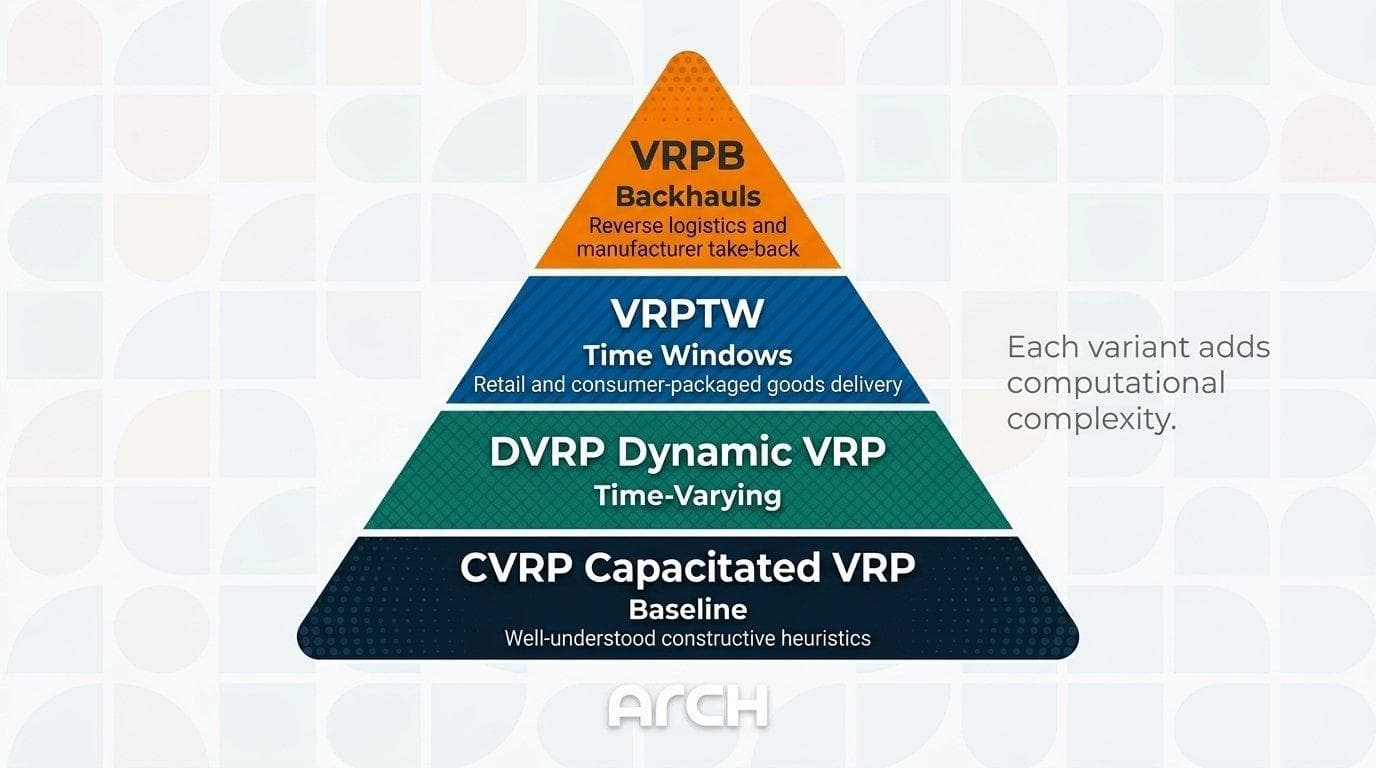
Four main variants dominate practical logistics software applications. Capacitated VRP adds weight and volume limits per vehicle to prevent overloading. Dynamic VRP handles real-time request arrivals and unexpected vehicle breakdowns.
VRP with Time Windows adds delivery hour constraints, which represents a daily operational requirement in retail logistics. VRP with Backhauls manages reverse logistics and returns to improve fleet efficiency. Each variant introduces computational complexity that pushes solvers towards metaheuristic approaches.
State of the Art in VRP Algorithms
The algorithmic frontier combines hybrid metaheuristics, such as evolutionary computation paired with local search, and machine learning models. These machine learning models utilise reinforcement learning for adaptive routing and graph neural networks for solution construction. However, reinforcement learning approaches currently remain at a lower technology readiness level than classical metaheuristics for production-scale problems.
To complement these engines, operators increasingly layer AI-driven demand forecasting and predictive arrival calculations over the core system. These tools use historical delivery data and real-time traffic signals to improve arrival window accuracy. This approach allows fleets to adjust schedules dynamically without overloading the central routing solver.
Enterprise operators often centre their routing strategies on heuristic decomposition. They split the highly complex VRP into distinct stages. This sequence typically addresses fleet capacity assignment, route construction, and delivery window repair.
Each individual stage runs rapidly enough to fit within tight operational time constraints. This decomposition effectively sidesteps the combinatorial explosion that makes the complete mathematical problem intractable. The primary engineering challenge is decomposition design and sequencing, not implementing a single metaheuristic.
4. The Integration Challenge
The integration stack in logistics demands more from software architects than almost any other vertical. Where a typical enterprise application might integrate with two or three external systems, a TMS routinely connects to double that number. Each system comes with its own protocol, data model, and operational assumptions.
A TMS built on the wrong architectural assumptions fails in production. Teams that treat integration as a first-class concern invest in structured requirements analysis before committing to a build path.
Carriers, Electronic Logging Device providers, load boards, ERP systems, and Warehouse Management Systems all require separate integration channels. ERP and WMS integrations represent a specialised domain requiring dedicated architectural expertise. The fundamentals of API integration are central to understanding this challenge.
The fundamental problem is heterogeneity, as carriers do not expose data in consistent formats. A mid-sized carrier in the United States might run a mixture of legacy systems built over two decades, a modern REST API, and perhaps an EDI connection for its largest customers.
The same carrier's competitive peer might use an entirely different set of standards. This forces integration teams building a TMS to maintain adapters for multiple styles of communication.
This architectural fragmentation requires development teams to maintain adapters for multiple communication frameworks. They must often support legacy EDI X12 systems alongside modern REST interfaces, reconciling highly divergent data models that share no natural alignment.
EDI X12 remains the dominant B2B transaction standard in North American freight. For UK and European operators trading internationally with US partners, EDI X12 compatibility is not optional. The standard persists partly because migrating away from it requires co-ordinating change across every trading partner simultaneously.
The 204 (Motor Carrier Shipment Information) and 214 (Transportation Shipment Status) transaction sets are the backbone of automated freight communication. These standards persist because the cost of migrating away from them is prohibitive. Large carriers have built their entire back-office systems around EDI processing.
The limitations of EDI are well documented among practitioners. A 2009 Stack Overflow discussion on why EDI still sees use attracted answers that emphasised the large sunk cost in existing EDI infrastructure. Respondents also noted the lack of any compelling replacement for high-volume, low-intelligence transaction processing.
One respondent noted that EDI handles Bill of Lading, invoicing, Electronic Funds Transfer, arrival notices, and shipment status in a standardised way. While archaic in syntax, the standard provides operational certainty that business relationships can rely upon.
The open-source EDI translator, Bots, is a common adapter for integrating legacy files with modern web architectures. This tool continues to support production deployments over fifteen years after its initial mention.
The structural persistence of EDI shows a broader industry lesson. The standard survives because replacing it requires co-ordinating complex changes across thousands of trading partners simultaneously, whatever its technical merits.
REST APIs have become the preferred mechanism for real-time logistics data exchange, particularly for rate quoting and shipment tracking. Where EDI operates on batch cycles, often overnight, REST endpoints allow a TMS to query a carrier's system at the moment a planner needs a rate or a shipper requests a status update.
PackageX's analysis describes how real-time rate quoting, shipment tracking, and label generation all flow through API endpoints. These endpoints connect shippers directly to carrier systems. The technical pattern is straightforward: authenticate, send a structured request, receive a JSON response with the relevant data.
The operational complexity arrives when a TMS must maintain dozens of these connections simultaneously. Each connection has its own rate limits, authentication schemes, and error handling requirements.
Event-driven webhooks are the architectural complement to REST polling. A carrier's system pushes notifications to the TMS when events occur, so the TMS does not have to ask repeatedly for status updates. A shipment picked up triggers one webhook; a delivery confirmation triggers another.
This pattern reduces latency and removes the polling overhead that strains both the integrating system and the carrier's API infrastructure. FourKites uses Apache Kafka-based data streaming to handle high-volume event distribution at scale. The approach combines real-time data processing with AI-powered predictive analytics.
For smaller teams, webhook implementation can be straightforward. A carrier's system makes an HTTP POST to a configured endpoint when a status change occurs. The TMS processes the payload and updates its own records.
The connection centre pattern has emerged as a practical response to integration sprawl. A connection centre provides a single API hub in place of point-to-point integrations between a TMS and every carrier, ELD provider, and load board. This hub mediates between the TMS and all external systems.
API2Cart describes this as a unified API layer that aggregates multiple carriers, automates order management, and synchronises inventory across systems. The appeal is developer efficiency. A team integrates once with the connection centre and gains access to the full carrier network through a consistent interface, without learning the quirks of twenty different carrier APIs.
This low-code abstraction layer has become a practical necessity for teams building bespoke platforms on constrained engineering budgets. By avoiding custom connector development, engineers can focus on proprietary routing logic.
Practitioner accounts describe the cost of mismanaging this architectural layer in concrete terms. For example, a developer who spent eight months building a multi-tenant TMS on AWS documented the challenge of serving carriers, brokers, and shippers simultaneously.
That engineer managed disparate integrations with load boards and ELD providers. Each integration point carried unique scaling characteristics, error modes, and a heavy maintenance burden.
A separate analysis among freight brokers estimated that building a custom TMS with full integrations requires a minimum investment of fifty thousand to two hundred thousand dollars. The integrations covered load boards, ELDs, factoring companies, and carrier systems.
Integration accounted for the vast majority of that total development budget. These figures demonstrate that connectivity is rarely a trivial line item.
Panorama Consulting's analysis of TMS failure modes identifies four recurring causes: underspecified freight requirements, insufficient integration testing between the TMS and connected systems, data synchronisation failures that accumulate when unreviewed, and integration error logs that grow without review. The second and fourth items speak directly to integration debt.
Grey literature on TMS implementation mistakes reinforces this operational pattern. Analyses from industry observers identify poor integration with existing software as a primary failure category. When connectivity fails between the TMS and peripheral systems, the overall implementation fails to deliver any real value.
A case study from Neon Logistics similarly highlights integration complexity with legacy ERP and WMS platforms as a core challenge during vendor evaluation. These documented failures align closely with what practitioners report in technical forums.
Integration is not a secondary feature to be added at the end of a software project plan. It is the structural reality that determines whether a custom platform succeeds or collapses under its own technical debt.
The reality that integration consumes 30% to 50% of custom TMS budgets remains highly consistent across the industry evidence base. Different technical assessments arrive at this figure through divergent lines of analysis.
Some analysts attribute the cost directly to the sheer number and complexity of the required endpoints. Others observe a recurring pattern where engineering teams discover midway through a build that data mapping has consumed far more resources than estimated.
What the evidence supports is that a TMS is better understood as an integration platform with planning and optimisation features layered on top. It is not a planning and optimisation platform to which integrations are subsequently attached.
The architectural implications of these findings are clear. Engineering teams that treat integration as a first-class concern invest early in a connection centre or a unified API abstraction layer.
These organisations schedule integration testing as a continuous activity from the start of the project. Consequently, they tend to deliver complex logistics systems on highly predictable timelines.
Teams that treat integrations as implementation details to be resolved later tend to discover, late in the project, that they have built a platform that is only as useful as the systems it connects to. Those connections are harder to build and maintain than the planning algorithms that seemed, at the outset, to be the hard problem.
5. IoT, Digital Twins, and Real-Time Visibility
IoT in Logistics Operations: GPS, RFID, and Sensor Networks
The technological substrate for real-time cargo visibility rests on a well-established trio: GPS tracking for vehicle position, RFID for unit-level identification, and wireless sensor networks for environmental conditions. These are not emerging technologies in 2026. They are production tools with documented deployment at scale across freight and logistics operations.
The broader IoT landscape in smart cities provides useful context for understanding sensor deployment at scale. GPS tracking forms the foundation of transport management systems, with vehicle-mounted telematics units transmitting position data to backend systems via cellular or satellite links.
This continuous tracking of fleet assets enables operators to monitor movement and predict delays. Platforms aggregate these position reports alongside electronic logging device (ELD) data to generate estimated arrival times and exception alerts.
ELD data records engine status, driver hours, and vehicle diagnostics, which adds operational depth to the basic telemetry. When combined with GPS coordinates, these metrics provide a complete and immediate operational picture for fleet managers.
RFID serves a different function: it identifies items and pallets instead of tracking vehicles. RFID tags on pallets and containers enable automated check-in and check-out at depot and warehouse locations, reducing manual data entry errors.
In controlled environments such as pharmaceutical distribution centres, RFID provides the readout layer for inventory accuracy systems. Sensor networks then extend this visibility layer directly into cargo condition.
Temperature, humidity, shock, and light-exposure sensors communicate via LoRaWAN, cellular IoT, or satellite links depending on coverage requirements. Unlike vehicle-mounted GPS units, these sensors are often battery-powered and require careful network coverage planning. This is particularly true in sea container environments where cellular coverage is unavailable through standard routes.
What IoT does not yet deliver consistently is end-to-end chain-of-custody without gaps. Visibility platforms show what is happening at instrumented points, but gaps remain between those points. The assumption that IoT visibility automatically equals supply chain transparency is not supported by operational evidence.
Cold Chain Monitoring and Compliance Value
Cold chain represents the specific logistics domain where IoT has moved furthest beyond proof-of-concept into sustained production deployment. The business case is straightforward because deviation in temperature-sensitive cargo produces direct financial loss through spoilage, regulatory non-compliance, and product recall costs.
In pharmaceutical logistics, cold chain monitoring is effectively mandatory in regulated markets. Good Distribution Practice (GDP) guidelines in the UK and EU, alongside regulatory requirements in other jurisdictions, mandate temperature monitoring and documentation throughout the distribution chain.
IoT temperature loggers satisfy this documentation requirement while providing real-time exception alerts. These continuous-recording sensors store data locally and transmit via cellular or Wi-Fi when connectivity is available.
This deployment model solves a concrete compliance problem. In food logistics, however, cold chain IoT deployment remains more variable.
Large-scale food distributors and supermarket supply chains have invested heavily in temperature visibility. This investment is driven partly by retailer compliance requirements and partly by the direct cost of spoilage in cold-storage facilities.
Smaller participants in the food logistics chain often adopt less consistent monitoring. They face constraints from capital investment thresholds and the operational overhead of device management.
The evidence from the research base indicates that cold chain IoT creates genuine operational value in production environments. This holds true where regulatory compliance is strictly enforced and where the cost of deviation is high, such as in pharmaceutical and fresh produce categories.
In less regulated segments, adoption remains patchy across the industry. Proof-of-concept deployments that worked in a pilot phase have sometimes failed to convert to sustained production operations.
Digital Twin Frameworks for the Supply Chain
The digital twin concept as applied to the supply chain has a specific architectural formulation. This formulation appears repeatedly in the academic literature, integrating the Supply Chain Operations Reference (SCOR) model with a system-of-systems architecture. The SCOR model is the industry-standard supply chain process taxonomy maintained by the Association for Supply Chain Management (ASCM).
The value of this framework is in establishing a clear domain ontology. SCOR provides a standardised vocabulary for supply chain processes, specifically covering planning, sourcing, manufacturing, delivery, and returns. This vocabulary gives the digital twin a coherent process model to reason against.
The system-of-systems architecture provides the integration layer, connecting physical assets like warehouses and vehicles with their digital representations. In production terms, the digital twin functions as a simulation capability rather than a real-time dashboard.
An instantiated supply chain twin models the behaviour of actual networks. This enables proactive scenario testing, such as evaluating the impact of missed shipment windows, and optimisation runs before committing to operational changes.
Commercial visibility platforms have moved towards this capability, though they typically frame it as predictive analytics rather than explicit digital twin language. The assessment of supply chain digital twins in 2026 reveals that they exist in production primarily at large enterprises with sophisticated control tower capabilities.
The SCOR-integrated formulation provides a theoretical framework for building these models. However, a practical gap remains in medium-sized enterprise and mid-market adoption. The engineering effort and data integration required to instantiate a supply chain twin at production quality remain substantial.
Bridging the Gap Between Pilot and Production
The literature on supply chain IT implementation contains a consistent finding. IoT deployments stall after the initial proof-of-concept phase more frequently than they progress to sustained production operations.
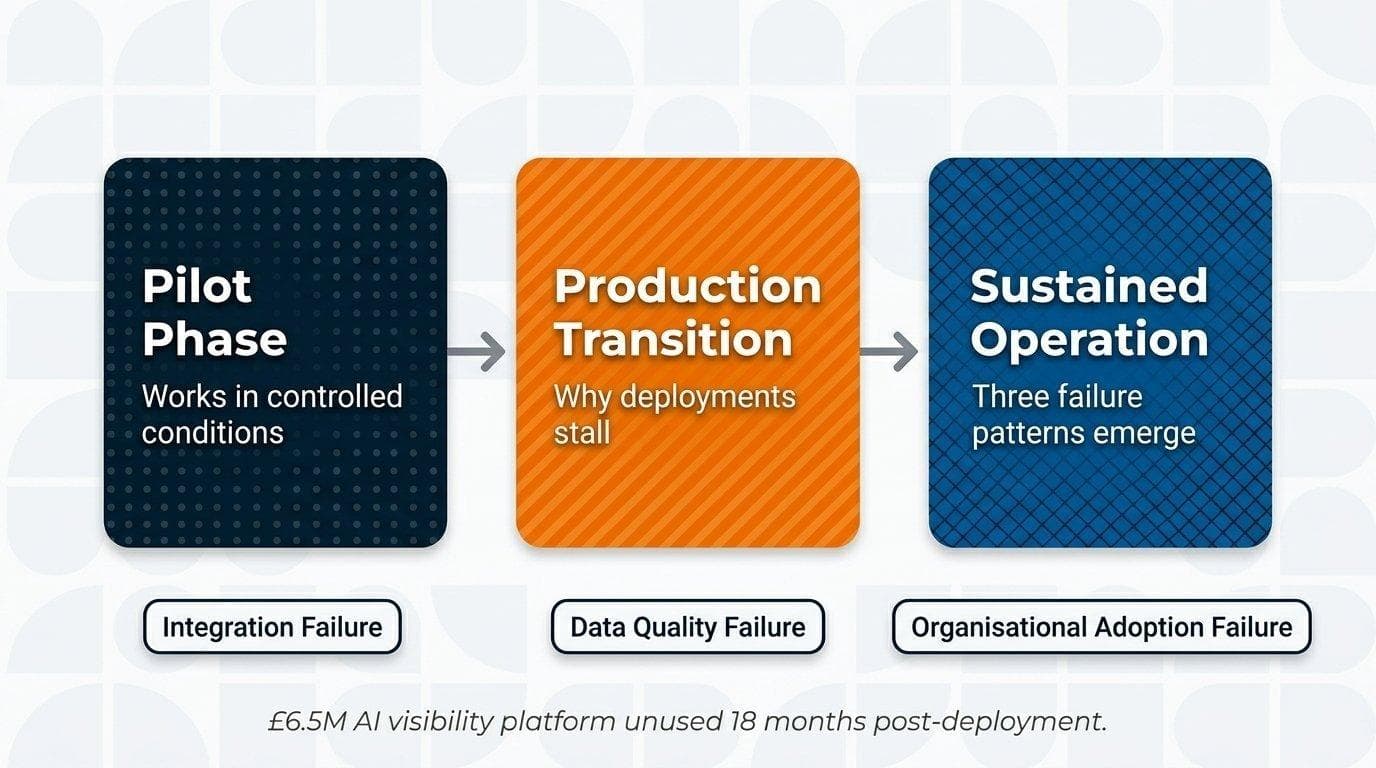
These failures generally fall into three distinct patterns, starting with integration failure. IoT platforms that demonstrate value in a controlled pilot environment frequently fail when integrated with existing Enterprise Resource Planning, Warehouse Management Systems, or transport management platforms.
API timeouts, incompatible data formats, and unhandled exception states in connected systems cause operational breakdowns that pilot environments do not expose. The second pattern is data quality failure.
IoT sensor networks generate vast volumes of operational data. The infrastructure to ingest, validate, and act on that data at scale is non-trivial, and organisations that invest in sensor hardware without investing in their data pipelines often collect data they cannot use operationally.
The final pattern is organisational adoption failure. A documented case describes a £6.2 million AI-powered supply chain visibility platform that managers were not using eighteen months after deployment. The failure was not technical, as the platform tracked exactly what it claimed to track.
Instead, the tool failed because it did not fit into the operational workflows of the managers it was intended for. No internal work had been done to adapt those workflows to accommodate the new system.
These patterns appear consistently enough in the implementation literature that they should be treated as structural risks. They are not execution problems to be solved by better project management alone.
Pilot environments are forgiving, whereas production environments are not. The gap between a working pilot and a production system that sustained operations require is routinely underestimated. This gap must be addressed during the early technical scoping phase.
UK Regulatory Context and Compliance for IoT Data
IoT systems in logistics generate and process significant amounts of personal data. Vehicle location records, driver behaviour metrics transmitted via telematics, and delivery recipient information all constitute personal data under the UK GDPR and the Data Protection Act 2018. The UK GDPR, retained from the EU framework post-Brexit, applies directly to the processing of personal data in logistics contexts.
Two regulatory dimensions are particularly relevant for logistics IoT deployments, starting with data subject rights. Location data collected by vehicle telematics constitutes personal data about drivers, who retain rights of access and erasure.
These rights are increasingly relevant when historical telematics records are retained indefinitely. Drivers also have the right to object to processing based on legitimate interests.
The Information Commissioner's Office (ICO) has published guidance on employment surveillance and fleet tracking. This guidance places obligations on organisations to demonstrate that vehicle monitoring is proportionate and that drivers have been informed of the scope of monitoring.
The second dimension relates to regulatory alignment. While the EU Digital Services Act does not apply directly to logistics IoT, the UK has signalled regulatory intentions in digital markets that bear watching. The more direct regulatory framework for UK logistics remains domestic, involving telecommunications and lawful interception frameworks that govern how location data can be accessed.
The Competition and Markets Authority also provides guidance on data sharing in supply chain contexts. Asset tracking data presents a specific compliance question when it crosses into driver behaviour monitoring.
If a telematics system records speed, braking patterns, and idle time to assess driver performance, it is classified as employment surveillance. The ICO guidance on this point is explicit in requiring a rigorous balancing of interests.
Such monitoring is not prohibited, but it requires transparent communication with employees and strict proportionality in the data collected. For logistics software built to serve UK-based operations, the practical compliance requirements are straightforward.
Organisations must enforce data minimisation by collecting only what the business purpose requires, maintaining transparency with drivers, and documenting clear retention periods. While these represent standard data protection practices, logistics organisations often implement IoT systems without engaging data protection counsel on the specific processing activity.
6. Build vs Buy: When Custom TMS Development Makes Sense
The build vs buy decision for transportation management software is not a philosophical question about in-house capability. It is an economic one. The question is whether the total cost of owning a custom system over its expected useful life is lower than the total cost of licensing, implementing, and living with an off-the-shelf platform.
This comparison must account for the specific constraints of the business model, the growth trajectory, and the integration requirements. The economics of bespoke software development in the UK are directly relevant here.
Most TMS evaluation processes fail at the first step: they compare vendor quotes against internal development estimates without accounting for the full cost of either path over a realistic planning horizon. This section provides the decision framework that the empirical evidence actually supports.
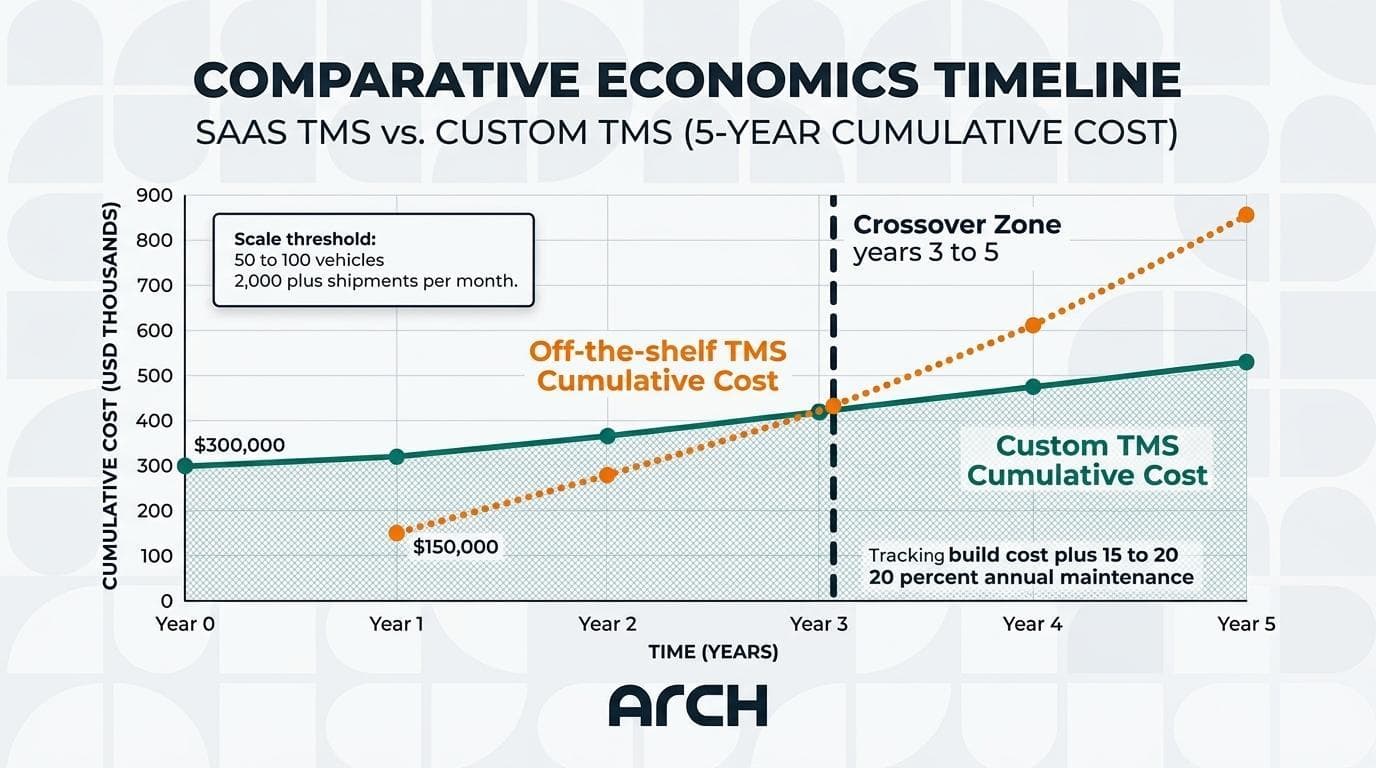
The Scale Threshold: When Fleet Size Makes Custom Development Economically Viable
The conventional wisdom that custom TMS development is only for large enterprises is imprecise. The relevant threshold is not fleet size alone but shipment volume and the resulting complexity of routing decisions.
For operations running fewer than 20 vehicles and processing fewer than 500 shipments per month, off-the-shelf TMS platforms typically deliver better economics. SaaS platforms typically charge £0.75 to £3.00 per freight load. At volumes below 500 shipments per month, this per-shipment cost is lower than the amortised cost of building and maintaining a custom system.
Monthly subscription costs for mid-sized operations running SaaS TMS range from £150 to £600 per user. Vendor implementation fees, while significant, are recoverable within a 12-to-24-month window if the platform is well-specified.
The economics shift at a threshold that research and industry evidence places roughly at 50 to 100 vehicles and 2,000-plus shipments per month. Beyond this range, the per-shipment economics of SaaS platforms begin to compound into material cost centres. A company processing 5,000 shipments per month at £1.50 per shipment is spending £90,000 annually on transaction fees alone.
This figure excludes implementation costs, user licensing, and the operational overhead of a platform that may not reflect specific lane preferences or operational logic. Custom development costs for a full-featured TMS fall in the £75,000 to £225,000 range for core functionality, based on documented projects. Ongoing maintenance typically runs at 15 to 20 per cent of the initial build cost annually.
These costs become competitive with SaaS licensing at approximately the three-to-five-year horizon. If the planning horizon is longer, and for a growing logistics business it should be, the net present value calculation increasingly favours custom development.
The Specificity Threshold: When Off-the-Shelf Configuration Is Insufficient
Not all TMS requirements are equal. Off-the-shelf platforms handle standardised routing, carrier rate shopping, and basic freight audit competently. They begin to fail when the business model depends on operational logic that the platform cannot represent through configuration.
The most common specificity failures fall into several distinct categories. First, private rate agreements, preferred carrier hierarchies that change by lane or season, and volume commitment pass-throughs are difficult to model in platforms designed around commodity freight. Second, multi-leg operations with cross-dock logic and dynamic load-building requirements frequently exceed what standard configuration can express.
Third, integration with proprietary systems creates data flow dependencies that SaaS platforms cannot accommodate. This includes warehouse management systems built on legacy platforms, private dock scheduling systems, or industry-specific compliance tooling. Without custom connector development, these dependencies become a permanent maintenance burden.
Fourth, last-mile delivery operations present a distinct configuration challenge. Multi-drop routes with tight delivery windows, real-time driver re-routing, and proof-of-delivery capture require operational logic that generic templates do not represent well. Operators running last-mile at scale frequently discover that standard routing modules cannot accommodate the granularity of their delivery constraints.
When configuration cannot express the operational model, the choice is not really between build and buy. It is between building a custom system and purchasing an off-the-shelf platform that requires continuous workarounds and manual processes. Even the buy path may demand expensive custom development within the platform anyway.
The hidden cost of forcing a square peg into a round configuration is paid in operational inefficiency every day the system is in use. Over time, these daily friction points degrade overall fleet utilisation and customer satisfaction.
Platform Business Model Exception: Logistics Startups with Network Effects
One category of operation may need custom TMS development regardless of scale: logistics businesses whose competitive position depends on network effects that standard platforms cannot support. For example, a freight marketplace that matches shippers and carriers needs a matching engine with dynamic pricing and real-time capacity visibility. A platform that routes loads through a SaaS TMS and then layers marketplace logic on top is operating two systems where one would suffice.
It pays transaction fees on both systems, leading to compounding inefficiencies. Network-effect logistics businesses have a different cost structure from traditional freight operations, where the value they create grows with the number of participants rather than the number of vehicles they own. For these businesses, custom development is often justified from the earliest stages because the architectural constraint of building on a single-operator platform limits the core business model.
The Hidden Cost of Off-the-Shelf: What the Price Tag Does Not Include
The most common evaluation error in TMS procurement is comparing the annual subscription fee against the development estimate. The subscription fee is the entry cost, not the total cost.
Implementation fees run from £37,000 to £186,000 depending on platform and scope. Per-transaction fees compound differently. At scale they become a line item that grows with the business.
The platform vendor has no incentive to reduce pricing as volume increases. Vendor lock-in is the structural risk that makes per-transaction fees a strategic concern. When an operation's entire planning, execution, and reporting runs on a single vendor's platform, the switching cost becomes prohibitive.
This cost encompasses data migration, business process re-engineering, and operational disruption. Data portability risk is the primary operational manifestation of lock-in. If the business accumulates years of operational data in a platform with limited export capability, that data becomes functionally unusable outside it.
The Hidden Cost of Custom: What the Build Estimate Does Not Include
Custom development estimates consistently underestimate three categories of cost. Integration is the most systematically underestimated, with the effort required to build, test, and maintain carrier API, ERP, WMS, and ELD integrations typically accounting for 30 to 50 per cent of the total development budget. Initial estimates routinely omit this figure.
The Vehicle Routing Problem algorithm requires more than an open-source library to reach production quality. Getting from a working prototype to a production-grade routing engine requires handling complex time windows, vehicle capacity, driver hours, and real road networks.
This is typically a three-to-six-month engineering effort. Initial timelines and budgets rarely allocate sufficient resources for these edge cases.
Platform evolution is the ongoing cost that makes custom development a commitment, not a project. Industry evidence places ongoing maintenance costs at 15 to 20 per cent of the original build cost annually.
The Temporal Dimension: Planning Horizon and Growth Into Architecture
Custom TMS development makes economic sense when the company is growing into the architecture. The capability being built should be used at a scale significantly larger than the current operation, over a planning horizon of five years or more.
A five-year horizon is relevant for two reasons. First, it is the window within which the amortised cost of custom development typically becomes competitive with accumulated SaaS licensing and transaction fees. Build cost plus annual maintenance typically reaches this crossover point for a growing operation.
Second, the business model is likely to have evolved enough within five years. A platform built for the current operation will need to evolve with it anyway.
If the planning horizon is three years or less, custom development carries an opportunity cost that a SaaS platform does not. This is true when the business is being sold. It also applies when the market is expected to shift significantly, or at a strategic inflection point where the current operating model is not expected to persist.
The capital and management attention deployed on a custom build during strategic uncertainty is capital not deployed on core business growth. This growth-into-architecture condition is the one most frequently missed in build vs buy decisions.
A custom TMS built for 50 vehicles that cannot scale to 200 is not a long-term solution. It is a medium-term distraction that will require replacement within the planning horizon. The software architecture must be designed with the target scale in mind, not simply the current scale.
Decision Checklist: Three Questions That Determine the Right Answer
Before committing to either path, a technical decision-maker must be able to answer three questions precisely. These indicators help ensure that the selected route aligns with long-term operational targets.
1. What is the realistic planning horizon, and will the operation reach the scale threshold, roughly 50+ vehicles and 2,000+ shipments per month, within it?
If the planning horizon is under five years, or if the growth trajectory remains uncertain, the financial crossover point may not be reached. The economics favouring custom development typically materialise at approximately three to five years. At that horizon, accumulated SaaS licensing and per-transaction fees exceed the amortised build-plus-maintenance cost of a purpose-built system.
2. Does the business model depend on operational logic, including lane-specific rules, multi-leg routing, compliance requirements, and proprietary data, that cannot be expressed in a standard TMS configuration?
If yes, the choice is not between building or buying, but between creating a custom system and accepting permanently degraded operational efficiency. When standard configuration cannot express the operational model, buying an off-the-shelf platform means continuous workarounds and manual processes. This route often requires expensive custom development within the third-party platform anyway.
3. Does the integration surface area justify it, and is vendor lock-in risk acceptable?
If the integration surface is large and complex, the integration budget must be accounted for explicitly. This typically includes multiple carrier APIs, ERP, WMS, and ELD systems, and represents 30 to 50 per cent of the total development cost. Separately, the data portability and switching cost of a buy-path decision must be treated as a strategic cost.
When switching platforms would require a multi-year migration project, the lock-in risk is a permanent structural constraint on the buy path. Understanding these factors before committing ensures the business does not get trapped in a costly and inflexible architecture.
7. Vendor Selection: What Evaluation Criteria Actually Matter
The TMS Vendor Landscape in 2026
The transportation management system market comprises a small number of platforms that command significant deployment share. Alongside these sits a layer of specialists and visibility-only vendors that occupy adjacent niches.
Understanding where each category wins clarifies the selection question considerably. Guidance on evaluating custom software development services is relevant for buyers weighing vendor options against custom build.
Blue Yonder (formerly JDA, now part of Panasonic) occupies the enterprise end of the market. Its TMS sits within a broader supply chain planning suite. Its strength lies in network optimisation, the algorithmic determination of transport routes, load consolidation patterns, and carrier selection across large freight volumes.
The platform has a documented weakness in user interface design. Practitioners consistently describe it as dated and cumbersome for routine operational tasks. Where it wins: large enterprises with complex multi-leg freight networks where optimisation is the primary value driver.
SAP TM occupies a different position. Its strongest case exists within organisations that already run SAP ERP.
The integration surface between SAP TM and SAP's order-to-cash or procurement modules is deliberately tight. That tightness delivers value precisely because no API translation layer exists between the systems.
Outside SAP environments, the platform requires significant integration work. The total cost of ownership curve slopes steeply upward in proportion to the complexity of non-SAP connectivity. Where it wins: organisations with mature SAP ERP deployments where transportation is one module in an integrated landscape.
The visibility layer vendors, project44 and FourKites, have established positions in real-time track-and-trace. FourKites uses Apache Kafka for event streaming architecture and applies machine learning to ETA prediction. It positions itself at the intersection of visibility and predictive analytics.
project44 has built carrier network connectivity as its primary differentiator. These platforms are typically evaluated alongside a core TMS.
They are integration aggregation layers rather than full transportation management platforms. This works well for organisations that have a functional TMS but lack real-time shipment visibility across carrier networks.
The honest characterisation of the 2026 TMS market is that no single platform wins universally. Each documented strength maps to a specific operational profile. The selection question is about matching platform architecture to freight complexity.
What Evaluation Criteria Actually Matter
The evaluation criteria that appear most often in failure post-mortems are not the ones that feature lists emphasise. Practitioners most often under-weight carrier network coverage at selection time.
Feature lists specify the number of carriers integrated via API or EDI. What they do not show is the operational quality of those integrations under production conditions.
This includes whether API timeouts are handled gracefully, whether carrier system outages produce cascading failures, and whether the integration handles real freight edge cases. Evaluating carrier network coverage requires talking to existing clients in similar freight verticals. Ask specifically about integration failure frequency.
API completeness is often evaluated as the number of documented endpoints. This metric is a poor proxy for integration quality.
Complete API documentation does not reveal how a platform handles rate limiting under burst loads. It does not show whether webhook delivery is acknowledged and retried on failure.
Nor does it reveal whether the API supports asynchronous patterns where a rate quote may not arrive immediately. Standard synchronous designs often fail when handling complex pricing logic across multiple carriers.
The appropriate evaluation for API completeness is a technical depth session with the vendor's integration engineering team, not a review of the API wiki. SLA terms deserve scrutiny that vendor presentations rarely invite. Uptime SLAs of 99.9% sound adequate until the permitted downtime per year is calculated: 99.9% uptime permits nearly nine hours of downtime annually.
More critically, most SLA definitions exclude planned maintenance windows during which the platform is unavailable. What matters is not the headline SLA figure but the underlying definition.
This includes what constitutes uptime, what maintenance windows apply, and what the notification requirement for planned downtime is. It also covers what remedies follow from an SLA breach.
Exit provisions are the criterion most consistently deferred until contract review, at which point the asymmetry of negotiating position has shifted. Contracts that require 90-day notice for termination but allow the vendor to terminate for convenience on 30 days embody one-sided terms. These terms create vendor lock-in conditions.
The provisions that deserve explicit attention before the contract stage include data export formats, completeness, and the duration of transition assistance. It is also vital to verify whether the contract assigns adequate rights to allow a successor platform to ingest historical data without vendor cooperation.
The Free Trial Illusion
TMS vendors routinely offer 30-day trial periods or proof-of-concept evaluations. The evidence from implementation failure research indicates that this trial window systematically misleads evaluation teams in a specific direction.
The integration complexity that produces implementation failures surfaces in months two and three, not in the initial weeks of a trial. The failure patterns include data synchronisation failures between the TMS and connected systems.
They also include the accumulation of unreviewed integration error logs. API timeout errors rarely surface until production load patterns are fully applied.
A 30-day trial exercises none of these conditions. The trial environment lacks the volume of historical data that triggers data quality issues. It also lacks the multi-system integration stack that produces cascading failures, and the operational context that reveals whether exception handling is adequate.
The appropriate interpretation of a 30-day trial is a user interface evaluation and a carrier API smoke test. It is not a representative sample of integration conditions under production load.
UK and EU Data Residency Requirements Post-Brexit
The UK's adequacy decision from the European Commission permits continued personal data flows from the EU to the UK under the EU GDPR framework. However, data residency requirements that apply to EU personal data processing do not automatically disappear when processing takes place in a UK-hosted TMS.
EU GDPR applies to the processing of personal data of EU data subjects regardless of where the processor is established. Consequently, UK-hosted TMS platforms that process data of EU-based employees, drivers, or customers remain fully within scope of EU GDPR obligations.
While the adequacy decision provides a legal basis for the transfer, the structural requirement for compliance remains intact. Systems must still demonstrate precise tracking of where personal records reside.
UK organisations that process EU personal data through TMS platforms should verify the data flows and processing terms in their vendor agreements. The adequacy decision is not permanent and can be challenged or withdrawn by either party.
Contracts that include appropriate standard contractual clauses alongside adequacy decision coverage provide a more durable compliance position. This approach is far safer than relying solely on the adequacy decision as the legal basis for EU-to-UK data transfer.
8. The Mobile Question: Flutter, Native, and Fleet Operations
The Driver App Use Case: A Distinct Category
Fleet manager mobile applications occupy a different category from consumer logistics apps. A driver delivering parcels in a city needs different software than a logistics manager monitoring a fleet of 200 vehicles from a dashboard. The principles of enterprise app development apply differently in fleet contexts than in consumer-facing applications.
Driver-facing apps are task-oriented, time-critical, and operate under conditions that consumer apps rarely encounter. These include poor cellular coverage in rural corridors, extended periods offline, and hardware that the development team does not control.
Consumer logistics apps, such as the tracking interfaces customers interact with, are built for different constraints. They assume reliable connectivity, run on devices the end user updates regularly, and prioritise visual polish over operational reliability.
Fleet driver apps invert these operational assumptions. They must function reliably when a vehicle travels through areas without cellular signal, even when the device has not been updated for eighteen months. Furthermore, they need to interface directly with hardware peripherals such as Electronic Logging Devices (ELDs).
This distinction matters when evaluating mobile architecture decisions. A fleet operation evaluating Flutter versus native development is not making the same choice as a consumer app team comparing React Native to Swift. The decision framework is different because the operational requirements are different.
Flutter's Fit for Logistics Fleet Apps
Flutter presents a coherent case for fleet driver applications in specific circumstances. The trade-offs between cross-platform and native development are well-documented in the logistics fleet management context, often intersecting with decisions made for web app development when building companion dashboards. Further reading on unleashing the power of Flutter covers the framework's capabilities for complex applications.
Fleet operators typically run heterogeneous device fleets. A delivery company might have Samsung devices for some drivers and Apple devices for others. This is particularly common as corporate BYOD policies mix with company-issued hardware.
Flutter's rendering approach draws its own UI widgets instead of using platform components, which delivers consistent user experiences across both operating systems from a single codebase. Logistics operations require the driver interface to behave identically on a tablet in a cab or an iPad at a depot. This visual and functional consistency offers operational value.
The practical benefit extends to the development team as well. One team maintaining a single Flutter codebase can implement route navigation updates, delivery confirmation flows, and compliance check workflows for both platforms simultaneously.
When a regulatory change requires updating how drivers acknowledge hours-of-service requirements, that change propagates across both Android and iOS in the same commit. The alternative, maintaining parallel Swift and Kotlin codebases, doubles the team size required for the same output.
Flutter's performance is sufficient for the workloads typical in driver apps. Fleet applications are not graphically intensive in the way that a game or a real-time 3D application is.
They involve forms, lists, maps, and status indicators, which represent the exact interface components Flutter handles without difficulty. Benchmarks comparing Flutter against native implementations on equivalent hardware show Flutter comfortably meeting the performance requirements of typical fleet management user interfaces (volpis.com, 2026).
When Native Makes the Genuinely Better Call
Honesty requires acknowledging that certain fleet requirements genuinely favour native development. The cases are specific, but they occur with enough frequency in logistics that an evaluation framework ignoring them remains incomplete.
Hardware access under heavy load is the clearest case. Flutter communicates with device peripherals through platform channels, which are abstractions that introduce latency and complexity not present in native implementations.
For standard GPS tracking this is not an operational concern. However, when an application needs to poll GPS data at high frequency for telemetry purposes, the platform channel overhead becomes meaningful. The same applies when interfacing with Bluetooth adapters for ELD compliance monitoring.
Logistics operations running intensive telemetry, such as real-time fuel consumption monitoring, often find that native builds provide lower-level access with minimal latency. This architectural choice bypasses the translation layers of cross-platform frameworks entirely.
Camera integration for document capture presents another genuine consideration. Fleet drivers commonly use their devices to photograph proof of delivery, capture damage reports, or scan barcodes on packages.
Flutter's camera plugin works well for standard capture scenarios. However, when the use case extends to hardware-level control, native implementations typically offer more direct access to the full camera API surface. This includes triggering scans from external barcode readers via Bluetooth and managing camera focus for OCR on faded shipping labels.
Platform-specific safety certifications represent a more niche but real constraint in logistics. Some fleet operators in regulated environments require applications to carry specific security certifications. These certifications apply to the binary format of the application itself as well as the code.
Flutter applications can be signed and packaged for both stores. However, the certification path for certain government or enterprise safety standards has historically been more straightforward for native binaries. Operations that know they will operate in these certification contexts should verify the current status of Flutter's compatibility with their specific requirements before committing to the framework.
The ELD Integration Angle
Electronic Logging Device integration deserves specific attention. It sits at the intersection of hardware access and regulatory compliance, which are two areas where logistics operations cannot afford approximation.
ELD devices in the United States are governed by the FMCSA mandate requiring commercial drivers to record hours of service electronically. These devices typically communicate with mobile applications via Bluetooth, making the Android and iOS distinction practically relevant.
Android's Bluetooth stack is more open in its configuration options than that of iOS. The iOS operating system imposes stricter requirements on what applications can do with Bluetooth in the background, partly for battery management and partly for user privacy.
For logistics applications that must maintain persistent Bluetooth connections to ELD adapters, Android's more permissive model can simplify implementation. This is especially relevant when maintaining the connection while the application is not in the foreground. An Android-based driver app can maintain the BLE connection to the ELD adapter more reliably during background operation.
This is not an insurmountable problem for iOS developers. Well-implemented iOS applications can achieve stable ELD Bluetooth communication, though this path requires more careful engineering.
For operations that have standardised on Android ELD hardware, this consideration tilts toward Android native or Flutter targeting Android primarily. This provides the most direct integration path.
For operations that need both platforms, Flutter's Bluetooth capabilities are sufficient for the majority of ELD integration requirements. The implementation may simply require more careful handling on the iOS side.
Offline-First Architecture: The Practical Necessity
Logistics operations cannot assume connectivity. A driver running a delivery route through rural areas may spend hours without reliable cell signal.
A trucker at a depot with thick walls may find their device cannot maintain a persistent connection to the backend. Building a fleet management application that assumes connectivity is building an application that will fail precisely when the driver requires immediate access.
Offline-first architecture treats the local device database as the source of truth. When a driver records a delivery confirmation, that confirmation writes to local storage first and syncs to the backend when connectivity becomes available.
The application does not wait for a server round-trip before confirming the action to the driver. This approach is the primary mode of operation (developer.android.com, offline-first architecture guide).
Flutter supports this pattern through several mechanisms. The framework's documentation explicitly addresses offline-first as a design pattern. It recommends that applications treat local data as authoritative and treat sync as a background process.
Libraries such as Drift provide local SQLite databases with sync engines. These handle conflict resolution when the same record is modified on multiple devices before sync completes (medium.com, November 2025).
The practical implication for fleet operations is significant. An offline-first driver app can record proof of delivery, log fuel purchases, and acknowledge compliance checks even in areas of zero connectivity.
When the driver returns to a coverage area, the sync engine pushes local changes to the backend. This behaviour matches how fleet operations actually work. Drivers do not stop operating because the network is unavailable, and their software should not stop functioning for the same reason.
Flutter's cross-platform benefit extends to offline-first implementations. The sync logic, conflict resolution, and local database schema all live in Dart code that runs identically on both Android and iOS. A logistics operation implementing offline-first for the first time writes that logic once and gets it on both platforms simultaneously.
9. What Logistics Decision-Makers Actually Ask
When logistics decision-makers evaluate a TMS, three questions surface consistently. These questions mirror the concerns addressed in Arch's research on web application development for complex platforms. Specifically, operators want to know if a platform will integrate with their carriers, what happens during rapid growth, and how easily they can access their own data.
These questions represent a single underlying concern expressed in three registers: integration, scale, and data sovereignty. In practice, technical leaders often speak in terms of capabilities, such as requiring EDI X12 support, while leaving the operational consequences implicit. However, raw protocol support is not the actual goal of an engineering project.
Instead, the real requirement is whether a load tender reaches a carrier within thirty seconds of submission or sits in an unmonitored queue. Similarly, vehicle routing optimisation is not merely about selecting a mathematical algorithm. The true business metric is whether a dispatcher spends two hours building routes manually or twenty minutes reviewing computer-generated paths.
Commercial vendors tend to respond to capability language because it is concrete, simple to demonstrate, and easy to check off in a procurement matrix. Focusing on operational consequences lets a software architect design a durable custom solution. Shifting the conversation from checkboxes to real-world performance helps the resulting platform meet the long-term demands of the fleet.
10. Conclusion
Nine sections of research, each following a different angle of inquiry, arrive at a consistent conclusion. The evidence does not suggest that custom logistics software development is universally the right call.
Instead, the data indicates that custom development makes sense under specific, identifiable conditions. Operators can assess these conditions before a project begins, rather than discovering them through costly failure after work has started.
The market data, architectural evidence, computational analysis, and integration research all converge to show that bespoke development is highly viable when correctly targeted. The crossover threshold is not a theoretical abstraction. It is a concrete metric that a technology leader can calculate directly against their own shipment volumes.
These findings demonstrate that custom logistics software development is viable and economically justified when the operational conditions are right. Those conditions are not arbitrary or subjective. They are identifiable and measurable before any development resource is allocated.
The Failure Pattern
Custom transport management system projects that fail do so for one of three reasons, and the evidence for each remains consistent across multiple independent sources. Primarily, the root cause lies in underestimating the integration requirements. The integration surface area in a TMS is the product itself.
Projects that scope integration as a simple line item within the development budget consistently underestimate the effort required. This is especially true when integration is not treated as the dominant architectural constraint shaping every other decision. They also underestimate the operational failure modes that inevitably result.
Carrier APIs change without notice, while older EDI connections require constant maintenance. Furthermore, ELD compliance integration adds layers of regulatory complexity that are rarely apparent at project initiation. These technical friction points can stall deployments and inflate year-one costs rapidly.
The second common failure pattern stems from vehicle routing problem complexity. While the vehicle routing problem is well-understood academically, production-grade routing that handles real-world constraints is not solved by simply integrating an open-source library. Managing time windows, driver hours, and temperature-controlled freight requires sophisticated computational design.
Assuming the integration of a basic solver is complete and moving immediately to the next work package is a common project planning error. The gap between a working prototype and a production-grade routing engine typically requires a three-to-six-month engineering effort. Projects that treat routing as a commodity component often encounter this gap late, resulting in severe schedule pressure.
Finally, incorrect team composition often derails custom development initiatives. A team that possesses software engineering capability without logistics domain understanding is likely to build what was asked for rather than what was actually needed. The distinction lies between capability language and consequence language.
For example, developers may focus on implementing EDI integration, whereas the business requires that load tenders reach carriers within thirty seconds of submission. A team that cannot translate between these registers will deliver technically functional systems that fail to fit operational workflows. Securing a partner with deep sector expertise is therefore essential to mitigating these architectural risks.
Selecting the right path requires balancing internal engineering capacity against the long-term cost of vendor lock-in. To see how these principles are applied in production environments, view some of our case studies.
What to Expect from a Logistics Software Development Company
Choosing a logistics software development company is not a simple procurement exercise. It is a long-term, collaborative architectural partnership.
Evidence shows that TMS projects succeed or fail based on integration understanding, domain knowledge, and the ability to translate operational requirements into technical constraints. A partner that understands these dynamics will ask fundamentally different questions from one that does not.
The first critical element to evaluate is the partner's integration track record. A seasoned developer will have documented examples of carrier API integration, legacy EDI migration, or ELD compliance work.
They will be able to describe how they handled data synchronisation failures, API timeout issues, and the specific challenge of maintaining adapters for multiple communication protocols. If they cannot outline these scenarios in concrete terms, their integration experience remains purely theoretical.
The second evaluation metric is deep domain understanding. Logistics software is not generic business software with a superficial industry skin.
The Vehicle Routing Problem, driver hours regulations, multi-depot scheduling, and temperature-controlled freight requirements each carry unique technical constraints. A partner with genuine sector experience will understand why a 30-minute delivery window constraint changes the algorithmic approach, or why EDI X12 transaction sets 204 and 214 matter for automated freight communication.
The third signal of competence is honest scoping. The evidence shows that integration accounts for 30% to 50% of custom TMS development budgets.
A credible partner will surface this figure during an initial discovery session rather than discovering it midway through a project. They will scope integration as a primary architectural concern, not a minor line item within a broader estimate.
Ready to Explore Your TMS Options?
Selecting the correct transport management architecture requires rigorous analysis. Whether evaluating off-the-shelf platforms or custom development, operators must map operational realities against long-term commercial goals. Arch works alongside logistics teams at this critical decision point to clarify the technical path forward.
Before committing to vendor contracts or development budgets, technical decision-makers benefit from early alignment. A dedicated discovery session maps specific operational requirements against architecture constraints to reveal true integration costs. This independent analysis ensures technical teams establish clarity before committing capital.
Common Questions
What does a Transport Management System do?
A TMS plans, executes, and tracks freight movements. Core functions include route optimisation, carrier selection, shipment tracking, and freight audit. At its computational heart sits a Vehicle Routing Problem (VRP) solver — the algorithm that determines optimal routes given constraints like time windows, vehicle capacity, and driver hours.
The architectural insight: a TMS is better understood as an integration platform with planning features layered on top, not a planning platform to which integrations are subsequently attached.
Why is digital adoption so slow in logistics?
Digital adoption lags because logistics runs on entrenched B2B relationships built around EDI, legacy carrier systems, and paper-based processes. EDI persists not because it is good but because migrating away requires coordinating change across every trading partner simultaneously.
A documented case describes a £6.2 million ($8.3 million) AI-powered supply chain visibility platform that managers were not using eighteen months after deployment — the failure was not technical but organisational: the tool did not fit the workflows it was intended for. Integration failures, data pipeline failures, and organisational adoption failures are the three documented patterns that stall IoT and TMS deployments after proof-of-concept.
How much does custom TMS development cost?
Custom TMS development ranges from £60,000–£375,000+ for core functionality with routing optimisation, driver communication, and carrier API integration. Year-one costs for mid-market SaaS deployments run £110,000–£300,000 when all components are included. Five-year SaaS total cost of ownership reaches £260,000–£630,000 before per-transaction fees compound.
Integration accounts for 30–50% of total custom TMS development budgets — the most commonly underestimated cost. Custom build economics become favourable at roughly 50+ vehicles and 2,000+ shipments per month.
What software do logistics companies use?
Logistics companies typically run multiple disconnected systems: a TMS for transport planning, a WMS for warehouse operations, ELD apps for driver hours compliance, and carrier portals for booking and tracking. Most mid-market operators add spreadsheets for route planning and separate systems for customs clearance post-Brexit.
This fragmentation is the operational reality custom development aims to resolve. Generic off-the-shelf platforms frequently fail to map to UK-specific operational workflows, particularly customs CDS integration, ENS/ELO filing, and DSR compliance requirements.
Why is logistics important in business?
Logistics typically represents the largest variable cost in a product's path to market. Inefficiency here — empty miles, failed deliveries, manual documentation — flows directly into margin. A company processing 5,000 shipments per month at £1.50 per shipment spends £90,000 annually on SaaS transaction fees alone.
The hidden cost of forcing a square peg into a round configuration is paid in operational inefficiency every day the system is in use. When configuration cannot express the operational model, buying an off-the-shelf platform means continuous workarounds and manual processes that erode margin daily.
Can custom logistics software development work for my business?
Custom logistics software development becomes economically viable at roughly 50–100+ vehicles and 2,000+ shipments per month. Below this threshold, SaaS transaction fees (£0.75–£3.00 per load) are more economical. Above it, cumulative SaaS fees eclipse custom amortisation.
The growth-into-architecture condition matters: a custom TMS built for 50 vehicles that cannot scale to 200 is not a long-term solution. Platform businesses with network effects may need custom development regardless of scale, because single-operator TMS architecture is incompatible with multi-party marketplace models.
How is transportation software developed?
Transportation software is developed through the same SDLC as other enterprise software, but with domain-specific constraints that shape every architectural decision. The integration surface — carrier APIs, ELD providers, customs systems — must be treated as the dominant architectural concern, not a line item.
The VRP solver requires 3–6 months of engineering effort to reach production quality from a working prototype. Teams that treat integration as a first-class concern invest in a connection centre or unified API layer and plan integration testing as a continuous activity. Those that treat it as an afterthought tend to discover late in the project that they have built a platform only as valuable as the systems it connects to.
About the Author
Hamish Kerry is the Marketing Manager at Arch, where he has spent six years shaping how digital products are positioned, launched, and understood. With over eight years of experience in the technology sector, he brings a deep understanding of accessible design and user-centred development to ensure digital products deliver tangible value to end users. His research interests span artificial intelligence, cross-platform app development, and web application development, alongside the potential of emerging technologies across logistics, healthcare, and enterprise software.
References
- Market Research Future (2026). Transportation Management System Market Report. https://www.marketresearchfuture.com/reports/transportation-management-systems-market-1397
- Markets and Markets (2025). Transportation Management System Market Report 2025-2030. https://www.marketsandmarkets.com/Market-Reports/transportation-management-market-232446179.html
- Grand View Research (2025). Transportation Management System Market Report 2026-2033. https://www.grandviewresearch.com/industry-analysis/transportation-management-systems-market
- Mordor Intelligence (2026). Transportation Management System Market Size & Share Analysis. https://www.mordorintelligence.com/industry-reports/transportation-management-system-market
- Global Market Insights (2025). Transportation Management System Market Size & Share 2026-2035. https://www.gminsights.com/industry-analysis/transportation-management-system-market
- Jöst, G. and Taneski, V. (2025). 'State-of-the-Art Cross-Platform Mobile Application Development Frameworks: A Comparative Study of Market and Developer Trends.' Informatics, 12(2), 45. https://doi.org/10.3390/informatics12020045
- Konstantakopoulos, G.D., Gayialis, S.P. and Kechagias, E.P. (2022). 'Vehicle routing problem and related algorithms for logistics distribution: a literature review and classification.' Operational Research, 22, 2033-2062. https://doi.org/10.1007/s12351-020-00600-7
- Clarke, G. and Wright, J.W. (1964). 'Scheduling of Vehicles from a Central Depot to a Number of Delivery Points.' Operations Research, 12(4), 568-581. https://doi.org/10.1287/opre.12.4.568
- Panorama Consulting (2026). Top Reasons for TMS Failure and How to Avoid Them. https://www.panorama-consulting.com/top-reasons-for-tms-failure/
- GoComet (2025). 3 Expensive TMS Implementation Mistakes. https://www.gocomet.com/blog/expensive-tms-implementation-mistakes/
- Zhang, J., Brintrup, A., Calinescu, A., Kosasih, E. and Sharma, A. (2021). 'Supply Chain Digital Twin Framework Design: An Approach of Supply Chain Operations Reference Model and System of Systems.' arXiv:2107.09485. https://arxiv.org/abs/2107.09485
- ICO (2025). Surveillance in Vehicles — Guidance on Fleet Vehicle Monitoring. https://ico.org.uk/for-organisations/uk-gdpr-guidance-and-resources/cctv-and-video-surveillance/guidance-on-video-surveillance-including-cctv/additional-considerations-for-technologies-other-than-cctv/surveillance-in-vehicles/
- Metafora (2026). Cost of TMS Software: Buying vs Building. https://blog.metafora.net/buying-vs-building-tms-software
- Neurored (2026). Build vs Buy Logistics Software. https://www.neurored.com/blog/build-vs-buy-logistics-software/
- Innovecs (2023). Build vs Buy: Your Perfect Approach to Supply Chain Management Software. https://innovecs.com/blog/build-vs-buy-supply-chain-management-software/
- Gartner Peer Insights (2025-2026). Transportation Management Systems Reviews. https://www.gartner.com/reviews/market/transportation-management-systems
- project44. https://www.project44.com
- FourKites. https://www.fourkites.com
- Reddit r/androiddev and r/FlutterDev practitioner discussions (2024-2026). https://reddit.com/r/androiddev | https://reddit.com/r/FlutterDev
- Flutter Documentation. https://docs.flutter.dev
- Reddit r/logistics, r/supplychain, r/freightbrokers practitioner discussions (2024-2026). https://reddit.com/r/logistics | https://reddit.com/r/supplychain
StackExchange Logistics discussions. https://stackexchange.com