
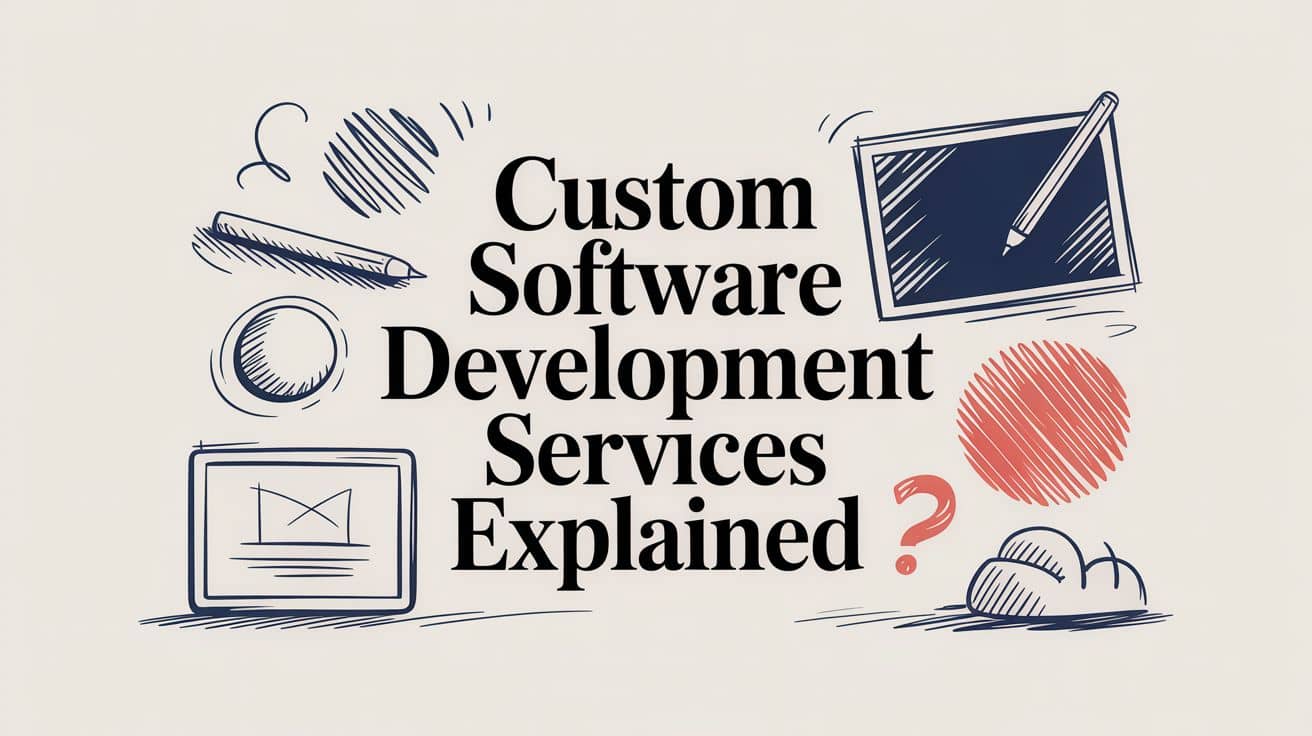
Custom Software Development Services Explained.
Explore custom software development services. This guide covers the benefits, process, and how to choose the right partner
Custom Software Development.
Share Via:
Key Takeaways
- Purpose-Built Solutions: Custom software is built from the ground up to solve your specific challenges, match your workflows, and hit your business goals. It is designed for your organisation, so it fits how you work.
- Key Business Benefits: The main gains are a clear edge over competitors, better efficiency through automating tedious tasks, and software that can scale with your business as it grows.
- Structured Development Lifecycle: Building custom software is a clear, multi-stage process. It starts with discovery and planning, moves through UI/UX design and development, and includes rigorous testing before deployment and ongoing support.
- Choosing the Right Partner: Your choice of development partner matters a great deal. Look at their technical skills, industry experience, communication style, and track record.
Instead of compromising, you partner with a team to design, build, and maintain a solution aligned with your operational needs. The aim is software that works for you, which can give you a competitive advantage.
If you're weighing up a build of your own, our team of UK software developers would be glad to talk it through.
What Are Custom Software Development Services?
Imagine you need a suit. You could walk into a high street shop and grab one off the rack. It’ll probably fit okay and get the job done, but it wasn't made with you in mind. Custom software development services, on the other hand, are like going to a bespoke tailor. They take your exact measurements, listen to what you need, and craft something that fits you well.
That’s what custom software is: a solution designed from the ground up to solve the unique challenges of a single business. It builds a digital tool that mirrors and improves your specific workflows, goals, and operational quirks, instead of bending your processes to fit a pre-packaged product. The work goes beyond writing code and becomes a strategic partnership aimed at building a competitive advantage.
Moving Beyond Off-the-Rack Solutions
More businesses are choosing custom software over generic, off-the-shelf options. Pre-made software can be quick to set up, but it often forces you into a box and makes you compromise on how your teams work. Custom solutions remove those constraints.
A bespoke software solution is built to integrate flawlessly with your existing systems, streamline your specific workflows, and scale precisely as your business grows. It’s an investment in a tool that evolves with you, rather than one you’ll eventually outgrow.
This tailored approach helps explain rising demand. The UK custom software development market is currently valued at around £2.4 billion ($3.01 billion USD), and projections show a compound annual growth rate of 24.83% over the next decade. By 2035, the market is expected to reach roughly £27.5 billion ($34.5 billion USD), a shift towards purpose-built tech. Discover more insights on the UK software market's growth.
A Partnership for Strategic Growth
Working with a custom software development service is a deep collaboration. The process starts with a thorough dive into your business to properly understand your pain points and uncover opportunities. The aim is to deliver a solution that provides tangible, measurable value, whether that’s by automating tedious manual tasks, delivering sharper data insights, or creating a one-of-a-kind customer experience.
When you boil it down, custom software development services deliver on three core promises that off-the-shelf products struggle to match:
- Close Fit: The software is moulded around your business.
- Competitive Edge: It gives you unique features and capabilities that your competitors, who are likely using generic software, can't replicate.
- Long-Term Value: It’s a scalable asset that grows with your business and can deliver a higher return on investment over time.
This strategic approach aims for a final product that is functional and also becomes a central part of your company's success and efficiency.
Why Bother With Bespoke Software Anyway?
Investing in custom software is a major strategic move: you decide to leave the constraints of generic, off-the-shelf products behind and build something that works exactly the way your business does. The biggest gain is a solution matched to your ways of working, which gives you a competitive advantage that is hard for others to copy.
Instead of twisting your processes to fit a pre-packaged tool, you get a solution built to support your specific workflows from the start. Each feature has a clear purpose, which cuts out clutter and supports your team's productivity.
Gaining a Unique Competitive Edge
Off-the-shelf software puts everyone on the same level, offering the same toolkit to you and all your competitors. Custom software, on the other hand, lets you create unique features and capabilities that are a direct reflection of your business strategy, making your service stand out in the market. That is how a lasting advantage gets built.
Imagine a logistics company developing its own routing algorithm. This bespoke system could optimise delivery times and cut fuel consumption in a way generic GPS software could not. That unique tool translates directly into lower running costs and a much better customer experience, leaving competitors who rely on standard solutions behind. You can dig deeper into why custom solutions are your future in our detailed article.
Supercharge Your Efficiency Through Automation
One of the biggest returns from custom software comes from automating repetitive tasks. By identifying and streamlining those manual workflows, you free up your team to focus on the bigger picture, the work that drives growth.
A bespoke solution is designed to hunt down and eliminate operational bottlenecks. By automating processes like data entry, report generation, or customer onboarding, businesses can achieve a dramatic increase in efficiency, reduce the risk of human error, and accelerate their operational pace.
Generic software rarely offers this kind of tailored automation, because it wasn't built with your specific internal processes in mind.
Built to Scale for Long-Term Growth
Businesses don't stand still, and the software that powers them shouldn't either. Off-the-shelf tools often come with frustrating limits on user numbers, data storage, or features that can hold you back as you expand. Custom software, however, is built from the ground up with scalability in mind.
- Adaptable Architecture: A custom solution is engineered to handle growing user numbers and increased data loads without strain.
- Flexible Feature Integration: As your business needs evolve, you can develop and plug in new features to the existing system.
- Future-Proof Investment: You're not at the mercy of a third-party vendor's product roadmap. You control the software's evolution, which helps it stay useful for years.
You're investing in a long-term solution that is less likely to become a dead end just as your company starts hitting its stride.
Seamless Integration with Your Existing Systems
Most businesses today run on a cocktail of different software tools, such as CRMs, ERPs and accounting platforms. A common headache with off-the-shelf products is getting them to talk to each other without causing chaos.
This is the problem custom software development services are designed to solve. Developers can build APIs and integrations that create a smooth flow of data between all your critical systems. The result is a unified setup that breaks down data silos and gives your organisation a single source of truth, which supports better decisions, better collaboration and a more efficient operation.
Understanding the Custom Software Development Lifecycle
Creating custom software is a structured journey. Think of it like building a bespoke home: you wouldn’t start laying bricks without detailed architectural blueprints, a solid foundation, and a clear plan for the plumbing and electrics.
The custom software development lifecycle provides that structure. It’s the roadmap that turns an idea into a working, reliable product. Each phase builds on the last, so the final result stays aligned with your business goals.
Phase 1: The Discovery and Strategic Planning Stage
This is the most critical phase, and the foundation for the entire project. Before a single line of code gets written, we need to understand your business well enough to know what you want to build and, more importantly, why.
Here’s what happens during discovery:
- Stakeholder Workshops: We bring your key team members together. The goal is to define clear business objectives, pinpoint user pain points, and agree on what success actually looks like.
- Market and Competitor Analysis: We need to understand the existing landscape. This is where we find opportunities for you to stand out and innovate.
- Technical Feasibility Assessment: We evaluate the technical requirements and identify potential roadblocks to make sure the project is viable from day one.
- Creating a Project Roadmap: This outlines the project’s scope, key features, milestones, and gives us a preliminary timeline.
Getting this stage right means everyone is on the same page. A thorough discovery phase reduces the risk of expensive changes down the line.
Phase 2: The UI/UX Design Stage
With a solid strategy locked in, the focus shifts to how the software will look and feel. This is all about the user experience (UX) and user interface (UI), where your software starts to take visual form.
UX design is about the overall flow of the solution: how intuitive and logical is it to use? UI design focuses on the visuals, meaning the buttons, screens, and aesthetic elements that people interact with.
The goal here is to create a design that isn't just nice to look at, but is incredibly intuitive to use. A seamless user experience is everything. Even the most powerful software will fall flat if people find it confusing or frustrating to navigate.
In this phase, we'll create wireframes (basic layouts), mockups (static visual designs), and interactive prototypes. These tools let you see and feel how the software will work before a single developer is involved, allowing for early feedback and quick refinements.
Phase 3: The Development and Coding Stage
Now it's time to build. This is where the blueprints from the design phase become a working product, and our developers write the code for all the features and functionality.
We typically manage this stage using an Agile methodology. This means breaking the project into small, manageable cycles called "sprints."
This iterative approach has clear advantages:
- Flexibility: The plan can adapt as new requirements pop up or priorities change.
- Transparency: You get regular updates and can see tangible progress through frequent demonstrations.
- Faster Delivery: Functional parts of the software are delivered incrementally, so you start seeing value much sooner.
We communicate throughout this phase, so the build stays true to the original vision.
Phase 4: The Quality Assurance and Testing Stage
Once features are built, they have to be put through their paces. Our Quality Assurance (QA) team steps in to hunt down and report any bugs, inconsistencies, or performance issues before the software ever reaches your users.
Testing covers several areas:
- Functional Testing: Does every feature do what it's supposed to do?
- Usability Testing: Is the software easy and intuitive for a real person to use?
- Performance Testing: Can the software handle the expected workload without slowing to a crawl?
- Security Testing: Are there any vulnerabilities that could be exploited?
This phase is not optional, and it is how we aim to deliver a high-quality, reliable, and secure product. For a deeper look at what a structured development journey involves, you can explore our process for building digital products.
Phase 5: The Deployment and Maintenance Stage
Once the software has passed testing, it is ready to go live. Deployment is the process of making it available to your end-users. A smooth deployment needs careful planning to minimise downtime and keep the transition clean.
The journey continues after launch.
Ongoing maintenance and support matter for the software's long-term success. This final, continuous phase involves monitoring performance, fixing bugs that appear in the live environment, and rolling out regular updates to keep the software secure, efficient, and relevant, so it keeps evolving alongside your business.
Common Types of Custom Software Solutions
The phrase "custom software" might sound vague, but in practice it means building the right tool for a specific job. Custom software development services craft bespoke solutions for unique business challenges, whether that’s engaging customers on their phones or untangling complex internal operations.
Thinking about the different forms custom software can take helps connect the dots between the idea and the real-world tools that businesses rely on every day. Each solution is built from the ground up to solve a distinct problem, so it fits an organisation's goals.
Bespoke Mobile Applications
Everyone expects instant access and slick experiences, and a bespoke mobile app can be a strong asset. It goes beyond a mobile-friendly website: a custom app creates a richer, more interactive space to connect with your audience. Businesses typically go down this route when off-the-shelf solutions can’t cut it.
They’re often trying to solve specific problems like:
- Building real customer loyalty: Creating unique loyalty schemes, pushing out personalised content, and using notifications to keep people coming back.
- Making complex services simple: For a company like Boiler Juice, a custom app takes the hassle out of ordering and managing heating oil deliveries on the go.
- Carving out a niche marketplace: Platforms like Findr connect models with brands, which demands specific features a generic app builder would not offer.
- Improving workforce management: Apps such as Deploy are purpose-built to handle the complexities of scheduling and communicating with temporary staff.
A custom mobile app is your brand’s own corner on a customer’s device, giving you a direct line for engagement and service that’s hard to beat.
Custom Web Applications and Platforms
A standard website is great for putting information out there, while a custom web application is an interactive tool you access through a browser, built to do a specific job, from managing complex data to automating entire business processes. It is a leap in sophistication from a simple marketing site.
Think of a custom web application as the central nervous system for your operations, accessible from any device with an internet connection. It’s designed to digitalise and simplify how you work, creating a single source of truth for the whole company.
Take a platform like H2OIQ, for example. It uses clever tech to help businesses manage their water usage, a task too complex for a standard website. In the same way, a custom web portal can give customers a secure place to log in, track their orders, or manage subscriptions. This creates a self-service experience that frees up your team from administrative work. These platforms are the digital backbone of modern business.
Tailored Enterprise Systems (ERP & CRM)
Enterprise Resource Planning (ERP) and Customer Relationship Management (CRM) systems are the operational heart of most businesses. You’ve probably heard of off-the-shelf options like Salesforce or SAP, but they often come packed with features you don't need and workflows that don't quite fit. Custom ERP and CRM solutions, on the other hand, are built to mirror your exact processes.
This tailored approach is a game-changer for businesses with unique ways of working. A custom CRM, for instance, can integrate your specific lead scoring models or automate a niche sales funnel that standard software can't handle. A bespoke ERP could manage specialised inventory, unique supply chain logistics, or complex financial reporting. The real win is getting a system that works the way your team does, eliminating clunky workarounds and boosting productivity.
AI and IoT-Powered Solutions
Custom software development increasingly involves advanced tech like Artificial Intelligence (AI) and the Internet of Things (IoT), which deliver intelligent automation and data-driven insights. It’s predicted that 85% of UK businesses will integrate AI and machine learning into their applications to sharpen their decision-making. You can read more about how businesses are using custom software for success.
Some practical applications in this space include:
- Predictive Analytics Platforms: Sifting through historical data to forecast what's coming next.
- AI-Driven Chatbots: Providing smart, 24/7 customer support that actually helps.
- IoT Dashboards: Pulling in data from connected devices to give you a real-time view for monitoring and control.
These systems can give businesses a competitive edge through new efficiencies and more responsive ways of operating.
How to Choose the Right Development Partner
Picking a partner for your custom software project is one of the most consequential decisions you can make. You are looking for an extension of your own team, with coding skills, an understanding of your vision, and a commitment to making it a reality.
Strong partners push back, challenge your assumptions, and offer strategic advice that steers you toward a good outcome. A mismatched partnership often leads to missed deadlines, blown budgets, and a final product that just doesn't hit the mark. To sidestep that, you need a clear way to evaluate potential partners.
Technical Expertise and Proven Portfolio
First, can they build what you need? Don't take their word for it. Look closely at their portfolio and case studies to see what they’ve accomplished for other clients.
Look for proof that they have experience with the specific technologies your project requires and have built solutions of similar scale and complexity. A strong portfolio is tangible proof of their ability to deliver real business results.
Industry Understanding and Alignment
Finding a partner who already understands your industry is a big advantage. They are likely to speak your language from day one, grasping your unique challenges, regulatory hurdles, and user needs without a lengthy crash course. This shared context is valuable.
A team with industry experience can offer proactive suggestions and insights that a generalist agency might miss. They understand the competitive landscape and can help you build a solution that truly stands out in your market.
When you're vetting potential partners, ask them directly about their experience in your sector. Have they worked with companies like yours before? Can they show they understand your operational realities? This alignment helps the software they build solve your problems.
Development Methodology and Communication
How a team builds software is as important as what they build. We use an Agile methodology, which breaks the project into manageable sprints. This approach allows flexibility, regular feedback, and continuous improvement, which minimises risk and keeps the project on track.
None of that works without good communication. Look for a team that prioritises transparency and collaboration. You want a partner who keeps you in the loop and treats you as part of the development journey, and they should have clear processes for regular check-ins, progress reports, and stakeholder demos.
Frequently Asked Questions
How much does custom software cost?
The cost of custom software depends entirely on its complexity, required features, and the technologies used. A simple application might start around £20,000, while a comprehensive enterprise system can exceed £100,000. Factors like third-party integrations, advanced security, and team size all influence the final price. The best approach is a discovery phase to define the scope and get a precise quote. Ready to discuss your project? Contact us for a detailed consultation.
What's the typical timeline for developing custom software?
Like cost, the timeline is project-specific. A Minimum Viable Product (MVP) can often be developed in 3 to 6 months, allowing for a quick market launch to gather user feedback. A more feature-rich solution typically takes 6 to 12 months or longer. We use an Agile approach, delivering functional software in iterative cycles. This means you start seeing a return on your investment much earlier than with traditional development methods where you wait for one big final release.
Do I own the source code of my custom software?
Absolutely. When you partner with a reputable development agency, you should retain 100% ownership of the intellectual property, including all the source code. This is a critical point that must be clearly stated in your contract. Owning the code gives you complete freedom to modify, scale, or even transfer the software to another team in the future. Always ensure your agreement explicitly transfers IP ownership to you upon final payment, providing full control over your digital asset.
How do I maintain and support my software after launch?
Launch is just the beginning. Ongoing support and maintenance are crucial for long-term success. A good development partner will offer a support agreement covering performance monitoring, bug fixes, security patches, and regular updates to keep the software running smoothly. This ensures your application remains secure, efficient, and compatible with evolving technologies. It’s a continuous partnership that protects your investment and allows the software to grow with your business needs, ensuring lasting value and reliability.
About the Author
Hamish Kerry is the Marketing Manager at Arch, where he has spent the past six years shaping how digital products are positioned, launched, and understood. He has over eight years in the tech industry and a deep understanding of accessible design and user-centred development, with a focus on delivering real impact to end users. His interests include AI, app and web development, and the potential of emerging technologies. Outside campaigns, he keeps a close eye on how tech can drive meaningful change.
You can catch up with Hamish on LinkedIn
When the software you need runs in a browser, our custom web application development page covers planning, design and the build itself.