



Enterprise App Development: The 2026 UK Buyer's Guide.
Your definitive guide to enterprise app development. Learn about architecture, security, costs, and choosing the right partner. Read now.
Enterprise App Development: The 2026 UK Buyer's Guide.
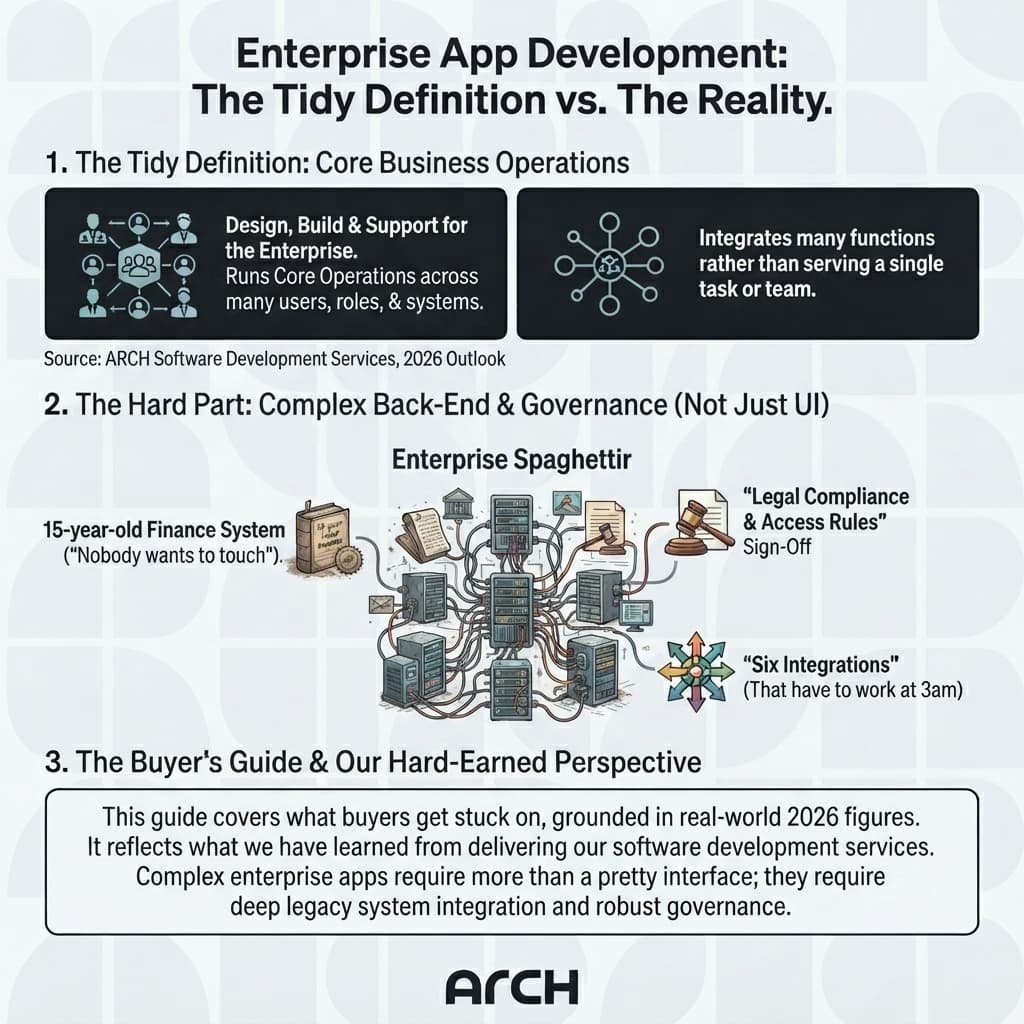
Enterprise app development is the practice of designing, building and supporting software that runs core business operations across many users, roles and connected systems.
The definition is tidy, but the work rarely is. The hard part of enterprise app development is usually not the interface. It's the fifteen-year-old finance system nobody wants to touch, the access rules legal signs off, and six integrations that have to keep agreeing with each other at 3am. This guide covers what buyers get stuck on, using 2026 figures. It reflects what we have learned from delivering our software development services.
Enterprise: where the users cannot uninstall you.
Where staff use a mix of phones, tablets and desktops, an internal tool built in Flutter can stay consistent across all of those devices.
Key Takeaways
- Enterprise app development is defined by integration depth, access control and operational criticality, not by screen count or user numbers.
- The global enterprise application market sits at roughly $342.1 billion in 2026, with ERP the single largest segment.
- Integration is where budgets go. The middleware market that exists purely to connect systems is worth about $24 billion.
- Security belongs in the design from the start. 69% of large UK businesses identified a breach or attack in the past year.
- Low-code has a real place, with about 65% adoption, but it tends to stop short where workflows are differentiated or legacy-heavy.
- Projects fail on scope and sequencing far more often than on code quality.
What Is Enterprise Application Development?
Enterprise application development is the building of software that supports business-critical processes at organisational scale: multiple user roles, formal access rules, integration with existing systems, and an expectation that it stays up.
The clearest way to separate it from consumer work is to ask what happens when it breaks. If a consumer app fails, someone closes it. If a dispatch platform fails, engineers stop arriving at jobs and the contact centre absorbs the difference within the hour.
Three characteristics define the category:
- Multi-role access. A field engineer, an approver and a finance controller may use the same record and see three different versions of it.
- System dependency. The app is rarely the source of truth. It reads from and writes to CRM, ERP, identity and finance systems.
- Evidence requirements. Someone will eventually ask who changed what, when, and on whose authority.
Consumer teams optimise for acquisition and delight. Enterprise app development optimises for correctness, permissions and the ability to answer questions under scrutiny. That operational scale is the world of enterprise clients like Nestlé.

The systems nobody wants to touch, and everything depends on.
The 2026 Enterprise Application Market at a Glance
The money involved explains why this category attracts so much attention. Gartner expects worldwide software spending to grow 14.7% in 2026 to more than $1.4 trillion, making it the second-fastest-growing IT category.
Within that, the enterprise application market itself is valued at about $342.1 billion in 2026, with ERP the largest segment at 31.6% share. The mobile slice is growing quickly too: enterprise mobile application development is projected to rise from $174.46 billion in 2025 to $196.79 billion in 2026, a 12.8% CAGR.
Read those numbers as context, not a business case. Market growth tells you the tooling and talent exist. It says nothing about whether you should build. The same caveat applies to mobile app builds.
The useful signal sits in the ERP share figure: most enterprise spend goes on systems of record that already exist. So the majority of enterprise app development work in 2026 is not greenfield. It's connecting to, extending, or replacing something already running.
Traditional vs Modern Enterprise App Development
Every vendor guide runs this comparison, so here it is without the sales pitch.
Traditional builds were monolithic. One codebase, one release, one deployment. Change anything and you ship everything. Testing was slow because the blast radius was the whole application, and hosting sat in a data centre with a capacity ceiling forecast in advance.
Modern builds split the application into services that deploy independently. Billing evolves without touching dispatch. Reporting improves without risking login. Cloud infrastructure removes the capacity guesswork. It is the shape most web app development in the UK now takes.
The honest caveat: modular is not automatically better. Splitting a small operational tool into a dozen services buys the coordination overhead of a large system with none of the benefit. The pattern earns its keep when different parts of the business change at different speeds.
A reasonable test is release risk. If your team is scared to deploy on a Thursday, architecture is already costing you money. Design for the next meaningful stage of growth, not the five-year slide.

Five approvers, one roadmap, no volunteers.
Common Types of Enterprise Applications
Most enterprise app development work falls into a small number of recognisable shapes:
- ERP: finance, supply chain and resource planning. The largest category by spend.
- CRM: customer records, pipeline and service history.
- HRMS: people data, onboarding, absence, performance.
- Procurement: purchase requests, approvals, supplier records.
- Asset management: equipment, maintenance schedules, field inventory.
- BI and reporting: pulling the above into something a director can act on.
Knowing your shape matters, because it tells you what to buy versus build. Very few organisations should write their own general ledger. Plenty should build the workflow layer sitting between that ledger and the way they actually trade. That is the pattern behind our apps for financial services.
Integration and Middleware: The Real Challenge
Integration is where enterprise app development budgets go. The integration and orchestration middleware market is worth about $24 billion in 2026, with cloud deployment taking a 55% share.
Cloud sprawl makes it harder. About 80% of organisations now run multiple public or private clouds, so a new enterprise app rarely integrates with one estate. It integrates across several, each with its own identity model and latency profile.
Three principles tend to survive contact with reality:
- API-first over hard-coded connections. Contracts between systems let you replace one part of the stack without rewriting the product.
- Event-driven where timing matters. When an action in one system must trigger work elsewhere, polling is a tax you pay forever.
- Assume the legacy system stays. Plans that depend on decommissioning something in phase one usually slip in phase one.
Integration is where estimates go wrong most often, because the work is invisible during discovery. Nobody demos a data mapping. But the mapping is the project. We go deeper on API integration elsewhere.

Integration is the job. The app is the easy half.
Security, Compliance and Data Governance
The stakes here are measurable. In the UK's 2025/2026 survey, 65% of medium and 69% of large businesses identified a cyber breach or attack in the past year. At enterprise scale, an incident is close to an annual expectation.
Security problems in enterprise app development rarely arrive as one dramatic failure. They accumulate: access granted quickly and left unreviewed, audit trails recording the wrong thing, personal data copied into a test environment because it was faster.
What that means in engineering terms:
- Role-based access control, designed before the roles multiply.
- Least privilege on admin accounts, deliberately and narrowly.
- Audit logging that compliance can actually read, not just tail.
- Encryption in transit and at rest, by default.
- Data mapping covering where personal data is created, stored, replicated and deleted across every integration.
Under UK GDPR and the Data Protection Act 2018, that last point is not a nice-to-have. Every integration extends the map, which is another reason integration planning cannot be a late-stage task.
Security is part of how the product behaves and what evidence the business can produce when challenged. Bolting it on afterwards changes architecture, not settings.

Security review: the gate that moves your launch date.
Modernising Legacy Systems
Most enterprise app development starts with something old. The legacy modernisation market reached $24.98 billion in 2025 and is projected to hit $56.87 billion by 2030, which tells you how many organisations are in exactly this position.
The reason is budgetary. Organisations can spend the majority of IT budgets simply maintaining legacy systems, and modernisation programmes report 288-362% ROI against that drag.
The failure mode is rip-and-replace. A full rewrite asks the business to accept months of risk with no delivered value, then discovers halfway through that the old system encodes rules nobody documented.
Phased modernisation works better. Put an API layer in front of the legacy system, build the new workflow against that contract, move one process at a time, and keep both running until the new path proves itself. There is a fuller playbook on modernising legacy applications. It's slower on paper and faster in practice, because nothing has to be right first time.
Build vs Buy vs Low-Code
This is the decision most enterprise buyers get wrong in both directions.
Low-code adoption is now mainstream: around 65% of organisations have adopted low-code tools, with 58% of new apps involving non-technical teams. Those gains are real where the workflow is clear and the user groups are known.
A workable framework:
- Buy when the process is standard and your version of it is not a competitive advantage. Payroll, general ledger, expense claims.
- Low-code when the workflow is well understood, the integration surface is shallow, and speed matters more than bespoke interaction design. Approvals, internal dashboards, structured process automation.
- Build when the workflow is the differentiator, the integration load is deep, or the domain rules are genuinely yours.
The trap in both directions is choosing on ideology. Teams that build everything end up maintaining a payroll system. Teams that buy everything run their business the way the vendor imagined it.
Plenty of estates want all three: a custom core where you compete, bought systems of record underneath, low-code for adjacent tooling. That custom core is where bespoke software development pays off.

Adoption, decided by people who did not ask for this.
Why Enterprise App Development Projects Fail and How to De-Risk Them
The competitor guides skip this part.
Enterprise projects rarely fail on engineering. They fail on sequencing:
- Scope agreed by addition. Every stakeholder adds one requirement, nobody removes any, and phase one becomes a transformation programme.
- Integration discovered late. Discovery focuses on features. The data questions arrive after the estimate.
- Compliance surfacing at the end. Audit and permission requirements emerge before launch, when fixing them means architecture.
- No single decision-maker. Delivery stalls waiting for a decision that four people each believe belongs to someone else.
De-risking is unglamorous and it works. Run discovery that maps integrations and access rules, not just screens. Scope phase one to one high-value workflow with real integrations behind it. Name one accountable business lead and one delivery lead. Define success operationally: task completion time, error frequency, approval turnaround, data re-entry volume. All of that belongs in a discovery phase.
Then release, watch real users, and let evidence decide phase two. Organisations that do this ship slower in month one and faster by month nine.
What Drives the Cost of Enterprise App Development
The question "how much does an enterprise app cost" leads nowhere useful, because the honest answer is a range so wide it's meaningless. The better question is what scope creates measurable value soonest.
Five factors move the number more than anything else:
- Feature complexity. Rule-heavy workflows and advanced permissions cost more than screens.
- Integration load. Every system you connect adds engineering and, more expensively, testing.
- Data quality. Poor existing data creates migration work that the brief did not mention.
- Compliance requirements. Auditability and access control materially affect scope.
- Support model. Hosting, monitoring and post-launch fixes need budget from day one.
None of these are late-stage additions. They belong in the first scoping conversation, because they routinely matter more than the visible front end. That budget line includes hosting and ongoing support.

Measure at the level the change happens, not group EBIT.
Choosing an Enterprise App Development Partner
Test enterprise app development partners on judgement, not visuals.
- Discovery quality. Can they turn a business problem into a defensible scope, or do they estimate first?
- Technical judgement. Do they explain architecture trade-offs plainly, or reach for buzzwords?
- Delivery discipline. How do they handle scope control and release planning when priorities shift?
- Security maturity. Can they discuss permissions, auditability and data handling in practical terms?
- Support model. What happens after launch, when the real issues appear?
- Comparable work. Have they shipped products with similar integration depth and user contexts?
Arch's work on Boiler Juice, Findr, Deploy, My Pension ID and Adaptwell spans different product types, audiences and operational demands. Larger engagements like Willmott Dixon show the same discipline at enterprise scale. Arch's web app developers in the UK set out the delivery approach in more detail.
The warning signs are consistent: estimates without discovery, fixed certainty where major unknowns remain, and silence on hosting and maintenance. A strong partner narrows scope and makes risk visible before it gets expensive.
Frequently Asked Questions
How Is Enterprise App Development Different From Building a Consumer App?
Enterprise apps sit closer to core workflows, connect to more internal systems, and carry stricter expectations around permissions, auditability and reliability. They typically serve several user roles with different access rules against the same records. Enterprise app development therefore lets architecture, security and governance shape the build from the start, rather than after the interface is designed.
How Long Does an Enterprise Application Take to Build?
Timelines depend on decision speed and integration complexity more than coding effort. A tightly scoped first release solving one operational problem moves faster than a broad programme. The common delays come from unclear ownership, changing requirements and late discovery of system dependencies, not from development itself. Phased delivery is the most reliable approach.
What Is the Role of APIs and Middleware in Enterprise Apps?
APIs put contracts between systems so one part of the stack can be replaced without rewriting the product. Middleware orchestrates the flow between them. The category is worth about $24 billion in 2026, which reflects how much enterprise value depends on systems agreeing with each other reliably.
Should We Build Custom, Buy Off-the-Shelf, or Use Low-Code?
Buy where the process is standard and not a competitive advantage. Use low-code where the workflow is clear and the integration surface is shallow: around 65% of organisations now do. Build where the workflow differentiates you or the integration load is deep. Most enterprise estates end up using all three deliberately.
What Security and Compliance Requirements Apply to Enterprise Apps?
Role-based access control, least-privilege admin, audit logging, encryption in transit and at rest, and a clear map of where personal data moves across integrations. Under UK GDPR and the Data Protection Act 2018 that mapping is a requirement, not documentation. With 69% of large UK businesses reporting a breach or attack last year, designing this in early is the cheaper path.
Why Do So Many Enterprise Application Projects Fail?
Scope grows by addition, integration work is discovered after the estimate, and compliance requirements surface late enough that fixing them means changing architecture. Unclear decision ownership compounds all three. De-risking enterprise app development means discovery that maps integrations and access rules, a first phase narrow enough to launch, and one accountable decision-maker on each side.
About the Author
Hamish Kerry is the Marketing Manager at Arch, where he has spent the past six years shaping how digital products are positioned, launched, and understood. He has over eight years in the tech industry and a deep understanding of accessible design and user-centred development, with a focus on delivering real impact to end users. His interests include AI, app and web development, and the potential of emerging technologies. Outside campaigns, he keeps a close eye on how tech can drive meaningful change.
You can catch up with Hamish on LinkedIn
Sources
- Gartner: Business Software Spend Will Grow a Stunning 14.7% in 2026 to $1.4 Trillion SaaStr, 15 February 2026.
- Enterprise Application Market Size & Forecast, 2026-2033 Coherent Market Insights, 30 March 2026.
- Enterprise Mobile Application Development Market Drivers 2026-2030 with Regional Outlook National Law Review, 25 March 2026.
- Integration & Orchestration Middleware Market Trends Coherent Market Insights, 3 April 2026.
- Legacy System Modernization Statistics DreamFactory, 6 January 2026.
- Low-Code Development Platforms Statistics and Trends 2026 ToolJet, 17 February 2026.
- Cyber Security Breaches Survey 2026 GOV.UK (DSIT), 30 April 2026.
- 100+ Cloud Computing Statistics: A 2026 Market Snapshot CloudZero, 15 April 2026.