



A Guide to IoT in Smart Cities and Our Urban Future.
Explore how IoT in smart cities is transforming urban life. Learn about the tech, use cases, and how to build a connected community.
Key Takeaways
- The City's Nervous System: The Internet of Things (IoT) is like a digital nervous system for a smart city. It connects physical objects with sensors to gather real-time data on everything happening across the urban environment.
- From Reactive to Proactive: This constant stream of information allows city leaders to shift from fixing problems after they happen to proactively managing the city, leading to better efficiency and resource use.
- Better Urban Life: Key applications, like smarter traffic flow, optimised bin collections, and enhanced public safety, directly improve the quality of life for everyone who lives and works there.
- Major Economic Growth: The smart city market is growing fast. In the UK alone, it’s projected to expand from £177.75 million in 2024 to over £1.1 billion by 2035, opening up huge opportunities for innovation.
Understanding the Smart City Revolution
When you hear "smart city," it's easy to picture a far-off, sci-fi future. But the reality is that the smart city is already here. It’s not built on fantastical ideas but on the very practical power of the Internet of Things (IoT).
Broadly, IoT in smart cities is about connecting the urban environment to a digital network, creating a city that can sense, analyse, and act on what’s happening in real time.
The City's Digital Nervous System
Think of it like a human’s sensory system. Billions of tiny, connected sensors act as the city's eyes, ears, and nerves. They gather data on everything from traffic flow and air quality to bin levels and energy consumption. This constant stream of information helps a city "feel" what’s happening, moment by moment.
This network of sensors and devices forms a digital nervous system. It lets city managers see and understand complex urban dynamics and respond with precision. Instead of guessing where a traffic jam might form, they can see it building and adjust traffic signals on the fly. Waste collection lorries no longer need fixed routes: they can be dispatched only when the bins are actually full.
A smart city uses IoT to transform raw data into intelligent action. It’s about creating a responsive, efficient, and liveable environment by understanding the real-time needs of its infrastructure and citizens. This shift from reactive fixes to proactive optimisation is the foundation of modern urban management.
Fuelling Urban Innovation
This data-first approach is already a rapidly growing economic force. The UK smart city market, heavily powered by IoT, was valued at £177.75 million in 2024. Projections show it surging to over £1.1 billion by 2035, driven by a compound annual growth rate of 18.37%. This growth is a direct result of government initiatives and the pressing need for smarter resource management in our expanding cities.
But data on its own isn't enough. The value comes when that data is made accessible and actionable. This is where well-designed platforms become essential, turning complex datasets into simple, practical tools for both citizens and city officials.
You can learn more about how Arch approaches this intersection in our article on The Impact of AI and IoT on UK Cities. By connecting technology directly to human needs, we can build cities that are smarter and genuinely better for everyone living in them.
The Technology Stack Behind A Smart City
So, what actually makes a city ‘smart’? It’s a stack of interconnected technologies. Think of it like a four-layer cake, where each layer supports the next. To get a handle on IoT in smart cities, it helps to break down this architecture.
This diagram offers a simple but effective visual. It all starts with sensors collecting data, which then flows through IoT networks to make the whole smart city concept work.
As you can see, sensors and IoT are the bedrock. They’re the foundation on which every smart city application is built.
The Four Layers Of Smart City Architecture
The entire system is designed to get data from the physical world into a digital application where it becomes useful. Each of the four layers has a very specific job to do.
- 1. The Sensing Layer: This is the ground floor, where the city gets its digital senses. It’s a huge network of physical devices embedded across the urban environment, from sensors sniffing out air pollution to others counting cars to manage traffic. These devices capture raw information about what’s happening in the real world. This layer also includes small but capable computers that can act as nodes in the network. For anyone dabbling in DIY electronics, you may recognise the principles in our guide on using a Raspberry Pi for various projects.
- 2. The Network Layer: Once the data is collected, it has to go somewhere. That’s the job of the network layer, which acts like the city’s circulatory system. It uses a mix of wireless technologies like 5G, Wi-Fi, and LoRaWAN (Long Range Wide Area Network) to shuttle information from the sensors to a central processing hub. The right technology choice is a balancing act between range, bandwidth, and power consumption.
The Brains Of The Operation
The final two layers are where data gets its intelligence. This is where raw information is processed, analysed, and finally handed to users in a way they can actually use.
- 3. The Data Layer: This is where the flood of incoming data is tamed. Stored in data centres or on cloud platforms, the information is cleaned up, organised, and analysed. It’s in this layer that algorithms get to work, finding patterns and generating insights. For example, an algorithm might analyse historical traffic data to predict tomorrow’s congestion hotspots or sift through utility data to spot an anomaly that signals a burst water main.
- 4. The Application Layer: This is the layer we all see and interact with. It’s where processed data becomes a service for citizens and city managers. It could be the dashboards officials use to get a real-time view of city operations, or the mobile apps we use every day. That app guiding you to a free parking spot or giving you live bus times? That’s the application layer in action.
This layered architecture is what makes a smart city more than just a collection of gadgets. It’s a cohesive system designed to turn raw data into actionable insights, delivering services that make urban life more efficient, sustainable, and liveable.
The Power Trio: IoT, AI, And Edge Computing
Driving the intelligence within this stack is a powerful combination of three technologies: IoT, Artificial Intelligence (AI), and edge computing. While IoT devices collect the data and AI algorithms find the patterns, it’s edge computing that brings processing power closer to where the data is actually generated.
Instead of sending every little bit of data to a distant cloud server for analysis, edge computing allows devices to process information locally. This is absolutely critical for applications that need split-second responses.
For instance, an intelligent traffic camera can use edge computing to detect a road accident and immediately change the signals to reroute vehicles. This all happens in an instant, without the delay of a round trip to the cloud. This localised processing makes the city’s responses faster, more reliable, and more resilient.
Real-World Examples of IoT in Smart Cities
Theory is one thing, but let's look at how IoT in smart cities is making an impact on the ground. This is where the value shows up, with tangible returns and direct improvements to the quality of urban life.
Across the UK and around the world, cities are using IoT to solve age-old problems with newfound precision. From easing traffic jams to optimising waste collection, these applications are actively reshaping municipal services.
Smart Mobility and Intelligent Transport
Traffic congestion is a universal urban headache. It costs us time, fuel, and pollutes our air. IoT offers a direct way to tackle this through intelligent transport systems (ITS).
Sensors embedded in roads, mounted on traffic lights, and integrated with public cameras feed real-time data into a central platform. This allows traffic managers to:
- Adapt traffic signals dynamically based on actual vehicle flow, not just fixed timers.
- Reroute drivers automatically around accidents or roadworks using digital signage and navigation apps.
- Prioritise emergency vehicles by giving them a "green wave" of traffic lights to slash response times.
Another big change is smart parking. We've all been there, circling the block, hunting for a space. IoT-enabled sensors detect whether a spot is free or occupied. This information is pushed to a mobile app, guiding drivers straight to available spaces and cutting down on the frustrating search. Beyond just cars, smart cities are also exploring how electric mopeds are revolutionising commuting and contributing to more sustainable urban travel.
Smart mobility aims at a more predictable, efficient, and less stressful transport network for everyone, including pedestrians, cyclists, and public transport users. Moving cars faster is only part of it.
Smart Utilities and Resource Management
Managing a city’s water, waste, and energy is a massive operational lift. IoT brings a welcome dose of intelligence and efficiency to these essential services.
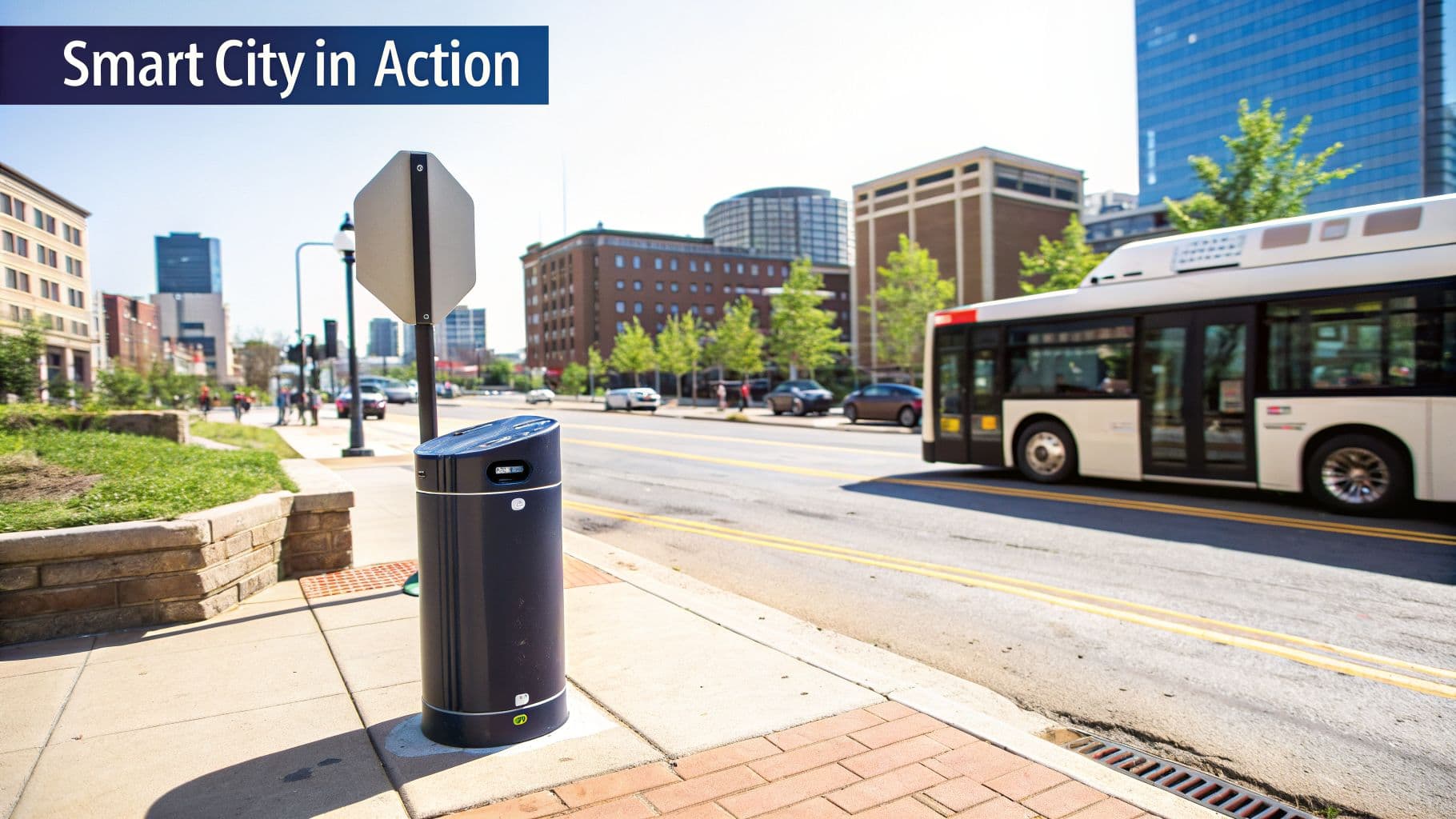
Dynamic Waste Collection: Instead of sending lorries on fixed, inefficient routes, smart bins fitted with ultrasonic sensors report how full they are. Once a bin hits a set threshold, it alerts the central system. Waste management teams can then generate optimised collection routes that only visit full or nearly-full bins. The result? Less fuel used, fewer vehicle emissions, and lower operational costs.
Proactive Water Management: In ageing urban water networks, leaks can go undetected for weeks, wasting millions of litres. By placing acoustic sensors along pipelines, utility companies can "listen" for the tell-tale sounds of a leak. This allows them to pinpoint and fix faults before they become major bursts, conserving a precious resource and preventing costly damage. Similar sensor networks also monitor water quality in real time, helping to ensure a safe supply.
UK Cities Leading the Way
These aren't just futuristic concepts; they're happening now, with measurable results. UK government investments, like the £5 billion for gigabit-capable broadband, are laying the essential groundwork for IoT adoption in UK smart cities. Hull, for example, used an £85 million investment from KCOM to deliver the nation's fastest full-fibre network, which now supports a Cisco-based Smart City OS unifying 12 separate IT systems for more agile services.
Meanwhile, Peterborough, now a fully gigabit city, is using IoT to predict maintenance needs in social housing, cutting costs and helping it move towards its zero-waste goals. These examples show that solid digital infrastructure is the foundation of any successful smart city project. You can read about our work with Edinburgh Council to see how these city-level digital transformations take shape.
Enhancing Public Safety and Environmental Quality
IoT is also being used to create safer and healthier urban environments. Connected cameras with intelligent video analytics can automatically spot incidents like unusual crowds forming or traffic accidents, alerting emergency services far faster than human observation alone.
Environmental monitoring is another strong application. A dense network of air quality sensors can provide a granular, real-time map of pollution across the city. This data helps officials identify pollution hotspots, issue public health advisories, and measure the real impact of environmental policies. It even helps citizens make informed decisions, like choosing a less polluted route for their daily run.
Each of these examples shows how IoT in smart cities moves beyond simple data collection. It’s about creating feedback loops where real-world information drives intelligent, automated actions. The end game is delivering tangible benefits, from saving money and resources to creating a safer, healthier, and more enjoyable place to live.
Confronting Smart City Security and Data Privacy
A city that runs on data is full of opportunity, but it also opens the door to significant risk. As we build our urban future on a foundation of IoT in smart cities, we have to tackle the critical challenges of cybersecurity, data privacy, and ethical governance head-on. The currency of a successful smart city is the trust of its citizens, and that trust is only earned through rock-solid security and transparent data handling.
This conversation is urgent, especially when you look at the sheer scale of IoT adoption in the UK. The market is projected to grow by USD 25.74 billion between 2024 and 2029. While this growth is good news for smart city initiatives, it also dramatically expands the potential attack surface for cyber threats. Getting security right is non-negotiable.
Unpacking The Key Vulnerabilities
Every connected device, from a simple traffic sensor to a smart water meter, is a potential doorway for malicious actors. The first step in building a resilient defence is knowing where the weak spots are.
- Hijacked Devices: Unsecured IoT sensors can be compromised and forced into a botnet, a network of infected devices. These botnets are then used to launch massive Distributed Denial-of-Service (DDoS) attacks that can bring city services to a grinding halt.
- Data Interception: If data isn’t encrypted as it travels from a sensor to a central platform, it can be snatched out of thin air. This "man-in-the-middle" attack could expose sensitive information or, even worse, allow an attacker to inject false data and create chaos.
- Physical Tampering: Many IoT devices are out in public spaces, making them easy targets for physical tampering or straight-up theft.
A huge part of protecting citizen data comes down to understanding and preventing data breaches, which is a vital discipline for safeguarding privacy against these kinds of threats.
Building A Fortress Of Security Best Practices
You can’t just hope for the best. Securing a smart city demands a multi-layered, defence-in-depth strategy where security is baked into the system from day one.
For any technical leader aiming to build trusted, secure, and resilient smart city solutions, security cannot be an afterthought. It must be a foundational principle, guiding every decision from device selection to platform architecture and data governance.
Key security measures include:
- End-to-End Encryption: All data must be encrypted, both "in transit" as it moves across networks and "at rest" when stored in databases. This makes sure that even if data is intercepted, it’s completely unreadable.
- Robust Device Management: Every device joining the network must be authenticated and authorised. This means secure onboarding processes, strong password policies, and the ability to remotely update firmware to patch security holes as they’re found.
- Continuous Security Audits: Regular penetration testing and vulnerability scanning are essential. Think of these as simulated attacks that help you find weaknesses in your system before a real attacker does.
Ethical Governance And GDPR Compliance
Beyond the technical side, smart cities need to establish a strong data governance framework. This is what answers the big questions: Who owns the data? How can it be used? Who gets to access it?
In the UK and Europe, this conversation usually begins with the General Data Protection Regulation (GDPR). Any system that processes citizen data, even anonymised data from traffic patterns, has to comply with GDPR principles. This means making sure data is collected for specific, legitimate reasons and isn't kept for longer than it's needed.
Transparency is everything. Cities have to be crystal clear with their citizens about what data is being collected and why. This is how you build the public trust needed for any smart city project to succeed in the long run.
Your Phased Roadmap to Smart City Innovation
Launching a new IoT solution in a smart city feels like a massive undertaking, but it doesn’t have to be an all-or-nothing gamble. The most successful projects don’t happen overnight. They’re built through a phased, methodical approach that lets you innovate with confidence, manage risk, and prove your value every step of the way.
By breaking the journey into manageable stages, you can turn a grand vision into a practical, achievable reality. This is about solving real urban problems for real people. It starts with a deep understanding of a specific challenge your city or its citizens face.
Phase 1: Discovery and Definition
Before a single sensor gets installed, the most important work happens. The Discovery phase is all about pinpointing a genuine problem and defining exactly what a successful outcome looks like. This initial stage grounds the entire project in a human-centric purpose, making sure the final solution delivers a real, tangible impact.
Key activities here include:
- Problem Identification: Talk to city stakeholders and residents to find a specific, high-impact pain point. Is it inefficient bin collection in one district? Or maybe dangerous traffic at a particular junction? Get specific.
- Defining Success Metrics: Establish clear, measurable Key Performance Indicators (KPIs). Success is a 20% reduction in vehicle emissions from council fleets or a 15% decrease in response times for maintenance calls, not just "better."
- Feasibility and Scope: Assess the technical and financial viability. This means outlining a clear scope and a realistic budget to build a business case that actually holds up to scrutiny.
This foundational work is everything. A well-defined problem and clear success metrics become the North Star for the entire project, keeping your team and stakeholders aligned from day one.
Phase 2: The Pilot Project
With a clear objective in hand, it's time to test your assumptions on a small scale. A pilot project is a controlled experiment designed to prove the concept, gather essential data, and iron out any technical wrinkles before you even think about a city-wide rollout.
A successful pilot is your most powerful tool for securing buy-in and funding. It moves your idea from a concept on paper to a tangible solution with demonstrable results, de-risking the larger investment.
For example, instead of trying to overhaul the entire city’s waste management system at once, you could pilot smart bins in just one or two neighbourhoods. This lets you test the sensor hardware, network connectivity, and data platform in a real-world setting. A successful pilot validates the technology and gives you hard data on potential cost savings and efficiency gains.
Phase 3: Scaling and Integration
Once the pilot has proven its value and hit its KPIs, it's time to scale. This phase is about rolling out the solution across a wider area: more neighbourhoods, a whole department, or the entire city. It also means making sure the system can handle a much larger volume of data and users without falling over.
This is also where integration with existing city systems becomes important. The data from your smart lighting project, for instance, might need to feed into the public safety department's central dashboard. For this to work smoothly, you need a scalable architecture and well-defined APIs. A partner experienced in building and integrating these kinds of complex systems is a real help here.
Phase 4: Optimisation and Expansion
A smart city solution is rarely truly "finished." The final phase is a continuous cycle of optimisation and expansion. Using the rich data now flowing from your deployed system, you can start applying more advanced analytics and even Artificial Intelligence (AI) to refine performance.
AI algorithms could start to predict equipment failures before they happen or spot new patterns in traffic flow to suggest further improvements. Citizen feedback, often gathered through a dedicated mobile app, provides another key stream of data for making things better. This ongoing process keeps the solution effective and evolving to meet the future needs of the city.
If you’re ready to start this journey, get in touch with our team to discuss your project.
FAQs on IoT in Smart Cities
What is the primary benefit of using IoT in smart cities?
The biggest win is moving from reactive to proactive management. By gathering real-time data, city leaders can anticipate issues like traffic jams or utility failures before they happen, rather than just fixing them afterwards. This proactive approach leads to significant cost savings, more efficient use of resources, and a higher quality of life for residents through smoother, more reliable city services. It allows cities to do more with less, creating a truly resilient urban environment.
Are smart city projects expensive to implement?
Costs vary widely. A small pilot, like installing smart bins in one neighbourhood, can be relatively low-cost and is a great way to prove ROI. A full-scale, city-wide intelligent transport system, however, can be a major investment. Key cost factors include the number of sensors, network infrastructure, data platform subscriptions, and custom application development. Starting with a focused pilot project helps manage initial spending and builds a solid business case for future expansion.
What are the main privacy concerns with IoT in smart cities?
The core concern is the large-scale collection of citizen data. From traffic patterns to utility usage, IoT generates a vast amount of information that can feel intrusive. Residents worry about surveillance, how their data is stored, and whether it could be used without their consent. To build trust, cities must be transparent about data policies, use strong encryption, comply with GDPR, and give citizens clear control over their information, ensuring it is used ethically and securely.
How do mobile apps fit into the smart city ecosystem?
Mobile apps act as the vital bridge connecting citizens to the city's IoT infrastructure. They translate complex data into practical, user-friendly services. For instance, an app can guide drivers to available parking, provide real-time public transport updates, or allow residents to report issues like potholes instantly. For city administrators, a dedicated mobile app becomes a direct channel for delivering services and gathering feedback, fostering a more engaged and connected community.
About the Author
Hamish Kerry is the Marketing Manager at Arch, where he has spent the past six years shaping how digital products are positioned, launched, and understood. With over eight years in the tech industry, he has a deep understanding of accessible design and user-centred development, with a focus on delivering real impact to end users. His interests include AI, app and web development, and the transformative potential of emerging technologies. Outside campaigns, he follows how tech can drive meaningful change.
Hamish’s LinkedIn: https://www.linkedin.com/in/hamish-kerry/