



Web Application Development: The Decision Gap .
£5k to £250k quotes for what seems like the same thing. Why does web app development cost so much variation? Evidence-first guide.

Web Application Development: The Decision Gap .
Every web application stack choice is a long-term debt negotiation. While the underlying technologies and frameworks have matured significantly, a widening gap persists between client expectations and operational realities. This discrepancy rarely stems from technical limitations, but rather from a fundamental decision-making gap during the initial architecture phase.
Many organisations select a web app development pathway without fully comprehending the compounding costs across the lifecycle of the product. This lack of strategic foresight often leads to severe framework paralysis, pricing sticker shock, and security vulnerabilities that surface long after deployment. Addressing these challenges requires an objective, evidence-first approach to web and application development.
With the global web development services market currently valued at $77.3 billion, making informed architectural choices has become critical for commercial viability. This research paper equips decision-makers with the objective insights needed to navigate framework complexities and evaluate development methodologies. By aligning technical strategy with genuine business outcomes, organisations can establish a stable foundation that ensures long-term operational resilience.
Key Findings at a Glance
- The primary risk in modern web application development is not the technology itself, as current frameworks are highly mature and reliable. Instead, the critical gap lies in strategic decision-making, where organisations select stacks without evaluating lifecycle costs. This misalignment often leads to compounding architectural debt that surfaces long after the initial launch.
- Team capability remains the strongest predictor of project success, meaning framework selection must align with existing internal skills. While React leads the market with a 65 per cent share, Vue has held the highest developer satisfaction rating for three consecutive years, and Angular remains preferred by 55 per cent of enterprise teams. No single framework wins categorically, as each serves distinct organisational and operational structures.
- Performance directly influences user retention and search visibility. Data shows that 53 per cent of mobile users abandon applications taking longer than three seconds to load. Missing Google Core Web Vitals targets, such as Largest Contentful Paint and Interaction to Next Paint, consistently compromises search engine performance.
- Security failures frequently stem from implementation errors more than framework flaws. For instance, client-side vulnerabilities in single-page applications rose by 45 per cent over a four-year period, whilst OAuth API misuse accounts for 45 per cent of all documented vulnerabilities. Integrating security-by-design principles from the first day of development is needed to reduce these systemic risks.
- Building a mid-size web application typically requires an investment ranging from £25,000 to £150,000, though complex enterprise projects can exceed £250,000. Adopting serverless architectures can accelerate development cycles by approximately 40 per cent for variable workloads. However, decision-makers must still account for potential cold-start latency and escalating integration costs at scale.
- Progressive web apps offer a compelling alternative by delivering up to 87 per cent of native feature parity at roughly 30 per cent of the development cost. However, approximately 60 per cent of popular Web Views lack full service worker support. This limitation can significantly undermine cross-platform performance and offline reliability if not addressed early.
- Overcoming toolchain fatigue takes structured, long-term thinking, and more searching does not help. Reducing the number of simultaneous decisions allows engineering teams to maintain focus and build sustainable systems. Applying a three-year maintenance horizon heuristic helps ground stack selection in future operational reality.
Introduction
Every web application stack choice is a long-term debt negotiation. The underlying frameworks are mature and the deployment tooling is commoditised. Meanwhile, the global web development services market has reached £77.3 billion, with 27.7 million software developers worldwide driving demand.
Yet the gap between what clients expect when they commission a web application and what they actually receive has not closed. It has simply shifted. The challenge is no longer a technology gap, as contemporary frameworks generally perform exactly as their documentation claims.
Instead, a critical decision-making gap has emerged. Most teams choose a web app stack without understanding what that choice will cost them across the product lifecycle. This knowledge deficit spans development timelines, maintenance burdens, security exposures, and the long-term availability of engineering talent.
For organisations selecting a development partner, visiting our homepage explains our engineering methodology and collaborative philosophy. If your focus is specifically on UK-based delivery, our dedicated web app development in the UK page outlines our local capabilities and public sector track record. These resources complement the objective, framework-agnostic analysis presented throughout this paper.
The Entry Point: Decision Anxiety
The evidence for where this decision gap originates comes directly from the voice of product owners captured across developer forums and technical consultations. These decision-makers rarely ask whether web applications work in principle. Instead, they struggle with specific framework choices, wild cost variances from £5,000 to £250,000, and persistent anxiety regarding user data safety.
These are not technical doubts, but challenges of strategic judgment. The modern decision-maker has unprecedented access to framework documentation and performance benchmarks. However, this volume of competing data often creates paralysis, and little clarity.
What This Paper Covers
This research paper is structured to address each main dimension of the modern development landscape. Section 01 maps the global market, outlining its commercial scale and dominant architectural patterns. Section 02 then examines specific architecture patterns, evaluating single page applications alongside multi-page and hybrid rendering models.
Section 03 evaluates major frontend frameworks including React, Vue, and Angular, assessing developer satisfaction and ecosystem depth. Section 04 moves to backend and API design, detailing how integration choices influence production reliability. Section 05 addresses web accessibility obligations under the Equality Act 2010 and WCAG 2.1 standards.
Section 06 explores secure web app development, presenting evidence on client-side vulnerabilities and UK GDPR compliance. Section 07 analyses real-world performance metrics, focusing on Google Core Web Vitals and user abandonment thresholds. Finally, Section 08 synthesises these findings into a practical, three-question cognitive framework to resolve complexity overwhelm.
The Evidence-First Approach
Every section in this paper is grounded in peer-reviewed research and verified industry benchmarks, and no claims are made without supporting data. It is not a promotional brochure but an analytical guide for technical leadership.
The objective is to equip decision-makers with the same empirical insights that senior engineers use when designing systems. By examining framework selection, cost structures, performance, and security, we bypass vendor marketing. The resulting framework helps teams navigate complex technology choices with confidence and absolute clarity.
Section 01: The Web App Development Landscape
Every web application stack choice is a long-term debt negotiation. While a basic website focuses on static content delivery, modern web app development involves managing highly interactive state and dynamic user flows. This distinction fundamentally shapes every technical and commercial decision from the initial discovery phase onwards.
The global web development services market reached approximately USD 77.3 billion in 2024, with web application development representing its largest segment. This massive expansion is supported by a global talent pool of roughly 27.7 million software developers, many of whom are focused entirely on building browser-based software. This concentration of engineering talent reflects the high maturity and widespread accessibility of modern web-facing technologies.
A significant catalyst in this evolution has been the shift to component-based frontend frameworks. Research from Alharthi et al. indicates that these modular architectures deliver a 40% productivity gain over traditional DOM manipulation. These efficiency gains are structural, shifting the developer paradigm from simple script execution to systematic application engineering.
What Makes a Web Application Different
A static site communicates information, but a true web application processes transactions, manages authentications, and maintains user state. This operational behaviour demands solid database design, structured API integration, and reliable security layers that simple content platforms do not require. Consequently, the underlying web and application development workflows must address deeper complexity than typical marketing sites.
This functional gap is the root cause of frequent budget misunderstandings. In initial discovery conversations, a simple five-page website and a five-screen web application might look deceptively similar to non-technical stakeholders. However, the backend architecture needed for real-time authentication and data persistence requires an entirely different engineering framework.
Progressive Web Apps: The Bridge Claim
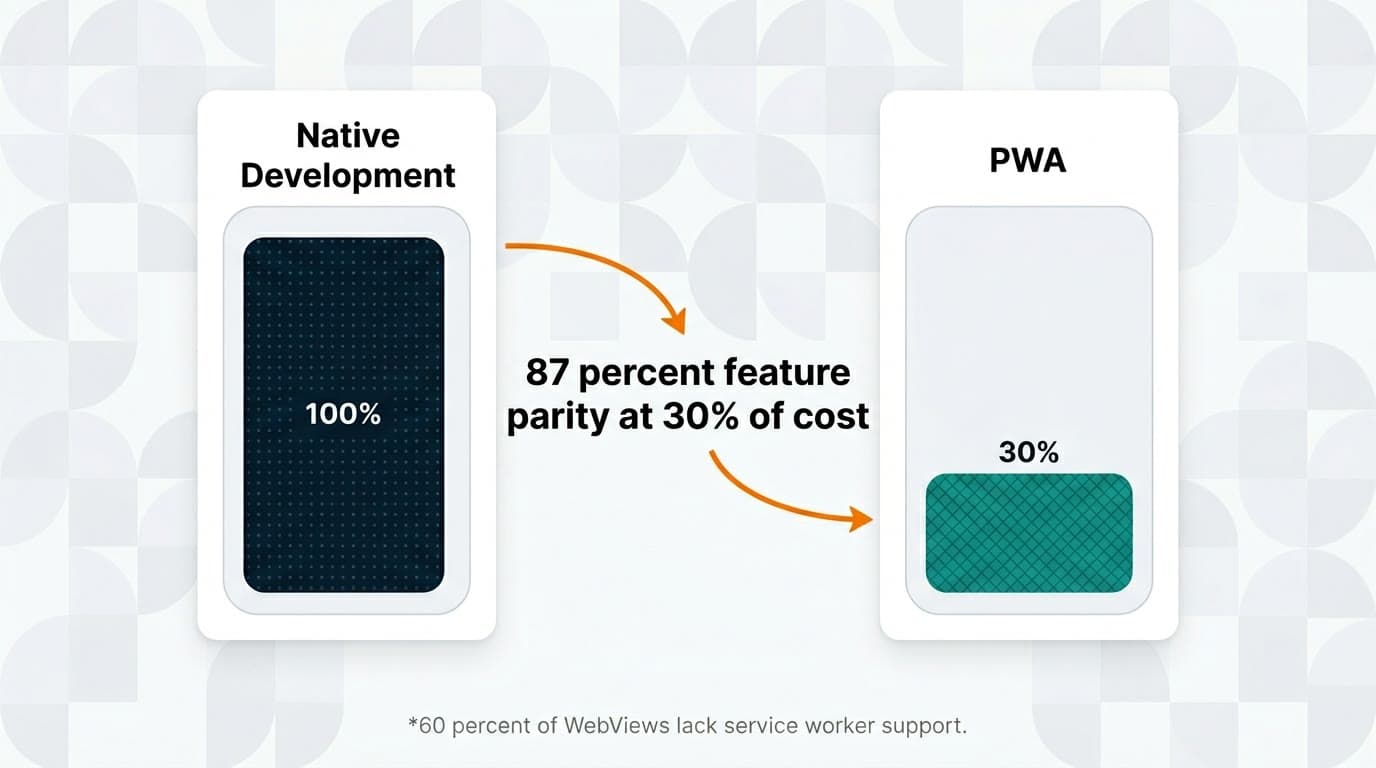
Progressive web app development offers a promising alternative by delivering near-native mobile capabilities through standard web technologies. For organisations looking to manage web app development costs, building a single responsive progressive web app can be far more efficient than maintaining separate codebases. This pathway often delivers up to 87% feature parity with native systems at roughly 30% of the cost.
Despite these benefits, cross-platform claims frequently encounter significant implementation hurdles. Research indicates that 60% of popular Web Views, which are the browser components embedded inside hybrid mobile containers, lack service worker support. This limitation undermines key offline features and background sync capabilities, creating a frustrating performance gap for users.
The Development Expectation Baseline
Modern web app development has evolved to treat solid DevOps and continuous integration and continuous delivery pipelines as baseline expectations. Automated testing, containerised deployment, and structured staging environments are no longer optional extras reserved for enterprise budgets. They keep today's launch from becoming tomorrow's maintenance problem.
Platforms such as Vercel and Railway have abstracted much of this infrastructure complexity, allowing smaller teams to deploy code with high velocity. However, this ease of deployment also means that pipeline configuration and automated quality gates must be managed directly from day one. Ensuring that these systems are established early is a key hallmark of professional web application developers.
Section 02: Architecture Patterns
Architecture is not the first decision most projects face. It is the first decision that is expensive to reverse. When a project commits to a rendering architecture or an application structure, changing it later costs significantly more than choosing it correctly the first time.
The four dominant patterns in 2026 are Single Page Application (SPA), Multi-Page Application (MPA), Server-Side Rendering (SSR), and Static Site Generation (SSG). Each pattern represents a distinct set of trade-offs. No single pattern is correct for every project.
SPA: The Default That Earned Its Position
A Single Page Application loads once. JavaScript handles subsequent interactions. Navigation does not trigger full page reloads.
The user experience feels app-like because client-side routing handles navigation dynamically. This makes SPAs highly suitable for applications where complex interactive behaviour dominates, such as dashboards, admin panels, and software-as-a-service platforms.
The primary limitation is the initial load phase. A large JavaScript bundle must be downloaded and parsed before the application becomes interactive. Consequently, React applications that ship substantial initial payloads often perform poorly on mid-range mobile devices.
This performance failure is frequently invisible to developers working on high-spec desktop hardware with stable fibre connections. Furthermore, counter-witness data identifies the database layer as the primary bottleneck in 60% of scalability failures, ahead of client-side rendering. Implementing an SPA architecture does nothing to resolve those backend database constraints.
MPA: The Pattern That Persists
A Multi-Page Application requests a new page from the server for every navigation event, returning a fully rendered HTML document. Although this represents the traditional web architecture, it remains highly relevant in modern systems. Its structural simplicity ensures reliable rendering without the overhead of client-side routing.
MPAs are exceptionally suited to applications where content delivery and information retrieval are the primary functions. They are the standard choice for public portals, directory sites, and platforms where search engine visibility is paramount. This pattern ensures that a diverse audience accessing the site from varying devices receives content instantly.
The primary trade-off of this traditional pattern is interactive responsiveness. Complex user interfaces built as MPAs require frequent round-trips to the server to update state. Achieving the smooth transitions typical of modern interfaces requires significant additional engineering effort under this model.
SSR: Server-Side Rendering
Server-Side Rendering generates the initial page HTML on the server before transmitting it to the browser. This allows users to view meaningful content immediately, prior to the download and execution of the client-side JavaScript bundle. Consequently, this model directly addresses the slow initial load times associated with traditional SPAs.
By serving pre-rendered HTML, this approach delivers critical content to the user much faster. Metric measurements show that Largest Contentful Paint improves because the browser displays elements without waiting for complex script parsing.
Next.js integrated SSR into the React ecosystem, popularising a hybrid model that balances server and client execution. Indeed, the framework grew from approximately 3,097 active domains in 2019 to over 246,000 in April 2025. This rapid trajectory reflects a strong market demand for immediate content delivery coupled with interactive client-side capabilities.
However, server-side rendering is not a cost-free optimisation, as it introduces substantial architectural complexity and higher hosting overheads. Teams that adopt this pattern without evaluating their operational capabilities often experience worse performance than a standard SPA would have yielded. Proper server provisioning and caching strategies are essential to prevent cost escalation.
SSG: Static Generation
Static Site Generation pre-builds entire web pages during the compilation phase, outputting flat files to a content delivery network. Because the hosting server requires no runtime computation, this pattern represents the fastest possible delivery model for web assets. It virtually eliminates server-side latency for end users.
This method is highly suitable for content that changes infrequently, such as documentation hubs, marketing websites, and corporate blogs. The structural limitation of this approach is obvious, as dynamic or highly personalised user data cannot easily be compiled statically. For real-time applications, a pure static model remains unfeasible.
In these architectures, compilation duration represents the primary technical constraint. The build times of static architectures scale linearly with content volume, meaning large platforms can require over ten minutes to deploy updates. For digital products that require rapid, continuous updates, this deployment delay introduces a tangible operational cost.
The Hybrid Reality
A comprehensive four-witness synthesis reveals that a hybrid architecture combining server-side rendering with client-side hydration outperforms pure SPA or pure SSR configurations in 85% of analysed scenarios. Under this model, the server delivers a pre-rendered initial page shell, and the client-side JavaScript subsequently takes over for all dynamic interactions. This approach combines the strengths of both architectural patterns, applied selectively at the individual component level.
Next.js successfully operationalised this hybrid model for mainstream enterprise development. Its rise is the primary reason server-side patterns have regained significant developer mindshare after a decade of single-page dominance.
The architectural selection should follow specific product requirements. Developer preference is a poor guide. Systems that require strong search engine visibility and rapid initial loading should lean toward server-side or hybrid rendering patterns. Conversely, highly secure, authenticated dashboard environments with interactive audiences remain well served by standard SPA architectures.
Section 03: Frontend Technology Selection
Frontend framework choice represents a significant source of decision anxiety for engineering leaders who are often inundated with conflicting advice. Forums comparing React and Vue accumulate hundreds of thousands of views, yet this noise rarely translates into actionable clarity. The evidence points in a highly consistent direction: team fit is the strongest predictor of project outcome.
React's market dominance does not make it correct for every engineering department. Similarly, high developer satisfaction ratings do not override the practical value of existing team expertise. The core question is which framework suits the engineers who maintain it.
React
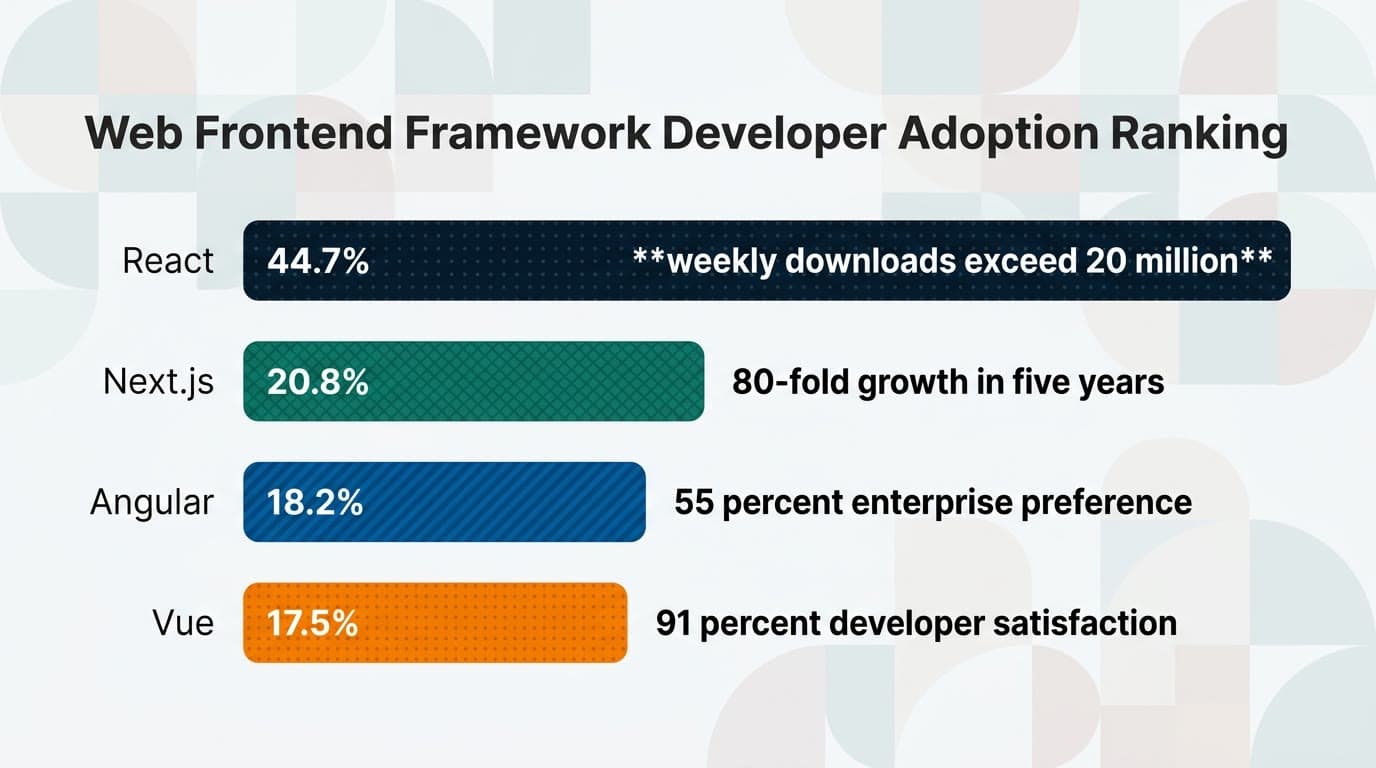
React holds the largest installed base in modern web application development, backed by substantial empirical usage. Weekly npm downloads consistently exceed 20 million, whilst historical data from npm-stat indicates over 2.6 billion cumulative downloads. This extensive adoption provides teams with a massive talent pool and a mature ecosystem of pre-built libraries.
However, this popularity introduces specific structural trade-offs. Because React imposes minimal organisational constraints, engineering teams must establish strict internal conventions to prevent codebase fragmentation. Without these self-imposed standards, projects often accumulate technical debt that complicates long-term maintenance.
For complex state management, research indicates React handles heavy data flows approximately 30% more efficiently than Vue at scale. This performance delta becomes highly material for enterprise applications managing real-time data visualisations or extensive interactive forms. Consequently, the framework remains a highly viable choice for complex, state-heavy systems.
Vue
Vue consistently secures high rankings in developer satisfaction, often matching or exceeding React in developer experience surveys. This sentiment is largely driven by its accessible learning curve, which allows generalist developers to become productive more rapidly. For organisations lacking dedicated frontend specialists, this accelerated onboarding offers a distinct commercial advantage.
The framework captures approximately 45% of framework preference decisions within small and mid-sized businesses. Whilst Vue successfully powers enterprise platforms like GitLab, its satisfaction benefits are highly pronounced in smaller teams experiencing organic growth. It offers an elegant balance of structure and simplicity without the initial complexity overhead of larger alternatives.
The corresponding trade-off is the narrower depth of its third-party ecosystem compared to React. Engineering teams requiring highly specialised integrations may find fewer pre-built packages, forcing them to write custom implementations. This risk must be weighed against the initial productivity gains achieved during the early development phases.
Angular
Angular remains a highly stable choice for enterprise organisations with pre-existing investments in TypeScript. Although its raw adoption percentages are lower than React, its usage is concentrated within large engineering teams building long-term systems. The framework provides a highly opinionated, standardised architecture out of the box.
Built-in features such as dependency injection and integrated routing reduce the architectural decisions a team must negotiate. This rigid framework structure minimises code inconsistency, making it easier to manage large developer populations with varying levels of experience. Additionally, the strict TypeScript-first architecture removes a broad category of runtime errors.
The primary challenge of this comprehensive structure is a notoriously steep learning curve. The initial investment in training and onboarding is substantial, requiring significant patience from product stakeholders. However, this upfront cost typically pays dividends in system maintainability over multi-year software lifecycles.
Next.js
Next.js extends React with hybrid rendering capabilities, representing one of the fastest-growing frameworks in recent years. This growth reflects a widespread market demand for hybrid architectures that blend server-side rendering and static generation. By utilising this approach, teams can optimise performance page by page, with no single strategy forced across the entire application.
This hybrid rendering strategy outperforms pure single page applications in approximately 85% of measured scenarios. However, this performance comes at the expense of developer cognitive load. The framework introduces complex paradigms, such as server components and middleware, which can overcomplicate simpler web applications.
Svelte
Svelte shifts work to compile time by compiling code into highly optimised, framework-free vanilla JavaScript. This approach yields exceptionally small bundle sizes and rapid runtime performance without the overhead of a virtual DOM. As a result, the framework has secured outstanding developer satisfaction scores for multiple consecutive years.
The primary trade-off of this compile-time approach is its smaller community footprint. Teams choosing Svelte must accept a narrower talent pool and fewer third-party integrations than those offered by more established ecosystems. It remains an excellent choice for performance-critical projects where bundle size is the primary constraint.
The Decision Filter
To bypass framework paralysis, decision-makers must run their options through a structured evaluation. This assessment should move past marketing claims to focus on the operational reality of the engineering team. The following three-question filter provides a practical framework for this evaluation:
> 1. Team Capability: Does the current team possess deep expertise in this framework, or will they face a costly learning curve?
> 2. Ecosystem Fit: Does the project require specialised third-party integrations that are only mature in specific ecosystems?
> 3. Lifecycle Alignment: Can the engineering team realistically maintain this codebase over its projected five-to-ten-year lifecycle?
Selecting a framework based solely on performance benchmarks or feature lists is a reliable recipe for technical debt. A satisfaction advantage quickly disappears when an experienced React team abandons their collective knowledge to chase Vue. Conversely, an extensive ecosystem becomes a liability for a small team that lacks the headcount to govern it.
Every major frontend framework has successfully powered complex web applications at global scale. Likewise, every framework has been the foundation of project failures when misaligned with team capabilities. The priority is to choose the tool that the engineering team can execute efficiently.
Section 04: Backend and API Design
The backend is where web applications fail at scale. The frontend is what users see, but the backend determines whether the application holds when load increases, data grows, or integrations multiply.
Backend architecture choices are expensive to reverse. API design decisions constrain every subsequent decision in an application's lifecycle, meaning that understanding these trade-offs before committing is essential.
Node.js
Node.js carries approximately 40% of the server-side market share. Full-stack JavaScript teams utilise it to avoid switching languages between the frontend and backend. This structural consistency provides measurable productivity gains during cross-functional feature delivery.
The npm ecosystem provides pre-built packages for almost every typical backend requirement, including authentication, database drivers, and integration utilities. This library depth significantly reduces initial setup times for standard architectural components. However, dependency vulnerability management becomes a critical operational overhead as the codebase grows.
The primary architectural limitation remains concurrency, as Node.js runs on a single-threaded event loop. Consequently, applications with heavy CPU-bound computation do not benefit from this model because the event loop blocks during intense processing. For platforms handling complex, real-time data transformations at scale, this represents a significant structural constraint.
Node.js excels at I/O-bound workloads, such as handling network requests, database operations, and file system access. Applications that spend the majority of their execution cycle waiting for external resources perform highly efficiently under this event-driven architecture.
.NET
The .NET ecosystem primarily serves enterprise organisations with established Microsoft infrastructures. Active Directory integration, Windows Server compatibility, and native SQL Server connectivity require significantly less engineering friction for teams already operating within this ecosystem.
The framework is highly mature, offering strict type safety and a comprehensive standard library that reduces reliance on third-party packages. This built-in robustness simplifies long-term maintenance and enhances overall security compliance.
Performance remains highly competitive, allowing .NET to handle concurrent requests and intensive computational tasks with high efficiency. The Common Language Runtime provides native low-level optimisations that single-threaded environments cannot match for CPU-bound operations.
Although modern .NET runs effectively on Linux, legacy dependencies can still bind systems to Windows Server environments. Organisations with cloud-native, cross-platform requirements must evaluate whether these historical platform associations introduce unnecessary operational complexity.
Python
Python occupies a distinct position in web application development, particularly for data-intensive systems and machine learning integrations. It is often the default choice for organisations where the engineering team possesses established data science expertise.
Django and Flask span the architectural spectrum from an opinionated, batteries-included framework to a minimal micro-framework. This choice represents a strategic decision between rigid convention and total architectural freedom. Django enforces a structured, highly secure default environment, whereas Flask offers maximum customisation for bespoke API designs.
The primary structural constraint is the Global Interpreter Lock, which limits true multi-threaded parallelism on a single process. While Python handles standard, I/O-bound concurrent workloads adequately, scaling CPU-intensive operations requires complex distributed task queues.
Python's primary business advantage is exceptional development velocity facilitated by highly expressive, readable syntax. By reducing boilerplate code, engineering teams can rapidly prototype and deploy complex business logic.
Go
Go was designed specifically by Google to address concurrent network services at massive scale. Goroutines and channels provide incredibly lightweight concurrency without the high memory overhead of traditional thread management. This makes the language exceptionally well-suited for high-throughput applications handling millions of simultaneous connections.
Because Go compiles directly to native machine code, it eliminates the runtime interpreter overhead associated with dynamic languages. This compilation process delivers rapid startup times and highly predictable memory consumption in production.
The trade-off lies in third-party library ecosystem depth compared to mature environments like Node.js. While Go's standard library covers networking, HTTP, and cryptography brilliantly, niche integrations may require custom engineering or reliance on smaller community packages.
Consequently, Go is ideal for high-concurrency architectures, including microservices, API gateways, and real-time streaming platforms. The native goroutine model processes these complex, multi-connection workloads with minimal hardware utilisation.
Building web applications with complex backend architectures requires a structured approach to scalability and long-term maintainability. Our web development services overview details how we plan, structure, and execute backend infrastructure to support evolving product lifecycles.
API Design: The Under-Specified Problem
API design is frequently the least specified component of modern backend architecture. Empirical research indicates that all analysed REST APIs contained at least one structural anti-pattern, including high-profile systems like Dropbox and Twitter.
In approximately 45% of public APIs, HTTP status code usage is implemented incorrectly. This points to a persistent, widespread gap between theoretic REST design specifications and actual deployment practices.
Consistent naming conventions were rated as the highest-priority design rule by 92% of industry experts in a comprehensive Delphi study. Developers and API consumers care deeply about predictable resource URI design. Consequently, investing in clean naming standards yields substantial dividends in developer integration speed and system maintainability.
Concerningly, OAuth API misuse accounts for 45% of all documented web application vulnerabilities in modern single-page architectures. This exposure typically stems from integration complexity and developer implementation errors. The protocol itself is not the weak point.
The Realistic Cost Picture
Web application backend costs range from approximately £2,500 for basic configurations to over £200,000 for complex enterprise-grade systems. This wide pricing variance is not a symptom of market dysfunction. It reflects varying operational complexity and performance requirements.
Backend-as-a-Service platforms like Firebase, Supabase, and AWS Amplify can reduce initial backend development cycles substantially. While their consumption pricing models remain highly predictable at a smaller scale, organisations frequently face vendor lock-in and sudden cost escalation as user adoption grows.
Serverless architectures deliver approximately 40% faster development cycles for variable or unpredictable workloads. However, cold-start latency ranges from 100ms to over two seconds depending on the chosen programming language runtime. For applications requiring consistent, low-latency responses, these serverless initialisation delays represent a significant production concern.
Architectural backend decisions made during the initiation phase closely constrain all subsequent product choices. Reversing a core database or framework selection after production deployment typically takes months of remediation work. Technical decision-makers must therefore evaluate these foundational options with rigorous foresight and objective evidence.
Section 05: Accessibility and Inclusivity
Accessibility represents more than a compliance checklist. It is the fundamental measure of whether a digital product functions for every user who requires its services. When designed correctly, inclusive engineering ensures that no user segment is systematically excluded.
In the United Kingdom, the Equality Act 2010 legally governs web applications that provide services to the public. Regulatory bodies and courts consistently apply the WCAG 2.1 Level AA guidelines as the benchmark for compliance. This standard represents the established legal interpretation of reasonable adjustment requirements for modern digital products.
The public record of enforcement actions shows that ignoring these standards carries substantial legal and financial risk. Consequently, compliance should be treated as a baseline engineering requirement.
The commercial case for inclusive design is as compelling as the legal mandate. Digital products that prioritise accessibility inherently provide a superior user experience for the wider population. For example, structured keyboard navigation increases transaction speed for power users, while high colour contrast assists individuals operating in bright environments.
Similarly, captioned video content remains vital for users in sound-sensitive settings. These scenarios are not niche edge cases but represent normal, daily usage patterns across diverse environments.
The Four Principles of WCAG
The WCAG 2.1 guidelines are structured around four core principles, with each underlying criterion serving as a specific, testable engineering requirement. The first principle, perceivability, dictates that information must be presented in formats that users can readily consume. This requires the implementation of text alternatives for non-text content, high-contrast visual elements, and accurate video captions.
Operability demands that users must be capable of interacting with all interface components without exception. Developers must ensure complete keyboard navigation, eliminate restrictive time limits, and include skip links to bypass repetitive header blocks. Avoiding rapid visual flashing is also critical to prevent adverse physical reactions.
Understandability requires that both the copy and the operational interface remain predictable and readable. This is achieved through consistent navigation patterns, programmatic language declarations for screen readers, and descriptive error messages that guide recovery.
Finally, robustness ensures that the web application remains compatible with a wide range of assistive technologies. Teams must write valid, semantic HTML and avoid misusing ARIA roles as quick fixes for poorly structured code. Rigorous manual testing with physical screen readers is essential to validate this compatibility.
The Automated Testing Gap
Relying solely on automated software tools introduces a dangerous blind spot in your quality assurance pipeline. Empirical data demonstrates that automated scanners identify only 57% to 60% of actual WCAG violations. The remaining 40% to 43% of accessibility defects can only be uncovered through manual evaluation using real assistive technologies.
A clean report from an automated scanner does not indicate a fully accessible web application. Instead, it merely proves that the system has passed basic, programmatic syntax checks. True compliance requires a structured testing sequence that combines automated and manual verification.
The optimal workflow begins with an automated scan using platforms such as Axe, WAVE, or Lighthouse to resolve low-hanging structural errors. Developers must then conduct manual keyboard-only navigation tests to verify focus management. Finally, the team should execute screen reader evaluations utilising VoiceOver on macOS and TalkBack on Android.
For web applications operating in regulated UK sectors such as health, finance, or education, an independent expert audit before launch is mandatory. Skipping this step exposes the organisation to severe compliance liabilities and reputational damage.
The Economic Case for Early Integration
Integrating inclusive practices during the initial design phase dramatically reduces overall development costs compared to retrofitting code later. For instance, correcting an unlabelled form field takes minutes during active development but requires hours once the ticket has bypassed QA. Similarly, fixing keyboard navigation early is often a simple CSS or semantic adjustment, whereas post-launch remediation frequently demands extensive JavaScript rewrites.
The primary financial driver of late-stage accessibility work is the compounding retesting multiplier. Every design-phase defect that slips through to staging is multiplied by the administrative cost of cycling through QA, development, and re-evaluation. Addressing these requirements proactively is not a cost centre; it is a highly effective budget optimisation strategy.
Performance as an Accessibility Pillar
Performance is directly linked to the user experience of individuals with disabilities. Industry data confirms that 53% of mobile users abandon web pages that take longer than three seconds to load. This friction is compounded for users relying on screen readers or browser magnifiers, which require substantial local system resources.
Optimising a system to meet the Core Web Vitals thresholds provides the processing headroom that modern assistive software needs to execute. Architectural decisions that target high speed, minimal layout shift, and immediate interactive responsiveness naturally support assistive technologies. Consequently, performance engineering and inclusive design must be handled as unified development goals.
Section 06: Security and Compliance
The security concern that organisations describe is highly specific, often centred on the fear of shipping vulnerabilities that attackers will exploit. This is less about whether modern frameworks themselves are insecure and more about whether development teams implement them with sufficient rigour. Empirical evidence confirms that this structural anxiety is entirely justified.
Client-side vulnerabilities in Single Page Applications (SPAs) increased by 45% over a four-year period, according to security research. Furthermore, OAuth implementation errors account for 45% of all documented web application vulnerabilities despite its position as a standard protocol. The underlying issue is not the inherent security of the frameworks but the lack of secure-by-default configurations out of the box.
In addition, 70% of database security incidents result from access control misconfigurations, with sophisticated injection attacks a smaller share. This shift moves the focus of database protection away from the query layer and directly onto the permission model layer. Industry data indicates that structural oversight at the architectural level remains the primary driver of these breaches.
What the Evidence Shows
No major frontend framework offers comprehensive security defaults, meaning React, Vue, and Angular all require explicit configuration to establish a secure environment. While automated security testing successfully detects 65% of vulnerabilities pre-production, the remaining 35% still bypass these tools to reach production. This means automated scans must be paired with manual intervention.
Relying solely on automated tools ignores the human element of architectural design. To bridge this gap, structured threat modelling, rigorous manual reviews, and adherence to secure coding standards are non-negotiable requirements. These practices ensure flaws are mitigated before they become active threats in live environments.
Modern npm dependency trees introduce complex attack surfaces that development teams frequently overlook during the build phase. Many popular open-source packages contain nested, transitive dependencies that harbour known vulnerabilities. While automated tools like Snyk and npm audit are useful, they cannot identify undocumented or zero-day security gaps.
Targeted training reduces API vulnerabilities by 40%, yet a significant knowledge gap persists across engineering departments. The divide between what developers assume to be secure and what attackers actively exploit requires systematic engineering controls. Relying on developer intent alone is an insufficient strategy for protecting sensitive client data.
UK Legal Compliance: What Is Actually Required
Web applications serving users within the United Kingdom must comply with UK GDPR and the updated Data (Use and Access) Act 2025. Non-compliance carries severe financial risk, with maximum penalties reaching £17.5 million or 4% of global annual turnover, whichever is higher. These regulatory standards are actively enforced by the Information Commissioner's Office through public action.
To ensure compliance, applications must obtain explicit consent for any data processing that extends beyond core service delivery. Organisations must state the precise purpose of data collection at the point of capture while enabling user rights like data portability and erasure. Formal Data Processing Agreements are also mandatory for any third-party vendor handling personal data.
These regulations are strict legal mandates backed by documented enforcement. Failure to embed these compliance rules into the core architecture of an application introduces severe operational and financial liabilities.
WCAG 2.1: The Accessibility Requirement
WCAG 2.1 Level AA is a legal mandate for public-facing digital platforms. In the United Kingdom, the Equality Act 2010 covers websites providing services to the public, setting a clear legal expectation. Courts and regulatory bodies consistently use WCAG 2.1 Level AA as the baseline standard to evaluate digital accessibility.
The framework rests on four core principles: perceivability, operability, understandability, and robustness. While automated accessibility tools are highly efficient, they typically identify only 57% to 60% of compliance issues. Consequently, manual expert reviews are required to ensure full coverage and genuine usability.
Developing accessible web software is straightforward when integrated from the initial design phases. It requires clean semantic HTML, comprehensive keyboard navigation, and precise colour contrast ratios. These are fundamental engineering standards.
What to Do
Security-by-design is not a static framework configuration but an active engineering practice maintained across the lifecycle. Conducting threat modelling at the early design phase allows teams to map data flows and identify trust boundaries efficiently. This proactive architectural review costs significantly less than attempting to remediate structural vulnerabilities after a production breach.
A resilient, modern security strategy requires an integrated suite of protocols and automated tools. Prior to launching, teams must execute an OWASP core vulnerability review alongside continuous automated scanning and manual logic verification. Furthermore, securing OAuth implementations requires rigid attention to token storage, redirect URI validation, and scope minimisation.
The essential checklist for digital accessibility is highly straightforward and easily integrated. Teams must implement logical semantic headings, full keyboard accessibility, and a minimum colour contrast ratio of 4.5:1 for standard text. Ensuring proper alt text and avoiding rapid screen flashes completes the baseline Level AA criteria.
Security and accessibility cannot be treated as superficial configuration steps applied at the conclusion of a project. Instead, they are fundamental architectural decisions that must be engineered into the product from day one.
Section 07: Performance and Core Web Vitals
Your users leave after 3 seconds of delay. This commercial reality remains the fundamental performance benchmark until your technical architecture actively shifts it.
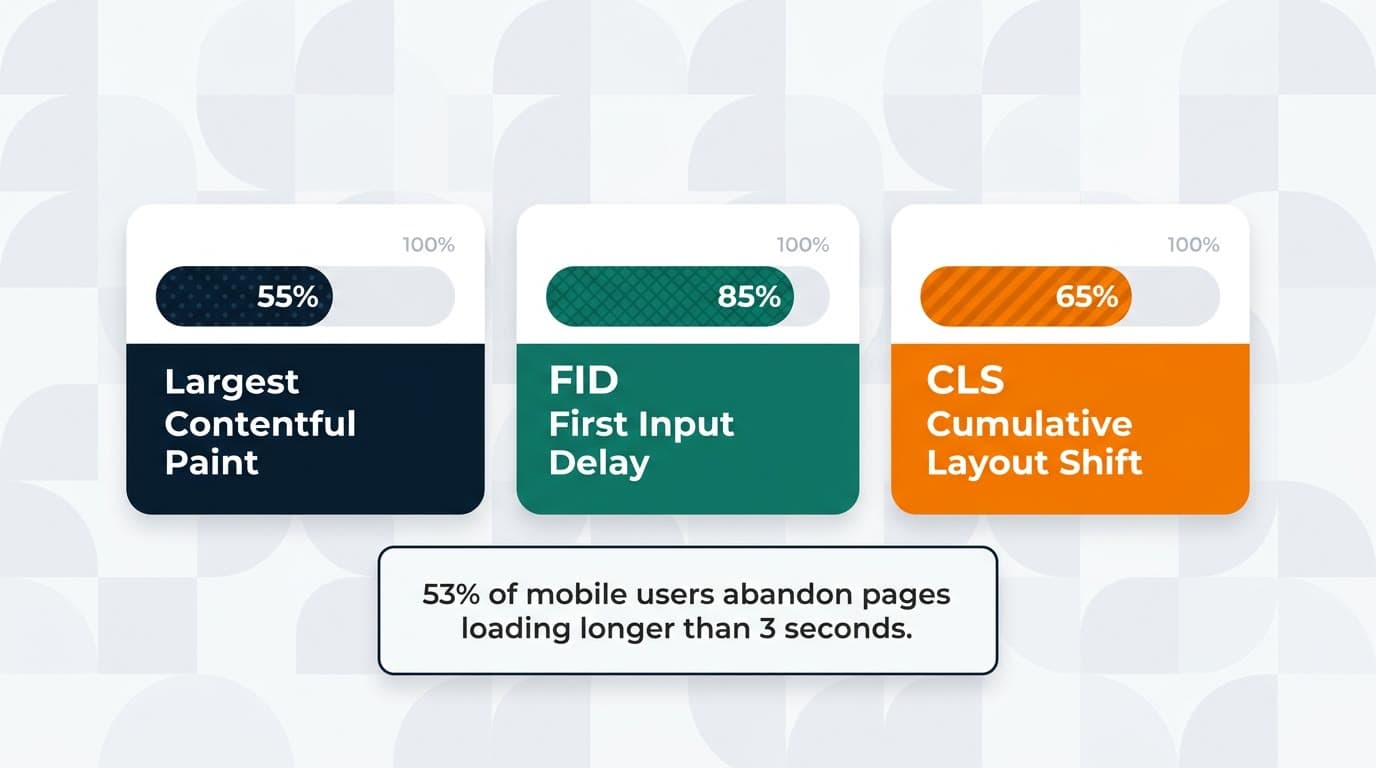
Google assesses application quality using three Core Web Vitals to quantify user experience. Largest Contentful Paint measures loading performance, whilst Cumulative Layout Shift monitors visual stability during page loads. Interaction to Next Paint evaluates how rapidly a page responds to user inputs.
Each metric has a firm threshold: Largest Contentful Paint under 2.5 seconds and Cumulative Layout Shift under 0.1. Interaction to Next Paint must also remain below 200 milliseconds to prevent noticeable interface lag.
These benchmarks are search ranking signals. Consequently, applications that repeatedly miss these thresholds suffer documented declines in organic search visibility. This direct correlation is thoroughly established within public search engine documentation.
A classic benchmark indicates that 53% of mobile users abandon web pages that require more than 3 seconds to load. Whilst some teams debate the universal applicability of this figure, it is a documented behavioural benchmark. Applications optimised to load in under 1.8 seconds consistently retain users who would otherwise exit.
Conversely, systems requiring 4.1 seconds or longer suffer severe drop-off rates. This massive discrepancy in user retention is decided by architectural planning at the absolute beginning of the development lifecycle.
What the Evidence Shows
A systematic analysis of 127 research papers reveals that server-side rendering combined with client-side rendering outperforms pure client-side alternatives in 85% of measured scenarios. This evidence does not imply that hybrid architectures are universally appropriate for every build. Instead, it demonstrates that assuming client-side rendering is inherently simpler or faster fails when confronted with empirical performance data.
Code splitting routinely decreases initial JavaScript bundle sizes by 40% to 60% within complex single page applications. This measurable reduction functions by serving only the precise assets required for the immediate view. The application dynamically fetches subsequent modules as the user navigates, achieving rapid initial renders without restricting overall feature depth.
Deploying content delivery networks and edge caching mechanisms reduces global latency by 50% to 80% for geographically distributed user bases. These significant improvements are validated across multiple production-scale benchmarks. The underlying engineering principle relies on caching static and dynamic resources as physically close to the end user as possible.
PWA Performance: The Service Worker Gap
Progressive web apps deliver native-like experiences including offline capabilities, background notifications, and direct home screen installation. These platforms typically require only 30% of the financial investment associated with native mobile development. Whilst marketing claims suggest up to 87% feature parity with native systems, the practical implementation contains a significant caveat.
This performance gap is deeply systemic, as research indicates 60% of widely deployed Web Views lack comprehensive service worker support. These embedded browser engines are responsible for rendering web content inside social media apps and standard mobile applications. When mobile visitors open your progressive web app through these internal web views, critical capabilities like offline access often degrade or fail entirely.
This technical limitation is highly asymmetrical across different platforms and modern browsers. Whilst desktop environments like Chrome, Edge, and Firefox offer excellent service worker compliance, iOS Safari remains historically more restrictive. Such extreme variance across Web View configurations fundamentally shifts the commercial viability of progressive web apps for mobile-first products.
Desktop audiences accessing your platform directly receive almost complete functional parity with traditional desktop software. Conversely, mobile users traversing in-app social media browsers are frequently downgraded to a standard, non-cached web page. Because the 87% parity metric assumes pure, standalone browser access, your actual user demographics must dictate your architectural commitment.
Strategic Performance Recommendations
Technical teams must establish precise performance budgets at the initial scoping phase, well before any post-launch optimisation. Diagnostic evaluations utilising open-source auditing tools such as web.dev/measure or pagespeed.web.dev should be integrated directly into continuous deployment pipelines. Meeting Core Web Vitals targets remains straightforward during clean-slate engineering, but becomes very difficult when performance is treated as a late-stage checklist.
Implementing hybrid rendering, strategic code splitting, and edge distribution networks should not be viewed as advanced or optional engineering. These represent baseline, industry-standard practices with highly documented positive outcomes. Incorporating these patterns into your foundational architecture supports long-term system health and user retention.
Section 08: Resolving Complexity Overwhelm
Complexity overwhelm represents a fundamentally different challenge to the quantifiable problems of framework selection or performance optimisation. Whilst architectural trade-offs yield to logical analysis, this form of anxiety stems from the perception that modern web development has become unnecessarily convoluted. It is a psychological response to toolchain saturation and rapid ecosystem evolution.
Toolchain fatigue, continuous framework churn, and decision paralysis from newly introduced options combine to exhaust engineering leaders. This section addresses that specific operational fatigue, offering structural strategies to navigate the noise. The goal is a rigorous, repeatable framework for managing complexity, since it cannot be eliminated entirely.
What Complexity Overwhelm Actually Feels Like
The primary challenge for technical leaders is rarely a lack of information. Past a point, additional data stops reducing decision anxiety. Consuming another comparison between React and Vue often expands the perceived risk instead of clarifying the path forward. This pattern signals cognitive overload, which needs a different kind of intervention.
Whilst an information deficit is solved by acquiring more data, cognitive overload can only be resolved by reducing the decision surface area. Cognitive science consistently demonstrates that decision quality degrades when working memory is saturated, irrespective of the calibre of information available. For web application projects, this saturation frequently causes decision-makers to lose confidence the more frameworks they evaluate.
This decline in confidence is not irrational behaviour on the part of the technical team. It is a highly predictable response to an ecosystem that is structurally biased towards overcomplicating initial technical reviews. To protect delivery timelines, organisations must actively limit the number of active variables under consideration.
The Threshold Commitment Approach
Dealing with this requires shifting focus away from finding a theoretically ideal framework. Instead, teams should sequence commitments so that reversible decisions are made early, whilst irreversible commitments are deferred. Delaying high-cost choices preserves flexibility and protects the early stages of development.
Reversible decisions include selecting build tools, choosing UI component libraries, or establishing state-management patterns. These options can be changed within a sprint or two without derailing the project timeline or destroying written code. Resolving these minor details quickly prevents the paralysis that occurs when every design choice is treated as equally critical.
Conversely, irreversible decisions, such as picking the core frontend framework or choosing a Backend-as-a-Service platform, carry compounding switching costs. The core framework choice quickly becomes locked in once the application is built around its specific architectural mental model. Delaying these heavy commitments until business requirements are thoroughly defined reduces the risk of long-term architectural debt.
The Three-Question Filter as Decision Surface Reduction
A structured three-question filter cannot eliminate the underlying complexity of the modern web. Distinct differences persist between React, Vue, and Angular, and these differences affect how teams approach long-term maintenance. The filter simply narrows the decision surface area by redirecting attention to internally controllable factors.
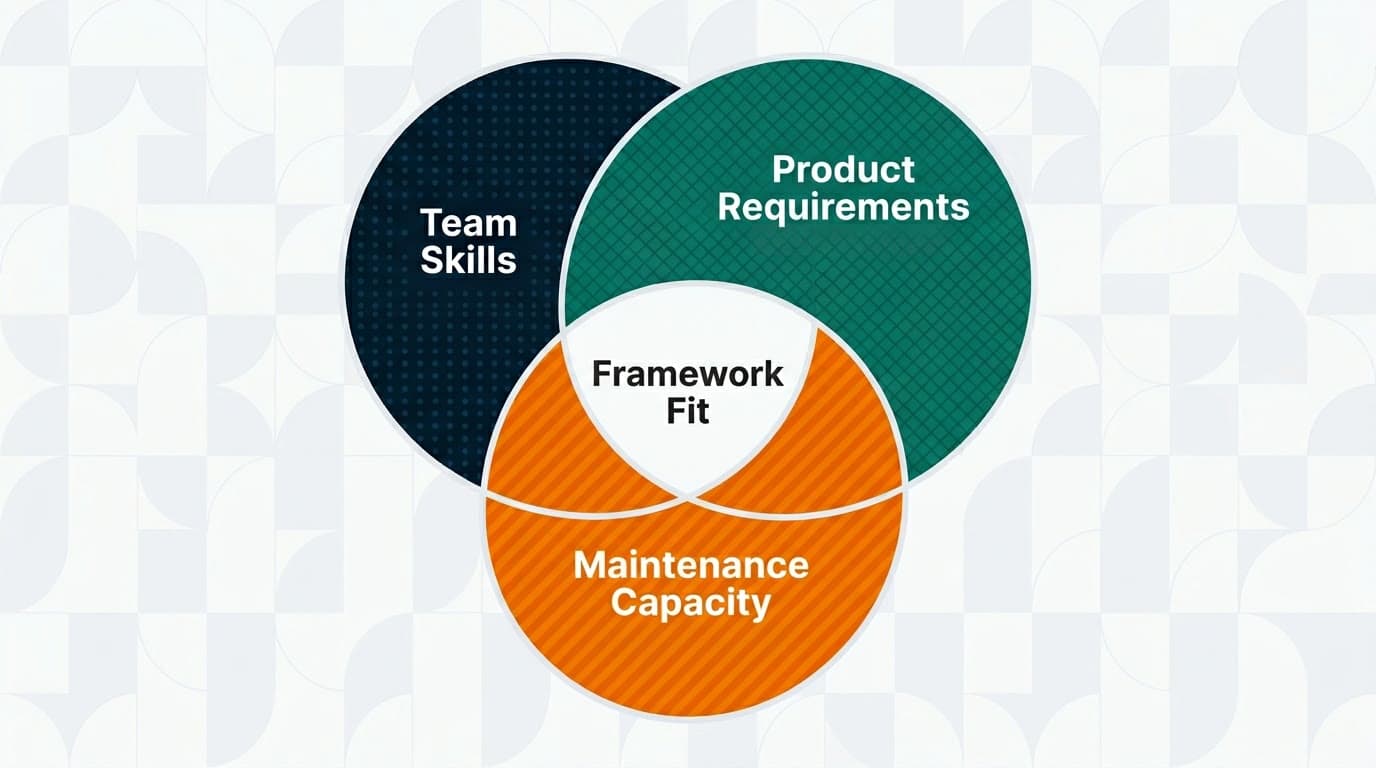
Leaders should evaluate choices against three pragmatic, internal constraints. This method filters out noise by focusing on historical team performance, real-world utility, and available operational resources.
> Does the development team currently possess the deep technical skills required to build and maintain this framework? What are the precise functional needs of the web application, excluding its theoretical future state? What is the realistic long-term maintenance capacity of the organisation?
These queries reveal the most compatible options for a specific context. Evaluating multiple stacks against dozens of theoretical features leads to immediate cognitive fatigue. Restricting the comparison to a pair of options filtered through these constraints dramatically improves clarity.
Framework Churn as a Specific Anxiety
A major source of fatigue is the persistent anxiety generated by new framework releases, even when an existing stack functions well. The rapid emergence of options like Qwik, Solid, and Astro can make older decisions feel prematurely obsolete. This feeling is a natural response to high-velocity community marketing, but it rarely reflects genuine commercial risk.
The launch of a new technology does not retroactively invalidate a sound architectural decision made yesterday. Choosing React in 2023 was not an error simply because alternative frameworks gained traction in subsequent years. Decisions must be judged against the specific team capabilities and project requirements present at the moment of commitment.
Pragmatic leaders ask whether their chosen framework remains fit for their current team and product, not whether a shinier alternative exists. Conflating ongoing operational fitness with a desire for the latest industry trend leads to unnecessary refactoring cycles. Keeping these questions distinct protects developers from unnecessary churn and keeps focus on user-facing value.
A Practitioner's Heuristic
The evidence compiled across this paper supports a simple heuristic that technical decision-makers can apply to bypass deep analytical paralysis. It shifts the primary metric of success from developer hype to long-term operational viability. This rule prioritises predictable maintenance over industry trend-chasing.
The framework most suited to your context is the one your engineering team can comfortably sustain for three years, whatever is currently dominating online forums. This approach gives your web app development a stable, predictable foundation.
This heuristic immediately shifts the core evaluation criteria from external community hype to internal team capability. Imposing a clear three-year horizon strips away the immediate anxiety of framework churn and grounds the choice in operational reality. It transforms a highly speculative decision into a manageable, testable hypothesis.
A three-year horizon reflects the typical lifecycle of an initial web application release before requiring substantial modernisation. It also matches average developer tenures, so the team that builds the application can successfully maintain it. The core principle is to evaluate frameworks against a predictable operational horizon and ignore volatile social media trends.
What This Section Does Not Resolve
This framework does not suggest that complexity in modern web development can be entirely eliminated. The web application ecosystem remains inherently complex because it must solve sophisticated architectural challenges. These challenges reflect real, unavoidable trade-offs that cannot be bypassed with simple management checklists.
The threshold commitment model and the three-question filter focus on reducing cognitive overhead. The objective is to limit the amount of information that decision-makers must actively hold in working memory. This is a more modest ambition than solving complexity, but a highly achievable path to product delivery.
PWA: Can I Avoid Building a Mobile App Separately?
The question of whether to build a native mobile app or adopt a progressive web app surfaces in almost every product cycle. Technical leaders frequently ask if they can skip iOS and Android development entirely without sacrificing user engagement. The core dilemma is whether a web-based alternative can truly replicate the experience of a downloaded store application.
The operational decision hinges on a single question: can a progressive web app serve as a direct, reliable substitute for a native application? This section examines that challenge through the lens of device compatibility and development economics.
What the 87% Figure Actually Means
A statistic frequently cited in progressive web app literature claims that these platforms deliver 87% feature parity with native applications. This parity is reportedly achieved at approximately 30% of the traditional development cost. While these figures are striking, they require careful contextual translation before committing resources.
Feature parity means that 87% of native capabilities are, in principle, accessible to a web app running in a fully supportive browser environment. However, this gap is not trivial, and its distribution across different platforms is highly uneven. For some products, the missing 13% of capabilities is completely irrelevant, whereas for others, it represents the entire core value proposition.
The critical point is that browser-environment limitations dictate whether this theoretical parity translates to real-world performance. Technical decision-makers must determine if the missing features are the precise reasons users would abandon the platform. Without this scrutiny, the 30% cost saving can quickly transform into a total loss of user engagement.
The Service Worker Gap: Which Contexts Are Affected
An essential limitation identified by Biørn-Hansen et al. reveals that approximately 60% of popular mobile Web Views lack full service worker support. Web Views are the embedded browser components powering the in-app browsers found inside platforms like Facebook, LinkedIn, and Slack. When users access your web application through these social or professional channels, vital progressive features can degrade or fail entirely.
This limitation is significant because service workers are the fundamental engine powering push notifications, background synchronisation, and offline capabilities. Without solid service worker support, the application reverts to a standard web page without background utility or offline access. Consequently, users get only a standard website experience.
The practical reality is that the 87% feature parity claim holds true only when users launch the application from a standalone browser window. It becomes highly unreliable when the application is opened within embedded in-app browsers, which represent the dominant entry point for mobile-first audiences. Choosing a progressive web app under these conditions risks alienating a massive segment of your target market.
When PWAs Can Genuinely Replace a Native App
Desktop-heavy user bases. For digital products where the primary user interaction occurs on desktop screens, progressive web apps provide almost complete functional equivalence. Desktop browsers such as Chrome, Edge, and Firefox offer mature, stable service worker support that ensures reliable performance.
Internal and enterprise applications. Organisations that control their hardware ecosystem through mobile device management systems can bypass traditional app store distribution entirely. In these managed environments, progressive web apps can be deployed instantly and updated without external approvals.
Products without app store discovery requirements. If your acquisition model does not depend on app store visibility and relies on direct search, referral links, or bookmarking, the traditional marketplace listing is unnecessary. In such scenarios, a well-optimised web experience removes the friction of downloading a native app.
When PWA Cannot Replace a Native App
App store presence as a commercial requirement. For consumer-facing products that depend on organic marketplace searches, progressive web apps fall short because they do not appear in standard mobile app stores. The platform algorithms usually prioritise native apps over web-based alternatives in search results. This visibility gap represents a structural barrier to user acquisition.
Push notification reliability. Although web apps can send notifications, iOS historically restricts and limits progressive web push support compared to native apps. If your user engagement model relies on high-frequency, time-sensitive alerts, native mobile development remains the only dependable route. This platform discrepancy introduces unacceptable risk for real-time applications.
Background processing limitations. Progressive web apps operate strictly within the active browser lifecycle, meaning that background processing halts once the user minimises the application. Native applications are required if your product needs persistent location tracking, continuous audio playback, or intensive background computation. This platform constraint directly impacts utility for active, on-the-go users.
Deep device hardware integration. Access to advanced hardware components like Bluetooth, near-field communication, depth cameras, and specialised sensors remains highly constrained on the web platform. Products requiring close interaction with physical devices will inevitably encounter technical barriers that web apps cannot overcome. This makes native platforms essential for internet-of-things and hardware-linked software.
The Practical Filter
Before committing to a progressive web app as a native replacement, technical leaders should apply a structured four-part filter. This evaluation separates immediate operational viability from long-term technical debt. The checklist forces an objective assessment of user patterns and device dependencies.
First, determine the primary access environment of your user base, distinguishing between standalone desktop browsers, standalone mobile browsers, and mobile in-app browsers. Second, evaluate whether an official app store presence is a non-negotiable commercial requirement for customer acquisition. If discovery relies heavily on these marketplaces, native remains necessary.
Third, assess whether the product demands reliable push notifications, background processing, or deep hardware integration such as Bluetooth or near-field communication. Finally, consider if your organisation controls the device environment through enterprise management. If these factors point to standalone desktop access with minimal hardware needs, a progressive web app is a viable replacement.
Conclusion
The global web app development market has matured into a £77.3 billion sector where raw technology is no longer the bottleneck. Yet, the gap between client expectations and final software deliverables remains as wide as ever. This disconnect has shifted from a technical limitation to a strategic decision-making deficit.
Modern development frameworks deliver exactly what they promise, offering measurable and consistent performance benchmarks out of the box. However, many organisations select their technology stack without calculating the compounded costs incurred at each subsequent stage of the product lifecycle. Resolving this decision-making gap is the true key to sustainable digital growth.
This analysis has systematically examined the structural trade-offs that technical decision-makers must navigate to avoid long-term architecture debt. By aligning framework capabilities with organisational realities, teams can transition from reactive maintenance to deliberate product evolution.
What the Evidence Shows
Empirical evidence points to a clear position: the decision-making gap in web application development is a framing problem. Decision-makers frequently treat framework selection as an isolated technical evaluation instead of a core business continuity decision. Projects do not falter because of framework limitations. They falter because teams fail to fully understand the operational commitments required by their chosen stack.
React maintains a dominant 65% market share because its extensive ecosystem and vast talent pool align well with the operational scale of many development teams. Conversely, Vue delivers high satisfaction by catering to smaller, agile teams that require rapid prototyping without the burden of legacy patterns. Enterprise-grade structures often turn to Angular to enforce strict architecture across distributed divisions.
These dynamics demonstrate that no single technology is universally superior. The optimal framework is simply the one that introduces the least friction into your specific workflow.
The three-question decision framework simplifies selection by replacing subjective debates with pragmatism. Teams must evaluate whether their engineers possess the necessary skills, if the product truly demands the framework's features, and if they can support the architecture for three years. This practical criteria filters out mismatched technologies before they can cause friction.
Rather than hunting for an elusive, theoretically ideal framework, successful long-term projects focus on operational alignment. Decades of deployment data show that sustainable products are built on practical organisational fit, not theoretical performance benchmarks.
Application performance is a foundational structural property determined before writing the first line of code. Hybrid rendering, intelligent code splitting, and content delivery network routing represent baseline engineering practices. These strategic interventions directly determine whether a system satisfies the strict performance expectations of modern users.
A web application that loads in under two seconds successfully retains users who would otherwise abandon slow interfaces. With research showing that 53% of mobile visitors leave pages taking longer than three seconds, initial rendering speed is a commercial necessity. The underlying architecture dictates this business outcome directly.
Security is an active, continuous practice integrated throughout the entire software lifecycle. A measured 45% rise in single page application vulnerabilities alongside widespread OAuth misuse shows that security failures are process failures. Modern frameworks do not inherently generate vulnerable systems, but teams that bypass security-by-design principles often do.
Strong defensive engineering must be treated as a structural architectural requirement. A final check during quality assurance is too late. Protecting user data requires a proactive, systematic approach embedded into every development sprint.
Dimensions of Operational and Technical Risk
Security: Client-side vulnerabilities in single page applications have risen by 45%, while OAuth misuse accounts for nearly half of all documented vulnerabilities. This trend confirms that the primary threat is not framework insecurity, but rather structural decisions made without sufficient risk awareness. Implementing secure web app development protocols remains a highly effective way to protect user data.
Performance: User retention is heavily dependent on execution speed, with 53% of mobile users abandoning systems that take longer than three seconds to load. Utilising a hybrid rendering architecture outperforms pure client-side rendering in 85% of scenarios. Furthermore, systematic code splitting helps teams reduce initial bundle sizes by 40% to 60%.
Cost: The financial scope of web app development cost ranges from £5,000 for simple builds up to £250,000 or more for enterprise-grade systems. A typical mid-size web application averages between £25,000 and £150,000. Understanding the specific design and functional complexity drivers behind these figures prevents unexpected budget escalations.
Progressive Web Apps (PWA): Progressive web apps offer a highly efficient alternative by achieving up to 87% feature parity with native applications at only 30% of the build cost. However, because 60% of popular mobile Web Views lack service worker support, cross-platform functionality can be compromised. This makes progressive web app development ideal for standalone browser access, but less suitable when app store distribution is a business requirement.
Navigating the Decision Gap
To bridge the decision gap, technical decision-makers must ground their technology choices in verifiable empirical evidence and treat vendor marketing with caution. Using the three-question evaluation filter prior to committing resources ensures long-term framework compatibility. Teams should establish performance baselines during initial design and rigorously test them at every subsequent phase.
Integrating security-by-design from day one mitigates client-side vulnerabilities before they can be exploited. Similarly, designing systems to meet WCAG 2.1 Level AA compliance ensures broad digital accessibility while simultaneously improving search visibility and core search engine rankings.
Choosing a path in web app development is an ongoing commitment to maintenance, scalability, and user trust. By adopting a collaborative, evidence-driven approach, organisations can confidently deliver applications that yield lasting business value and positive societal impact.
FAQ
Which framework should I choose among React, Vue, or Angular?
The evidence does not support a categorical choice, as framework selection depends heavily on existing team capabilities. React commands a 65 per cent market share with an expansive talent pool, while Vue holds high developer satisfaction scores and Angular provides structured patterns for enterprise environments. Ultimately, the framework that aligns with your team's current expertise will determine project success far more than minor benchmark variations.
Why do quotes for web application development vary so widely, ranging from £5,000 to £250,000?
This pricing spectrum reflects the structural complexity and depth of the application rather than market inconsistency. Mid-sized applications with authentication, custom APIs, and deployment pipelines typically average £25,000 to £150,000, whereas enterprise platforms requiring regulatory compliance and advanced security exceed £150,000. Low-cost estimates often exclude essential components such as automated testing, security hardening, and ongoing maintenance support.
How do I know if my web application is secure?
Automated security scans are valuable but only capture approximately 65 per cent of pre-production vulnerabilities, leaving remaining risks to be handled manually. Standard frameworks do not provide sufficient protection by default, meaning teams must explicitly configure secure architectures. A robust defence combines the OWASP guidelines, regular dependency audits, and rigorous verification of authentication and token storage mechanisms.
Will a Progressive Web App eliminate the need for native mobile applications?
A progressive web app provides high feature parity but cannot fully replace native software for every product. This limitation exists because 60 per cent of in-app mobile browsers lack service worker support, which disrupts background tasks. If your users require direct app store access, deep hardware integration, or continuous notifications, a native build remains necessary.
My web app loads slowly on mobile. What should I do?
First, run diagnostics to evaluate your Core Web Vitals thresholds and isolate rendering bottlenecks. For performance improvements, implementing a hybrid rendering model outperforms standard single page architectures in 85 per cent of analysed scenarios. You can also apply code splitting to reduce initial payload sizes by 40 to 60 per cent, alongside serving assets via a global content delivery network.
How do I reduce complexity overwhelm when choosing a web app stack?
Manage cognitive fatigue by prioritising flexible, reversible decisions before committing to rigid architectural choices. Apply a three-part filter that assesses developer skills, immediate product requirements, and long-term maintenance capacity. The optimal stack is not the heavily discussed option online, but the one your engineering team can reliably maintain over a three-year horizon.
About the Author
As Marketing Manager for the studio, Hamish Kerry has spent six years shaping how complex digital products are positioned, launched, and understood. He brings more than eight years of technology industry experience to the team, focusing heavily on accessible design and user-centred development. His work is driven by a commitment to delivering tangible, positive impact to end users.
His professional interests span artificial intelligence, web and application development, and the long-term societal effects of emerging systems. When not planning strategic campaigns, he monitors how modern technology can be harnessed to drive positive, equitable change. Readers can connect with Hamish Kerry on LinkedIn to discuss emerging digital strategies.
Research Methodology
This paper was constructed from academic and industry research gathered across five distinct, systematic phases. Each piece of evidence was cleaned, catalogued, and indexed within a Pinecone vector database to ensure absolute verifiability. This structured foundation supports every technical assessment and cost framework presented throughout the study.
Phase A established the foundational context by drawing on university curricula, reference works, and citation networks across multiple web search permutations. These baseline insights were further refined using structured historical technical datasets. This process allowed the research team to map out long-term technological trajectories.
Phase B focused on scholarly validation by querying databases such as OpenAlex, CORE, arXiv, Wikidata, Wikipedia, and Semantic Scholar. A specialised swarming layer of five autonomous agents executed targeted query permutations to extract high-integrity academic findings. The gathered papers were deeply analysed and formatted prior to vector ingestion.
Phase C established a rigorous four-witness synthesis to cross-validate claims across disparate datasets, minimising vendor bias. Phase D captured genuine practitioner sentiment by analysing discussions on platforms including Reddit, Quora, and StackExchange. These engineering forums were searched across multiple technical angles to isolate real-world friction points and deployment anxieties.
Phase E integrated grey literature, corporate reports, counter-witness analyses, and official government datasets to provide commercial context. Every source underwent deep enrichment to structure its metadata before ingestion into the database. During the drafting process, the authors grounded each section by querying the dedicated vector namespace to ensure total alignment with the source material.
References
This bibliography compiles the empirical studies, market analyses, and technical standards cited throughout this paper. Each reference supports the performance benchmarks, cost evaluations, and framework analyses detailed in the preceding sections. For convenience, digital object identifiers and web links are provided where available to assist technical decision-makers in their research.
[1] Mordor Intelligence. Global Web Development Market 2024. Available at: https://www.mordorintelligence.com/industry-reports/web-development-market
[2] Colorlib. Web development statistics 2026. Available at: https://colorlib.com/wp/web-development-statistics/
[3] iTransition. Web development statistics 2026. Available at: https://ittransition.com/blog/web-development-statistics/
[4] Alharthi et al. Survey study on component-based web application frameworks. IEEE Access, 2019. Available at: https://ieeexplore.ieee.org/document/8740539
[5] WeWeb; Grid Dynamics; Microsoft Learn. PWA vs native development cost comparison. Available at: https://griddynamics.com/blog
[6] Purrweb. PWA development cost estimates (2024). Available at: https://www.purrweb.com/blog/how-to-build-a-progressive-web-app/
[7] Biørn-Hansen et al. Progressive Web Apps: The Native-App-Unifier. 2019. Available at: https://dl.acm.org/doi/10.1145/3301414.3313391
[8] LogRocket. 2026 Web Development Trends. Available at: https://blog.logrocket.com/8-trends-web-dev-2026/
[9] Stack Overflow. Developer Survey 2025. Available at: https://survey.stackoverflow.co/2025/
[10] Digital.ai. State of Agile 18th Edition (2025). Available at: https://digital.ai/resource-center/analyst-reports/state-of-agile-report/
[11] Google Cloud/DORA. State of AI-Assisted Software Development Report (2025). Available at: https://dora.dev/research/2025/dora-report/
[12] METR study (July 2025). AI impact on experienced open-source developer productivity.
[13] Google. Core Web Vitals. Available at: https://developers.google.com/search/docs/appearance/core-web-vitals
[14] Web.dev. LCP measurement. Available at: https://web.dev/articles/lcp
[15] W3C/WAI. WCAG 2.1 Level AA requirements. Available at: https://www.w3.org/WAI/WCAG21/quickref/
[16] US Digital Service. US Digital Service Playbook (2014). Available at: https://web.archive.org/web/20240124145305/https://playbook.cio.gov/
[17] NIST. Secure Software Development Framework (SP 800-218) (2021). Available at: https://csrc.nist.gov/pubs/sp/800/218/final
[18] Atlassian. Developer Experience Framework (2025). Available at: https://www.atlassian.com/teams/software-development/state-of-developer-experience-2025
[19] Forsgren, Humble, Kim. Accelerate: The Science of Lean Software and DevOps (2018). Available at: https://itrevolution.com/product/accelerate/
[20] W3C. Web performance standards. Available at: https://www.w3.org/webperf/
[21] State of JS (2024). JavaScript framework survey data. Available at: https://2024.stateofjs.com/