



Your Guide to Building a Mobile Banking App in 2026.
Your expert guide to creating a market-leading mobile banking app. Learn features, tech, costs, and strategies to succeed.
Key Takeaways
- Market Dominance is Clear: Mobile banking is no longer a trend; it's the primary way consumers manage their finances. User adoption rates confirm that a high-quality app is essential for any financial institution to stay relevant.
- User-Centred Design is Non-Negotiable: A great app makes complicated financial tasks feel simple and intuitive. Trust and loyalty are won by designing an experience that truly solves user problems, not just by adding features.
- Security and Compliance are Foundational: Trust is everything in finance. Sticking to regulations like PSD2 and building in strong security features like end-to-end encryption are essential for protecting user data and maintaining that trust.
- Strategic Development Drives Success: A clear plan, often kicking off with a Minimum Viable Product (MVP), is the best way to lower risk and make sure the final product genuinely meets what the market needs.
A mobile banking app is the software a financial institution gives its customers to manage accounts, make transactions, and handle their finances right from a smartphone or tablet. In a remarkably short time, these apps have replaced traditional banking for most daily tasks, giving people the convenience, security, and real-time control they now expect.
If you're comparing frameworks for a banking app, it's worth seeing which well-known apps are built with Flutter.
Why a Mobile Banking App Is No Longer Optional
The shift in how people bank is undeniable. A decade ago, popping into a local branch was just part of the routine. Today, the "branch" lives in our pockets. The modern customer expects to manage their money instantly, whether that's checking a balance while in a queue for coffee or sending money from their sofa.
This expectation has completely changed the game. A mobile banking app is no longer a nice-to-have; it's a core part of the business. Financial institutions aren’t just up against the bank down the road anymore. They’re competing with every slick, easy-to-use digital experience on their customers’ phones. Recent surveys have made this crystal clear, showing that a majority now see mobile banking apps as consumers' preferred banking option.
For any financial institution in 2026, a well-built mobile app is essential for survival and growth. Failing to deliver a top-tier mobile experience means risking customer loyalty and, ultimately, becoming irrelevant in a digital-first world.
This guide will walk you through everything you need to know to build a successful mobile banking app. We'll cover it all, from understanding the market and defining core features to the technology, timelines, and costs involved.
Understanding the UK Mobile Banking Market
The shift to mobile banking in the UK is a complete rewiring of how people manage their financial lives. The days of queuing in a branch for everyday tasks are vanishing, replaced by the instant, on-demand convenience of a smartphone. This is a universal demand for speed, simplicity, and real-time control over money.
When you dig into this market, you realise it’s not about demographics. Whether it's a student opening their first account, a busy professional on the go, or a retiree managing their pension, the core expectation is the same: banking should feel as effortless as ordering a taxi or streaming a film. This has made a slick, dependable mobile app less of a nice-to-have and more of a baseline requirement for any financial institution hoping to stay relevant.
The Scale of Digital Adoption
The data tells a story of a massive, industry-wide migration. Projections show rapid growth, driven by near-universal smartphone ownership and the relentless pace of tech innovation. This goes beyond more people downloading an app: the app is becoming the primary, and often only, point of contact between a bank and its customers.
And this is only set to accelerate. The UK mobile banking market, valued at USD 100.5 million in 2024, is projected to hit USD 116.18 million in 2025. By 2035, it's expected to soar to USD 495.21 million, growing at a staggering 15.6% compound annual growth rate. This reflects a profound behavioural shift: in 2024, an incredible 73% of UK bank account holders used mobile apps to manage their finances, a huge leap from 63% in 2019. You can explore more of the data in Statista's comprehensive market report.
What Modern Users Expect
Today’s users want more than a digital bank statement. They want tools that genuinely help them, and this has dramatically raised the bar for what a mobile banking app must deliver.
Their expectations now centre on a few key areas:
- Instant Access and Control: I want to see my balance, check recent transactions, and freeze my card in seconds. No waiting, no friction.
- Effortless Payments: Sending money to a friend, paying a bill, or setting up a standing order should be intuitive and quick.
- Personalised Insights: Features like spending breakdowns, budgeting tools, and savings goals help people feel in control of their financial wellbeing, not just observers of it.
- Ironclad Security: Convenience can't come at the cost of safety. Users are hyper-aware of security risks, making things like biometric logins and proactive fraud alerts essential for building trust.
The real opportunity is in delivering a genuinely superior mobile experience that solves these core user needs, beyond simply having an app. A well-crafted app is a direct answer to what modern customers are asking for.
Meeting these expectations is no longer optional; it’s critical for keeping customers and attracting new ones. Investing in high-quality mobile app services allows financial institutions to build products that are functional, secure and genuinely valued, turning a simple app into an engine for customer loyalty.
Core Features That Define a Winning App
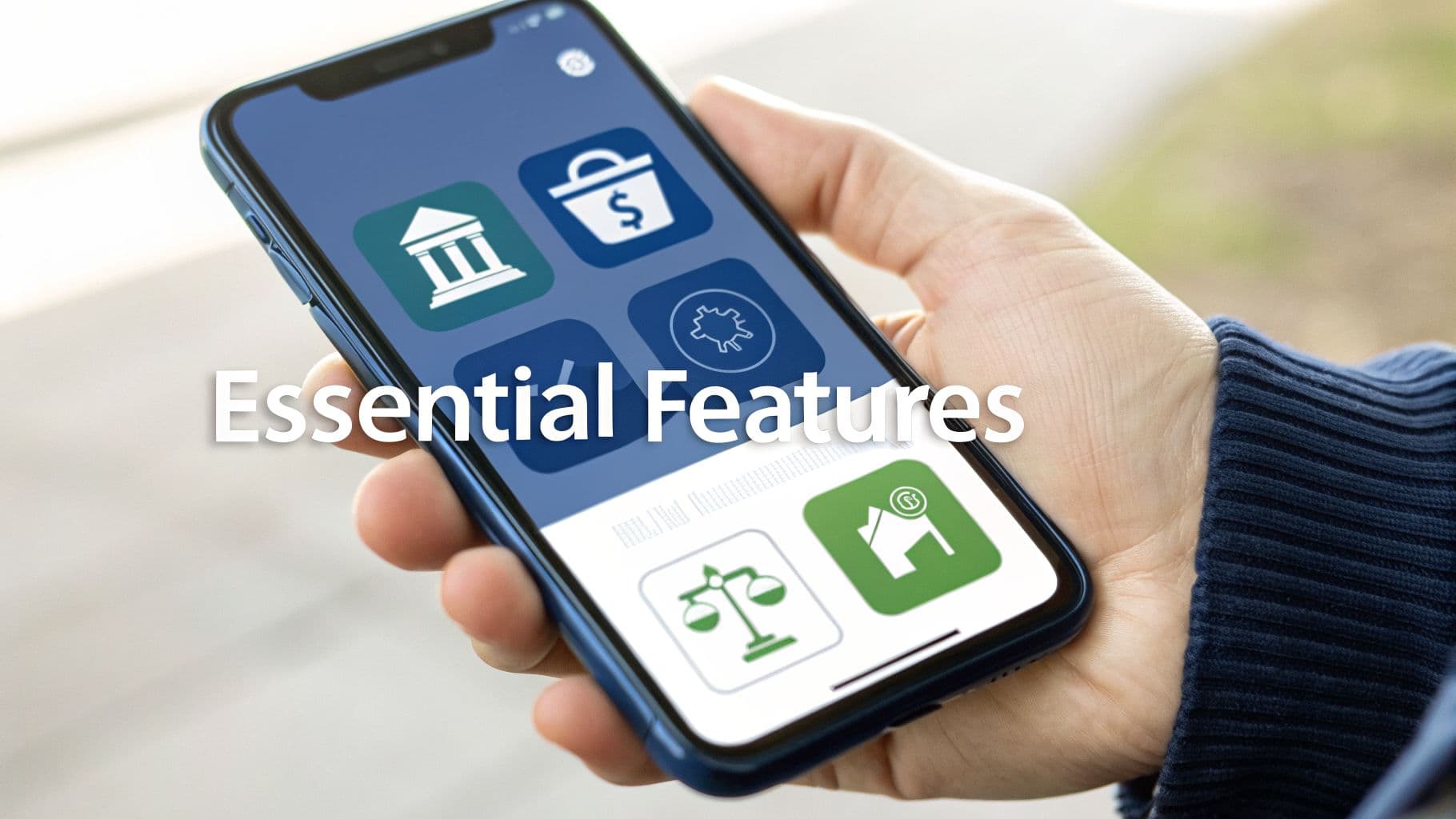
A great mobile banking app is far more than just a list of features. It’s an experience that genuinely simplifies someone’s financial life. Moving from the ‘why’ to the ‘what’, the real measure of a winning app is how well it transforms complex banking tasks into simple, intuitive actions. This is only possible with a thoughtful blend of essential user journeys and clever features that build trust.
Expert development is what bridges the gap between a feature list and a product people actually love to use. Every element must be designed as a direct solution to a real-world need, not as a technical function. The aim is to make managing money feel less like a chore and more like a tool that puts people in control.
Foundational User Journeys
Before you can even think about advanced features, an app has to nail the basics. These are the non-negotiable interactions that form the bedrock of the daily user experience. If these journeys are clunky or unreliable, you’ll lose user confidence in a heartbeat.
Every great mobile banking app must perfect these core journeys:
- Seamless Onboarding: This is your first impression. It has to be fast, secure, and straightforward, often using the phone’s camera to scan ID and biometrics for identity checks.
- Instant Balance Checks: For most people, this is the single most frequent action. A clear, one-glance view of account balances right when they open the app is essential.
- Secure Fund Transfers: Moving money, whether between their own accounts or to other people, needs to be incredibly simple and secure. Features like saving payees and sending money via phone contacts make a huge difference.
- Simple Bill Payments: Paying bills, setting up standing orders, and managing Direct Debits must be an easy-to-manage process, with clear confirmations and scheduling options.
These journeys connect your app to the core banking system through secure communication channels. To pull this off, it's vital to understand what API integration is and how it enables these critical data exchanges securely and efficiently.
Value-Add Features That Build Loyalty
Once the foundation is solid, it’s the value-add features that separate a good app from a great one. These are the tools that help users feel more in control of their finances, turning the app from a simple utility into an indispensable companion. They show you understand their needs beyond just basic transactions.
A truly winning app anticipates what the user needs before they even ask. By providing insightful tools and personalised controls, you build a relationship based on trust and genuine value, not just convenience.
This is where thoughtful design and smart technology come together to create loyalty. Instead of just showing users their transaction history, the app helps them understand it.
Creating a Stickier Experience
Features that encourage regular engagement are key to long-term success. These tools are what transform the app from a passive information screen into a proactive financial partner.
Some of the most effective features include:
- Intuitive Budgeting Tools: Allowing users to set monthly budgets, categorise spending, and see their progress helps them actively manage their money.
- Spending Analytics: Visual breakdowns of where money is going (e.g., "You spent £150 on groceries this month") provide powerful, actionable insights.
- Custom Notifications: Real-time alerts for incoming payments, low balances, or large transactions give users peace of mind and help them stay on top of their accounts.
- Savings Goals: Tools that let users create and track savings pots for specific goals, like a holiday or a house deposit, make saving feel more engaging and achievable.
Ultimately, a winning mobile banking app is defined by how well it weaves these core and value-add features into a single, elegant experience. The focus must stay on solving user problems with simplicity and security, turning every interaction into a moment of confidence.
Building a Foundation of Trust and Security
In banking, trust is the entire game. While slick features and a beautiful design might get a user to download your app, it’s the invisible framework of security and compliance that keeps them there. A successful mobile banking app has to be built on an unshakeable foundation of trust.
This means navigating a complex world of regulations and technical safeguards. For any financial product in the UK, this starts with strict adherence to rules from bodies like the Financial Conduct Authority (FCA), which exists to ensure financial markets are honest, fair, and effective for everyone.
Understanding Key Regulations
Regulations like the second Payment Services Directive (PSD2) have completely reshaped digital banking. PSD2 aims to make payments safer, spark innovation, and help banking services keep pace with new technology. Its biggest impact is the mandate for Strong Customer Authentication (SCA).
SCA is a security process designed to shield users by making it much harder for fraudsters to make payments from their accounts. It works by requiring authentication using at least two of the following three factors:
- Knowledge: Something only you know (like a password or PIN).
- Possession: Something only you have (like your smartphone, often verified with a one-time code).
- Inherence: Something you are (like your fingerprint or face).
To make this happen, many mobile banking apps rely on dependable SMS verification services to protect accounts and prevent fraud through this kind of multi-factor authentication.
Architectural Best Practices for Security
But compliance is just one piece of the puzzle. A genuinely secure mobile banking app bakes security into its very architecture. This isn't something you can just bolt on at the end; it has to be a consideration from the very first line of code.
Key architectural pillars for security include:
- End-to-End Encryption: All data, whether it's sitting on a device (at rest) or being sent between the app and the server (in transit), must be encrypted. This essentially scrambles the information, making it unreadable to anyone without the right decryption key.
- Secure API Design: APIs are the digital bridges connecting your app to core banking systems. They need to be rigorously secured to prevent unauthorised access and stop data leaks in their tracks.
- Proactive Fraud Detection: Modern security goes beyond passive protection. It involves using algorithms and machine learning to actively monitor for unusual activity, so you can flag and block potentially fraudulent transactions in real time.
This intense focus on security is non-negotiable, especially as new technologies and standards emerge. You can dive deeper into this topic in our guide on Open Banking security.
The Role of Open Banking
Open Banking, a major outcome of PSD2, allows users to securely share their financial data with authorised third-party providers. For a mobile banking app, this unlocks a huge range of features, from seeing all your accounts in one place (account aggregation) to getting personalised financial advice.
The impact has been massive. Open Banking has turbocharged UK mobile apps, hitting 2 billion API calls in a landmark month by mid-2025 and gathering 15 million users. This ecosystem shift lets apps pull together accounts, offer budgeting insights, and push personalised deals, which aligns perfectly with the 95% digital banking adoption rate among online UK adults.
Building a secure and compliant app is a non-negotiable. It requires a partner who understands the intricacies of fintech regulation and can engineer a product that protects users from day one, just as we did when developing the secure digital identity solution for My Pension ID.
Choosing the Right Technology Stack
Picking the right technology stack is one of the most important decisions you can make. It's a strategic move that can define your mobile banking app’s performance, how quickly you can get to market, and how easily you can scale down the line. For a banking app built on Flutter, Arch’s Flutter app developers work across iPhone and Android from one codebase.
The first big question is whether to build natively or use a cross-platform framework. Going native means building two entirely separate apps: one for iOS (using Swift or Objective-C) and another for Android (using Kotlin or Java). While this gives you absolute peak performance and direct access to all device features, it’s also the most expensive route. You’re essentially funding two parallel projects in terms of time, money, and maintenance.
The Cross-Platform Advantage
For most businesses, especially in fintech, a cross-platform approach is a much more pragmatic and efficient path. These frameworks let your team write a single codebase that works well on both iOS and Android. This dramatically cuts down development time, makes updates and maintenance far simpler, and lowers your overall costs, all without forcing a major compromise on the user experience.
The market has already made its preference clear. In 2024, a massive 75% of UK adults used mobile banking as their main way of managing money, pushing desktop banking into second place for the first time. This isn’t a slow shift; it’s a wholesale change in behaviour, with people swapping branch visits for the convenience of their phones. You can dig into the data yourself in UK Finance's Payment Markets Report 2025. This mobile-first reality makes an efficient development strategy non-negotiable.
Why Flutter Is the Smart Choice for Fintech
While there are a few cross-platform options out there, Flutter has pulled ahead as the superior choice, particularly for the demanding world of fintech. Backed by Google, Flutter isn’t a shortcut that produces a clunky, web-like app. It’s a modern toolkit designed from the ground up to build beautiful, high-performance applications from a single codebase.
It brings several key advantages that are perfectly suited to the needs of a mobile banking app:
- Faster, More Cost-Effective Development: Writing code once for both platforms means a smaller team can deliver a market-ready product much faster. This directly translates to lower development costs and a quicker path to seeing a return on your investment.
- A Truly Native-Like Experience: Unlike older frameworks that often felt sluggish, Flutter compiles directly to native ARM code. The result is a smooth, responsive user experience with fluid animations and performance that feels indistinguishable from a native app.
- Robust and Expressive UI: Flutter gives designers and developers complete control over every single pixel on the screen. This allows you to create a beautiful, branded, and intuitive user interface that builds trust and makes managing finances feel effortless.
For a mobile banking app, the user experience is everything. Flutter's ability to deliver a high-fidelity, high-performance interface from a single codebase makes it the ideal foundation for building a product that users will trust and love.
Our experience developing successful mobile apps has proven the power of Flutter again and again. For instance, our work on the Boiler Juice app shows how it can handle complex ordering and account management with a simple, clean interface. Likewise, the Findr app showcases its ability to create a fast, reliable, and visually appealing platform.
Choosing Flutter means adopting a strategy that prioritises speed, quality, and cost-efficiency. It lets you focus your resources on what matters: building secure, user-focused features that deliver real value and drive your business forward.
Your Step-by-Step Development Roadmap
Building a mobile banking app is a journey, not a sprint. To get it right, you need a practical roadmap that takes you from the initial spark of an idea to a polished application your customers will trust and use every day. A structured approach is the best way to manage the complexity, sidestep common risks, and make sure the final product delivers on its promise.
This journey starts long before a single line of code gets written. It begins with a crystal-clear vision and a deep understanding of the problem you’re solving for your users.
The Discovery and Prototyping Phase
This is, without a doubt, the most critical stage of the entire project. The Discovery Phase is where we roll up our sleeves and work together to define the app's core purpose, pinpoint the target audience, analyse what competitors are doing, and map out the absolute must-have features. It’s a highly collaborative process, packed with workshops and research that lays a rock-solid foundation for everything that follows.
From there, we jump into Prototyping. This step creates interactive wireframes and visual mockups, with no code involved. It’s the very first chance you get to see, touch, and feel how your mobile banking app would actually work. This step is vital for gathering feedback on the user flow and interface design before you commit to the heavy lifting of development, so everyone is on the same page.
Building a Minimum Viable Product (MVP)
Instead of getting bogged down trying to build every feature you can imagine all at once, the smartest move is to launch with a Minimum Viable Product (MVP). An MVP isn’t a cheap, half-baked version of your app. It’s a strategically lean but fully functional, production-ready product that includes only the most critical features needed to solve a core problem for your first users.
The goal of an MVP is to learn, not just to launch. It’s about getting a real product into the hands of real users as quickly as possible to validate your assumptions and gather priceless feedback.
Launching an MVP for your banking app gives you some powerful advantages:
- Faster Time-to-Market: You can get your app into users' hands in a matter of months, not years.
- Reduced Initial Investment: Lower upfront costs make it easier to get off the ground and prove your concept.
- User-Driven Development: Real-world feedback becomes your guide, so you only build features people actually want and need.
- Risk Mitigation: It validates market demand before you commit to a much larger investment down the line.
We’re big believers in this strategy. You can dive deeper into how it works by checking out our guide on developing an MVP.
Scaling and Post-Launch Support
The launch of your MVP is the starting gun. The data and user feedback you gather become the blueprint for what comes next: scaling the product. This is an iterative cycle of adding new features, refining the user experience, and thoughtfully growing your user base.
After launch, ongoing Support and Maintenance are essential. This means keeping a close eye on app performance, squashing bugs, and rolling out regular updates. These updates are necessary to maintain compatibility with new operating systems and stay ahead of emerging security threats. A well-supported mobile banking app is one that earns and keeps user trust for the long haul.
Frequently Asked Questions
How much does it cost to develop a mobile banking app?
The cost varies widely based on complexity. A Minimum Viable Product (MVP) with core features can start in the tens of thousands, while a full-featured, custom-designed app with complex integrations can cost several hundred thousand pounds. Using a cross-platform framework like Flutter helps manage costs by building for iOS and Android from a single codebase. A detailed discovery phase is the only way to get a precise quote tailored to your specific needs.
How long does it take to build a banking app?
Timelines depend on the app's scope. A lean MVP focusing on essential features can be ready for launch in as little as 4–6 months, allowing you to gather user feedback quickly. A more sophisticated application with advanced features, bespoke design, and rigorous compliance checks will typically take 9–12 months or longer. An agile methodology and efficient frameworks can help accelerate this process without compromising on quality or security, a journey you can start by getting in contact with us.
What are the biggest security risks to address?
The main threats are data breaches, unauthorised account access, and fraud. Key vulnerabilities include insecure on-device data storage, weak user authentication, and unencrypted data transmission. To mitigate these risks, you must implement end-to-end encryption, multi-factor authentication (MFA), and biometric logins. Regular, independent security audits and strict adherence to regulations like PSD2 are non-negotiable for protecting users and earning their trust, as we've demonstrated in projects like Deploy.
Why is UX/UI design so important for a banking app?
In finance, a great user experience builds trust. A clunky, confusing interface makes users anxious about their money and will drive them to competitors. In contrast, an intuitive design makes managing finances feel simple, clear, and reassuring, guiding them through complex tasks without stress. In a crowded market, a seamless user experience is the core driver of adoption, engagement, and long-term customer loyalty. Our work on Adaptwell highlights how design can simplify complex processes.
About the Author
Hamish Kerry is the Marketing Manager at Arch, where he’s spent the past six years shaping how digital products are positioned, launched, and understood. With over eight years in the tech industry, Hamish brings a deep understanding of accessible design and user-centred development, always with a focus on delivering real impact to end users. His interests span AI, app and web development, and the transformative potential of emerging technologies. When he’s not strategising the next big campaign, he’s keeping a close eye on how tech can drive meaningful change.
Hamish’s LinkedIn: https://www.linkedin.com/in/hamish-kerry/