



Cloud vs On Premise Cost.
Three variables decide cloud vs on premise cost, and the sticker price is not one of them. Five years, workload by workload.
Cloud vs On Premise Cost.
Key Takeaways
- Three variables decide cloud vs on premise cost and the sticker price is none of them: how predictable the load is, how much data leaves the network, and whether you already employ someone who can run infrastructure.
- Capital against operating expenditure frequently decides the outcome on its own, because the two routes run through different approval processes.
- A real five year cloud vs on premise cost comparison includes staff time, egress, backup and monitoring, not hardware cost set against cloud invoices.
- Security is one of the larger transfers of work between the two options, and it rarely appears as a line in a cost model.
- The useful output is an allocation workload by workload, not a single verdict.
Steady load on hardware you own tends to be cheaper on premises across five years. Spiky or growing load, or a team with nobody to look after servers, tends to be cheaper in cloud. Most organisations sit somewhere in between.
Arch provides hosting and infrastructure alongside development, so we make this call together with clients. Worth saying plainly, because nearly every page ranking on this question was published by a company that sells exactly one of the two answers.

Somebody still owns the hardware. The only question is whether it is you.
Capex and Opex, and Why Finance Cares Which One It Is
Most technical comparisons skip this, and it frequently decides the outcome on its own.
Buying servers is capital expenditure. The cash leaves in year one, but the cost spreads across the asset's useful life through depreciation, usually three to five years, and it sits on the balance sheet as an asset.
Cloud is operating expenditure. It hits the profit and loss account in the month you incur it, there is no asset, and there is nothing to depreciate.
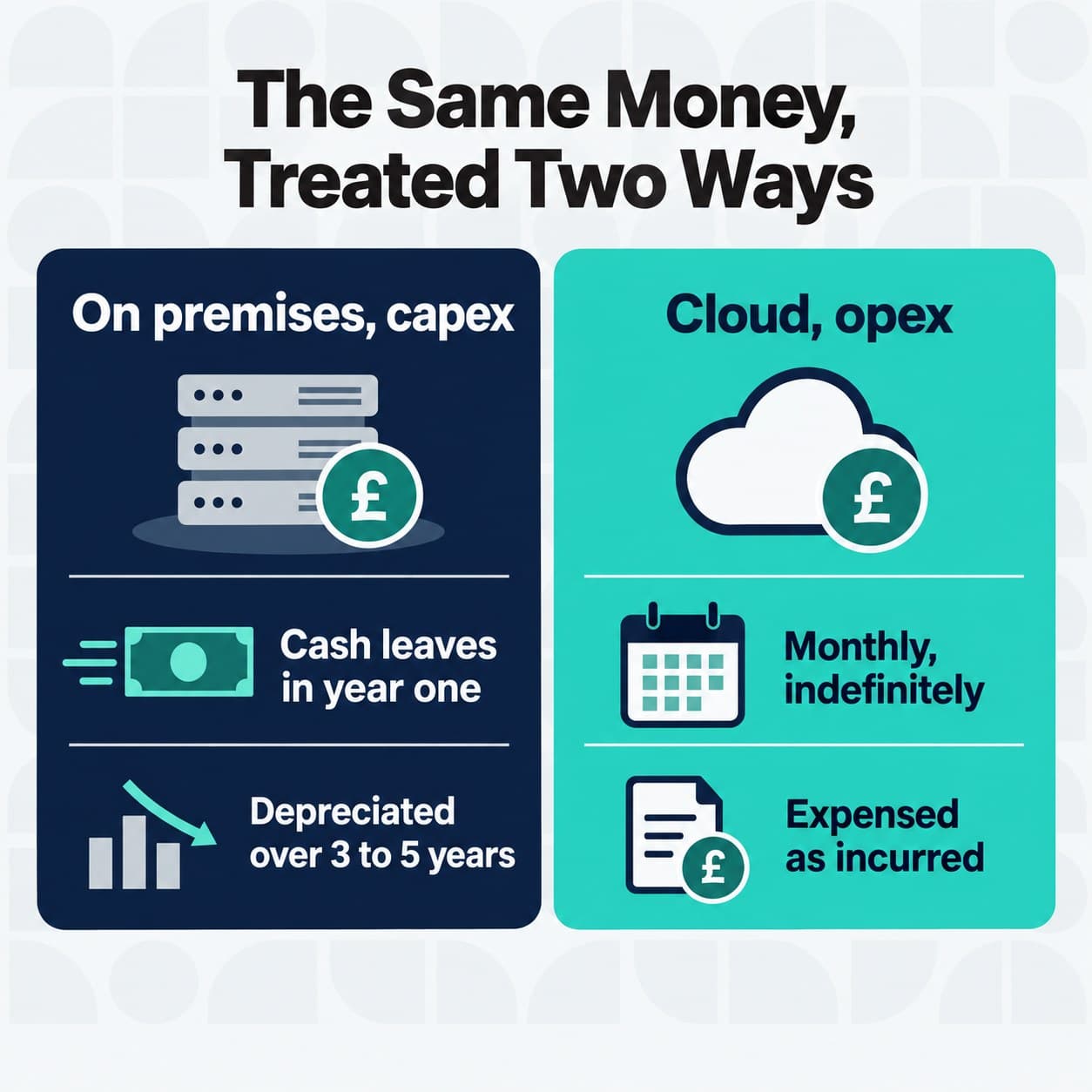
The same money, treated two very different ways.
On premises (capex) | Cloud (opex) | |
|---|---|---|
When cash leaves | Mostly year one | Monthly, indefinitely |
Accounting treatment | Depreciated over 3 to 5 years | Expensed as incurred |
Balance sheet | Appears as an asset | Does not appear |
Approval route | Usually a capital request | Usually a budget line |
Effect on annual profit | Smoothed by depreciation | Full cost every year |
Here is why that matters in practice. The two routes often run through different approval processes, with different thresholds and different people signing them off.
A capital request might need board approval where an equivalent monthly cost does not, or the reverse. Teams regularly pick cloud because the approval route is quicker, and when cloud vs on premise cost is framed afterwards as a technical decision, the technical reasoning is doing work it did not actually do. Better to name the procedural reason and move on.
What a Five Year Total Cost of Ownership Actually Contains
Cloud vs on premise cost comparisons go wrong because they set hardware cost against cloud cost. The lines below make the comparison real, and several are staff time as well as invoices.
Cost line | On premises | Cloud |
|---|---|---|
Hardware purchase | Yes, plus refresh at year 3 to 5 | No |
Rack space or floor space | Yes | No |
Power and cooling | Yes, and rising | Included |
Network connectivity | Yes | Partly, plus egress |
Data egress | Rarely charged | Yes, and it compounds |
Operating system and licences | Yes | Often bundled, sometimes dearer |
Backup and disaster recovery | Build and maintain it | A service, charged |
Security patching | Staff time | Shared, depending on service |
Monitoring | Build and maintain it | A service, charged |
Staff to run it | Yes, and this is the big one | Less, though never none |
Idle or over-provisioned capacity | Paid for at purchase | Paid for monthly, forever |
Staff time is where most comparisons fail. On-premises infrastructure needs somebody who can patch, monitor, replace failed disks and pick up the phone at three in the morning.
If you already employ that person, the marginal cost looks like zero. If you do not, it is the largest single line on the table, and it does not appear on any vendor's calculator.
So when someone hands you a five year cloud vs on premise cost figure, ask which of those eleven lines it includes before you argue about the number. Most calculators include the lines that flatter whoever built them.
The Costs That Surprise People
Four cloud vs on premise cost lines catch people out, and they do it on both sides of the decision.
Egress is the first. Moving data out of a cloud provider is charged per gigabyte, which looks trivial at the start and grows with your data volume and your user count. Those happen to be the two things you are hoping will grow.
The second is the discount period ending. Introductory and committed-use discounts run to a term, and renewal pricing is not the price you modelled. It tends to arrive at the moment switching is hardest.
Then there are idle virtual machines, provisioned for a project that finished, still running inside a subscription nobody reviews. Alongside them sit forgotten development, staging and test environments that were spun up and left running.
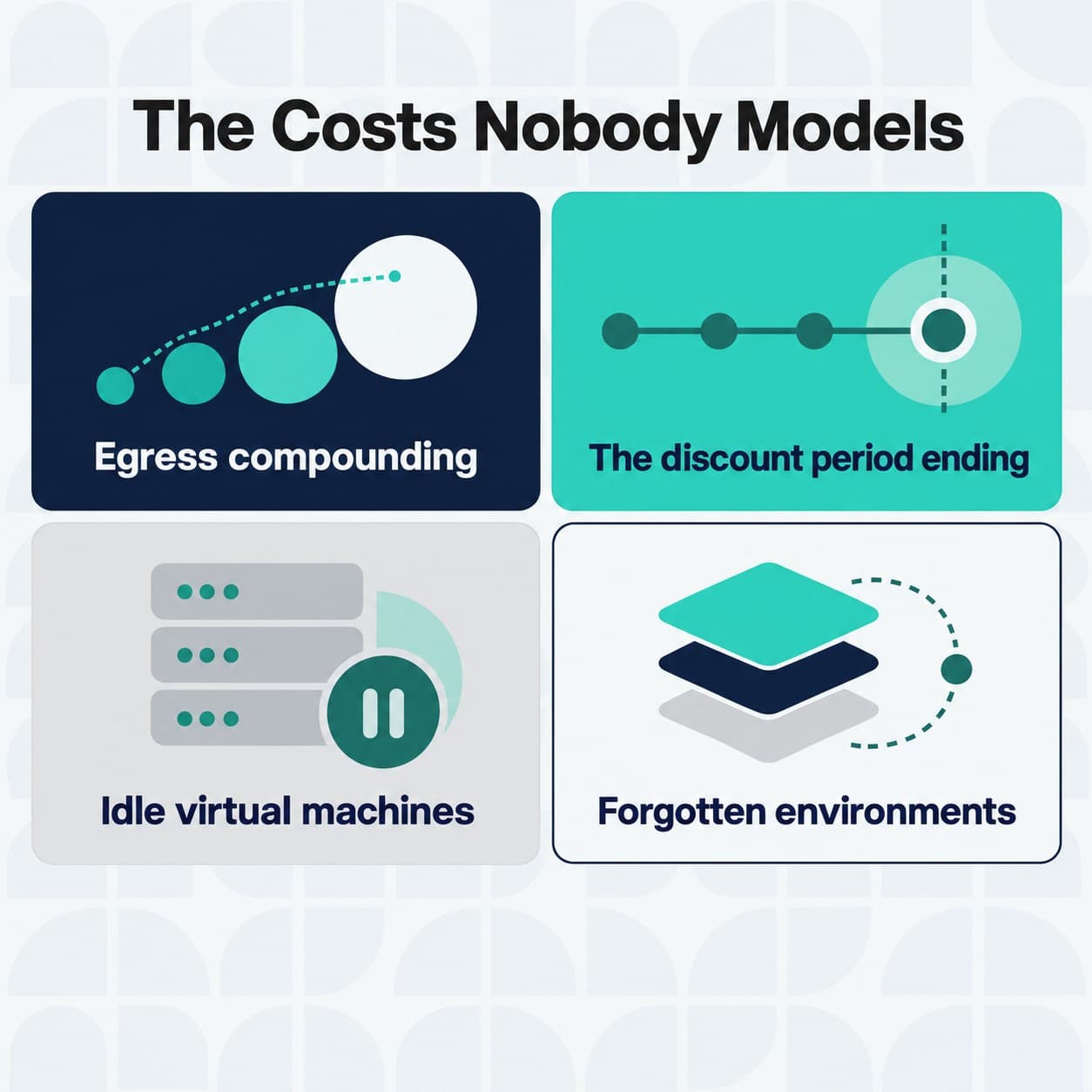
Four cost lines that appear in neither vendor's comparison table.
On-premises has its own version of the last two, which is over-provisioning at purchase. You buy for peak load plus headroom, and you pay for that headroom whether or not anything ever uses it.
The difference is in how you experience the waste. On-premises waste is a sunk cost you notice once and then forget. Cloud waste bills every month and, for exactly that reason, stops being noticed at all.
Where UK Businesses Have Actually Landed
On where cloud vs on premise cost decisions have actually landed, official statistics are worth more than vendor surveys, for the obvious reason that the vendors running surveys are selling something.
Government figures show 31 percent of UK businesses use a public cloud provider, up from 19 percent in 2024, while 27 percent still run on premises servers and 29 percent now rely entirely on external infrastructure they do not own.
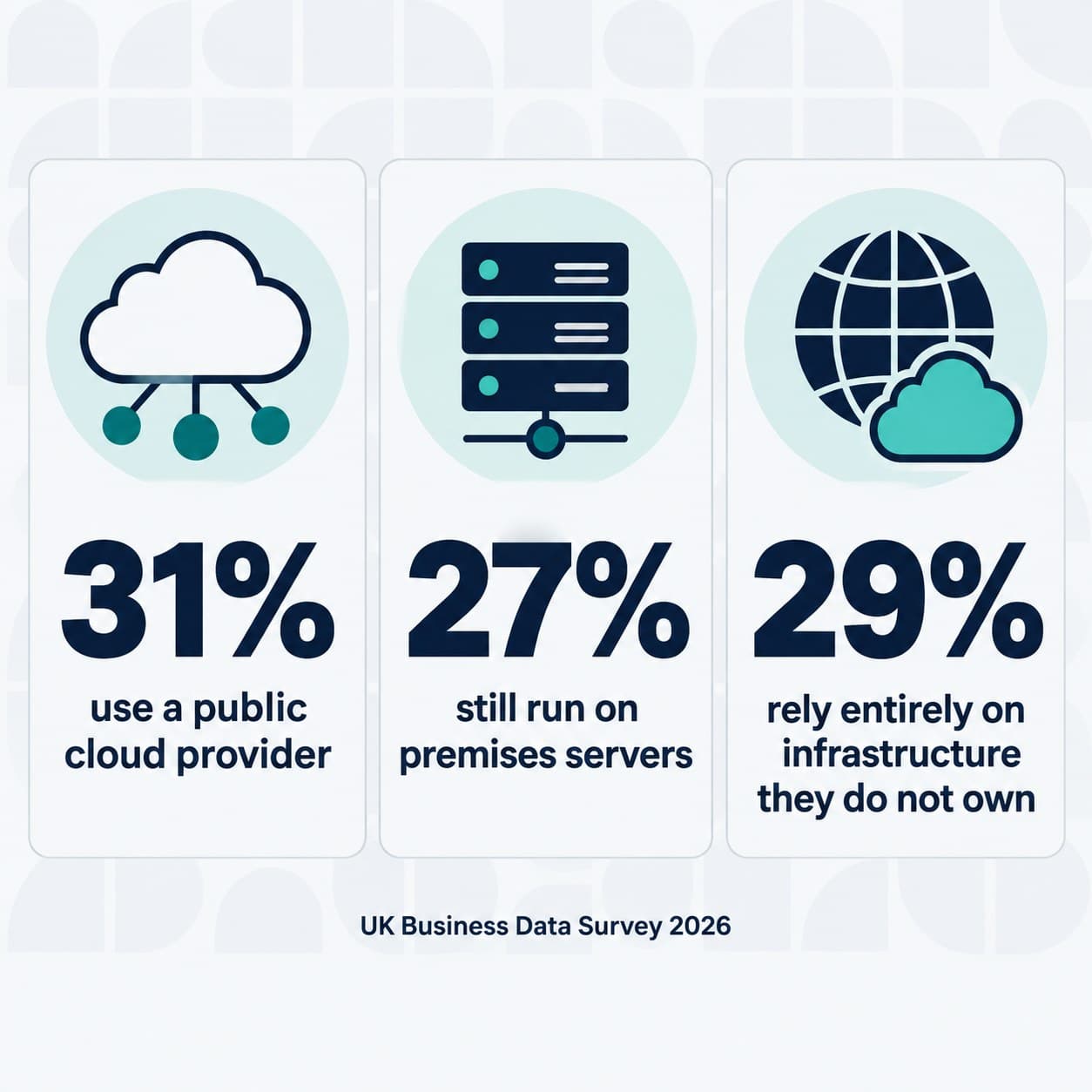
Where UK businesses actually run things, according to official statistics.
Those three figures together describe a mixed market rather than a migration in progress.
The Office for National Statistics separately found 69 percent of UK firms used cloud-based computing systems and applications in 2023. That figure counts software use. It does not count infrastructure, which is why the two numbers sit so far apart.
The distinction is worth keeping hold of. Using cloud software is close to universal, while running your infrastructure in cloud remains a minority position, and a lot of muddled comparison lives in the gap between those two sentences.
Investment continues on both sides. ONS put UK digital infrastructure investment at 11.2 billion pounds in 2025.
Who is Responsible for Security, and What That is Worth
Security rarely appears as a line in a cloud vs on premise cost model, which is odd, because it is one of the larger transfers of work between the two options.
The NCSC frames this as a shared responsibility model and is unusually direct about the conclusion. It advises that you should cede as much security responsibility as possible to your trusted cloud provider, on the grounds that the provider is well placed to manage it. The same guidance notes that when you build in your own data centre you are entirely responsible for the security of your service.
Read that as a cost statement and not only a security one. Patching, hardening, monitoring and incident response are real hours, and on premises every one of those hours is yours.
/
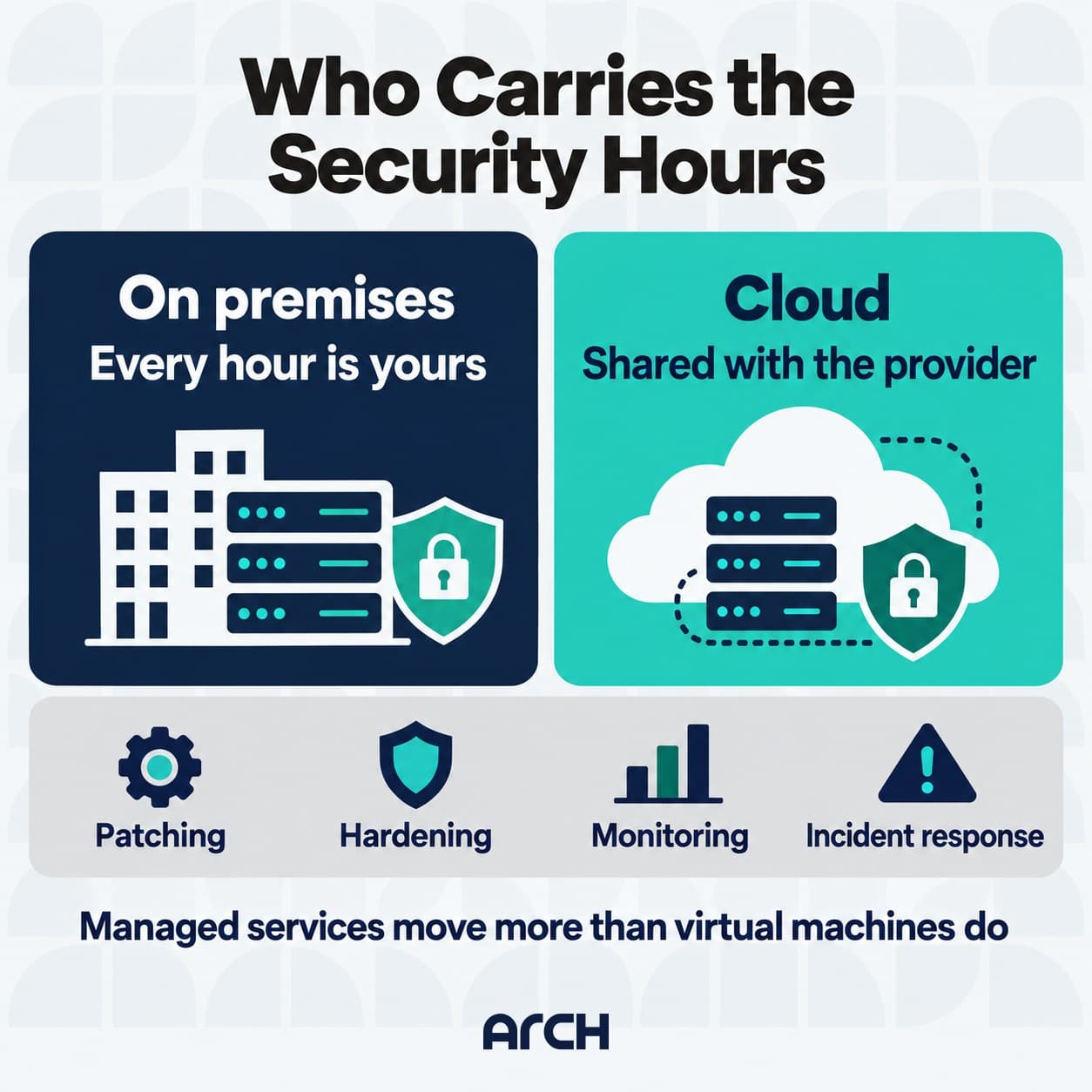
The same four jobs. The difference is who stays up doing them.
How much transfers depends on the service model. Managed services move more of the work to the provider than raw virtual machines do, and the split is worth establishing for each workload, since it varies across what you run.
Data Residency and UK Regulatory Pressure
Residency rarely changes cloud vs on premise cost much, and it can rule one option out entirely. You should be able to say where your data physically sits in one sentence, and a surprising number of organisations cannot.
What you need to know is which country stores it, which jurisdictions your provider's support staff can reach it from, what happens to it when you terminate, and whether backups live somewhere different from the primary copy.
Every major cloud provider offers UK regions, so residency is achievable in cloud. It is a configuration decision, and a property you do not get for free, which means it can be got wrong and is worth checking.
On premises gives you residency by default and hands you everything else to manage. That is the trade, and neither side is automatically safer.
When Repatriation Makes Sense, and When It is a Fashion
Workloads genuinely do move back from cloud to owned hardware, and there is a great deal of noise around it. Repatriation is where cloud vs on premise cost arguments get loudest and least careful.
Worth knowing where the loudest figures come from. Much of the repatriation research in circulation is published by managed service providers and hardware vendors who sell on-premises and colocation. That does not make the numbers wrong, but it earns them the same reading you would give a cloud provider's migration case study.
Repatriation genuinely pays in a few situations: a workload with steady, high utilisation, one with very high data egress, or an organisation that already has the staff and the physical space, where adding capacity costs little at the margin.
It rarely works as a general strategy, and seldom as a reaction to one unexpected invoice. A surprise bill usually points at an unoptimised deployment, and the model itself is rarely at fault.
Which Workloads Belong Where
The useful output of a cloud vs on premise cost exercise is an allocation rather than a verdict.
Workload characteristic | Usually cheaper | Why |
|---|---|---|
Steady, predictable, high utilisation | On premises | You pay for capacity you actually use |
Spiky or seasonal | Cloud | You stop paying when it stops running |
Early stage, uncertain scale | Cloud | No commitment to capacity you may not need |
Very high data egress | On premises | Egress is the line that compounds |
Latency-sensitive to local systems | On premises | Physics, not economics |
Disaster recovery | Cloud | Paying for standby capacity is what cloud is good at |
Regulated with residency constraints | Either | Both can comply, both can be misconfigured |
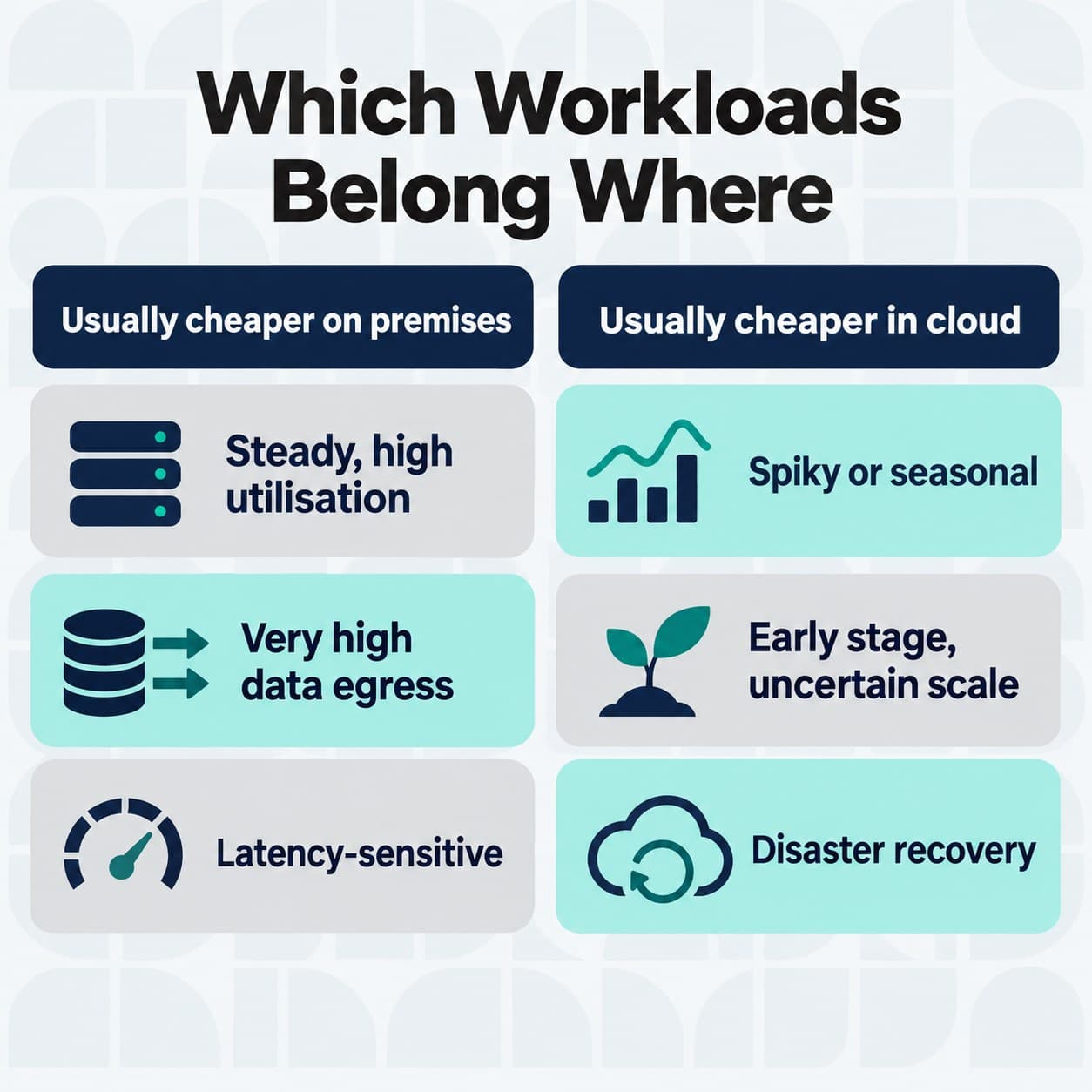
Which workloads belong where. The reason in each case matters more than the verdict.
Most organisations end up with a mixture, and a mixture is a legitimate answer. The failure is a mixture nobody chose, arrived at by accretion, where nothing is optimised because nothing was decided.
Cloud infrastructure for web applications UK teams run should be allocated this way before web app development starts, because the architecture follows from it. A system designed for elastic scaling and then deployed on fixed hardware carries cost in both directions.
Frequently Asked Questions
Is Cloud Cheaper Than On Premise?
Cloud vs on premise cost splits by workload rather than by provider. For spiky, growing or uncertain workloads, usually. For steady high-utilisation workloads on hardware you own and staff you already employ, usually not.
The comparison only means anything across three to five years, because on-premises cost is front-loaded and cloud cost is level. A twelve-month comparison will always favour cloud and will always mislead you.
How Do Cloud vs On Premise Architecture Decisions Differ?
Cloud architecture assumes capacity is elastic and failure is routine, so it favours horizontal scaling, statelessness and designing for instances that disappear. On-premises architecture assumes capacity is fixed and expensive to add, so it favours vertical scaling and getting more out of the hardware you have.
Deploying one architecture on the other's infrastructure is the most common source of both unexpected cost and disappointing performance.
On Premise vs Cloud Cost Comparison UK Buyers Can Rely On: What Goes in It
Every line in the table above, staff time and refresh cycles included, across at least five years. Insist both sides of the comparison carry the same lines, which is precisely where vendor calculators quietly differ.
Add data residency and egress volume. Both are UK-relevant and both get left out.
What Are the Opex and Capex Trade-Offs Between Hardware and Cloud for Broadcast Infrastructure?
Broadcast workloads sit at the awkward end of this decision, because playout and transcoding are steady, heavy and latency-sensitive, which favours owned hardware, while peaks around live events favour cloud.
The common answer is a split: baseline capacity on premises as capex, burst capacity in cloud as opex. That keeps the predictable load on the cheaper footing and buys elasticity only where it earns its price.
The same reasoning applies to laboratory systems and any other workload with a heavy steady core and occasional spikes, where a five year total cost view usually beats an annual one.
How Do I Work Out a Five Year TCO for Cloud Against On Premises?
Model the on-premises side as purchase plus refresh at year three or four, plus power, space, licences, backup and a realistic share of a person's time. Model the cloud side as monthly run cost, plus egress at your projected data volume, plus renewal pricing once the discount term expires rather than the introductory rate.
Then run both against your real utilisation rather than your peak. Utilisation decides the answer, and it is the number most models quietly assume.
Does Moving to Cloud Reduce the Need for Infrastructure Staff?
It reduces it. It does not remove it, and organisations that budget for removal tend to rediscover that cost optimisation, security configuration and monitoring were somebody's job all along.
What About Older Systems That Cannot Move?
Some genuinely cannot, usually because of a dependency on specific hardware, an unsupported operating system, or a licence tied to a physical machine. Those constrain the decision and belong in the comparison from the start.
Modernising older systems sometimes turns out to be a prerequisite to either option, and planning a migration properly matters more than which destination you picked. Work such as database optimisation also shifts the arithmetic, since a workload needing half the capacity costs half as much on either side.
Bigger programmes bring their own constraints. Enterprise application development usually spans systems in both places, so how systems talk to each other across that boundary becomes a design question of its own. Our post on cloud against on premise covers the wider trade-offs beyond cost.
About the Author
Hamish Kerry is the Marketing Manager at Arch, where he's spent the past six years shaping how digital products are positioned, launched, and understood. With over eight years in the tech industry, Hamish brings a deep understanding of accessible design and user-centred development, with a focus on delivering real impact to end users. His interests span AI, app and web development, and the potential of emerging technologies. When he's not strategising the next big campaign, he's keeping a close eye on how tech can drive meaningful change.
You can catch up with Hamish on LinkedIn
Sources
- Department for Science, Innovation and Technology, UK Business Data Survey 2026, 18 June 2026. https://www.gov.uk/government/statistics/uk-business-data-survey-2026/uk-business-data-survey-2026
- Office for National Statistics, Management practices and the adoption of technology and artificial intelligence in UK firms: 2023, 24 March 2025. https://ons.gov.uk/economy/economicoutputandproductivity/productivitymeasures/articles/managementpracticesandtheadoptionoftechnologyandartificialintelligenceinukfirms2023/2025-03-24/pdf
- Office for National Statistics, Redefining investment in digital infrastructure in the UK, 23 August 2026. https://ons.gov.uk/economy/economicoutputandproductivity/productivitymeasures/articles/redefininginvestmentindigitalinfrastructureintheuk/2026
- National Cyber Security Centre, Cloud security shared responsibility model, 2026. https://www.ncsc.gov.uk/collection/cloud/understanding-cloud-services/cloud-security-shared-responsibility-model
- Arch, Hosting, 2026. https://wearearch.com/services/hosting