



Legacy App Modernisation: A 2026 Roadmap for UK Firms.
Get a practical roadmap for legacy app modernization. Assess systems, choose strategies, calculate ROI, and secure buy-in for UK businesses.
Legacy App Modernisation: A 2026 Roadmap for UK Firms.
Most CTOs don't need another abstract lecture on technical debt. They need a way out of the situation they're already in: a core system that still runs the business, still holds critical data, and still breaks every plan for faster delivery, cleaner integrations, and better customer experience.
You might be dealing with an ageing platform that nobody wants to touch before month-end reporting. Or a monolith that can't support the mobile experience the business now expects. Or a stack held together by undocumented rules, manual workarounds, and a shrinking pool of people who understand it. That's the context for legacy app modernization. It isn't a trend. It's operational risk management tied directly to growth.
Your Guide to Legacy App Modernization
A common starting point looks like this. The core platform still processes orders, reconciles payments, and produces the reports finance needs, but every meaningful change now feels risky, expensive, and slow. For UK firms, that pressure is usually not just technical. It sits alongside GDPR obligations, sector rules, audit requirements, and a delivery backlog that keeps growing because the old estate cannot support new products or channels at a sensible pace.
Legacy app modernization is the work of reducing that drag without putting the business at unnecessary risk. For SMEs and scale-ups, that matters as much as it does for large enterprises. The constraint is usually not ambition. It is budget, internal capacity, and the reality that a full rewrite can consume a year before the business sees any return.
Key takeaways
- Modernization is a business decision first: Strong programmes start with risk, cost, compliance, and delivery constraints, not with a preferred framework.
- Smaller, staged moves tend to outperform big-bang rewrites: Focused work on high-value services, workflows, or integrations usually produces earlier returns and fewer operational surprises.
- UK compliance changes the shape of the plan: GDPR, FCA expectations, data residency choices, and auditability should be designed into the migration path from the start.
- AI has made modernization more achievable for smaller firms: Used carefully, AI can speed up code analysis, documentation, test creation, and refactoring preparation without removing the need for engineering oversight.
- Cloud is not the end goal: The primary target is a system your team can maintain, extend, secure, and connect to modern products and data services.
- Delivery discipline decides the outcome: Dependency mapping, rollback planning, staged releases, and realistic scope control matter more than presentation decks.
Many legacy estates still perform their narrow original job. They store records, complete transactions, and produce required outputs. The problem is the cost around that basic function. Change requests take too long. Security patching becomes harder. Integrations depend on fragile workarounds. Compliance teams spend more time proving control because the system was not built for current reporting and governance expectations.
That is why modernization should be framed as a business capability programme, not a technology refresh exercise. In practice, the goal is to reduce operational fragility while making future delivery cheaper.
What modernization actually means
Modernization rarely starts with replacing everything. The better route is usually selective change, based on risk, value, and technical constraints.
- Expose stable capabilities through APIs: Keep proven core processes in place where needed, but make them easier to integrate with customer portals, mobile apps, and partner systems.
- Replace the fragile edges first: Old admin interfaces, unsupported middleware, and manual data handoffs often create more day-to-day pain than the core ledger or transaction engine.
- Separate business rules from ageing infrastructure: Preserve logic that still gives the business an advantage. Move it into services or components your team can test and change safely.
- Use AI where it saves real effort: AI tools can help catalogue codebases, identify dead code, suggest test cases, and speed up documentation. They are useful accelerators, especially for smaller teams, but they do not remove the need for architecture reviews, security checks, or domain validation.
A practical modernization plan starts when teams stop asking, “How do we replace everything?” and start asking, “What must change first to reduce risk and enable faster delivery?”
The same operating pressures appear in other markets. This perspective on modernizing business technology in Houston is a useful comparison if you want to see how firms approach ageing systems under uptime, cost, and integration pressure.
What good looks like
A modernized application estate gives teams more control over change. Releases are more predictable. Dependencies are visible. Data flows are easier to trace for audits and security reviews. New digital products can use the core business logic without inheriting all of the old platform's constraints.
That does not always mean microservices throughout or a full cloud rebuild. Sometimes it means a modular monolith with better deployment practices. Sometimes it means API layers around a system you intend to keep for years. Sometimes it means retiring entire applications that no longer justify their support cost. The right answer depends on business criticality, regulatory exposure, team capability, and how quickly the organisation needs results. Where the old system stays, an API layer is usually the cheaper way of connecting a legacy system to something modern, as long as someone budgets for running it.
If you want a customer-facing example of the kind of outcome modern delivery should support, look at products that prioritise clean mobile experiences such as Boiler Juice.
The objective is simple. Remove the structural barriers that make delivery slow, compliance harder, and growth more expensive than it should be.
How to Assess Your Legacy System
Good modernization starts with a hard audit, not a workshop full of opinions. The fastest way to waste budget is to begin with the most painful application because it's noisy. Better results come from rating each system by business value and technical condition, then choosing a first move that creates visible progress without putting core operations at unnecessary risk.
Use a simple two-axis lens
Start by plotting every significant application into one of four categories:
- High value, poor condition: Modernize early. These systems matter too much to ignore.
- High value, fair condition: Stabilise and extend. They may only need targeted refactoring or API work.
- Low value, poor condition: Retire, replace, or consolidate.
- Low value, fair condition: Keep them running with minimal investment until there's a stronger reason to act.
That sounds obvious, but many teams skip it and jump straight into architecture decisions. Benchmark data from Red Hat indicates that 66% of application modernization journeys succeed when scope is managed through value-led strategies, such as starting with high-impact, low-risk initiatives.
What to inspect in practice
A proper audit goes beyond code quality. It should cover:
- Operational dependence: Which teams rely on it daily, and what breaks if it goes down?
- Change friction: How long does a small change take from request to release?
- Integration load: Which APIs, batch jobs, spreadsheets, or manual workarounds sit around it?
- Data criticality: Does it hold regulated, customer, or finance-sensitive data?
- People risk: Who still understands the stack, and what happens if they leave?
Practical rule: If a system is business-critical but only one or two people can safely change it, you already have a modernization problem.
Technical review should include dependency age, test coverage quality, deployment method, environment consistency, security posture, and the adequacy of documentation. “It's in Confluence somewhere” isn't documentation if developers still need tribal knowledge to release safely.
Don't ignore infrastructure context
Application health is only part of the story. Old network layouts, hardware dependencies, and undocumented integrations often drive more risk than the application code itself. That's why broader Network infrastructure assessments can be useful when mapping what's really coupled to the legacy estate.
A strong assessment leaves you with a ranked backlog. You should know which application to start with, which capability to leave alone for now, and which systems deserve retirement rather than rescue.
Choosing Your Modernization Approach
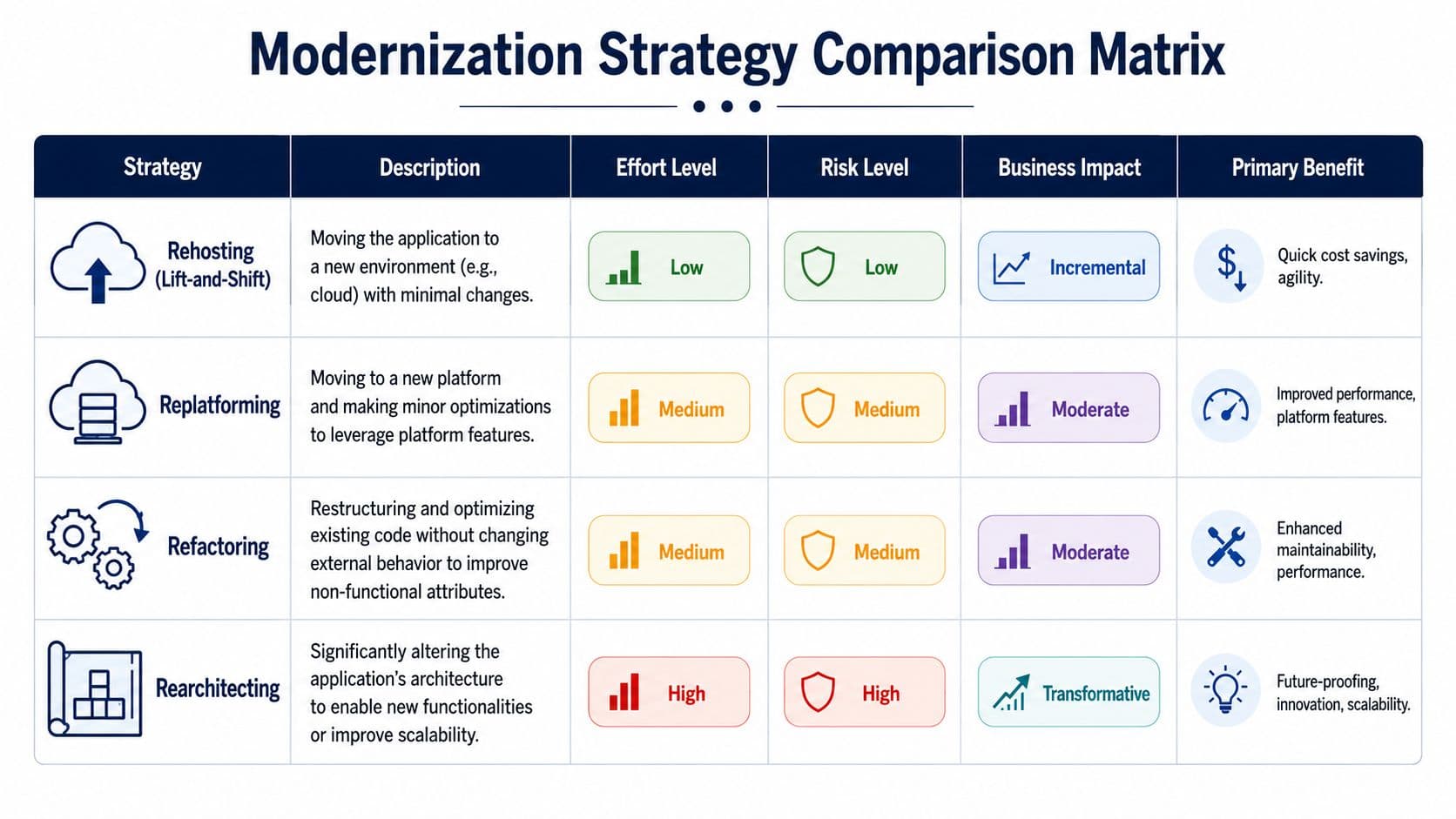
Once you know what you're dealing with, the next question is tactical. Not every legacy app needs the same treatment, and the wrong modernization pattern creates avoidable cost. The right choice depends on how urgent the risk is, how much business logic is worth preserving, and whether the application needs to support future product changes or stop causing operational drag.
When to choose rehosting
Rehosting, often called lift-and-shift, is the pragmatic option when your immediate problem is infrastructure fragility rather than application design. It's useful when servers are old, support contracts are awkward, or you need a faster move out of an on-premise environment.
What it won't do is solve a brittle release process, poor modularity, or tangled code. It changes where the app runs, not how it behaves.
When to choose replatforming
Replatforming makes sense when the application still has useful structure but can benefit from managed databases, container platforms, or cloud services. This approach usually gives better operational resilience than rehosting without demanding a full code-level rewrite.
It's often a sensible middle path for internal systems that need better performance and easier deployment, but don't justify a ground-up redesign yet.
When to choose refactoring
Refactoring is the right move when the product still matters and your team needs cleaner code, better testability, and lower change risk. In this process, developers improve structure without deliberately changing user-facing behaviour.
The key is discipline. Refactoring without a clear boundary can inadvertently become a rewrite. That's why teams should agree in advance which parts of the system they're improving and which they're only wrapping or isolating.
When to choose rearchitecting
Rearchitecting is for applications that have become structural blockers. If the monolith prevents independent deployment, can't scale the way demand requires, or makes every new feature expensive, a deeper redesign is justified.
According to Kellton, the most impactful approach involves refactoring or rearchitecting legacy systems into microservices or serverless cloud-native architectures, and 85% of applications in successful modernization journeys are modernized using 2 or 3 iterative steps. That matters because it confirms what experienced teams already know. Big-bang rewrites are rarely the safest route.
The pattern that usually works
In practice, many successful programmes combine approaches:
- Move first: Rehost or replatform to reduce environmental risk.
- Untangle second: Refactor key domains behind stable interfaces.
- Redesign selectively: Rearchitect only the capabilities that need independent scale, faster release cycles, or better resilience.
For teams weighing those trade-offs in more detail, this guide to software development approaches is a useful companion when deciding how far to push change in one phase.
The right modernization strategy is the one that removes the current constraint without creating a bigger one six months later.
The mistake I see most often is choosing the most ambitious architecture before proving the delivery model can support it.
Building Your Business Case and Roadmap
Monday morning. The board pack is due by noon, the legacy platform has caused another release delay, and the proposed fix still reads like an engineering wish list. That is usually where modernization slows down. The technical problem is real, but the funding case is still too abstract.
.jpg&w=2048&q=75)
A CTO rarely gets approval for “modernization” on ambition alone. The case needs to show what the current system is costing the business now, what changes first, and how risk stays contained while the product keeps running.
For UK SMEs and scale-ups, that usually means translating technical debt into business terms the finance team, operations lead, and compliance owner can all recognise. Rising support effort. Slower onboarding of customers or staff. Audit gaps around access, retention, or data handling. Revenue delayed because a partner integration takes months instead of weeks. If the system touches regulated workflows, the cost of standing still is not theoretical.
A credible business case should answer four questions:
- What is the current drag on the business? Include support effort, delivery delays, brittle integrations, compliance exposure, and the opportunity cost of work the team keeps postponing.
- What improves in the first phase? Show early gains such as shorter release cycles, fewer manual workarounds, more reliable reporting, or faster integration delivery.
- What stays intact? Protect business rules, operational workflows, and data that the organisation already trusts.
- How will you control delivery risk? Set out phased releases, rollback options, measurable checkpoints, and clear ownership across product, engineering, and operations.
The strongest business cases also separate cost categories properly. One budget line covers platform work such as environments, deployment, observability, and access control. Another covers product change that delivers visible business value. Mixing those together makes every phase harder to defend.
Where AI can help is in reducing the cost of getting to a credible plan. Used well, it speeds up codebase analysis, dependency mapping, documentation of obscure modules, and test generation for legacy areas with poor coverage. For smaller UK organisations without a large architecture team, that can turn a six month discovery into a much shorter evidence-gathering exercise. It does not replace engineering judgement, but it can lower the entry cost of modernization enough to make the programme viable.
Put numbers where they belong
Earlier in the article, we noted that specialist partners are heavily involved in UK modernization work. That matters because the commercial model needs to reflect reality. Many teams will need outside support for discovery, architecture, migration planning, or compliance-heavy delivery, especially where internal staff are tied up keeping the current platform alive.
The ROI case should be built from your own operating data, not generic promises. Start with incidents, support hours, infrastructure waste, release delays, audit remediation effort, and missed delivery tied to the current system. Then model the financial effect of fixing specific constraints in stages. A roadmap that removes one costly bottleneck each quarter is easier to approve than a two-year transformation with vague benefits at the end.
A roadmap people will approve
The roadmap needs to read like an execution plan, not a vision document. In practice, the pattern that gets funded is usually:
- Discovery and dependency mapping. Identify the core system, surrounding integrations, data flows, compliance obligations, and release risks.
- First-value slice. Pick one business problem with visible upside, such as a customer journey, reporting bottleneck, or partner API that is currently too expensive to maintain.
- Delivery foundations. Set up CI/CD, observability, environment consistency, and role-based access controls so later phases do not inherit the same operational weaknesses.
- Incremental rollout. Replace or expose capability in small releases, with clear exit criteria for each phase.
- Retirement and simplification. Switch off duplicate modules, remove manual steps, and reduce the support surface area.
For regulated businesses in the UK, add compliance gates to the roadmap early, well before final sign-off. GDPR, sector-specific controls, and audit requirements can change the order of delivery. For example, moving customer data into a new service may be technically straightforward, but it still needs the right retention, access logging, and processor arrangements before it should go live.
Good roadmap design is also a product management exercise. This guide on what a product roadmap should cover is a useful reference when you need to sequence technical work around commercial milestones, team capacity, and business risk.
Boards fund lower operating drag, reduced delivery risk, and faster execution tied to named outcomes.
Use that language throughout the case. It is more credible, and it gives the programme a clearer standard for success.
Modern Architecture and Tech Stack Choices
The target architecture should follow the operational need. Teams often jump straight to “microservices” because it sounds modern, then end up rebuilding monolithic complexity across multiple repositories. The better question is simpler: what structure makes this product easier to change, safer to run, and cheaper to maintain?
What to move towards
For many organisations, the answer is some mix of these patterns:
- Modular monoliths: A strong choice when the domain is still tightly connected but the code needs clear boundaries.
- Microservices: Useful when parts of the business need independent release cycles, separate scaling, or strict ownership.
- Serverless components: Effective for event-driven tasks, burst workloads, and isolated processing jobs.
- API-led access layers: Needed when important business logic still sits in a legacy core that can't be replaced immediately.
The architecture only works if the data model evolves with it. If data remains locked in siloed tables and batch exports, the shiny new front end won't solve much.
Where AI helps in real projects
AI has moved from demo feature to practical engineering assistant in modernization work. The strongest use cases aren't generic chat prompts. They're codebase analysis, dependency mapping, test generation support, documentation of obscure modules, and candidate refactors for repetitive legacy patterns.
That matters for UK SMEs in particular. According to CGI, AI-powered refactoring can cut legacy system maintenance costs, which average £12K to £45K annually for UK SMEs, by 30 to 40% while accelerating feature delivery by 2.5x.
The important trade-off is governance. AI can help teams move faster, but it shouldn't be allowed to reshape critical systems without review. Sensitive logic, compliance workflows, payment handling, and edge-case business rules still need experienced engineering judgement.
Stack choices should support delivery, not vanity
If your team can't test, deploy, monitor, and support the stack confidently, it isn't the right stack. That's true whether you're considering .NET, Node.js, Python, Java, container platforms, or managed cloud services.
A useful technical benchmark is whether the architecture supports:
- clean API contracts
- automated deployment
- reliable observability
- isolated rollback
- sustainable team ownership
For leaders balancing hosting decisions during modernization, this comparison of cloud vs on-premise is a practical reference.
If AI is becoming part of the delivery model, organisations should also think about where those capabilities sit inside the wider product strategy. In some cases, that means dedicated AI services. In others, it means applying AI behind the scenes to speed up engineering, not to change the customer proposition.
Executing the Migration Safely
In the migration phase, strategy meets consequence. Good programmes protect the business, while bad ones create new outages, broken reports, and emergency rollbacks. Safe execution depends less on confidence and more on controls.
/uploa
.jpg&w=2048&q=75)
Protect data flows before you move anything
For UK firms, this is particularly important where regulatory reporting depends on near real-time data movement. A 2025 UK Industry Report revealed that 54% of modernization projects failed due to broken real-time data integrations affecting regulatory reporting, including FCA-related workflows.
That's why migration planning should begin with integration mapping, not infrastructure cutover. You need to know which upstream and downstream systems expect what data, in what format, and within what timeframe.
The execution controls that matter
A reliable migration plan usually includes:
- Pilot first: Choose a non-critical but meaningful component to prove the approach.
- Parallel running where needed: Compare outputs from old and new paths before switching fully.
- Automated testing: Use unit, integration, regression, performance, and user acceptance testing at each release gate.
- Rollback design: Define exactly how you revert, who approves it, and what data reconciliation follows.
- Monitoring from day one: Instrument logs, traces, alerts, and user journey metrics before traffic shifts.
If you can't explain how rollback works in one page, the release isn't ready.
Keep compliance live during transition
The safest pattern for regulated environments is usually to decouple legacy silos into compliant data products and shift interfaces gradually. That reduces the odds of one migration step knocking out reporting or creating inconsistent records across systems.
Security also needs to be treated as an execution discipline, not a final review step. Teams modernizing authentication, APIs, front-end services, and deployment pipelines should work from a practical standard such as this practical guide to secure modern apps, especially when older systems are being exposed to new interfaces.
A good migration doesn't feel dramatic to the business. Users keep working. Reports keep running. Support teams know what changed. Engineering gets better visibility. That's the standard to aim for.
FAQs about Legacy App Modernization
Should we rewrite the whole application or modernize it in stages
Organizations should modernize in stages. A full rewrite sounds clean, but it usually introduces more delivery risk, more hidden scope, and a longer period before the business sees value. A staged approach lets you preserve proven business logic, reduce operational risk, and validate architectural choices early. Rewrites only make sense when the current system is so restrictive that preserving it creates more cost and complexity than replacing it.
What do we do if the legacy system has poor documentation
Assume the codebase is the documentation, then work to improve that situation quickly. Start with dependency mapping, user journey tracing, release history, and interviews with people who support the system day to day. Instrument the application where possible so you can observe real behaviour. Modernization should include creating living documentation around integrations, business rules, and deployment steps, not treating documentation as something to fix later.
Can SMEs afford legacy app modernization
Yes, if the scope is framed properly. SMEs often get into trouble when they approach modernization as a full transformation programme instead of a sequence of commercially justified improvements. Start with one expensive bottleneck, one brittle reporting process, or one customer journey blocked by the old stack. AI-assisted refactoring, API layers, and selective replatforming can make modernization practical without forcing the business into a risky all-or-nothing investment.
How do we modernize without disrupting regulated reporting
Begin with the data flows that support reporting, not the user interface. Identify every source, transformation, dependency, and timing requirement tied to FCA, GDPR, or internal governance obligations. Build new interfaces around those flows carefully, validate outputs in parallel, and keep rollback options ready until confidence is high. The safest programmes treat compliance data as a product with clear ownership, contracts, and monitoring rather than as a side effect of the legacy application.
Should we retrain the current team or bring in external specialists
Usually both. Your internal team understands business context, edge cases, and operational realities that outsiders won't spot immediately. External specialists bring modernization patterns, platform experience, and delivery discipline that shorten the path to a safe result. The strongest model is a blended team with shared ownership. That avoids dependency on a supplier while giving internal engineers practical exposure to new architecture, tooling, and ways of working.
Your Modernization Journey Starts Here
Legacy app modernization succeeds when leaders treat it as product strategy with engineering discipline. The organisations that get value from it don't chase novelty. They identify the systems that constrain growth, choose the smallest credible move that changes the economics, and build from there.
That means assessing the estate thoroughly, choosing the right modernization pattern for each application, building a business case the board can back, and executing with proper controls around data, testing, and rollout. It also means being realistic about architecture. Not every system needs microservices. Not every team needs a rewrite. Nearly every business does need cleaner interfaces, lower maintenance drag, and a delivery model that can support what comes next.
For UK SMEs and scale-ups, the challenge is often affordability rather than intent. That's where phased delivery and AI-assisted refactoring have become especially useful. They make it possible to reduce legacy burden without pretending the business can pause for a giant transformation programme.
If your current estate is slowing releases, increasing operational risk, or making digital product plans harder to deliver, waiting won't make the decision easier. It usually makes the dependency graph worse.
If you're planning a legacy app modernization programme and want a team that can take it from discovery through delivery, talk to Arch. They build apps, websites, software and AI products for ambitious teams that need pragmatic strategy, strong engineering, and a clear path from legacy constraint to scalable product.
About the Author
Hamish Kerry is the Marketing Manager at Arch, where he's spent the past six years shaping how digital products are positioned, launched, and understood. With over eight years in the tech industry, Hamish brings a deep understanding of accessible design and user-centred development, with a focus on delivering real impact to end users. His interests span AI, app and web development, and the potential of emerging technologies. When he's not strategising the next big campaign, he's keeping a close eye on how tech can drive meaningful change.
Hamish's LinkedIn: Hamish Kerry on LinkedIn