



Pros and Cons of Chatbots.
Explore the pros and cons of chatbots for UK businesses, covering AI accuracy, privacy risks, and hybrid service design.
Pros and Cons of Chatbots.
The standard advice is wrong. You're told to install a chatbot, deflect tickets and cut support costs. That framing treats a service design decision as a procurement decision, and it's why so many deployments frustrate customers while dashboards look healthy. The pros and cons of chatbots don't balance on availability alone. They balance on whether you can be accurate, transparent and easy to escape from when the bot is out of its depth.
Key Takeaways and the Reality of Chatbot Adoption
A chatbot deployment succeeds or fails on decisions made before anyone compares vendors. Five principles hold across almost every implementation:
- Bounded beats broad: Chatbots work best on repetitive, low risk tasks with current, approved knowledge. They fail fastest on ambiguous, emotional or financially consequential cases.
- Containment isn't resolution: A closed chat isn't a solved problem. Measure resolution, recontact and escalation quality, not deflection alone.
- Trust is the constraint: Disclosure, data minimisation and a visible route to a person matter more than conversational fluency.
- Work changes, it doesn't vanish: Teams shift toward exception handling, monitoring and quality assurance. Train for that work, not just the go-live.
- Hybrid is the default: Design the handover first, then automate what's safely left.
Familiarity isn't the barrier it once was. The DSIT Public Attitudes to Data and AI Tracker Wave 4 found 60% of UK adults had used an AI chatbot in the previous three months, with 44% using one at least monthly and 23% at least weekly. The same survey reported that only 43% agreed organisations disclose how personal data is collected and used.
That tension defines deployment in 2026. People will use the channel, especially for routine help outside office hours, but they haven't granted it unconditional trust. A chatbot that answers quickly and wrongly doesn't save effort. It creates recontact, complaints and exception queues that your agents absorb while the dashboard still counts a deflection.
A chatbot should be judged by what happens when it doesn't know, not by how confidently it answers when it does.
Treat the decision as service design. Define which intents you'll automate, which you'll never automate, and how a customer reaches a person without repeating themselves. If you can't answer those three questions, you're not ready to choose a platform.
Operational Advantages and Capacity Improvements
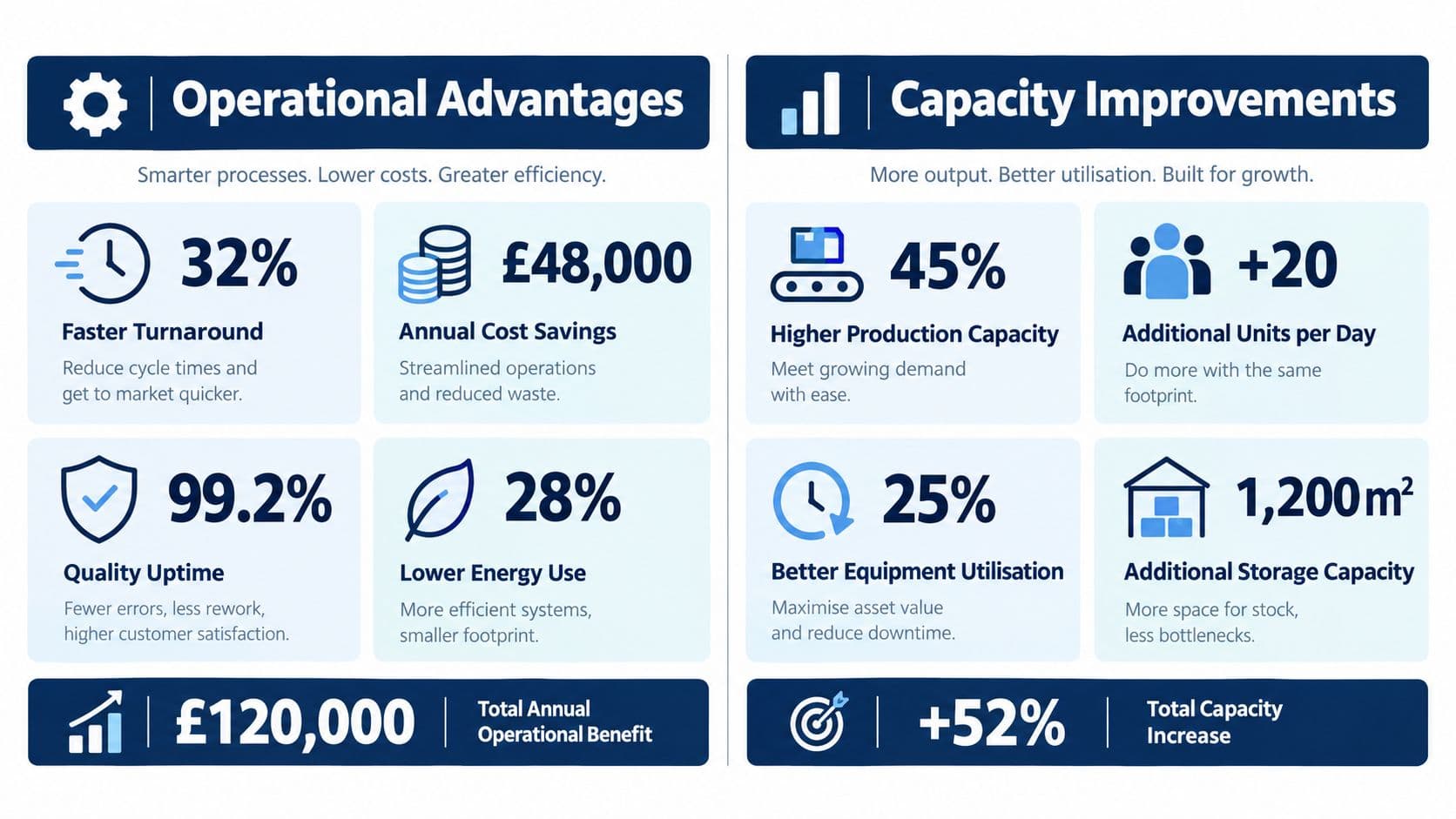
The genuine advantage is capacity, not headcount theatre. When a chatbot handles well structured, repetitive enquiries, agents get time back for cases that need judgement, authentication or empathy. That's triage, and it's where the evidence is strongest.
Where the Productivity Gain Sits
Government Digital Service trial evidence shows agents using AI enabled support tools handled 14% more enquiries per hour, with lower skilled workers achieving a 34% increase while higher skilled workers saw little improvement, and chat resolution rates rose by 1.3%, as set out in the UK Government Digital and Data Benefits Framework.
Read that carefully. The gain concentrates where work is routine and guidance helps newer staff most. It doesn't prove an autonomous bot can replace experienced agents on complex cases. For a scale-up, automate the predictable front door and run agent assistance, suggested replies and summarisation behind it, rather than forcing every customer through self service.
Demand for that front door already exists. The ONS reported in June 2023 that 34% of UK adults had used an AI chatbot in the previous month, and among users 50% used them for customer service, rising to 63% among those aged 70 and over, in the ONS survey of AI uptake and sentiment in the UK.
That older cohort figure is worth sitting with. Customers with the least patience for failed automation are among the most likely to end up in your bot.
Practical Wins Worth Building For
- Out of hours first response: Answer opening hours, delivery windows, password and account guidance when staff aren't available, then queue anything sensitive for morning review.
- Transactional status checks: Order tracking, appointment confirmation and returns eligibility suit deterministic lookups. For a concrete view of that pattern, see how chatbots handle returns and orders in an ecommerce context.
- Guided triage: Collect order numbers, error codes and screenshots before handover so agents start with context, not interrogation.
- Consistent policy answers: Serve the current returns, warranty or onboarding policy from one approved source, rather than relying on memory.
These wins align with broader practical AI solutions for businesses that start narrow and prove value before expanding. The pattern that works is boring on purpose. Pick a small intent set, connect it to authoritative systems, log every conversation, and review failures weekly.
Measure it properly. Separate containment rate from resolution rate. Track recontact within a sensible window, escalation completion, and outcomes by case complexity. If containment rises while recontact rises faster, you haven't improved service. You've hidden demand.
Drawbacks, Hallucinations, and the Trust Deficit
Fluent text is not evidence of correctness. That's the central technical risk, and vendors who demo well often underplay it. A language model allowed to answer beyond its verified knowledge boundary will eventually invent a policy, a price or a process, and your organisation owns the consequence.
Error Amplification in Plain Terms
UK Government analysis warns that large language models can hallucinate fabricated information, and its consumer evidence is blunt: 68% of surveyed consumers said AI chatbots had not met expectations over the previous five years, only 5% considered them more effective than expected, and 69% identified failure to understand emotional cues as a sign they were interacting with AI, according to the UK Government review of agentic AI and consumers.
That last figure matters operationally. Complaints, bereavement, vulnerability, billing distress and safety issues aren't information retrieval problems. Route them to a bot that can't read the room and you've signalled you didn't care enough to staff the moment properly.
A fabricated answer also travels further than a slow honest one. Customers quote it back, screenshot it and treat it as policy in disputes, so a single wrong output can become a refund argument, a formal complaint or a churned account. The error doesn't stay inside the conversation. It lands on an agent's desk, often with interest.
Privacy and the Preference for People
In the ONS July to October 2023 survey, 72% of adults identified use of personal data without consent as a negative impact of AI, 68% said AI could make it harder to distinguish fake information, and 60% believed it could increase cybercrime risk, in the ONS survey on public awareness and expectations about AI. Research Live reported a September 2023 survey of 2,000 UK adults where 44% distrusted information from chatbots, 74% preferred speaking with a real person, and 53% were concerned about data privacy, in Research Live reporting on trust in AI chatbots.
- Consent and minimisation: Don't ask for data the task doesn't need. Don't retain transcripts longer than your stated purpose requires.
- Security exposure: Chat is an attractive place for users to paste account details, health information or payment data. Filter it, redact it and warn against sharing it.
- Hidden staff burden: Every confident wrong answer becomes exception work for agents, who must apologise, correct records and rebuild trust. That cost never appears in the vendor's ROI model, but it shows up clearly in your staffing plan.
Many stalled programmes trace back to these governance gaps rather than model choice, a pattern explored in reasons AI integration projects stall in practice. If legal, support and data protection teams aren't in the room before launch, they'll be in the incident review after it.
Practical rule: If an answer could change money, rights, health or access to a service, require a verified source or a human. No exceptions for fluency.
Comparing Rules-Based and AI-Driven Architectures
Choosing between rules based and AI driven systems isn't a maturity contest. It's a risk decision based on how predictable user intent is, how fast your content changes, and how much damage a wrong answer causes.
Rules Based Systems
A rules based chatbot follows decision trees, buttons and keyword triggers. It can only say what you've scripted, which is a limitation and a safeguard. For appointment booking, store locators, simple eligibility checks or structured data capture, that determinism is valuable. Auditors can review every path. Product teams can test every branch.
The cost shows up in maintenance and brittleness. Users phrase things unexpectedly, new intents appear, and trees sprawl. Without disciplined pruning, customers hit dead ends and learn to type "agent" immediately. Tools in this category, from basic website widgets to decision tree builders in platforms such as Intercom or Zendesk, suit narrow journeys where the next step is always known.
AI Driven Systems
An AI driven chatbot uses natural language understanding and, increasingly, retrieval augmented generation over your knowledge base. It handles varied phrasing and multi part questions far better, and it scales across large help centres without scripting every path. Platforms built on models from providers such as OpenAI or Anthropic, or support products with embedded generative features, fit information heavy use cases.
The trade off is control. You gain coverage and lose certainty unless you add retrieval from version controlled sources, citation requirements, confidence thresholds and refusal behaviour for out of scope questions. Evaluation also gets harder. You're not testing branches, you're sampling outputs, red teaming prompts and monitoring drift as content changes.
Consider three decision criteria before you commit.
- Predictability of intent: If users want one of a few transactions, choose rules. If they ask open ended questions across many topics, consider AI with retrieval.
- Cost of error: If a wrong answer creates financial, legal or safety exposure, favour deterministic flows and human approval, regardless of how capable the model demos.
- Content ownership: AI doesn't fix a poor knowledge base. If no one owns help content, you'll automate contradictions at scale.
Many effective deployments are hybrids. Rules handle identity checks, payments and bookings through verified APIs. AI handles discovery, summarisation and routing. That combination gives customers natural language at the surface and deterministic control underneath, which is usually the right balance for a scale-up without a large AI governance team.
Implementation Strategies for Hybrid Service Design
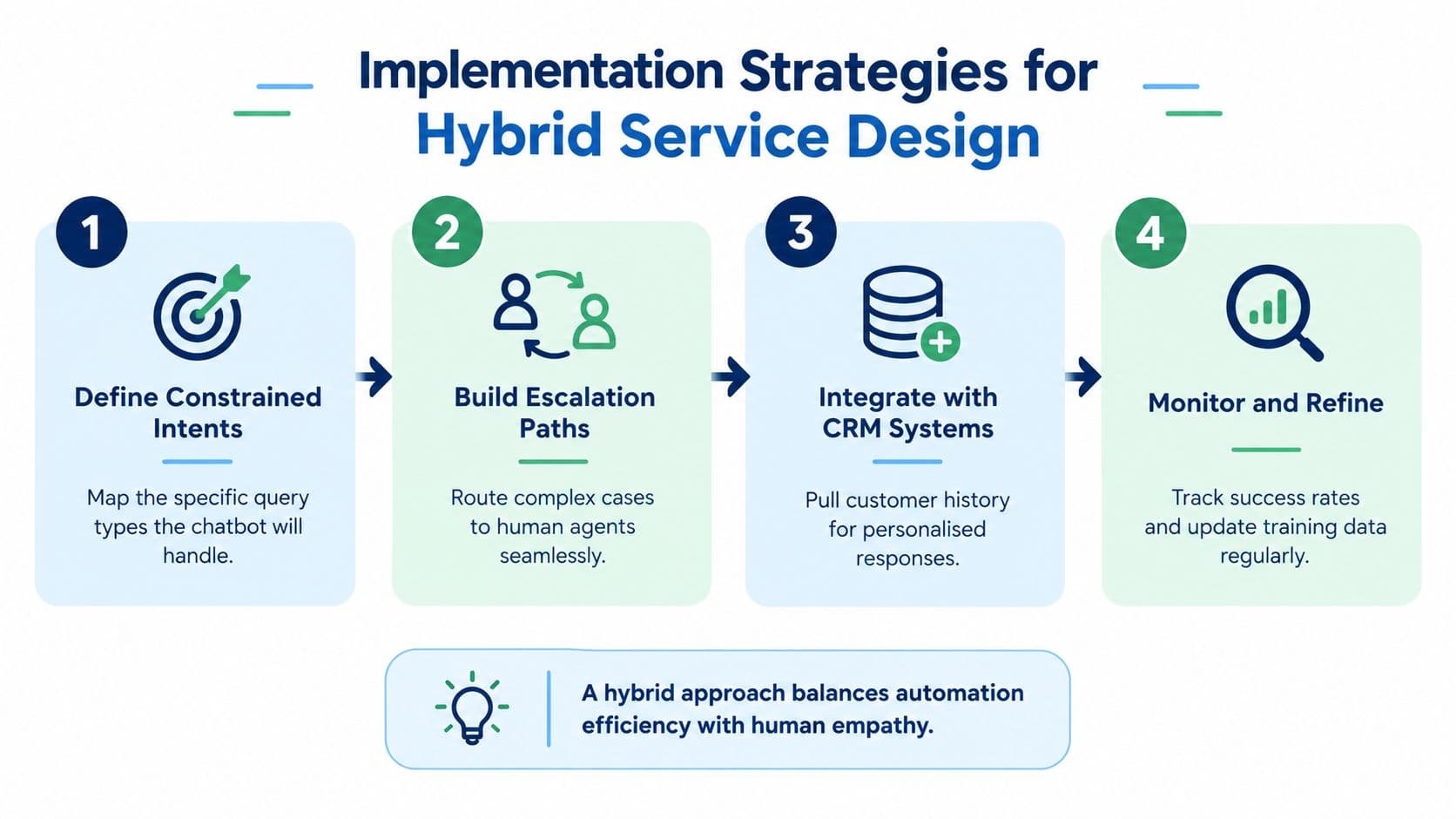
Start with the handover, not the greeting message. If escalation is slow, context free or hidden behind repeated bot prompts, everything else you build will be judged against that frustration.
Build the Boundaries First
- Define a constrained intent taxonomy: List the specific query types in scope, the systems needed to resolve each one, and the exact triggers for escalation. Authentication failures, payment disputes, complaints, vulnerability disclosures and safety concerns should route to people immediately.
- Ground answers in approved sources: Use retrieval over version controlled help articles, policy documents and product data. Require evidence for factual answers and let the bot say it doesn't know.
- Set confidence thresholds: Below threshold, don't improvise. Offer a clarifying question once, then escalate with the transcript, intent guess and any collected identifiers attached.
Public concern supports this caution. DSIT public engagement data shows 74% of people see inaccurate information as an AI risk, 69% are concerned about privacy and security, and 63% worry about job losses, in the DSIT Public Engagement Survey 2025 to 2026. Transparency isn't a compliance garnish. Tell users they're talking to AI, explain what data you collect and why, and make the human route visible from the first message.
Operate It Like a Service
Good implementation follows the same discipline as user centred design for digital products. Test with real tasks, including misspellings, vague requests and adversarial prompts designed to extract personal data or contradict policy. Include agents in testing. They know which customer phrases signal distress, fraud or churn risk long before a model vendor does.
- Monitor the right failure modes: Track unsupported answers, abandonment, repeat contact, complaint rate and escalation completion, segmented by intent and user group.
- Review transcripts weekly at launch: Sample successes as well as failures. Confident, wrong and unchallenged answers are the dangerous category.
- Version everything: Prompts, knowledge sources, thresholds and escalation rules need owners and change history, so you can explain what the bot said on a given date.
Plan workforce change alongside the technology. Agents will handle fewer password resets and more difficult escalations, monitoring and quality review. That's more cognitively demanding work, not less. Staff rotas, training and wellbeing support need to reflect that shift, or you'll burn out the people your hybrid model depends on.
Frequently Asked Questions About Chatbot Deployment
Will a Chatbot Reduce Our Support Headcount
Not automatically, and planning on it is risky. ONS evidence from late September 2025 found 23% of businesses reported using some form of AI, while only 4% of AI using businesses said headcount had decreased because of it, in ONS research into how AI is affecting employment. Many groups redeploy time toward escalations, monitoring and quality work first. Treat any headcount effect as a later workforce design decision, based on resolved demand, not a launch business case.
When Does a Chatbot Make Service Worse
It makes service worse when it blocks access to help, invents policy, or forces vulnerable customers to repeat distressing details to a system that can't act on them. Ambiguous complaints, billing disputes, contractual questions and emotionally sensitive cases need people early. If your bot can't detect those signals reliably, narrow its scope until it can, and keep a prominent human route available at every step rather than after several failed attempts.
How Should Regulated or Sensitive Services Approach This
Start with information and triage, not advice or decisions. Use approved content, clear identity disclosure, strict data minimisation and human approval for anything consequential. Healthcare is a useful test of discipline, so see TOOLii's clinic chatbot guide for a sector specific view of booking and enquiry handling. Whatever your sector, document data flows, retention and escalation ownership before launch, and involve compliance colleagues in transcript review, not just sign off.
What Should We Measure in the First Ninety Days
Measure resolution, not activity. Track whether the customer's issue was solved, whether they contacted you again, how often escalation completed without repetition, and how accuracy performs on your highest impact questions. Segment by intent and complexity so easy wins don't hide harmful failures. Review agent workload and training needs alongside customer metrics, because a bot that improves dashboards while exhausting your escalation team isn't succeeding sustainably.
Final Thoughts and About the Author
The balanced view of the pros and cons of chatbots is conditional. Deploy one as a bounded interface to authoritative systems, with clear disclosure, verified content and a humane escape route, and it can improve capacity and responsiveness. Deploy one as an autonomous replacement for a service team, measured only on deflection, and you'll likely trade visible cost for hidden rework and lost trust.
Before you launch, confirm your in scope intents, content owners, escalation staffing, data retention and failure metrics. If you're scoping that work, explore Arch AI services for product teams, review relevant delivery experience such as the H2OiQ product case study, or contact Arch to discuss your roadmap.
About the Author
Hamish Kerry is the Marketing Manager at Arch, where he's spent the past six years shaping how digital products are positioned, launched, and understood. With over eight years in the tech industry, Hamish brings a deep understanding of accessible design and user-centred development, always with a focus on delivering real impact to end users. His interests span AI, app and web development, and the widely expected potential of emerging technologies. When he's not strategising the next big campaign, he's keeping a close eye on how tech can drive meaningful change.
Hamish's LinkedIn: Hamish Kerry on LinkedIn
If you're weighing a chatbot against the trust of your customers and the workload of your team, Arch can help you scope a hybrid service that automates safely and escalates well. Talk to us about discovery, AI product design and build, and we'll help you ship something users can rely on.