



Predictive Analytics: A Strategic Guide for Leaders.
Unlock the power of predictive analytics. Our guide explains core concepts, use cases, and implementation for product and tech leaders.
Predictive Analytics: A Strategic Guide for Leaders.
Predictive analytics is now central to UK decision-making. In the UK, it held 40.07% of the data analytics market by revenue share in 2025, making it the largest segment according to Grand View Research's UK data analytics market outlook.
- The value isn't the model alone. The real return comes when predictions change workflows, prioritisation, pricing, service delivery, or risk handling.
- Most projects succeed or fail before modelling starts. Problem definition, data quality, governance, and operational ownership matter more than algorithm hype.
- Leaders need a delivery roadmap, not a glossary. Strong projects move from a narrow business question to usable data, controlled testing, validation, and monitored production rollout.
- Data quality is non-negotiable. Poor accuracy, timeliness, or representativeness will undermine forecasting even when the engineering looks sophisticated.
- Ethics and compliance need design decisions early. In regulated sectors, predictive analytics can create real risk if bias, explainability, and review processes are left until launch.
- The right partner reduces waste. Product strategy, technical delivery, and adoption planning need to work together if a model is going to produce commercial value.
Our review of insurance apps for customers, agents and underwriting shows how one regulated sector is using predictive analytics in its products.
Introduction Turning Data into Foresight
Predictive analytics accounted for 40.07% of the UK data analytics market by revenue share in 2025, making it the largest segment in the category. That scale signals a clear shift. Predictive analytics is now part of mainstream digital strategy, not a niche capability reserved for large enterprise innovation teams.
For product leaders, CTOs, and operations teams, the practical question is simple. Can your organisation use its data early enough to change an outcome before the cost lands? That might mean intervening before a customer churns, spotting demand changes before stock or staffing falls out of line, or identifying risk before it turns into delay, waste, or compliance exposure.
Predictive analytics helps teams turn historical data into decision support. The commercial value does not come from the model on its own. It comes from what the business does differently once a likely outcome is visible.
In practice, that usually means embedding predictions into a workflow. A service team can prioritise high-risk cases first. A product team can target retention work at the users most likely to drop off. A finance or operations team can plan around likely demand instead of reacting after the fact.
Practical rule: If a prediction doesn't change a decision, it doesn't create business value.
That is the point many organisations miss. They fund data science work, but leave ownership, process change, and success metrics unresolved. The result is familiar. A promising prototype, an interesting dashboard, and very little commercial return.
The stronger approach treats predictive analytics as a product and operating decision, not just a modelling task. Start with one decision that is expensive, frequent, and measurable. Use the simplest model that can improve it. Put governance, data quality, and operational ownership in place early, because those factors shape ROI long before model tuning does.
That is the business case for predictive analytics. Better foresight is useful. Better decisions at the right moment are what produce value.
What Is Predictive Analytics Really
Predictive analytics is often explained too narrowly, as if it were just a machine learning exercise. It's better understood as a decision support capability. You take historical data, identify patterns, and use those patterns to estimate likely future outcomes.
In UK public sector practice, predictive modelling in councils uses statistics and probability to forecast potential outcomes, while descriptive modelling only describes real-world events and their causal factors. That distinction is useful because it keeps the term tied to decision-making.
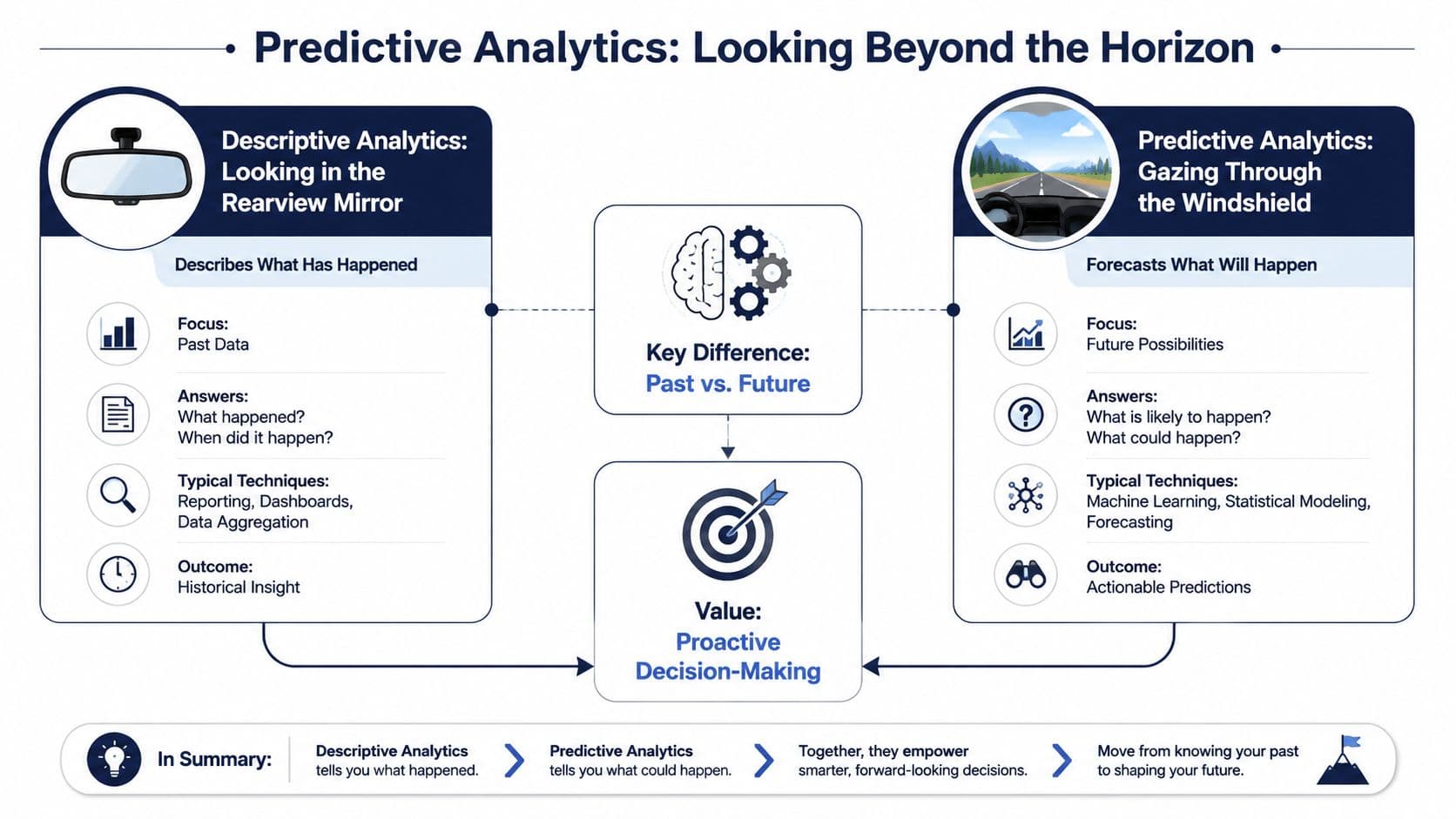
Rear-view mirror, windscreen, and route choice
A simple analogy helps.
Descriptive analytics is the rear-view mirror. It tells you what happened. Sales dropped. Support tickets rose. Users abandoned onboarding at a particular step.
Predictive analytics is the windscreen. It estimates what's likely to happen next. Which users may churn. Which claims are higher risk. Which demand pattern may hit next week.
Prescriptive analytics goes a step further. It informs what action to take. Who should receive outreach first. Which queue should be prioritised. Which intervention is likely to reduce risk.
That middle layer is where many organisations can realize value quickly. They don't need a fully autonomous decision engine. They need better foresight feeding better human choices.
It's forecasting for operations, not fortune-telling
Predictive analytics doesn't “know” the future. It calculates likelihoods from data that already exists. That means every prediction carries assumptions, limitations, and confidence boundaries.
This is why experienced teams avoid overclaiming. A model can estimate the probability of loan default, service demand, or customer drop-off. It cannot remove uncertainty altogether. And when leaders misunderstand that, they push models into use cases where the data doesn't support reliable output.
A practical framing is this:
- Use predictive analytics when patterns exist. If historical behaviour has repeatable structure, forecasting can help.
- Avoid it when the environment is too unstable. If the context changes faster than the data can reflect, model output degrades quickly.
- Use it to improve judgement. Strong systems support people making better calls, and accountability stays with them.
Good predictive analytics narrows uncertainty enough to improve action. It doesn't eliminate uncertainty.
Where it fits in a product strategy
For digital products, predictive analytics becomes useful when it changes an interaction or process. A risk score shown inside a back-office tool. A maintenance forecast triggering earlier action. A customer likelihood model shaping messaging, support, or pricing logic.
That's why product and engineering leaders should care. The point isn't to own a model. The point is to embed foresight into the product experience, operational workflow, or service logic where decisions are made.
The Engine Room How Predictive Models Are Built
Leaders don't need to become modellers, but they do need to understand how predictive systems are assembled. That understanding improves scoping, budget decisions, and delivery governance.
A useful reference point comes from Allied Market Research's description of UK business use of predictive analytics, which notes that organisations use machine learning algorithms including regression analysis, decision trees, and neural networks to forecast future outcomes from historical patterns. Those methods sound technical, but their role is straightforward. They're different tools for learning patterns from past data.
.jpg&w=2048&q=75)
Start with the decision, not the dataset
The first mistake teams make is starting with available data and no business question. A good brief is specific. “Which customers are most likely to cancel in the next renewal window?” is a modelling problem. “Can we do something with AI?” isn't.
Strong delivery usually follows this sequence:
- Define the decision. Identify the operational choice the model should improve.
- Acquire relevant data. Pull the data sources that relate to the outcome.
- Prepare the data. Clean errors, align formats, fill gaps, remove duplicates.
- Engineer useful features. Turn raw fields into variables that carry signal.
- Train and test the model. Compare approaches against held-out data.
- Deploy into workflow. Make predictions usable inside a real product or process.
- Monitor performance. Watch for drift, bad inputs, and changing behaviour.
Each stage matters because predictive analytics is cumulative. Weakness at the beginning usually compounds later.
What the common model types are good at
Not every problem needs the same method.
Regression models are often a sensible starting point when you need a clear baseline and a relatively interpretable output. They're useful when the relationship between inputs and outcomes is stable enough to model cleanly.
Decision trees work well when business rules and branching logic matter. They can be easier to explain to non-technical stakeholders because they mirror familiar decision paths.
Neural networks can capture more complex patterns, especially where interactions between variables are less obvious. They can be powerful, but they often need stronger data foundations and tighter validation discipline.
Maths aside, the leadership question is simple. Which method gives enough predictive value, enough explainability, and enough maintainability for the use case?
Data preparation usually takes more effort than modelling
This is the part most non-technical stakeholders underestimate. Teams spend substantial time turning operational data into model-ready inputs. Categories need standardising. Missing values need handling. Dates need consistent logic. Text labels may need encoding into machine-readable form.
If your team is working with categorical variables such as product types, user plans, channels, or status labels, RapidNative one hot encoding insights offer a useful practical walkthrough of a common preparation step. It's a good example of how “small” preprocessing decisions can materially affect model performance and reliability.
Leadership check: Ask where the training data came from, how it was cleaned, and who validated the labels. Those answers matter more than hearing the name of the algorithm.
Real-World Impact Use Cases and Measuring ROI
The UK market projection tells its own story. The UK predictive analytics market is projected to reach between USD 463.1 million and USD 3,930 million by 2035. Read that as a signal of adoption pressure. More organisations are building forecasting capability because the commercial case is getting harder to ignore.
Still, leaders don't buy predictive analytics because the category is growing. They invest because a prediction improves revenue protection, efficiency, service quality, or risk management.
Use cases that create practical business value
In finance, predictive analytics often supports risk scoring, fraud review, arrears prioritisation, or loan-related forecasting. The strongest implementations don't treat the score as the outcome. They treat it as an input to a reviewed decision process.
In utilities and service operations, forecasting can help teams anticipate demand, prioritise field work, and identify customers or assets that need intervention sooner. The payoff often comes from better sequencing and resource allocation rather than a dramatic front-end feature.
For workforce and operations platforms, likely outcomes can shape scheduling, staffing pressure management, support triage, or retention planning. These are often good candidates because there's a clear operational loop. A prediction can trigger a real action.
How to think about ROI without falling for vanity metrics
The cleanest ROI cases usually share three traits:
- A costly decision already exists. Teams are already spending money, time, or attention on it.
- Historical outcomes are visible. You can compare predicted risk against what later happened.
- There's a workable intervention. Staff can act on the signal in a repeatable way.
That means your measurement framework should follow the workflow, not the model alone. For example, if you're predicting churn, the useful metrics may include retention after intervention, reduction in wasted outreach, and improved prioritisation of customer success effort. If you're forecasting maintenance, the value may show up in avoided downtime, better scheduling, or reduced emergency response.
The model score is not the return. The changed behaviour after the score is where return appears.
What good commercial framing looks like
A practical business case usually starts with one narrow use case and one decision owner. It asks:
- What is the decision today?
- What does it cost when that decision is wrong?
- What data already exists to improve it?
- What action becomes possible if we can rank risk or forecast demand earlier?
- How will the team measure whether the prediction changed outcomes?
That approach is far more useful than trying to justify an enterprise-wide AI strategy in the abstract.
For teams exploring adjacent forecasting models, markets, and signal-driven product concepts, prediction market platform development is an interesting specialist read. Not because every business needs a prediction market, but because it shows another way forecast signals can be structured into a working digital product.
What doesn't produce value
Some predictive analytics projects fail for boring reasons. The target outcome is vague. Nobody owns the operational response. The model isn't integrated into the product people already use. Or the business can't tell whether the prediction improved anything.
When that happens, teams blame the modelling. More often, the issue was product design and implementation discipline.
Laying the Foundation Data and Infrastructure Needs
Predictive analytics doesn't break because teams lack ambition. It breaks because inputs are messy, stale, biased, fragmented, or operationally inaccessible.
The Local Government Association's guidance is one of the clearest statements of this. It notes that the accuracy of predictive analytics models in UK local public services depends on nine data quality factors: accuracy, completeness, uniqueness, timeliness, validity, sufficiency, relevancy, representativeness, and consistency. That framework applies well beyond councils. It's a reliable standard for any organisation considering predictive systems.
The nine factors are operational, not academic
These factors shouldn't sit in a governance document nobody reads. They should shape delivery choices.
Accuracy asks whether the underlying values are correct.
Completeness asks whether important fields are missing.
Uniqueness guards against duplicates that distort outcomes.
Timeliness matters because old signals can drive bad decisions.
Validity checks whether data conforms to expected rules.
Sufficiency asks whether there's enough data to support the task.
Relevancy forces focus on inputs that matter.
Representativeness checks whether the data reflects the population you're making decisions about.
Consistency makes sure the same thing means the same thing across systems.
A team can have modern tooling and still fail on these basics.
Infrastructure needs to support repeatability
A workable predictive analytics stack doesn't need to be extravagant. It needs to be dependable.
That usually means:
- Reliable ingestion pipelines: data arrives consistently from source systems
- Storage with governance: raw and processed data are separated and traceable
- Processing capability: teams can clean, transform, and test data efficiently
- Deployment paths: predictions can reach the app, dashboard, API, or workflow where action happens
- Monitoring: the business can detect data issues, drift, and degraded outputs
The operating model matters too. Data engineers, analysts, domain experts, product owners, and machine learning specialists all play different roles. If one of those roles is missing, quality often slips somewhere nobody notices until late.
Buyer data is only useful if it's usable
A lot of commercial teams assume they have enough customer data because they have a CRM, analytics events, and campaign history. That's rarely the whole picture. The harder question is whether those signals are clean enough, connected enough, and permissioned correctly enough to support prediction.
Arch has written a useful piece on leveraging buyer data that fits this reality. The important takeaway is that more data isn't automatically better. Better-structured, better-governed data is what makes downstream forecasting credible.
Weak data foundations don't just lower model quality. They create false confidence, which is worse.
Your Implementation Roadmap From Discovery to Production
The most effective predictive analytics programmes are run like product initiatives with governance, milestones, and clear ownership. They aren't treated as isolated experiments handed to a data science team and reviewed at the end.
Google's high-level framework is useful here. It describes five steps in building predictive analytics systems: defining the problem, acquiring data, pre-processing data, developing models, and validating results for deployment. For leaders, those same steps can be expanded into a management roadmap.
Phase one and two define whether the project deserves to exist
A predictive initiative should begin with strategic discovery, not model selection. The first task is to define the business problem tightly enough that success is testable.
That means agreeing on the outcome, the user or team who will act on the prediction, and the operational decision the model is expected to improve. If those three things aren't clear, the project usually drifts.
The next stage is data readiness. Teams need to know what systems hold the relevant data, how usable that data is, and whether legal or governance constraints affect the plan. At this stage, many weak projects should stop early. That's healthy. It's cheaper to discover poor readiness than to build a polished failure.
For teams that need a structured start, Arch's perspective on what discovery is is relevant. Good discovery reduces risk by exposing assumptions before delivery cost rises.
Phase three and four prove value before scale
A pilot should answer a narrow question under controlled conditions. It is not a miniature version of full production. It's a test of signal quality, business usefulness, and implementation fit.
Useful pilot outcomes include:
- Signal validation: the data appears predictive enough to justify further work
- Workflow fit: staff or systems can act on the output sensibly
- Risk visibility: bias, quality, and explainability issues become visible early
- Scoping clarity: integration and operational costs are better understood
Once a pilot shows promise, solution development can move forward with firmer constraints. Product, engineering, data, and operational stakeholders need regular alignment at this point. Otherwise the model improves while the adoption plan weakens.
Phase five and six are where many teams lose value
Integration planning isn't admin. It's where the prediction becomes usable.
A score hidden in a data environment nobody checks won't change outcomes. A ranking surfaced at the right point in a case-management flow might. The same model can therefore create very different value depending on where and how it's delivered.
Leaders should review:
- Where the prediction appears
- Who sees it
- What action it triggers
- What override or review process exists
- How the result is logged for later evaluation
This is also the stage where ethical risk needs operational controls. In finance and social impact contexts especially, leaders should ask whether predictions could systematically disadvantage certain groups, whether human review is required, and whether the rationale behind a prediction can be examined when challenged.
Phase seven never ends
Predictive analytics in production is a living system. User behaviour changes. Product changes affect data patterns. Source systems evolve. Policy changes alter the context around the model.
That means teams need ongoing monitoring for data drift, outcome quality, and unintended effects. Review cadence matters. So does ownership. Someone has to be responsible for model health after launch.
A predictive model is not finished at deployment. It enters a maintenance phase with business consequences.
The most mature teams build this expectation in from the start. They budget for iteration, define escalation routes, and treat retraining or recalibration as part of normal product operations.
Partnering for Success with Arch
By the time most organisations seriously consider predictive analytics, they've already learned one thing. The challenge isn't understanding the headline idea. It's connecting strategy, data, governance, engineering, and product design tightly enough that predictions become useful in practice.
That's why delivery partnership matters. A strong partner helps narrow the use case, pressure-test the data, shape the user journey around the prediction, and plan how outputs will be governed once live. Without that connective work, teams often end up with a technically interesting model and no dependable route to value.
For businesses building AI-enabled digital products, Arch's AI software development solutions are one route to that kind of delivery support. The practical advantage of working this way is that predictive capability isn't treated as a bolt-on model. It's designed into the product, workflow, and rollout plan from the beginning.
The same principle applies whether you're forecasting risk in a finance product, prioritising operational activity in a service platform, or adding intelligence to a web or mobile experience. Product thinking matters as much as modelling. Teams need to decide where predictions appear, what confidence threshold matters, when people can override the output, and how the effect will be measured after release.
A useful partner should also be comfortable saying no. Not every use case is ready. Sometimes the correct move is to improve data collection first. Sometimes it's to run a narrow pilot. Sometimes it's to redesign the workflow before any machine learning work begins.
The organisations that get value from predictive analytics tend to do three things well:
- They stay narrow at the start. One decision, one user group, one measurable outcome.
- They build governance into delivery. Data quality, fairness, review, and accountability are part of the implementation, not an afterthought.
- They focus on adoption. If teams don't trust or use the output, the project won't earn its keep.
Predictive analytics is powerful when it helps people act earlier and with better judgement. That's a product and operational challenge as much as a technical one.
Frequently Asked Questions
Is predictive analytics only useful for large enterprises
No. Smaller organisations can benefit if they focus on one expensive or repeated decision. A scale-up doesn't need a vast data science department to start. It needs a clear use case, usable historical data, and a workflow where a prediction changes action. In practice, SMEs often do well when they start with demand forecasting, lead prioritisation, churn risk, or operational triage rather than attempting a broad AI transformation programme.
What's the difference between predictive analytics and machine learning
Machine learning is a set of techniques. Predictive analytics is the business capability those techniques can support. Some predictive systems use machine learning, while others may use simpler statistical methods. The key question isn't which label to use. It's whether the system helps estimate a future outcome well enough to improve a business decision. Leaders should care more about usefulness, explainability, and reliability than terminology.
How much data do you need before starting
There isn't a universal minimum because the answer depends on the use case, the stability of the pattern, and the quality of the labels. What matters most early on is whether the available data is relevant, representative, and usable. A smaller but well-structured dataset can be more valuable than a large messy one. Before building anything serious, teams should audit the inputs and test whether they contain predictive signal.
How do you know if a predictive model is working in production
You track more than technical performance. Teams should monitor whether the model is still receiving clean inputs, whether prediction quality remains stable, and whether the prediction is changing operational outcomes. A model may continue running while creating less value because user behaviour changed or staff stopped acting on it. That's why production monitoring needs both technical checks and business outcome reviews on a recurring basis.
Can predictive analytics create compliance or ethical risk
Yes, especially in regulated or high-impact sectors. If historical data contains bias, the model can reproduce that bias at scale. Risks also increase when teams cannot explain outputs, document review logic, or show how human oversight works. Good governance means identifying harm scenarios early, testing for unfair patterns, and deciding where manual review is required. Ethical design isn't separate from implementation. It's part of responsible product delivery.
About the Author
Hamish Kerry is the Marketing Manager at Arch, where he's spent the past six years shaping how digital products are positioned, launched, and understood. With over eight years in the tech industry, Hamish brings a deep understanding of accessible design and user-centred development, with a focus on delivering real impact to end users. His interests span AI, app and web development, and the potential of emerging technologies. When he's not strategising the next big campaign, he's keeping a close eye on how tech can drive meaningful change.
Hamish's LinkedIn: Hamish Kerry on LinkedIn
If you're exploring how predictive analytics could fit into a product, service, or internal workflow, talk to Arch. The right starting point is usually a focused discovery process that tests the use case, data readiness, and delivery path before you commit to a full build.