



Rapid Prototyping Services: The 2026 Ultimate Guide.
Explore rapid prototyping services to turn ideas into reality faster. Our guide covers methods, costs, ROI, and choosing the right partner.
Rapid Prototyping Services: The 2026 Ultimate Guide.
You've got a product idea that feels urgent. It might be a new mobile app, a service portal, an internal tool, or a hardware-enabled product that needs proving before anyone signs off budget. The problem usually isn't the idea itself. It's the gap between a promising concept and something real enough to test, challenge, and improve.
That gap is where teams lose time.
Some organisations stay in PowerPoint too long. Others jump straight into build, then discover they've committed to the wrong feature set, the wrong interaction model, or the wrong assumptions about how the product should work. Rapid prototyping services sit in the middle. Done well, they reduce uncertainty before it turns into wasted design, engineering, and delivery effort.
Your Idea from Concept to Reality Starts Here
Key takeaways
- Rapid prototyping services are a strategic de-risking tool, not just a production step. They help teams validate ideas before committing to full build.
- The service matters as much as the output. You're not buying access to software or machines alone. You're buying judgement, iteration, and structured feedback.
- Speed changes decision quality. Industry guidance notes that rapid prototyping can compress iteration from weeks or months into several days, which helps teams catch issues earlier in the process (GlobalSpec guidance on rapid prototyping).
- The UK market has clear momentum. The global rapid prototyping services market reached USD 4.35 billion in 2024 and is projected to grow at a 13.2% CAGR from 2025 through 2033, while UK adoption has helped reduce product development cycles by up to 50% and cut manufacturing costs significantly (Dataintelo market overview).
- Good prototyping starts with clarity. For physical work, suppliers often need a complete 3D model in STEP or IGES plus 2D drawings with critical dimensions before they can quote accurately.
- Outsourcing often wins when capability is the constraint. Many teams can create rough outputs internally, but functional and production-relevant prototypes usually need broader expertise, stronger workflows, and better material or process choices.
The practical value is simple. A prototype gives decision-makers something concrete to react to. It lets users respond to a flow instead of a promise. It lets technical teams test feasibility before they inherit expensive assumptions.
That's why the strongest teams don't treat prototyping as optional polish. They use it to make sharper decisions earlier, while changes are still manageable.
Practical rule: If a prototype won't answer a real product question, it's probably the wrong prototype.
What Exactly Are Rapid Prototyping Services
A team approves a product idea on Monday, shows rough concepts to investors on Wednesday, and by the following week real users are reacting to something they can click, hold, or test. That speed matters, but speed alone is not the service.
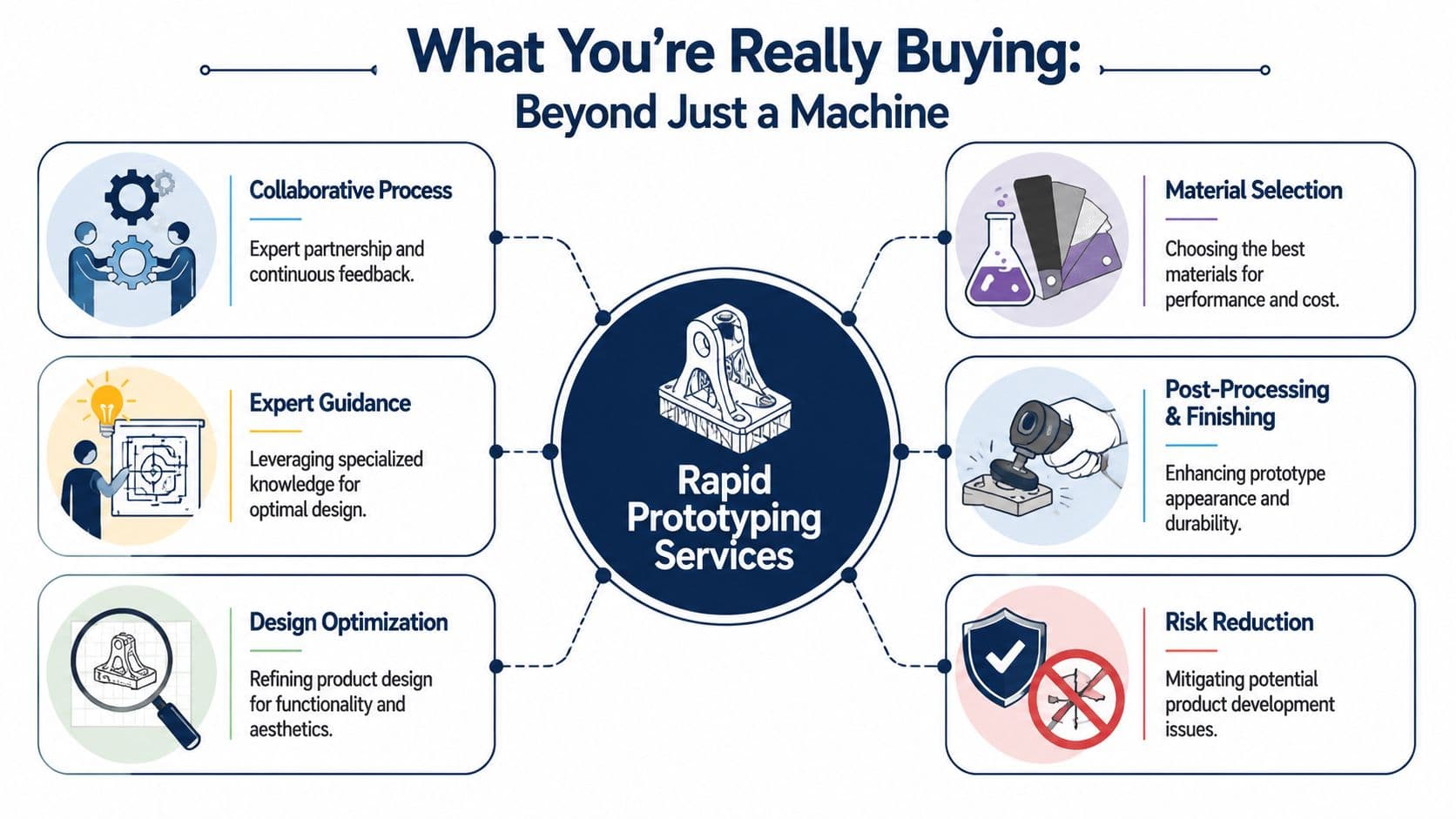
Rapid prototyping services are a structured engagement that helps a business reduce uncertainty before it commits serious budget, engineering time, or manufacturing effort. The output might be a wireframe, a clickable app flow, a CAD-ready model, or a functional part. The primary value comes from the decision support provided: what to test, how realistic the prototype needs to be, what can be ignored for now, and what cannot.
For digital products, that often includes low-fidelity UX concepts, interactive Figma flows, or functional prototypes that prove a user journey end to end. For physical products, it can include CAD review, process selection, material guidance, build preparation, finishing, and inspection. In both cases, the prototype is only one deliverable. The service is the thinking that makes that prototype useful.
/upl
What you're actually paying for
Clients rarely need “a prototype” in the abstract. They need answers.
A good prototyping partner helps define the question first, then scopes the fastest credible way to answer it. That usually means balancing cost, fidelity, and risk. A founder raising capital may need a polished interactive demo that sells the vision. A product team preparing delivery may need a rougher prototype that exposes usability issues. A hardware team may need a part that is ugly but dimensionally accurate enough to test fit and function.
That service usually includes:
- Problem framing: defining the product, user, or technical assumption that needs evidence
- Method selection: choosing the right prototype type, from visual concept to functional or production-relevant model
- Design refinement: resolving avoidable issues before build time gets wasted
- Feedback synthesis: turning stakeholder, user, or engineering input into clear next actions
- Decision support: confirming whether the prototype answered the original question or whether another iteration is justified
This scenario often leads to the failure of weaker engagements. A supplier can deliver exactly what was requested and still leave the client with the wrong learning. Strong service providers challenge the brief when the brief is too broad, too polished, or too early for the decision at hand.
That distinction matters for buyers evaluating partners such as Arch. The job is not only to produce screens or parts quickly. The job is to help startups, scale-ups, and enterprise teams move from assumption to evidence with a workflow that fits commercial pressure, stakeholder expectations, and delivery reality.
Service, not just output
In practice, rapid prototyping works well as a partnership model.
The client brings the business goal, product context, constraints, and decision-makers. The prototyping partner brings method, execution, and judgement. Together, they define scope, agree deliverables, review iterations, and decide whether the prototype should lead to user testing, investor conversations, technical validation, or production planning.
This is also why in-house capability does not automatically replace an external service. A team may have Figma, CAD software, or a 3D printer and still lack the specialist judgement to choose the right fidelity, interpret conflicting feedback, or prepare outputs that are credible enough for testing. Tools help produce artefacts. Services help produce evidence.
Digital and physical prototyping often belong in the same commercial conversation. A connected product may need an app flow, a packaging concept, and a physical enclosure check at the same time. A new internal platform may need a clickable workflow for end users and a service blueprint for operational teams. Treating those as one validation programme usually produces better decisions than splitting them into isolated workstreams.
If you're working on an app-led product, early prototype work often feeds directly into later mobile app development services, especially when interaction, usability, and technical feasibility need proving together. For a short first step, a Kick Start engagement turns an idea into a scope and a high-fidelity prototype.
A strong prototyping service does more than show what the product could be. It helps a business decide what deserves to be built next.
The Prototyping Service Workflow Step by Step
A typical engagement starts with pressure. A founder needs something credible for investor conversations in ten days. A product lead needs proof that a workflow makes sense before committing delivery budget. An innovation team needs to test a physical concept without spending months on engineering. The service works when the prototype is tied to that decision from day one.
/u
.jpg&w=2048&q=75)
Step one to three
- Initial discovery and goal setting
The first session should clarify the commercial context, the constraint that matters most, and the decision the prototype needs to support. That usually means getting founders, product owners, technical leads, and operational stakeholders to agree on one priority. Teams that skip this step often ask for a prototype that tries to do four jobs at once. If you need a clearer view of this stage, our guide to product discovery for digital products sets out what good early alignment looks like. - Scope the prototype around a decision
Good scoping is less about features and more about evidence. The right brief sounds like this: test whether users understand the value proposition, confirm the service flow with internal teams, or check whether a housing fits around the core components. The wrong brief is “build a prototype of the whole thing.” That usually produces more output, more opinions, and less clarity. - Choose fidelity and format
The format should match the question. A low-fidelity wireframe can be enough for workflow validation. A polished clickable prototype may be better for customer research or stakeholder buy-in. A coded proof of concept, CAD model, or functional physical prototype makes sense when feasibility, fit, or behaviour needs testing. Experienced partners guide this choice because higher fidelity costs more and does not necessarily produce better learning.
Step four to seven
- Build the first version
This phase should be fast, but controlled. The goal is to create the minimum artefact that can stand up to the review it needs to face, whether that is a user session, technical assessment, internal demo, or investor meeting. In practice, strong service teams keep clients close during build so small corrections happen early, before time is wasted polishing the wrong thing. - Test with the right people
Review quality matters more than review volume. Senior stakeholders may judge strategic fit. End users expose friction and confusion. Engineers and delivery teams spot feasibility risks that a design-only review can miss. A prototype shown only to the internal project team rarely tells a business enough to justify the next investment. - Iterate deliberately
Feedback needs triage. Some comments reveal a real pattern. Others reflect personal preference or a misunderstanding that does not affect the core decision. A strong prototyping partner filters that input, updates what matters, and protects the scope from expanding every time a new opinion enters the room. - Decide the next investment level
This is the point of the service. The engagement should end with a decision and a recommendation, not just a file handover. That may mean proceeding to MVP, refining the proposition, running another test cycle, preparing for technical discovery, or stopping work because the evidence is weak. Stopping early is sometimes a good outcome because it prevents a larger mistake later.
What the client should expect to receive
A good prototyping engagement produces more than screens, models, or mock-ups. The useful outputs usually include:
- A clear validation objective
- A record of the assumptions tested
- Review findings from users, stakeholders, or technical teams
- A summary of what changed between iterations
- A recommendation for the next stage of product, design, or engineering work
- Files or assets that can be reused in delivery where appropriate
That is the difference between buying a prototype and using prototyping as a service. One gives you an artefact. The other gives you evidence, direction, and a clearer basis for investment.
Common Prototyping Methods and Materials
A team trying to answer the wrong question often picks the wrong prototype. The result is familiar. They spend money on finish when they needed evidence on usability, or they test desirability with something too rough for stakeholders to take seriously.
Good rapid prototyping services prevent that mismatch. The job is not to push a preferred tool or process. It is to match the method and material to the decision the client needs to make, then package the output in a form the business, design, and engineering teams can use.
Physical methods for form, fit, and function
FDM is usually the fastest route to a physical artefact when the goal is early validation. It works well for concept models, enclosure checks, and practical workshop items such as jigs or fixtures. It is often the right choice when speed and cost matter more than finish.
SLA suits prototypes that need cleaner surfaces and finer visual detail. Teams often use it for presentation models, interface parts, or stakeholder reviews where shape, proportion, and finish affect the feedback.
CNC machining is a better fit when tolerances, load, or material behaviour need to be closer to production reality. If a part must fit precisely, survive handling, or support assembly testing, machined components usually give a more reliable answer than printed plastic.
The trade-off is simple. FDM gets answers quickly. SLA improves visual quality. CNC improves realism for functional testing. A good service partner helps clients avoid paying for production-grade fidelity before the product has earned it.
Digital methods for product teams
A large share of rapid prototyping work now supports digital products more than physical ones. That changes the toolkit, but not the principle. The method still needs to match the risk.
A common progression looks like this:
- Low-fidelity wireframes for validating structure, task flow, and priority
- High-fidelity Figma prototypes for testing interaction, messaging, and stakeholder understanding
- Functional prototypes built in tools or frameworks such as Flutter when realistic behaviour matters
- Technical proofs of concept for testing integrations, data handling, or performance risk
Teams that want a clearer view of where each stage fits can use this guide to prototyping in design, especially when deciding whether they need a design artefact, a coded prototype, or both.
The right method proves the highest-risk assumption without wasting budget on detail that does not change the decision.
Materials and method choice
Material choice should reflect the test environment, not wishful thinking. A visual review may only need a representative shape and finish. A fit test, stress test, or assembly check often needs a more representative material or process.
Three questions usually expose the right level of fidelity:
- What decision needs to be made after this prototype?
- Who needs confidence in the result?
- What type of failure needs to show up early?
Service quality matters here as much as method choice. A strong partner does not just ask for a file and send back a model. They challenge the brief, confirm tolerances, flag unrealistic assumptions, and define what "good enough" looks like for the stage you are in.
For physical quoting, handover quality still affects speed and accuracy. Clear 3D files, usable drawings, and identified critical dimensions reduce avoidable back-and-forth and lower the risk of getting a prototype that answers the wrong question.
Evaluating the Business Benefits and ROI
A team approves a build budget on the strength of a promising deck. Six weeks later, basic user testing shows the core journey is confusing, the handoff between systems is harder than expected, and the first release is carrying features nobody can justify. Rapid prototyping services reduce that kind of waste by creating evidence before the expensive work begins.
The business case is decision quality. A good prototype gives product, engineering, commercial, and leadership teams something concrete to react to. That shortens debate, exposes risk earlier, and makes investment choices easier to defend.
.jpg&w=2048&q=75)
Where the return usually comes from
ROI usually appears through avoided cost and better sequencing, not through the prototype itself.
- Avoided rework: catching the wrong workflow, interaction, or component design before delivery teams build around it
- Faster alignment: reducing internal review cycles because stakeholders can assess something tangible instead of debating assumptions
- Better prioritisation: proving which features affect adoption, conversion, or usability, and which ones can wait
- Stronger buy-in: giving investors, senior sponsors, or procurement teams a clearer basis for approval
- Cleaner MVP scope: preventing version one from absorbing too much complexity too early
For digital products, this is often where a prototyping partner adds more value than a supplier who only produces artefacts. The work should shape release logic, delivery scope, and confidence in the first launch. Teams weighing those decisions often benefit from the thinking outlined by an MVP development company, especially when they are deciding what must be proven before build starts.
In practice, the return is rarely isolated to one department. Product gets sharper evidence. Engineering gets fewer late changes. Commercial teams get a clearer story to take to market. Finance gets a stronger rationale for spend.
What weakens ROI
Poor returns usually come from weak briefs and the wrong level of fidelity.
- Overbuilding too early: commissioning a polished prototype when a lower-fidelity version would answer the question
- Testing with the wrong audience: collecting feedback from internal reviewers instead of actual users, buyers, or operators
- Skipping success criteria: finishing the prototype without defining what decision it needs to support
- Treating the prototype as the product: confusing validation work with delivery readiness
A prototype creates value when it helps you avoid a larger mistake.
The service model matters here. A strong partner does not just make screens, models, or demos. They help define the learning goal, recommend the right fidelity, structure feedback, and turn results into a next-step recommendation. That is where businesses see better ROI. Not from volume of output, but from clearer choices at each stage.
A simple ROI test works well. Ask three questions. What decision will this prototype influence? What cost could that decision help avoid? What is faster learning worth if it shortens time to launch or prevents the wrong build? If those answers are vague, the brief needs more work before any prototype starts.
How to Choose the Right Prototyping Partner
A weak prototyping partner gives you artefacts. A strong one gives you direction, evidence, and a clear next move.
That difference matters most when the stakes are commercial, not just technical. A startup may need a testable product story before fundraising. A scale-up may need to validate a feature without slowing the roadmap. An enterprise team may need to align product, compliance, operations, and procurement before any build decision gets approved. In each case, the service model matters as much as the prototype itself.
What to check first
Start by assessing how they think.
A good partner should be able to challenge the brief, narrow the scope, and explain what decision the work is meant to support. If the first conversation stays fixed on tools, timelines, or output formats, that is usually a warning sign. Good prototyping services are structured around questions, risks, and learning priorities.
Check for four things early:
- Relevant product context: experience with similar user journeys, business models, or delivery constraints
- Problem framing: the ability to identify what needs testing first, instead of accepting every request at face value
- Method flexibility: enough range to recommend the right fidelity and format for the job
- Working style: clear communication, sensible milestones, and a process your team can work with
For digital products, case studies often tell you more than a long service list. Reviewing work such as Findr or Deploy helps you judge whether a studio can handle user flow, product logic, and delivery quality in a real business setting.
.jpg&w=2048&q=75)
Questions worth asking in the first meeting
The first call should tell you how the engagement will run.
Ask questions that reveal judgment, not sales polish:
- What assumptions would you test first, and why?
- What prototype fidelity do you recommend for this stage?
- Who needs to be involved on our side for the work to stay useful?
- What deliverables will we receive beyond the prototype?
- How will findings be documented and turned into a recommendation?
- Under what conditions would you advise us to stop, change direction, or reduce scope?
Strong answers are specific. They should reflect trade-offs between speed, realism, stakeholder needs, and cost. If a provider promises to do everything at once, that usually leads to wasted effort or a polished prototype that is still unusable for decision-making.
Outsource or build in-house
This choice is rarely about software access alone. It is about speed, objectivity, specialist capability, and whether your internal team has enough distance to challenge assumptions.
Outsourcing tends to make sense when the work needs a structured validation process, cross-functional facilitation, or prototype quality that internal teams cannot produce quickly without disrupting delivery. It also helps when political weight matters. External partners can often bring sharper alignment because they are expected to define scope, expose gaps, and document decisions in a way internal teams sometimes cannot.
As noted earlier, many firms still lack the in-house expertise, materials range, or qualification workflows needed for functional, production-relevant prototypes, which can make outsourcing the faster route to useful learning (Digital Leadership on prototyping capability gaps).
A strong partner will be transparent about fit. They should tell you when a lightweight in-house test is enough, when external support can speed things up, and what success looks like at the end of the engagement. That is the standard to look for: sound judgment across the full service as well as output capacity.
Frequently Asked Questions About Prototyping
Is rapid prototyping only relevant for physical products
No. It is just as useful for digital products, especially when a team needs evidence before committing design and engineering time. A clickable app flow, a service walkthrough, or a technical proof of concept can all act as prototypes if they help answer a real product question.
For digital teams, the service matters as much as the artifact. The value often comes from how a prototyping partner frames the test, defines the learning objective, and turns feedback into a clearer delivery plan.
How polished should a prototype be
A prototype should be polished enough to support the decision in front of you. Rough wireframes can be enough for testing structure or task flow. Higher fidelity is often justified when the goal is stakeholder approval, customer testing, or investor conversations.
Over-finishing too early is a common mistake. Time spent on surface detail should produce better evidence, not just a better-looking prototype.
Is outsourcing still worth it if we can prototype in-house
Often, yes. Internal teams can usually handle early sketches and lightweight validation, but service partners add value when the work needs speed, structured facilitation, specialist skills, or tighter decision-making.
That trade-off is usually commercial, not ideological. If in-house work delays learning, pulls senior product and engineering people away from delivery, or produces weak test conditions, external support can save time and reduce waste.
What should we prepare before asking for a quote
Bring a clear problem statement, the assumptions you need to test, the audience involved, and the timing constraints. That gives a prototyping partner enough context to recommend the right scope instead of guessing based on enthusiasm alone.
For physical products, 3D files, dimensions, tolerances, and intended materials make pricing more accurate. For digital products, user flows, feature priorities, existing research, and examples of comparable experiences help define the engagement and the likely deliverables.
How many iterations should we expect
Expect more than one cycle. In practice, most useful engagements include an initial prototype, a review phase, and one or more focused revisions based on what the team learned.
The number matters less than the discipline behind each round. Good iteration has a reason, a decision owner, and a stopping point.
What's the difference between a prototype and an MVP
A prototype helps teams learn before they commit. An MVP is a real product release with enough stability for live users.
That difference affects who should be involved and what the output needs to do. Prototypes can cut corners in code, scale, and completeness if they still answer the right question. MVPs cannot. Strong teams use prototyping services to narrow MVP scope, reduce rework, and enter delivery with fewer unresolved assumptions.
Can rapid prototyping help with internal stakeholder alignment
Yes. It often helps faster than another round of meetings or requirement documents.
A prototype gives leadership, product, engineering, operations, and commercial teams something concrete to react to. That shifts the conversation from opinion to evidence. It also exposes disagreement early, while changes are still cheap.
If you are assessing rapid prototyping services for a new app, platform, website, or AI product, the right partner should help you do more than produce a mockup. They should clarify the brief, choose the right method, define the learning goal, and leave your team with a clearer path into delivery. Arch works with startups, scale-ups, and enterprise teams on that basis, turning early product ideas into testable outputs and actionable next steps.
About the Author
Hamish Kerry is the Marketing Manager at Arch, where he has spent the past six years shaping how digital products are positioned, launched, and understood. With more than eight years in the tech sector, he focuses on accessible design, user-centred development, and the commercial side of bringing digital products to market. His interests include AI, app and web development, and the potential of emerging technologies to drive meaningful change. Hamish's LinkedIn: Hamish Kerry on LinkedIn