



Flutter for Fintech Apps.
Is Flutter for fintech apps the right call? Two conditions decide it, and the independent numbers are modest.
Flutter for Fintech Apps.
Key Takeaways
- Flutter for fintech apps suits most products on two conditions: compliance is designed into the product, and some platform-specific code still gets written natively.
- Flutter's showcase lists Google Pay, Nubank, Credit Agricole and Virgin Money, but it is the vendor's own selection rather than independent verification.
- What the FCA expects of the technology underneath outranks the framework question entirely for a UK firm.
- The independent survey numbers are more modest than agency pages imply.
- Three situations make native the better answer, and a week of evidence beats a reading list.
Neither condition is a Flutter problem. They apply to React Native, and to native builds, and to anything else you might pick. The framework decision is genuinely less important in regulated fintech than the decisions around it, which is not what most pages on this subject will tell you.
Arch builds in Flutter and is listed on Google's Flutter Directory, so read what follows with that in mind. We have tried to make this page useful enough to talk you out of Flutter where native is the better answer, and our post on why we build in Flutter covers the positive case separately.

The framework argument is invisible from here, which is rather the point.
Who is Already Shipping Fintech on Flutter
Companies that build fintech apps using Flutter include some names you would recognise. Flutter's own showcase lists Google Pay, Nubank, Credit Agricole and Virgin Money as production Flutter applications.
Worth being precise about what that is. It is the framework vendor's marketing showcase, selected by the vendor, and it is not independent verification of how much of each app is Flutter or how well it performs. Most pages citing these names do not mention that, and they should.
What the showcase does establish is that the framework is not disqualified at scale in regulated finance. Organisations with serious compliance functions have signed it off, which is a meaningful signal even when the source is partisan.
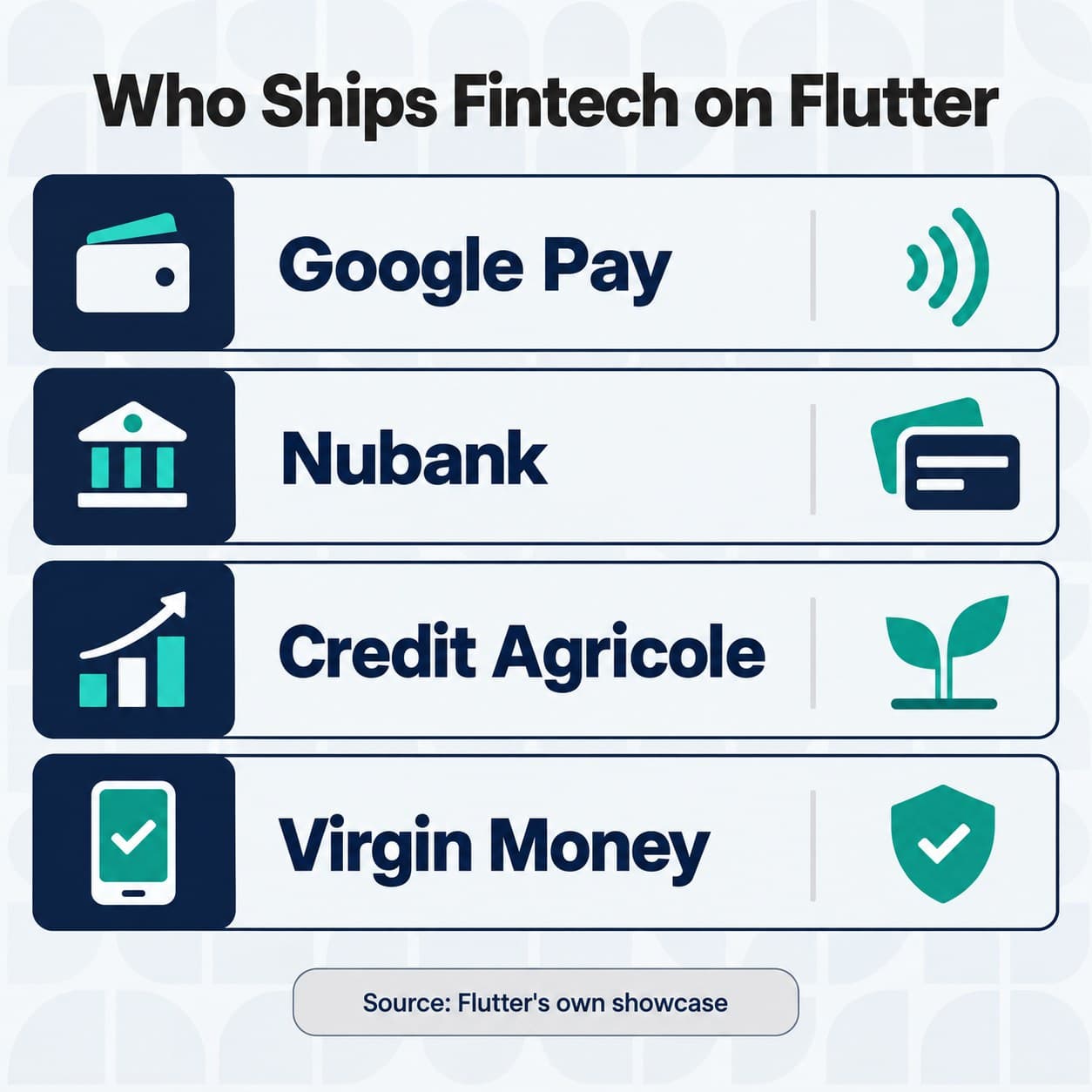
Named production users. The evidence behind each name is not all of one kind.
Our post on the banks already shipping Flutter goes through the individual cases in more detail.
What an Independent Survey Actually Shows
Agency pages discussing Flutter for fintech apps tend to imply the framework has won. The independent numbers are more modest.
The Stack Overflow Developer Survey 2024, which drew more than 65,000 responses, found Flutter used by 9.4 percent of respondents. That is the 2024 survey specifically, and it is worth stating the year because these figures move.
Academic comparison is more interesting than the popularity contest. A peer-reviewed study in Informatics found Flutter significantly outperforms React Native on long-term developer satisfaction, while finding no statistically significant difference in popularity or interest.
Satisfaction over time matters more than adoption share for a product you will maintain for years. A team that remains willing to work in the codebase is worth more than one that inherited a popular choice.
What the FCA Expects of the Technology Underneath
This is the part every page on Flutter for fintech apps omits, and for a UK firm it outranks the framework question entirely.
FCA operational resilience rules have been in force since 31 March 2022. Firms must identify important business services, set impact tolerances and map the technology supporting them.
Read that last requirement carefully. Mapping the technology supporting an important business service means you need to know what your app depends on, including third-party libraries and services, well enough to document it.
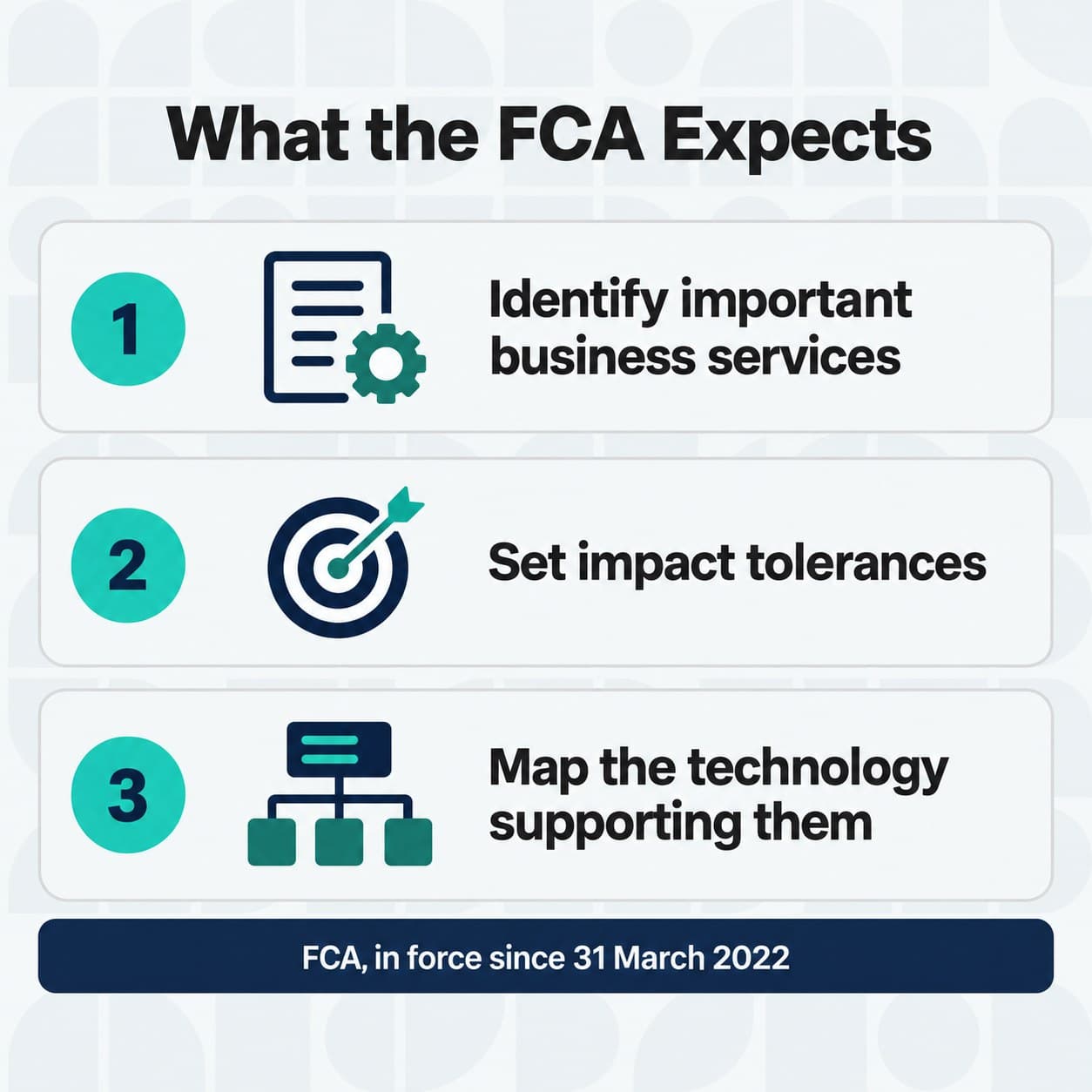
What FCA operational resilience asks of the technology, in plain terms.
There is a supplier dimension too. The FCA requires firms to manage operational risks arising from third-party technology providers, with material arrangements notifiable under SYSC 8.1.12.
If you outsource development, that is a relationship your compliance function may need to notify and will certainly need to understand. Raise it with your development partner during procurement rather than during an audit.
None of this favours one framework over another. It does favour a team that has met these obligations before, because the documentation and mapping work is unfamiliar to most app developers.
Payments, PCI DSS and Mobile
If your product touches card data, the standards are set by the PCI Security Standards Council and they are worth reading from the source rather than from a security vendor's summary.
PCI DSS 4.0.1 applies to mobile payment applications. Separately, the PCI Mobile Payments on COTS standard defines security requirements for accepting payments on commercial off-the-shelf devices, which matters if your app turns a phone into a card terminal. Both are published in the PCI Security Standards Council document library.
The framework does not determine compliance here. Key handling, storage, certificate management and the treatment of cardholder data are design decisions, and they can be got wrong in any language.
What Flutter does change is where some of that work lives. Platform-specific secure storage and hardware-backed key material are reached through platform channels, meaning native code on each side, which is worth knowing when scoping.
Open Banking, if You Are Touching UK Account Data
The UK Open Banking Standard is specific and checkable, which makes it a good test of whether a supplier has done this before.
Ask a prospective supplier to name that profile. A team that has implemented it will say FAPI without prompting, and a team that has not will talk about OAuth in general terms.
Most of this work sits in the open banking APIs underneath rather than in the app, which is another reason the framework choice matters less than it appears. Our post on open banking security covers the implementation side.
Where Flutter Costs You
A page that only praises Flutter for fintech apps is a Flutter agency page. Here is the other side.
Cost | What it means | How much it matters |
|---|---|---|
Platform channels | Some features need native code on both sides | Moderate, and unavoidable in fintech |
Binary size | Flutter apps start larger than native equivalents | Low for most, real in low-connectivity markets |
Single vendor roadmap | The framework's direction is Google's to set | Moderate, worth a conscious decision |
Hiring pool | Smaller than native iOS or Android | Moderate, though satisfaction helps retention |
Platform lag | New OS features arrive after native | Low to moderate, depends on your product |
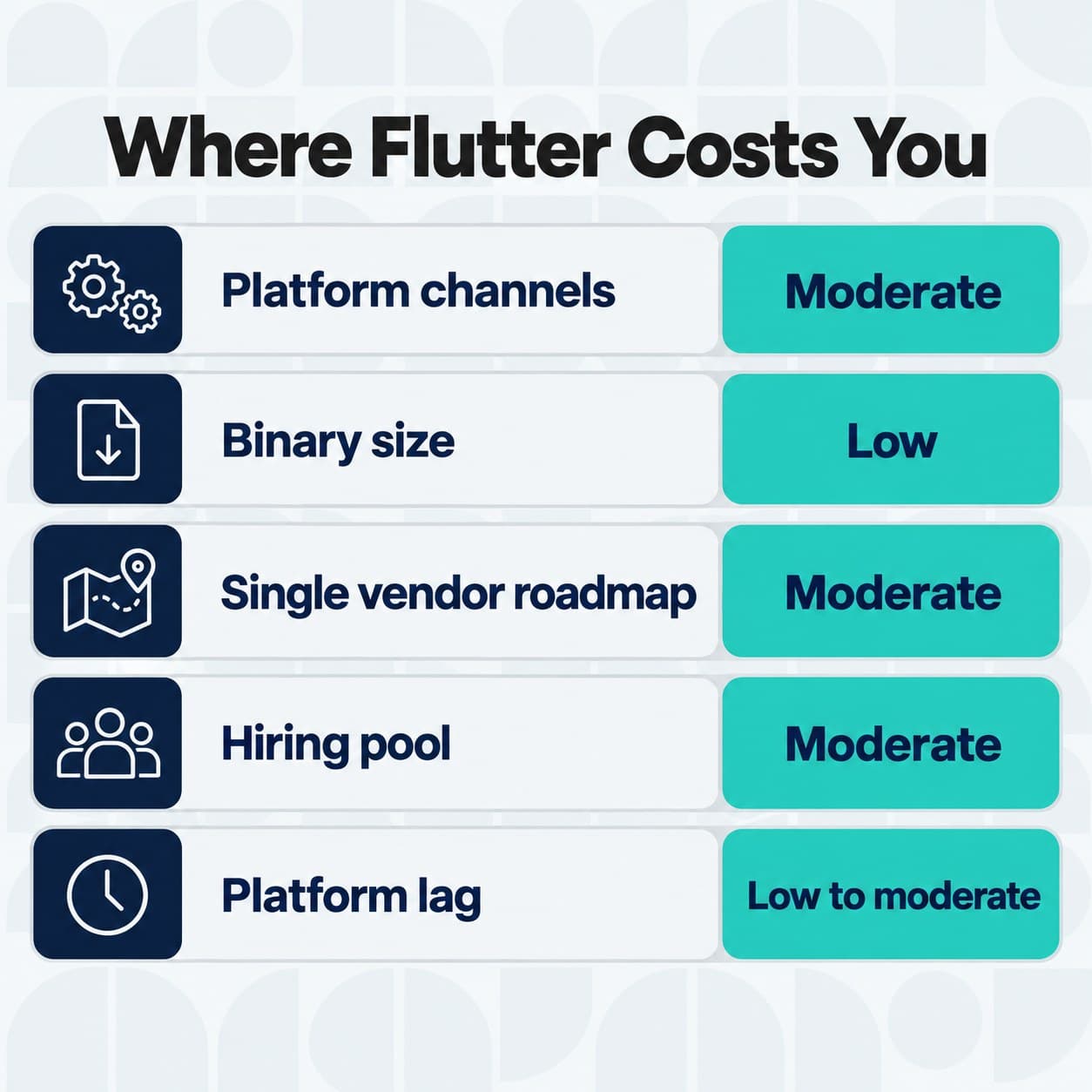
Five genuine costs of choosing Flutter, and how much each one weighs.
The platform channel row is the one that surprises fintech teams. Biometric authentication, secure enclave access, certificate pinning and some payment integrations all touch platform-specific code, so a fintech Flutter build is rarely one hundred percent Dart.
The single vendor point deserves an honest hearing rather than dismissal. Flutter's direction is set by one company, and for a product you expect to run for a decade that is a real consideration. It is also true of the native platforms, each governed by a single vendor with its own priorities.
When Native is the Better Answer
Three situations where we would tell you to skip Flutter for fintech apps and build native, and mean it.
If your product depends on deep platform integration, such as extensive widget support, complex background processing or tight integration with platform-specific payment and wallet features, native removes a layer of indirection you would otherwise fight.
If you need specialised hardware access, particularly around secure elements, NFC in unusual configurations or device-specific peripherals, the platform channel overhead starts to dominate.
If you already employ a substantial native team, changing framework means retraining people who are currently productive, and the cross-platform saving has to beat that cost before it means anything.
There is a fourth, less technical case. If your organisation has a strong existing preference and a team that will resist the choice, the framework that your team will actually maintain well beats the one that looks better on paper.
Migrating an Existing Native Fintech App
No competing page covers this, and it is a common situation for teams considering Flutter for fintech apps.
The workable approach is incremental rather than a rewrite. Flutter can be embedded into an existing native application, letting you move one screen or one flow at a time while the rest stays where it is.
That means you can start with a low-risk area, prove the integration and the build pipeline, and keep shipping throughout. A full rewrite of a regulated product means a period where you are maintaining two codebases and delivering no new value, which is difficult to defend at board level.
Approach | Risk | Right when |
|---|---|---|
Incremental embedding | Lower, spread over time | An app already in production with users |
Full rewrite | High, concentrated | The existing app is being replaced anyway |
New product only | Lowest | You are building alongside, not replacing |
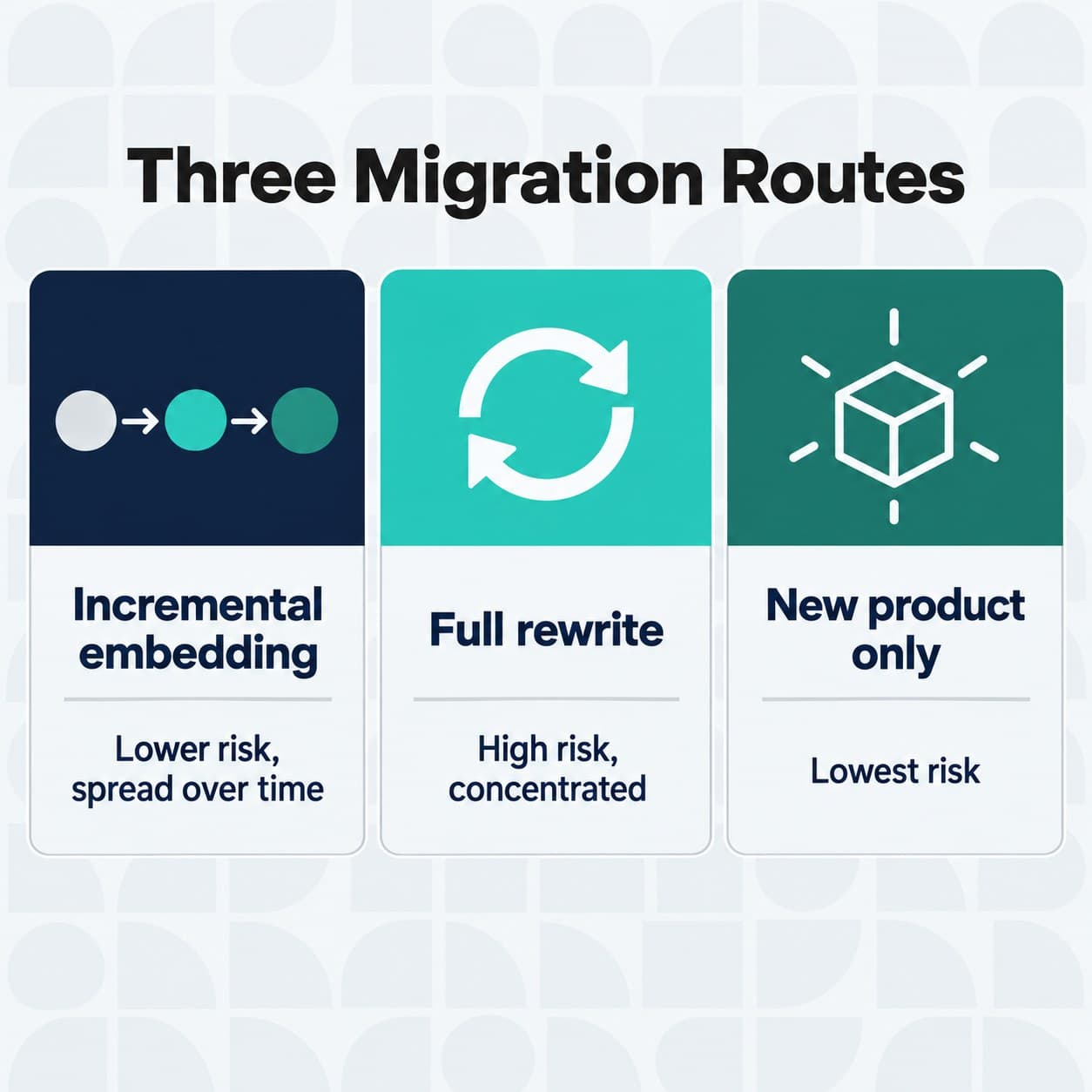
Three migration routes off an existing native fintech app.
The incremental route carries its own overhead, since you run two toolchains for a period. It is still usually the right trade for a live financial product.
What to Test Before You Commit
A framework decision of this size deserves a week of evidence rather than a reading list.
Build your heaviest screen first. Whatever your app does most, the transaction list, the chart, the document viewer, build that one thing in Flutter and run it on the oldest device your users actually carry.
Then prove one platform channel end to end. Pick biometric authentication or secure storage, implement it on both platforms, and see how much native code it took and who on your team could maintain it.
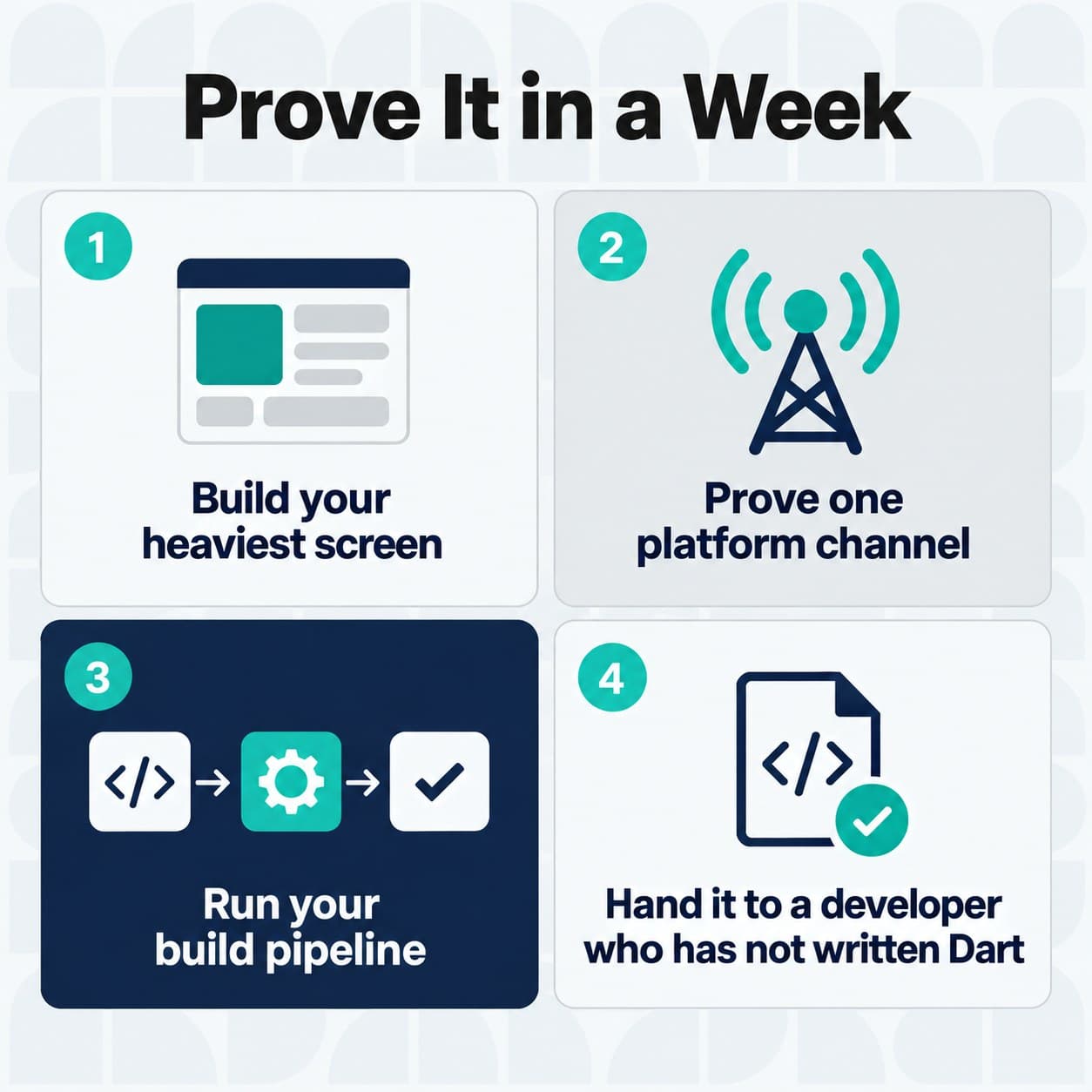
Four things worth proving in a week before committing to a framework.
Third, run your build pipeline. Signing, provisioning, store submission and whatever internal distribution you use, all the way through, because toolchain friction is where cross-platform projects lose the time they were supposed to save.
Fourth, hand the code to a developer who has not written Dart. Their honest reaction after two days tells you more about your hiring and handover risk than any survey figure.
None of that takes long and all of it produces evidence specific to you. Framework arguments in the abstract are unresolvable, and a week of your own code settles them.
Frequently Asked Questions
Is Flutter Good for Fintech Apps?
For most products, yes, provided security, key handling and compliance are designed rather than assumed. Flutter for fintech apps is a mainstream choice rather than an adventurous one. Choosing Flutter for fintech apps does not make regulatory obligations easier or harder, because those obligations sit around the framework rather than inside it.
The framework matters less than whether your team has met FCA operational resilience, PCI and Open Banking requirements before.
Which Companies Building Fintech Apps Using Flutter Are Worth Knowing About?
Flutter's own showcase names Google Pay, Nubank, Credit Agricole and Virgin Money among production users. That is the vendor's curated list rather than independent verification, and it is worth treating as such.
It does show the framework has cleared compliance review at organisations with serious risk functions.
What Big Companies Using Flutter Should I Know About?
Beyond the firms using Flutter for fintech apps, the same showcase covers users well beyond finance. For a framework decision, adoption by large organisations is weaker evidence than it looks, since their constraints and engineering capacity rarely resemble yours.
Developer satisfaction over the product's life is a better guide, and the peer-reviewed comparison above is more useful there than any logo wall.
How Do I Choose a Flutter App Development Company?
Ask what they have shipped in a regulated environment, whether they can name FAPI 1 Advanced without prompting, and how they handle secure storage across platform channels. Ask who owns the code and what handover looks like.
Arch is listed on Google's Flutter Directory and works as a Flutter app development agency across regulated sectors, or a Flutter app development company if you prefer the term, including fintech product work and wider finance app development.
Does Flutter Reduce Development Cost for a Fintech App?
Flutter for fintech apps reduces duplicated effort across two platforms, which is real, and the commonly repeated 40 to 70 percent saving figures are marketing rather than measurement. The saving is smaller in fintech than elsewhere because more of the work sits in platform channels, integrations and compliance, none of which is shared.
What a cross platform build costs depends far more on integration count and compliance load than on framework choice.
Is Flutter Performance Good Enough for a Financial App?
For the interfaces financial products actually need, lists, forms, charts and transaction histories, yes. Near-native performance is claimed everywhere and benchmarked almost nowhere, so treat the general claim with suspicion and test your own heaviest screen.
If your product does something genuinely demanding on the device, benchmark it before committing rather than relying on anyone's assurance, ours included.
About the Author
Hamish Kerry is the Marketing Manager at Arch, where he's spent the past six years shaping how digital products are positioned, launched, and understood. With over eight years in the tech industry, Hamish brings a deep understanding of accessible design and user-centred development, always with a focus on delivering real impact to end users. His interests span AI, app and web development, and the transformative potential of emerging technologies. When he's not strategising the next big campaign, he's keeping a close eye on how tech can drive meaningful change.
You can catch up with Hamish on LinkedIn
Sources
- Stack Overflow, Developer Survey 2024: Technology, July 2024. https://survey.stackoverflow.co/2024/technology
- Informatics (MDPI), A comparison of Flutter and React Native, June 2025. https://www.mdpi.com/2227-9709/12/2/45
- Financial Conduct Authority, Operational resilience, 31 March 2022. https://www.fca.org.uk/firms/operational-resilience
- Financial Conduct Authority, Outsourcing and operational resilience, 2026. https://www.fca.org.uk/firms/outsourcing-and-operational-resilience
- Open Banking Limited, OBL API security profile, 2026. https://standards.openbanking.org.uk/security-profiles/get-started-obl-api-security-profile/
- PCI Security Standards Council, Document library, June 2024. https://www.pcisecuritystandards.org/document_library/
- Flutter (Google), Showcase: Google Pay, 2026. https://flutter.dev/showcase/google-pay