



Companies Using Flutter: The Big Names Banking on It.
In this blog, we take a look at some of the best flutter apps out there and find out just why they're regarded so highly by their users.
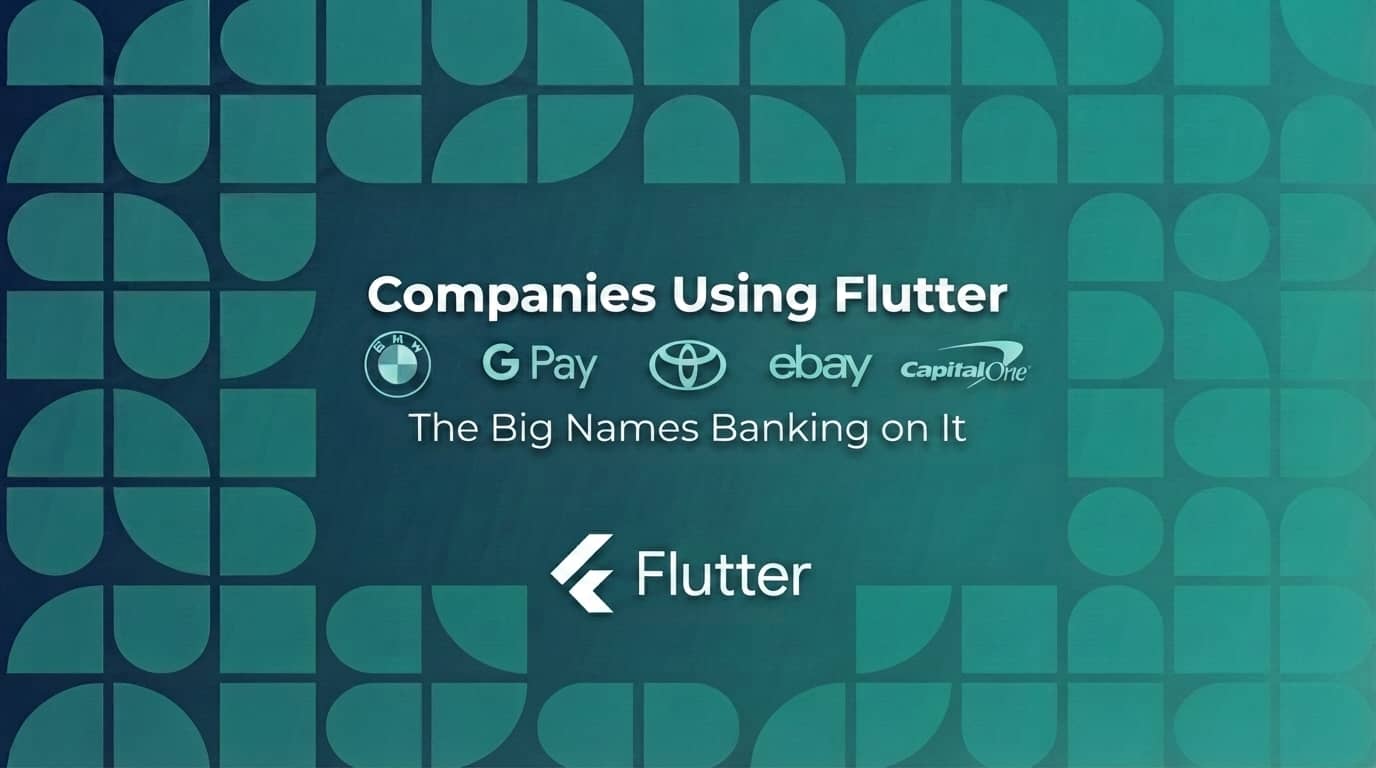
Companies Using Flutter: The Big Names Banking on It.
Share Via:
Companies using Flutter in production include BMW, Toyota, eBay Motors, Nubank, Virgin Money and AJ Bell. Between them they cover regulated banking, connected cars, and a marketplace that moves vehicles at scale.
A list of companies using Flutter settles a framework question better than most arguments. Anyone can claim a technology is ready. Fewer can point at a car manufacturer shipping it to drivers in 47 countries.
The scale behind those names is not small either. Google confirmed at I/O 2026 that Flutter is now used by 1.5 million developers every month, a 50% rise in a single year, and it has become the second most popular app-development SDK on both the App Store and Google Play. A developer base that size is also why it is straightforward to hire mobile developers for a Flutter build.
This post is about what those engineering teams shipped and what they said publicly afterwards, and it leaves the framework debate aside.

The people who decided BMW's app would be one codebase, not two.
We build in Flutter too, and our mobile app development services page covers what that looks like for a UK business.
The Short Answer: Which Companies Using Flutter Are Worth Knowing?
Here is the roster, grouped the way a buyer actually thinks about it:
- Fintech and banking: Nubank, Virgin Money, AJ Bell
- Automotive: BMW (the My BMW app), Toyota (2026 RAV4 infotainment)
- E-commerce and marketplaces: eBay Motors
Those are the names with published, checkable numbers attached, which is a deliberately shorter list than most round-ups will give you. The wider picture is broader still: more than 90 mid-market and enterprise companies confirmed Flutter in production between 2024 and 2026, with the heaviest concentration sitting in financial services.
Financial services being the densest cluster is the detail worth pausing on. Regulated industries tend to adopt last, not first. When banks move, the technology has usually already been de-risked by someone else.
The sections below take each sector in turn, with the figure that company's own team put on the record.
How Big Is Flutter in 2026?
Big enough that "is this a fad" may no longer be the right question, and big enough that the companies using Flutter below can be taken as representative. If you are new to the framework, our explainer on what Flutter apps actually are gives the quick version.
Around 9.4% of all developers now build with Flutter, which puts it among the most widely used app frameworks in the world.
The output is visible on the app stores. Roughly 2 million apps on Android have been built with Flutter. That is a production framework by any reasonable definition.
Day-to-day activity backs that up. Flutter's pub.dev package registry recorded over 1.3 billion package downloads in a single 30-day period around Google I/O 2026. Registries measure people building things, not people bookmarking things.
Put the 50% year-on-year growth in monthly developers next to that and the direction looks settled. Frameworks in decline do not add half a million monthly developers in a year.
Roughly one in every few of these was drawn by the same framework.
Fintech: Do Banks Trust Flutter With Regulated Apps?
They do, and the UK is in that group.
Virgin Money and AJ Bell both feature among 18 documented fintech apps built with Flutter across regulated markets. Two recognisable British financial brands, shipping to customers who are subject to the same FCA expectations as everyone else in the sector. For the build decisions behind a banking app, see our guide to developing a mobile banking app.
This matters more than a logo wall. Financial apps carry the least forgiving requirements in consumer software: authentication, audit trails, accessibility, and a security review that treats every dependency as a liability. A framework that clears that bar has cleared most bars.
The largest example sits in Latin America. Nubank runs its app on Flutter, and reported customer counts have grown fast enough that the published figures no longer agree with each other. A 2026 production showcase of 25 shipping Flutter apps puts Nubank above 90 million customers, while an earlier 2026 round-up recorded tens of millions of clients across the region. Treat it as a range: this is a bank at a scale most UK institutions do not reach, running on one codebase.
The pattern across those 18 fintech apps is consistent. Nobody adopted Flutter to save a few weeks. The companies using Flutter in banking did it to stop maintaining two versions of the same regulated product.
Automotive: Why Did BMW Build the My BMW App With Flutter?
Because one codebase is worth considerably more when you are shipping to dozens of markets at once.
The My BMW app launched across 47 countries from a single codebase. Every one of those markets needs its own languages, regional features and regulatory quirks. Doing that twice, once for iOS and once for Android, is not a technical problem so much as an organisational one. Two teams drift. Features arrive on one platform first. The backlog forks.
Your bank's compliance team already signed this off. That is the whole point.
Toyota took it somewhere less expected. Flutter premiered in the 2026 Toyota RAV4 infotainment system, which means the framework is no longer confined to phones. It is running on a dashboard, in a car, in front of a driver. The same reach extends to the same codebase on desktop.
That is a much harder environment than a handset, with embedded hardware, safety expectations, and a product lifecycle measured in years. Car manufacturers do not experiment in the cabin.
For anyone weighing Flutter for a phone app, the automotive entries are useful precisely because they are excessive. If it holds up in a vehicle, your customer portal will probably be fine. Of all the companies using Flutter, the car manufacturers had the least room to be wrong.
E-commerce: What eBay Motors Proved About Code Sharing
eBay Motors gave the clearest number anyone has published on this question.
The eBay Motors app achieved 98.3% shared code between iOS and Android. Nearly all of it was shared, and under 2% of that codebase needed to know which platform it was running on.
Sit with what that figure implies commercially. The old cross-platform pitch was "write once, then spend a third of your budget on platform-specific fixes." At 98.3%, that tax has mostly gone. One team, one review process, one bug fixed once.

98.3% of the code behind this transaction never asked which phone it was on.
eBay Motors also happens to be a high-traffic commerce product where a slow or broken screen costs real transactions. Marketplaces are unsentimental about technology. It stays because it works.
The engineering write-up behind that number is the most-cited piece of evidence in this entire conversation, and it came from eBay's own team, which is a stronger source than a vendor. When you read any list of companies using Flutter, remember that first-party reporting is stronger evidence than a round-up.
How Far the Companies Using Flutter Reach Beyond the Named Roster
The famous names are the proof. The volume is the context.
The framework is Google's own, which removes the single biggest risk with any open-source dependency: nobody is wondering whether it will still be maintained next year. Google announced Flutter 3.44 at I/O 2026 alongside the developer figures above.
Underneath the recognisable brands sit those roughly 2 million Flutter-built Android apps and the 90-plus enterprises documented in production. The companies using Flutter that you have heard of are the visible edge of something considerably larger. The same engine also powers Flutter for web.
That depth is what makes hiring viable. A framework used by 9.4% of developers has a labour market. A niche one does not, and you find that out eighteen months in, when your lead developer leaves.
Why These Companies Using Flutter Chose It Over the Alternatives
Read the case evidence side by side and the same three reasons keep surfacing.
One codebase, genuinely. eBay Motors' 98.3% code sharing is the number that separates Flutter's pitch from the usual cross-platform promise. Most frameworks share code. Very few share nearly all of it. We unpack that trade-off in our guide to cross-platform app development.
Reach without duplication. BMW shipping to 47 countries from one codebase is a distribution argument, not an engineering one. The same logic scales down: a UK business serving three markets faces a smaller version of the identical problem.
A framework that will still be there. Google's backing, 1.5 million monthly developers and a number-two SDK ranking on both stores add up to longevity. That is the quiet reason regulated businesses can sign it off.
Notice what is absent from that list. None of these teams chose Flutter because it was trendy, and the ones with the most to lose, the banks and the car manufacturers, moved anyway. Cost savings barely appear in the public record either, which is telling: the companies using Flutter tend to talk about shipping faster, not spending less. Our own view on why we build in Flutter lands in the same place.

The meeting where someone finally says it out loud: why maintain two of these?
What the Companies Using Flutter Mean for UK Businesses
You may not be BMW. That is rather the point.
The value of this list to a UK SME or scale-up is that the risk has already been absorbed by someone with a larger legal team and a lower tolerance for failure. When Virgin Money and AJ Bell ship regulated apps on Flutter, the question of whether it is production-ready has been answered by people who had to prove it to a compliance function first.
What transfers directly is the economics. A company with 200 engineers saving duplicated work saves a lot in absolute terms. A company with four engineers saving the same proportion may be the difference between shipping and not shipping. If you are nearby, our Flutter team in London can take it from there.
If you are weighing this up for your own build, Arch builds cross-platform Flutter apps for UK businesses, and holds a 4.7 rating on Clutch. The roster above is the evidence base we point clients at, because it is stronger than anything an agency could say about itself.

Four engineers, two platforms. The arithmetic is friendlier than it used to be.
Frequently Asked Questions
Is Flutter Used for Whole Apps or Only Parts of Them?
Both, though the strongest examples are whole apps. eBay Motors reported 98.3% shared code, meaning almost the entire product is Flutter with only a sliver of platform-specific code underneath. Some organisations do adopt it feature by feature inside an existing native app instead, which lets them test it on one screen before committing the whole roadmap to it.
How Many Developers and Companies Using Flutter Are There in 2026?
Google reported 1.5 million monthly developers at I/O 2026, up 50% year on year, and around 9.4% of all developers now build with it. On the company side, more than 90 mid-market and enterprise organisations were confirmed in production between 2024 and 2026, with financial services the densest sector.
Is Flutter Still Growing?
The available figures point that way. Monthly developer numbers grew 50% in a year, pub.dev logged over 1.3 billion package downloads in 30 days, and it now ranks second among app-development SDKs on both major stores. Its first appearance in a production car dashboard suggests expansion rather than consolidation.
Does an App Built With Flutter Feel Less Native?
The commercial evidence suggests users do not notice. eBay Motors, the My BMW app and Nubank's banking app all ship to demanding consumer audiences, and Nubank alone serves tens of millions of clients. Apps that felt wrong at that scale would show up in store ratings very quickly. Flutter draws its own interface rather than wrapping a web page, which is the technical reason it holds up.
Should a UK Business Pick Flutter for Its Next App?
It depends on how many platforms you need and how much duplicated work you can afford. If you need iOS and Android from a small team, the companies using Flutter listed above suggest the risk is low: 18 fintech apps in regulated markets and roughly 2 million Flutter apps on Android is not an unproven position. If you only need one platform and lean heavily on brand-new OS features, native may still suit you better. That is the core case for Flutter for mobile.
Start From the Evidence, Not the Sales Pitch
The useful thing about the companies using Flutter is that they showed their working. eBay published its code-sharing percentage. Google published its developer numbers. BMW shipped to 47 countries in public.
That is a far better basis for a build decision than any agency's opinion, including ours. If Flutter fits your product, the case has already been made by teams with more at stake than you have.
Take the sector nearest your own from the list of companies using Flutter above, read what that team actually reported, and start the conversation there.
About the Author
Hamish Kerry is the Marketing Manager at Arch, where he has spent the past six years shaping how digital products are positioned, launched, and understood. He has over eight years in the tech industry and a deep understanding of accessible design and user-centred development, with a focus on delivering real impact to end users. His interests include AI, app and web development, and the potential of emerging technologies. Outside campaigns, he keeps a close eye on how tech can drive meaningful change.
You can catch up with Hamish on LinkedIn
Sources
- What's new in Flutter 3.44. Flutter (Google), 20 May 2026.
- Top Companies Using Flutter in 2026: Enterprise Examples & Case Studies. Very Good Ventures, 1 February 2026.
- Flutter 3.44 at Google I/O 2026: What We Saw at the Conference. Very Good Ventures, 22 May 2026.
- Best Fintech Apps Built with Flutter. LeanCode, 22 April 2026.
- Must-Know Examples of Apps Built with Flutter. LITSLINK, 9 May 2026.
- Best Flutter Apps in Production (Showcase). HireFlutterDev, 15 May 2026.
- Flutter App Examples Built by Real Companies. CueBytes, 1 June 2026.
- Top Apps Built with Flutter: Global Brands & Real Results. Bacancy Technology, 24 March 2026.
- React Native vs Flutter in 2026: Which Cross-Platform Framework Wins?. Nucamp, 18 January 2026.
- Google I/O 2026 for Flutter Developers. Anand Gaur, Medium, 21 May 2026.