



App Modernization Services: A Pragmatic Guide for CTOs.
Discover app modernization services. This guide covers approaches, processes, costs, and how to choose the right partner for your legacy app.
App Modernization Services: A Pragmatic Guide for CTOs.
An important app probably sits somewhere in your estate right now that nobody wants to touch. It still runs a core workflow. It still carries revenue, service delivery, or compliance risk. But every change takes too long, every integration feels brittle, and every security conversation ends with the same uneasy conclusion: this can't stay as it is forever.
That's where app modernization services become useful. Not as a buzzword, and not as a blanket rewrite programme, but as a structured way to decide what to keep, what to change, what to retire, and how to run the result without creating a new operational mess.
Your Guide to App Modernisation
Key takeaways
- App modernisation is a business decision first. The point isn't new technology for its own sake. It's lower risk, better resilience, faster delivery, and stronger user experience.
- Not every app should be rebuilt. Some systems need rehosting or refactoring. Others should be replaced, consolidated, or deliberately retained.
- Security is a major driver. The 2025 UK Cyber Security Breaches Survey summary cited here notes that 50% of UK businesses and 32% of charities reported a cyber security breach or attack in the previous 12 months.
- Assessment matters more than enthusiasm. If you don't map dependencies, business criticality, and operational cost first, you'll modernise the wrong thing.
- Containerisation and microservices only help when the domain supports them. Splitting a monolith too early often creates more complexity, not less.
- Success is decided after launch as much as before it. Governance, observability, support ownership, and cloud cost control are where many programmes succeed or fail.
- A phased path is usually safer than a big-bang rewrite. High-risk, high-change components are often the right place to start.
- If your priority is digital product delivery, it helps to ground modernisation decisions in real delivery capability such as mobile app development services, not just architecture diagrams.
App modernisation means updating legacy software so it creates more business value. Sometimes that means moving it to cloud infrastructure. Sometimes it means redesigning workflows, untangling integrations, or replacing an old back-office tool with something more supportable. In many cases, it means all of those things at different points in the same portfolio.
The mistake many leadership teams make is treating modernisation as a technical estate programme owned entirely by engineering. It rarely works that way. Old applications shape customer journeys, staff productivity, reporting, risk posture, vendor lock-in, and the speed at which teams can launch anything new.
Practical rule: Modernise the constraint, not the loudest application. The app creating the most strategic drag deserves attention before the app creating the most internal complaints.
Why App Modernisation Is a Business Imperative
A familiar pattern plays out in board reviews. Revenue teams want faster product changes. Security wants unsupported components removed. Operations wants fewer late-night incidents. Finance wants cloud spend and support costs explained line by line. One ageing application can sit in the middle of all four conversations.
That is why app modernisation becomes a business issue long before a system fully breaks. Legacy applications often remain functional enough to avoid immediate replacement, but they steadily increase the cost of change, oversight, and resilience. The pressure is rarely isolated to engineering. It reaches service teams, compliance owners, commercial leaders, and anyone accountable for delivery risk.
Where business pressure typically shows up
The first warning sign is usually not system failure. It is drag.
An ageing application creates drag in predictable places:
- Delivery speed: Releases depend on manual steps, fragile environments, or a small number of people who understand how changes safely reach production.
- Security and compliance: Patching takes longer, audit evidence is harder to produce, and exceptions start to accumulate around identity, logging, and access control.
- Integration and data flow: New channels, partners, and internal products take more effort because APIs are inconsistent, data structures are brittle, or the app was not designed to share information cleanly.
- Customer and employee experience: Teams compensate for weak workflows with spreadsheets, rekeying, support tickets, and workarounds that slowly become part of the operating model.
Each issue looks manageable on its own. Together, they reduce the organisation's ability to launch, learn, and control risk.
The hidden cost sits after go-live
This point gets missed in many modernisation discussions. Delivery cost matters, but the bigger financial question is what happens over the next three to five years.
A legacy app often survives because its direct running cost looks familiar. The support team knows its quirks. The hosting contract already exists. The business has adapted its processes around the limitations. That can make inaction look prudent, especially when compared with the visible cost of replacement or refactoring.
In practice, the more expensive line items often appear later. Extra monitoring tools get added because the platform lacks visibility. Specialist contractors stay longer because internal teams cannot support the stack with confidence. Cloud bills rise after a hurried migration because environments were copied without governance. Change approval gets slower because no one trusts the blast radius. Teams then spend more to stabilise what should have been simplified.
This is why decisions about hosting matter, but only as part of a wider operating model. A move from legacy infrastructure to cloud can help, but it only pays off when the target setup reduces support overhead, improves observability, and gives teams clearer ownership. This comparison of cloud vs on-premise infrastructure trade-offs is useful context for that decision.
Inaction creates operational debt
Operational debt is what accumulates after years of exceptions, partial fixes, and deferred clean-up. It shows up in incident response, supplier dependency, duplicated controls, and unclear accountability.
I have seen organisations approve a migration budget, declare success at launch, then watch costs climb because nobody defined who owned optimisation, service governance, or lifecycle management afterwards. Modernisation only works when teams plan for run costs, performance tuning, platform standards, and support ownership from the start.
That is also why a phased strategy usually outperforms a symbolic rewrite. Some applications need retirement. Some need containment. Some need careful improvement around the parts that create the most business exposure. Kogifi's modernization approach reflects this reality well. The objective is not novelty. It is a service estate that costs less to operate, is easier to govern, and can change at the pace the business needs.
Why this now sits with leadership
The leadership question is not whether every old application deserves investment. It is which business capabilities are too expensive, risky, or slow to leave as they are.
That changes the conversation. Modernisation becomes a portfolio decision about resilience, delivery capacity, governance, and long-term operating cost. Strong programmes define target outcomes beyond launch. They set ownership, service levels, observability standards, security controls, and cost guardrails early, because those are the controls that determine whether the investment keeps paying back.
Applications shape how the business sells, serves, reports, and adapts. That is why modernisation belongs on the leadership agenda.
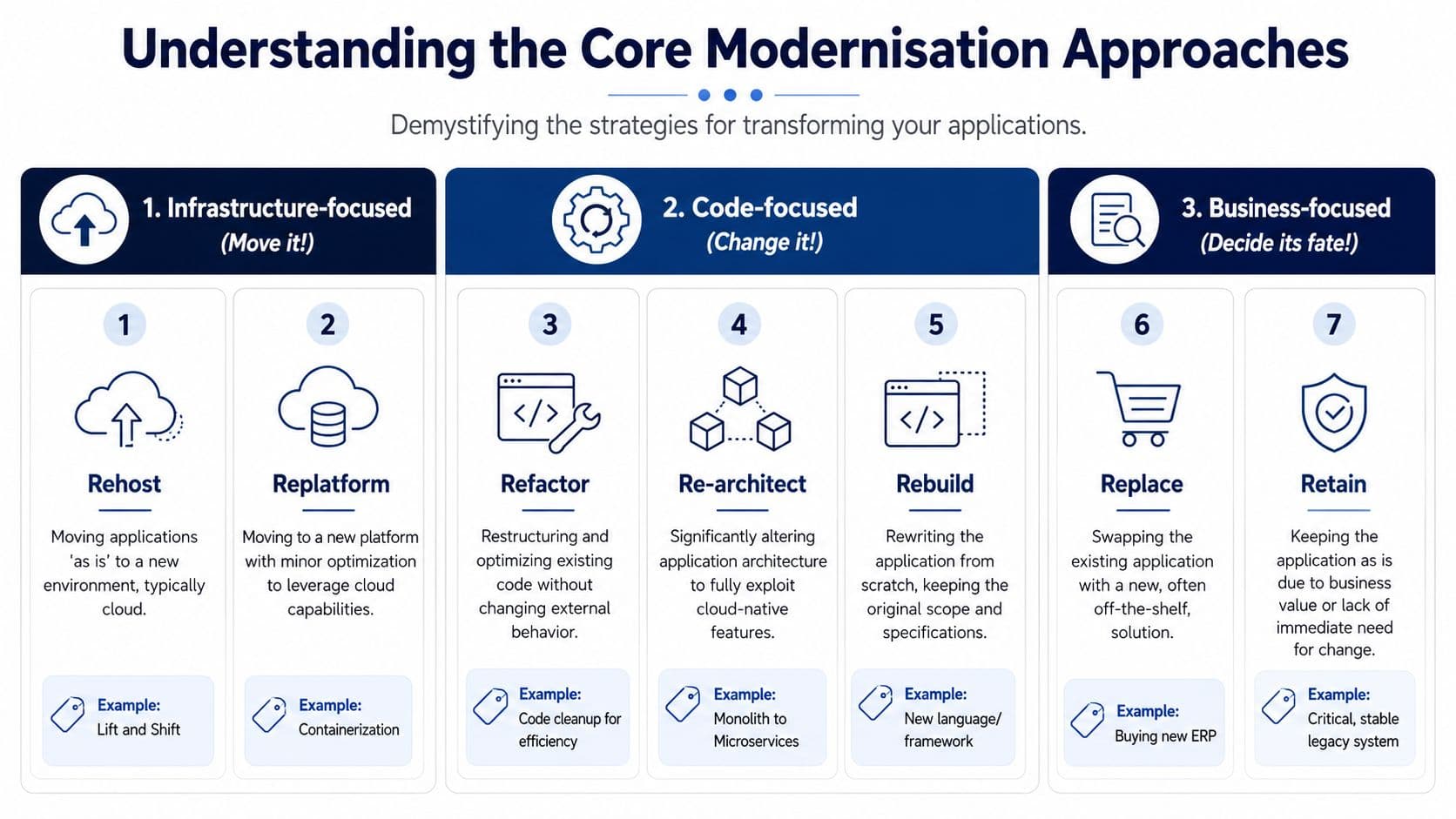
Understanding the Core Modernisation Approaches
The easiest way to explain modernisation options is to compare them to dealing with a property portfolio. Some buildings only need utilities upgraded. Some need structural work. Some should be sold. Some should be knocked down and rebuilt. Software works much the same way.
.jpg&w=2048&q=75)
Move it with minimal disruption
Rehost is the software equivalent of moving to a new site without changing the layout. You shift the application into a different hosting environment and keep code changes light. It can be useful when infrastructure risk is the immediate issue and the business needs breathing room.
Replatform goes a step further. You still move the app, but you make selective improvements so it runs better on the target platform. That might include managed services, updated runtimes, or containerisation where it reduces operational burden.
This is often where leaders confuse activity with progress. A successful move can improve resilience, but it won't automatically fix poor architecture, tangled logic, or weak product flows. Teams should be honest about that.
Change the structure without losing the business logic
Refactor means improving the internal quality of the code while keeping the external behaviour broadly the same. This can reduce maintenance pain and make later changes safer. It's rarely dramatic from the outside, but it can be one of the highest-value paths when the application still serves the business well.
Re-architect is deeper. Here, the target is usually independent deployment and scaling. Industry guidance on app modernisation points to container orchestration, microservice decomposition, and CI/CD automation as the mechanisms that improve delivery speed, with high-risk components often rewritten first, as outlined in WinWire's application modernisation guidance.
That doesn't mean every monolith should become microservices. In fact, many teams split too early. If domain boundaries are unclear, a distributed architecture can make ownership, observability, and support harder. For a useful external view of phased legacy decision-making, Kogifi's modernization approach is worth reading because it treats strategy choice as contextual.
Decision cue: If teams can't clearly describe service boundaries, data ownership, and release ownership, they probably aren't ready for aggressive decomposition.
Start again or swap it out
Rebuild means recreating the application with modern tools while preserving the underlying business purpose. This makes sense when the current codebase is holding the organisation hostage, but the product itself still matters.
Replace is different. You stop trying to preserve the software and instead adopt a new product or platform that solves the same business problem. This is often the right answer for commodity functions where differentiation is low.
Retain is also a valid strategy. Some systems should stay put for now because they are stable, low change, and not worth disturbing yet.
The wrong move is picking one method for the whole portfolio. Good app modernization services mix approaches. They also tie each choice back to architecture reality, service risk, and hosting decisions. Teams weighing target environments often benefit from a grounded review of cloud vs on-premise trade-offs, because the hosting model shapes support, governance, and spend long after migration day.
A Pragmatic Step-by-Step Modernisation Process
A sound modernisation programme usually follows four stages. Assess, plan, execute, and optimise. The sequence looks straightforward, but the quality of the early decisions determines almost everything that follows.
.jpg&w=2048&q=75)
Assess what matters and what breaks
Assessment isn't a documentation exercise. It's a prioritisation exercise. You need to know which applications support critical workflows, which ones create hidden risk, and which ones consume disproportionate operational effort.
That matters in the UK context. A 2024 National Audit Office finding cited here identified 148 government digital systems as red-rated for urgent replacement or significant redesign. That's a useful reminder that fragile systems often survive in plain sight for years because they remain essential.
A practical assessment should cover:
- Business criticality: Which services stop if this app fails?
- Dependency mapping: What data feeds, vendors, internal tools, and manual processes sit around it?
- Change profile: Does the app need frequent updates or is it largely static?
- Operational pain: Where do support teams spend recurring effort?
- Exit options: Can the capability be replaced, consolidated, or retired?
Plan around outcomes, not architecture theatre
Once the estate is visible, planning becomes far more disciplined. The key is to define success in business terms before choosing technical patterns. Faster releases, fewer incidents, better resilience, simpler support ownership, or reduced estate complexity are all valid goals. “Move to microservices” is not a goal. It's a method.
Strong delivery discipline is essential. A credible plan sets sequencing, identifies rollback points, and limits the blast radius of each release wave. It also assigns decision rights early. Product, engineering, security, operations, and finance all need clarity on who approves what.
If you want a useful benchmark for how mature teams structure delivery from discovery through build, a defined digital product process is a better reference point than a stack diagram alone.
Execute in slices, not in slogans
Execution works best when teams target the highest-risk or highest-change components first. That gives the programme a chance to prove delivery, validate assumptions, and expose operational issues before the whole estate is touched.
In practical terms, that might mean extracting one volatile workflow behind an API, containerising a specific service with clear ownership, or replacing a brittle admin interface before touching the transaction engine beneath it. It also means testing rollback paths before cutover, not after.
A phased release model reduces disruption. It also gives stakeholders evidence to work from, which is worth more than optimism.
Optimise after launch or lose the value
Many programmes lose momentum at this point. The team ships the modernised app, closes the project, and assumes the hard part is over. It usually isn't.
Production ownership defines long-term success. You need observability, runbooks, cost monitoring, security patching discipline, release governance, and a clear model for how the application evolves. Without that, modernised software can become tomorrow's legacy much faster than expected.
A modern application that nobody governs properly is just a newer form of operational debt.
Measuring Success and Managing Risks
The most useful way to judge app modernization services is to ask two questions. Did the change improve how the business operates? And can the team sustain the result without constant intervention?
What good measurement looks like
Strong measurement spans multiple layers. Technical signals matter, but they aren't enough on their own.
Useful indicators often include:
- Operational reliability: uptime, incident frequency, rollback rates, and recovery confidence
- Delivery efficiency: lead time for changes, release cadence, and the effort needed to ship routine updates
- Business responsiveness: how quickly teams can launch features, onboard a new partner, or adapt a workflow
- User outcomes: task completion, support burden, performance experience, and satisfaction signals
What matters most is consistency. Track the same measures before, during, and after the programme. Otherwise teams end up reporting activity rather than improvement.
A practical product example such as Findr is useful here, not as a generic “success story”, but as a reminder that product performance and user experience should sit alongside infrastructure outcomes when you judge modernisation work.
The risks that usually hurt programmes
The common risks are rarely mysterious. They are just under-managed.
Scope expansion causes trouble when a sensible modernisation effort turns into a hidden transformation programme. Teams start by replacing a brittle component, then keep adding adjacent ambitions.
Dependency surprises appear when legacy apps rely on undocumented integrations, manual operational steps, or knowledge held by one person.
Data migration failures happen when leaders underestimate data quality, mapping complexity, or cutover rehearsal.
Service disruption becomes more likely when testing focuses on functional correctness but ignores real traffic patterns, support processes, and rollback readiness.
The safest migration plan is the one that assumes reality will be messier than the architecture review suggests.
Why optimisation belongs in the ROI conversation
Modernisation isn't finished when the release is complete. Credible guidance stresses that it's an ongoing process, and the final optimisation stage depends on continuous monitoring of KPIs, cloud usage, and cost control, as described in HealthTech Magazine's discussion of the optimisation stage.
That point matters because many business cases are approved on delivery logic alone. The actual return often depends on what happens afterwards. If cloud resources aren't governed, if observability isn't wired into support workflows, or if release ownership becomes blurred, the business gets a technically modern platform with poor financial and operational discipline.
Choosing Your Modernisation Partner
A modernisation partner shouldn't just be good at shipping software. They need to be good at helping you make fewer bad decisions.
That means they should challenge scope, expose trade-offs early, and tell you when not to rebuild. If every problem gets answered with “new platform, new stack, new architecture”, you're not looking at strategic guidance. You're looking at an expensive preference.
What to look for beyond technical capability
Start with portfolio thinking. A strong partner understands that some apps deserve investment, some need containment, and some should disappear entirely. That matters because simplification is often where the biggest gains come from.
The UK public sector offers a useful signal. The Cabinet Office application rationalisation programme referenced here reduced the government application estate from 2,159 applications in 2015 to 802 by 2018. The lesson isn't that every organisation should chase the same shape. It's that modernisation often depends on consolidation and decommissioning, not just rebuild work.
A capable partner should also show strength in:
- Discovery quality: They ask hard questions about workflows, ownership, and operating model before they recommend a target architecture.
- Delivery realism: They phase work, validate assumptions, and plan cutovers with rollback in mind.
- Operational thinking: They care about support, governance, and post-launch optimisation, not just go-live.
- Cross-functional communication: They can speak to product, engineering, security, and executive stakeholders without hiding behind jargon.
What weak partner behaviour looks like
You should be cautious if a partner:
- Pushes one pattern for every app
- Skips dependency mapping
- Treats cloud migration as the same thing as modernisation
- Focuses only on build and ignores run
- Can't explain who will own the platform after launch
Those warning signs usually lead to programmes that look modern on paper and feel fragile in production.
Why delivery context matters
If your modernisation effort touches customer-facing products, internal tools, and service integrations, the partner needs breadth. That includes product design, engineering, security awareness, and practical build discipline across web and app estates.
Examples such as Deploy, My Pension ID, and Adaptwell show the kind of varied delivery context worth looking for when you evaluate a team. The question isn't whether they've worked in your exact niche. It's whether they can handle complex user journeys, sensitive workflows, and production-grade delivery.
For organisations reviewing technical partners, a sensible starting point is to assess whether they offer end-to-end development services with enough strategic depth to support both transformation and long-term ownership.
Frequently Asked Questions and Next Steps
FAQ 1
How do I know whether an app needs modernising or better support?
Start with behaviour, not age. If the app is stable, secure, easy to change, and cheap to operate, you may not need major modernisation yet. If changes are slow, integrations are painful, support depends on a few individuals, or security controls feel bolted on, the problem is structural. In that case, improved support alone usually delays the issue rather than solving it.
FAQ 2
Should we modernise one application at a time or treat the whole estate as a portfolio?
Treat the estate as a portfolio first, then execute in targeted slices. Looking at one app in isolation often hides shared services, duplicate functions, and retirement opportunities. Portfolio thinking helps you avoid rebuilding something that should be consolidated or replaced. Delivery should still happen in manageable waves, because phased execution reduces operational risk and gives teams room to learn.
FAQ 3
Is a full rebuild ever the right answer?
Yes, but only when the existing codebase blocks change so badly that incremental work no longer makes sense. A rebuild can be justified if the architecture is too brittle, the technology stack is no longer supportable, or the product needs capabilities the current system can't realistically absorb. It becomes a poor choice when leaders use it to avoid making difficult prioritisation and simplification decisions.
FAQ 4
Do we need microservices to modernise properly?
No. Microservices are useful when you have clear domain boundaries, distinct ownership, and a real need for independent deployment and scaling. Without those conditions, they can increase operational overhead and make debugging harder. Many organisations get better results from a modular monolith, selective API extraction, or targeted refactoring. The right architecture is the one your team can operate confidently at production scale.
FAQ 5
What internal capability should we have before hiring a partner?
You don't need every technical skill in-house, but you do need internal ownership. Someone must define business priorities, validate workflows, and make timely decisions. You'll also need involvement from security, operations, and product leadership. The healthiest model is shared responsibility: the partner brings specialist delivery depth, while your team keeps control of outcomes, context, and post-launch ownership.
Modernisation works when it's treated as a long-term operating decision, not a one-off technical event. The strongest programmes reduce complexity, improve resilience, and create a platform the business can live with after launch.
About the Author
Hamish Kerry is the Marketing Manager at Arch, where he's spent the past six years shaping how digital products are positioned, launched, and understood. With over eight years in the tech industry, Hamish brings a deep understanding of accessible design and user-centred development, with a focus on delivering real impact to end users. His interests span AI, app and web development, and the potential of emerging technologies. When he's not strategising the next big campaign, he's keeping a close eye on how tech can drive meaningful change.
If your team is weighing app modernization services and wants a practical view of what to modernise, what to retire, and how to run the result well, Arch can help. You can explore their product and engineering work, or get in touch with the team to discuss your estate, constraints, and next steps.