



A Practical Guide to AI in Manufacturing.
Explore how AI in manufacturing drives efficiency and growth. Learn key technologies, use cases, and how to implement them successfully.
Key Takeaways
- AI is a Practical Tool: Artificial intelligence is no longer a future concept but a current tool for enhancing efficiency, reducing costs, and improving productivity in manufacturing.
- Focus on Core Technologies: Key AI applications include Computer Vision for automated quality control, Predictive Maintenance to prevent equipment failure, Generative Design for product innovation, and Digital Twins for risk-free simulations.
- Start with a Clear Problem: Successful AI implementation begins by identifying a specific, high-impact business problem, such as production bottlenecks or high defect rates, to ensure a clear return on investment.
- Phased Rollout is Key: A structured approach (Discovery, Data Prep, Pilot, Scale) de-risks AI adoption, allowing manufacturers to prove value on a small scale before committing to a full rollout.
- AI Augments, Not Replaces: The primary role of AI in manufacturing is to augment human workers by automating repetitive and dangerous tasks, freeing them to focus on complex problem-solving and innovation.
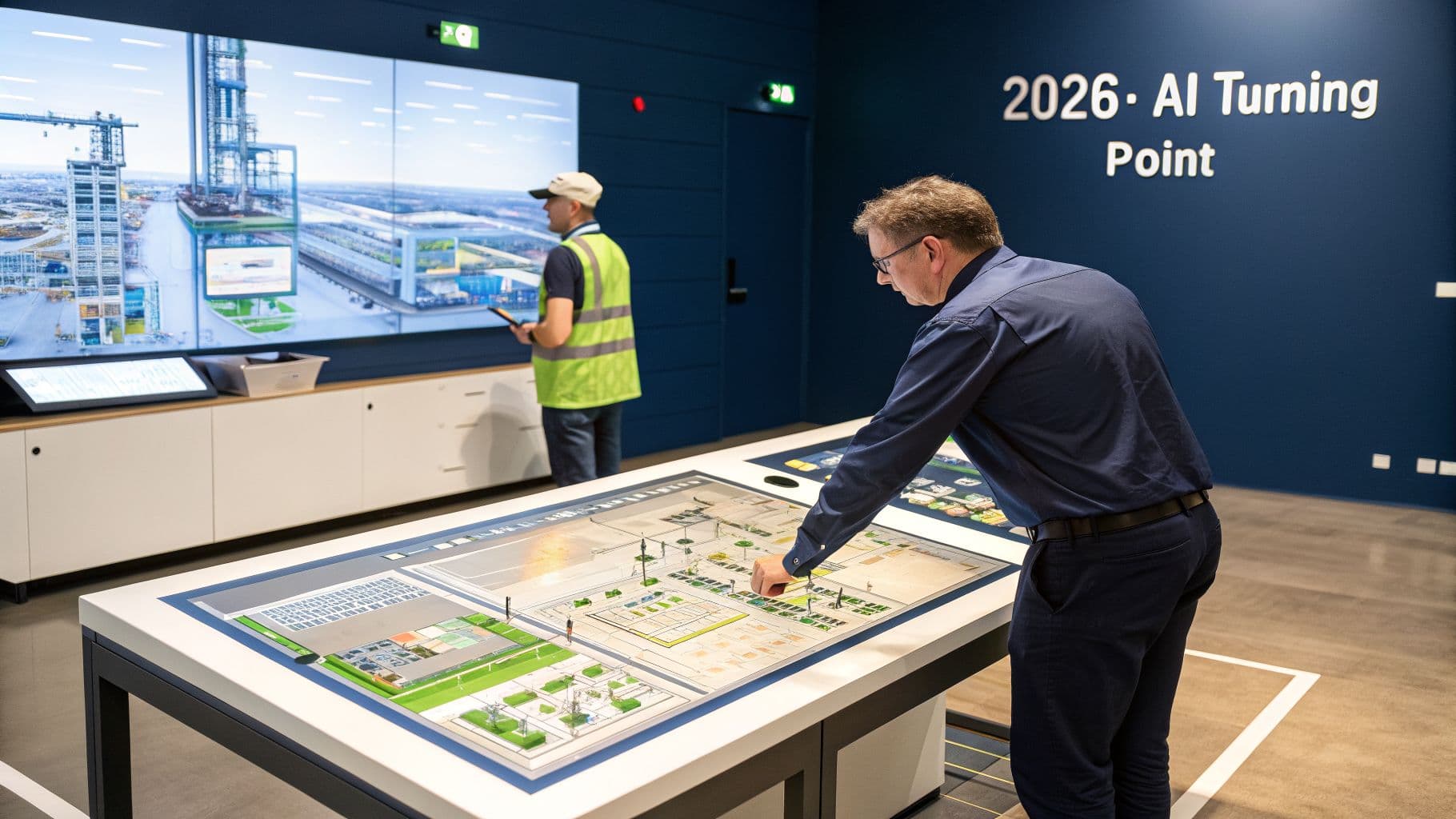
Artificial intelligence in manufacturing isn’t some far-off concept anymore; it’s a practical tool for staying competitive right now. Think of it as the central nervous system for a smart factory, using data to fine-tune everything from a single machine to an entire production line. It’s the key to driving efficiency, cutting costs, and finding new ways to be productive. For many, 2026 is looking like the year where adoption moves from the early few to the mainstream.
The Shift Towards Intelligent Operations
The manufacturing sector is in the middle of a major change, shifting from traditional assembly lines to operations driven by data and intelligence. AI gives your teams analytical tools that turn huge volumes of factory data into clear, actionable insights, in support of human expertise.
You can think of AI in manufacturing like the conductor of a complex orchestra. Every machine, process, and supplier is an instrument. AI’s job is to coordinate them, making real-time adjustments to prevent mistakes. This is what turns a standard factory into a smart, responsive facility.
A Tipping Point in Manufacturer Confidence
A recent Make UK and PwC UK Executive Survey shows just how much mindsets are changing. It found that 65% of manufacturers now believe the opportunities from technology and AI will outweigh the risks by 2026. This confidence is being backed by real money, with 68% increasing their investment in developing new products that have AI at their core.
This tells us the industry is moving past just talking about AI and is now getting down to the business of implementation. The focus has shifted to getting tangible returns and building operations that are resilient enough for whatever comes next.
AI is fundamentally changing the calculus for manufacturers. It allows for the prediction of equipment failures before they happen, the automatic detection of product defects invisible to the human eye, and the dynamic optimisation of complex supply chains in response to global events.
As we look towards 2026, getting the foundations right will be everything. This means understanding how core systems, like the Top 12 Manufacturing ERP Softwares for Australian Businesses in 2026, provide the data backbone needed for smart automation. The goal is no longer just to make things, but to make them smarter.
Understanding the Core AI Technologies on Your Factory Floor
To see how AI can improve your operations, it helps to understand the specific tools driving the change. Think of AI as a toolkit of specialised technologies, each designed to solve a particular problem on your factory floor. Here is what these tools actually do.
This section demystifies the core technologies behind AI in manufacturing, focusing on their real-world value.
Computer Vision: The Superhuman Eyes
Imagine having inspectors who don’t get tired, don’t blink, and can spot microscopic defects on a fast-moving production line. That’s Computer Vision. This AI technology gives machines the ability to "see" and interpret the physical world using cameras and sophisticated software.
In a factory, computer vision automates quality control by identifying flaws, cracks, or misalignments that are too small or too fast for the human eye to catch. It can check that every component is placed correctly on a circuit board or that packaging labels are correctly applied. This can cut defect rates and goes beyond simple pass/fail checks to give insight into production trends.
By catching errors at the source, it prevents faulty products from ever reaching your customers. This protects your brand's reputation and saves you from the significant costs of rework and returns.
Predictive Maintenance: The Crystal Ball for Machinery
What if you knew a critical machine was going to fail before it actually broke down? That’s the power of predictive maintenance. This AI application acts like a crystal ball for your equipment, analysing data from sensors to forecast potential failures.
It works by constantly monitoring operational data like temperature, vibration, and energy consumption. AI algorithms learn the normal operating patterns of each machine. When they detect subtle changes that signal an impending problem, they alert your maintenance teams.
Instead of reacting to breakdowns, your team can schedule repairs during planned downtime, avoiding costly emergency shutdowns that bring production to a halt. This shifts maintenance from a reactive, costly fire-fight to a proactive, strategic activity.
This approach cuts unplanned downtime by an average of 30 to 50% and extends the lifespan of your machinery by catching issues before they cause major damage.
Generative Design: The AI Co-Designer
Think of generative design as an AI partner collaborating with your engineers to create better products. Your team sets the design goals, such as weight, material, strength, and cost constraints, and the AI explores thousands of possible design variations on its own.
The algorithm generates and refines designs, often producing innovative, organic-looking shapes that a human engineer might not have considered. These designs are frequently stronger, lighter, and more material-efficient than designs made with traditional methods.
- Aerospace: Creating lightweight yet incredibly strong components for aircraft.
- Automotive: Designing parts that reduce vehicle weight to improve fuel efficiency.
- Medical: Developing custom implants that are optimised for a patient's anatomy.
This technology doesn't replace your engineers. It supercharges their creativity, letting them focus on high-level problem-solving while the AI handles the repetitive grind of iterating through countless design options.
Digital Twins: The Risk-Free Virtual Sandbox
A digital twin is a living virtual replica of a physical asset, a process, or even an entire factory. This model is continuously updated with real-time data from sensors on its physical counterpart, creating a mirror of what’s happening on your factory floor.
This gives you a completely risk-free environment to test changes. Want to see how a new production layout will affect efficiency? Simulate it on the digital twin first. Need to train new operators on complex machinery? Let them practise in the virtual world without any danger to real equipment.
Digital twins enable you to optimise processes, troubleshoot issues, and predict outcomes with incredible accuracy before committing resources in the real world. It's a foundational piece for many AI advancements, including those used to design the next generation of smart factories. By working with our AI services, you can build the core models needed to bring this technology to life.
Real-World AI Use Cases and Their Financial Impact
Understanding the core technologies is one thing, but the real test is seeing how AI in manufacturing actually delivers a return. It's time to move past the theory and look at what’s already happening on the factory floor, where these tools are creating real value and boosting profits.
The most successful applications of AI solve a specific, often expensive, business problem. By targeting these pain points, manufacturers can draw a straight line from their technology investment to genuine improvements in their bottom line.
AI-Powered Quality Control
One of the most immediate and high-impact wins comes from using computer vision for quality control. Human inspectors, no matter how skilled, get tired and can be inconsistent. AI systems, on the other hand, can inspect thousands of parts an hour with unwavering precision.
These systems can spot microscopic defects, tiny colour variations, or misalignments that are completely invisible to the human eye. The result? A massive drop in faulty products ever reaching the market. Many manufacturers have seen defect rates fall by up to 90%, which dramatically cuts costs from scrap, rework, and warranty claims.
This technology doesn’t just find faults; it gives you the data to trace quality issues back to their source. This means you can fix the problem upstream, preventing defects from happening in the first place and creating a cycle of continuous improvement.
Predictive Maintenance and Downtime Reduction
Unplanned downtime is one of the biggest, and often hidden, costs in any factory. It can grind an entire production line to a halt. One of AI’s most powerful applications, Predictive Maintenance for Manufacturing, tackles this head-on by anticipating equipment failures before they happen.
By analysing sensor data such as vibration, temperature, and power consumption, AI algorithms can pick up on the subtle warning signs of an impending breakdown. This gives maintenance teams the notice they need to schedule repairs during planned downtime, instead of scrambling to fix a broken machine mid-shift.
The financial upside is huge. Many factories report a 20-30% reduction in maintenance costs and a 30-50% cut in unplanned downtime. This directly lifts Overall Equipment Effectiveness (OEE), a critical metric for any operation, and is a core part of the advanced engineering solutions we see today.
Optimising the Entire Value Chain
AI’s influence doesn’t stop at a single machine; it’s being used to untangle complex supply chains and automate essential back-office jobs.
- Supply Chain Optimisation: AI algorithms analyse enormous datasets, from shipping routes and weather patterns to supplier performance, to build more resilient and efficient logistics. This helps factories get ahead of disruptions and dynamically re-route shipments, saving time and money.
- Robotic Process Automation (RPA): In the back office, AI-powered bots are taking over repetitive, rules-based tasks like processing invoices, entering orders, and generating reports. This frees up staff to work on more strategic activities, while also improving accuracy and cutting administrative overhead.
Interestingly, while robotics is often seen purely as a way to increase productivity, AI is viewed more broadly. Research shows that 47% of manufacturers are using AI to target growth, while 46% focus on productivity gains, showing its balanced impact across the business.
Building Your AI Implementation Roadmap
Jumping into an AI project can feel overwhelming, but a clear, phased roadmap turns a huge undertaking into a manageable process. It’s the key to making sure your efforts are tied to real business goals.
A structured approach helps you move from an initial idea to a fully scaled solution that delivers a clear return. It's about starting small, proving the value, and building momentum from there. The goal is to sidestep common traps, such as chasing technology for its own sake, and focus on solving a genuine business problem.
Phase 1: Discovery and Strategy
This first phase is arguably the most important. Before anyone writes a single line of code, you need to identify a specific, high-impact business problem you want to solve with AI. Don't start with the technology; start with the pain point.
Is it a production bottleneck holding up your entire line? Are high defect rates eating into your profit margins? Is unscheduled machine downtime killing your output? Finding a clear problem with a measurable financial impact gives your project a defined purpose. It also makes building a compelling business case much easier.
During this phase, you should:
- Identify Key Stakeholders: Get leaders from operations, IT, and finance in the same room to ensure everyone is on the same page.
- Define Success Metrics: How will you know if it worked? This could be a reduction in defect rates, a drop in downtime, or faster order processing.
- Assess Feasibility: Take a hard look at whether you have the data and resources needed to tackle the problem you’ve chosen.
Phase 2: Data Readiness and Preparation
AI runs on data. Without clean, accessible, and relevant data, even the cleverest algorithm is useless. This phase is all about getting your data house in order, which is often the most difficult part of any AI project.
This process visualises the core areas where AI can drive impact, moving from quality control and maintenance to overall process optimisation. Each step builds on the last, turning specific interventions into widespread efficiency gains across the operation.
Realising the potential £550 billion boost to UK GDP from AI means getting past some significant hurdles, like integrating with legacy systems and unifying scattered data sources. Many manufacturers first need to establish operational visibility and strengthen their foundational systems before they can think about scaling AI. This presents a clear strategic imperative. You can read the full research about industrial AI opportunities on techUK.org.
Phase 3: The Pilot Project
With a clear strategy and your data prepared, it’s time for a pilot project. The mantra here is ‘start small, prove value’. A pilot is just a limited, controlled experiment designed to test your idea and show a return on investment with minimal risk.
For example, you might deploy a computer vision system on just one production line to prove it can cut down on defects. Or you could run a predictive maintenance model on a single critical machine to show it can prevent unplanned downtime.
A successful pilot is your most powerful tool for getting executive buy-in. It turns an abstract idea into a tangible success story, complete with hard data on cost savings or efficiency gains, paving the way for wider adoption.
Phase 4: Scaling and Integration
Once your pilot has proven its worth, the final phase is to scale the solution. This means rolling out the AI model across other production lines, machines, or even entire facilities. Scaling needs careful planning.
You'll need to figure out how the AI system integrates with your existing workflows and software, like your ERP or MES. It also means training your team to work alongside the new technology, turning them from operators into system overseers and problem-solvers. This is where you turn a successful experiment into a core part of your day-to-day operations with AI in manufacturing.
For more insights, you might be interested in our guide on choosing an artificial intelligence development company.
How Arch Accelerates Your Path to a Smarter Factory
Bringing AI into a manufacturing environment can feel daunting. You’re often juggling legacy systems, fragmented data, and the constant pressure to show a clear return on investment. It takes more than plugging in new technology: you need a partner who understands these hurdles and can help you turn a smart factory vision into a practical, value-driven reality.
This is where a structured, human-centred approach helps. We de-risk your AI journey by breaking it down into clear, manageable phases. We focus on delivering measurable results quickly, making sure every step aligns with what your business actually needs. We build your confidence in the investment as well as the technology.
Discovery: Pinpointing High-Value Opportunities
Your journey starts with our Discovery phase. Forget broad, theoretical chats about AI. We get straight to the point, working alongside your team to identify the specific operational pain points where AI will make the biggest, most immediate difference.
We concentrate on finding a single, high-value use case. Maybe it’s cutting down defects on a critical production line or predicting downtime for that one bottleneck machine everyone worries about. By focusing on a tangible problem with a measurable outcome, we build a solid business case from day one. This makes sure your first AI project is set up for a clear, demonstrable win.
We believe effective AI solutions come from a deep understanding of the human side of manufacturing. Our goal is to give your team intelligent tools that augment their skills, not replace them, and support both efficiency and employee engagement.
Prototyping: Demonstrating ROI with Minimal Risk
Once we have a clear target, we move to the Prototype phase. The idea here is simple: build a small-scale, working model to prove the solution's value quickly and with minimal investment. This could be a computer vision model for a single quality checkpoint or a predictive algorithm for one piece of equipment.
This agile approach lets you see the technology in action and measure its potential ROI without committing to a full-scale deployment. For example, in our work with H2OIQ, we developed solutions that turned raw data into actionable insights, proving the power of a focused, prototype-first method. Seeing is believing, and a successful prototype delivers the hard evidence you need to get wider buy-in.
Production Delivery: Building Robust, Scalable Solutions
With the concept proven and ROI validated, we get to Production Delivery. Here, we take the successful prototype and engineer it into a scalable, fully integrated solution ready for your factory floor. Our experience building production-ready systems means your AI solution is built to be reliable, secure, and prepared for the demands of a real-world manufacturing environment.
By using our end-to-end AI services, you can sidestep common implementation pitfalls and get to a smarter, more efficient factory faster. We handle the technical complexity, so you can stay focused on the business outcomes.
If you’re ready to explore how a targeted AI strategy can transform your operations, we invite you to contact us today. Let's build the future of your factory, together.
Frequently Asked Questions about AI in Manufacturing
What is the primary role of AI in manufacturing?
AI's main role is to enhance operations by turning vast amounts of data into actionable insights. It optimises processes, predicts equipment failures, automates quality control, and makes supply chains more efficient. Rather than a single technology, it’s a toolkit for creating a "smart factory" that is more productive, cost-effective, and responsive. This intelligence helps manufacturers move from reactive problem-solving to proactive, data-driven decision-making, giving them a significant competitive edge in the market.
How does AI improve quality control?
AI, particularly computer vision, revolutionises quality control by automating inspection processes with superhuman precision. Cameras and algorithms can detect microscopic defects, colour inconsistencies, or misalignments on a production line that are invisible to the human eye. This system works 24/7 without fatigue, drastically reducing the number of faulty products reaching customers. By catching errors at the source, it not only cuts scrap and rework costs but also provides data to fix the underlying cause of the defect.
What is the biggest challenge when implementing AI in manufacturing?
The biggest challenge is often data readiness. AI algorithms require large volumes of clean, structured, and accessible data to function effectively. Many manufacturers struggle with legacy systems, siloed information, and inconsistent data formats. Overcoming this involves a dedicated effort to unify data sources, ensure data quality, and establish robust data governance. Without a solid data foundation, even the most advanced AI models will fail to deliver meaningful results, making data preparation a critical first step.
Will AI replace manufacturing jobs?
The consensus is that AI will augment human workers, not replace them en masse. It excels at automating repetitive, dangerous, or physically demanding tasks, which frees up employees to focus on higher-value activities like complex problem-solving, process innovation, and strategic oversight. This transition requires a commitment to upskilling and retraining the workforce. The future smart factory will thrive on the synergy between human ingenuity and machine efficiency, creating a more skilled and engaged workforce.
How can a small manufacturer get started with AI?
Small manufacturers should start with a focused pilot project that solves a specific, high-impact problem. Instead of a factory-wide overhaul, identify a single pain point, such as a quality bottleneck or a frequently failing machine. Partner with an AI specialist to develop a small-scale solution to prove the concept and demonstrate a clear return on investment. This approach minimises risk, controls costs, and builds a strong business case for scaling successful AI initiatives in the future.
About the Author
Hamish Kerry is the Marketing Manager at Arch, where he’s spent the past six years shaping how digital products are positioned, launched, and understood. With over eight years in the tech industry, Hamish brings a deep understanding of accessible design and user-centred development, with a focus on delivering real impact to end users. His interests span AI, app and web development, and the potential of emerging technologies. When he’s not strategising the next big campaign, he’s keeping a close eye on how tech can drive meaningful change.
Hamish’s LinkedIn: https://www.linkedin.com/in/hamish-kerry/
Manufacturers ready to move from a pilot idea to working software can talk to our AI software development team about what to build first.