



Choosing Your Artificial Intelligence development Company.
Find the right artificial intelligence development company. Our guide covers vetting partners, project scoping, and avoiding common pitfalls.
Artificial Intelligence development Company.
Key Takeaways
- Partner, Not Vendor: Seek a strategic partner who understands your business goals, not just a vendor who completes tasks. A true partner will challenge assumptions and focus on long-term value.
- Define Your Problem: Before you start your search, clearly define the business problem you're solving with AI and establish specific, measurable KPIs to track success.
- Vet Thoroughly: Scrutinise portfolios for relevant experience (not just industry-specific), ask probing questions about process and problem-solving, and ensure both technical and cultural fit.
- Choose the Right Model: Understand the engagement models. While Fixed Price suits small, defined projects, Time & Materials or a Dedicated Team model offers the flexibility needed for most complex AI development.
- Data is Critical: The AI project lifecycle begins with data sourcing, cleaning, and preparation. The quality of your data directly determines the quality of your AI model.
Choosing the right artificial intelligence development company is a huge decision, one that can shape the future of your business. You’re finding a partner to help turn a complex vision into a real, high-impact solution, and that takes more than hiring coders.
Here is how to get this critical selection process right.
Finding Your Strategic AI Partner
Picking a team to build your AI solution is one of the most important calls you’ll make. The market is absolutely crowded, and the real challenge is finding a company that has both deep technical skills and a genuine understanding of your commercial goals. Success depends on it.
This takes more than someone who can write code. You need a strategic ally who can work through machine learning, data science, and practical, real-world implementation.
The stakes are high, but so are the rewards. The UK's artificial intelligence market is proof, generating a massive USD 23,364.9 million in revenue in 2025. Projections show that figure soaring to USD 180,797.5 million by 2033, all driven by businesses using AI to innovate and become more efficient.
Why a Strategic Partner Matters More Than a Vendor
A vendor just ticks off a list of tasks. A strategic partner, on the other hand, is invested in your success. They’ll challenge your assumptions, suggest better ways of doing things, and stay focused on the ultimate business outcome you’re trying to achieve.
A true partner guides you through the whole journey, from the first spark of an idea to a scalable launch and all the support that comes after.
This difference is everything in AI development, where projects are rarely a straight line. They’re messy, involving a lot of experimentation, iteration, and discovery along the way.
An effective AI partnership depends on collaborative problem-solving. Your chosen company should feel like an extension of your own team, fully aligned with your long-term objectives and ready to adapt as the project evolves.
Getting Started on Your Search
Your first step is to get a lay of the land. A good starting point is to review comprehensive lists of the best AI development companies to see who the key players are and what they specialise in.
This initial research helps you build a shortlist of potential partners whose expertise seems to fit what you need.
Remember, you want a technically brilliant team that can also translate complex AI capabilities into tangible business value. For more on this, check out our guide to building impactful, production-ready AI services.
Translating Your Business Vision Into an AI Blueprint
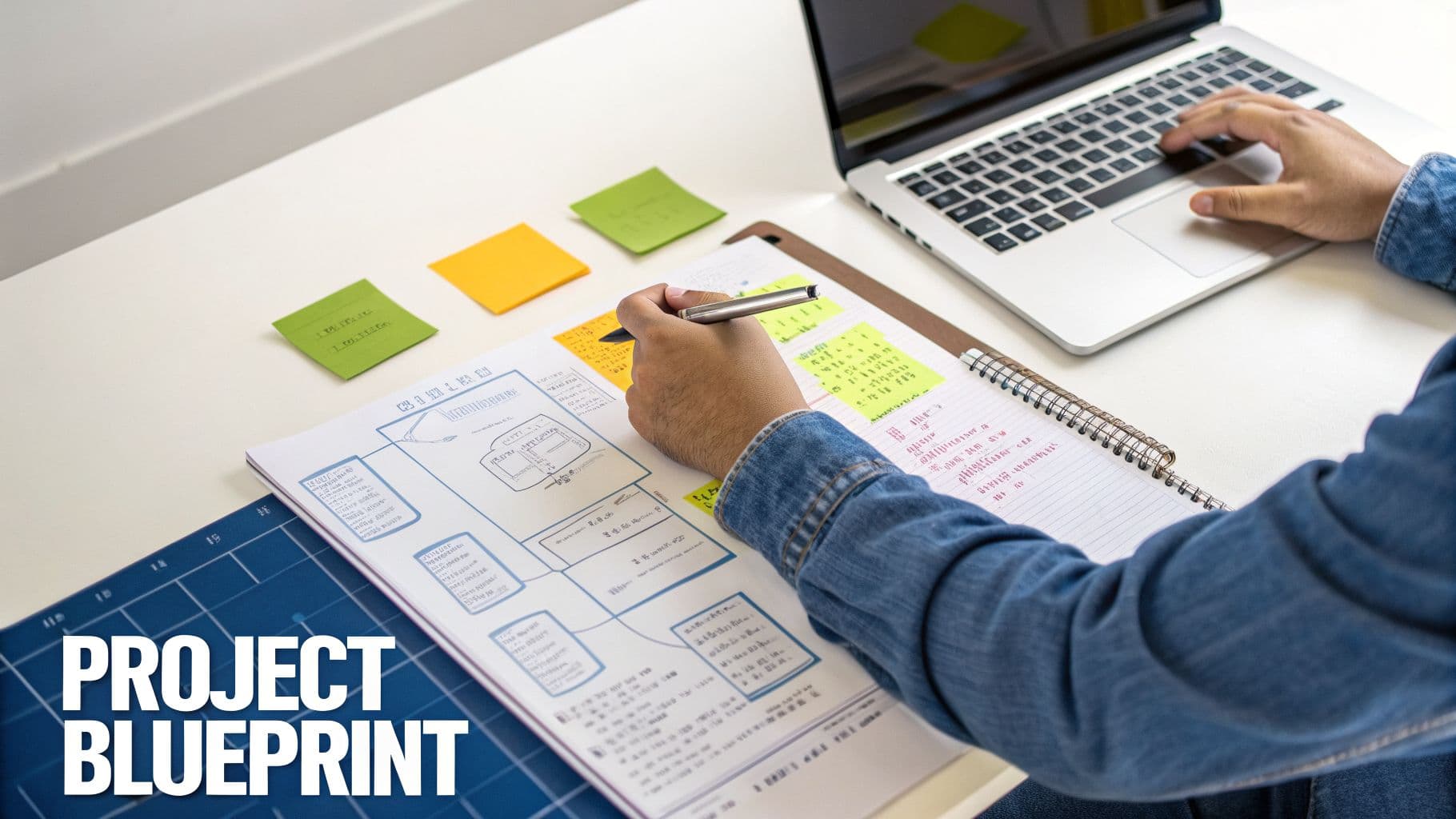
Before you start shortlisting partners, the real work begins in-house. You need to take that big idea rattling around your company and sharpen it into a clear, actionable project blueprint. This document becomes the single source of truth for your entire AI initiative.
Simply saying "we want to use AI" isn't going to cut it. Any serious artificial intelligence development company needs the specifics to understand if they can genuinely help. The first step is to get crystal clear on the exact business problem you’re trying to solve.
Defining Your Core Business Problem
What’s the specific, measurable outcome you’re chasing? Moving from a fuzzy concept to a well-defined problem is your first make-or-break moment. Without this clarity, projects drift, budgets get torched, and enthusiasm dies.
Think about what success actually looks like for you. Are you aiming to:
- Slash operational costs? This could mean automating tedious manual jobs, optimising your logistics network, or using predictive maintenance to stop expensive equipment from failing.
- Deepen customer personalisation? Maybe you want a recommendation engine that nudges up the average order value or a chatbot that actually resolves queries fast, making customers happier.
- Launch a new revenue stream? Perhaps the goal is to build a new AI-powered feature you can sell to customers as a premium upgrade.
This exercise is a critical step for your own team too, because it forces everyone to get on the same page.
Setting Clear and Realistic KPIs
Once you’ve nailed the problem, you need a way to measure success. Key Performance Indicators (KPIs) are what turn your abstract goals into tangible, measurable targets. Forget vague ambitions like "improve efficiency."
Get specific. For instance:
- For automation: Aim to "cut manual data entry time by 40% within six months."
- For personalisation: Target a "15% increase in customer retention over the next financial year."
- For logistics: A solid goal could be to "reduce average delivery times by 20%."
These hard numbers give your project direction and a clear yardstick to judge whether the final solution actually delivered.
Assessing Your Data Readiness
Data is the lifeblood of any AI system. A huge part of your blueprint is an honest look at the data you have versus the data you need. Don’t panic if your datasets aren’t perfect, as very few companies have pristine, analysis-ready data from day one.
The goal here is just to understand your starting line. Ask yourselves:
- What relevant data are we already collecting?
- Where is it all stored, and how easy is it to get to?
- Are there obvious gaps in our data we’ll need to fill?
This initial audit helps an AI development company scope the data engineering work required. They can even help you map out a strategy to collect the right data if you're starting from square one.
Interestingly, despite the enormous potential, AI adoption among UK businesses is still just 16%, with a staggering 80% of non-adopters citing irrelevance or lack of need. This reveals a massive opportunity for businesses that get their data and strategy right from the start.
One step in translating your business vision into an AI blueprint involves identifying strategic applications, such as integrating AI Search Engine Optimization for improved digital presence.
Crafting this blueprint gives your project purpose and clarity. When you’re ready to discuss your ideas, you can explore our AI services or contact us to see how we can help.
Right, you’ve got a solid plan. Now it’s time to talk to potential partners.
But how do you cut through the slick sales presentations and figure out who really has the AI chops? This vetting process is where you separate the genuine experts from the pretenders. It's about finding proof, not just promises.
You’re not just hiring a supplier; you’re looking for a team with the technical skill and strategic foresight to guide you through the complexities of an AI project.
Scrutinise Portfolios for Relevant Experience
First things first, dive into their portfolio. Don't stop at the client logos: get stuck into the case studies. You're looking for experience solving similar types of business problems, which matters more than having worked in your specific industry.
For example, say you want to build a predictive maintenance system for manufacturing equipment. A company that has developed a demand forecasting tool for a retail business has highly relevant skills. Both projects are rooted in time-series analysis and prediction, which is the core capability you need.
A strong portfolio reveals the journey, not just the destination. Look for case studies that detail the initial business challenge, how they navigated data hurdles, and the measurable impact of the final solution. That tells a much richer story than a simple screenshot.
Ask Questions That Go Beyond the Surface
A polished presentation can hide a multitude of sins. To get a real feel for a company's depth, you need to ask probing questions that reveal their process, problem-solving skills, and how they collaborate.
Here are a few essentials to have in your back pocket when you talk to a potential artificial intelligence development company:
- Process and Methodology: "Can you walk me through a typical AI project, from discovery to deployment and beyond? How do you handle communication and reporting?"
- Technical Expertise: "Which machine learning frameworks and tools does your team specialise in? How do you keep up with the relentless pace of change in AI?"
- Problem-Solving: "Tell me about a time an AI project went off-piste. What were the data challenges or scope changes you faced, and how did your team get it back on track?"
- Team Composition: "Who would actually be on our project team? Can we speak with the lead data scientist or AI engineer who would be working on our project?"
Their answers will tell you whether they have a structured, battle-tested process or if they’re just making it up as they go. A confident, transparent partner will welcome these questions. If you want to learn more about what makes a collaboration click, we've shared our thoughts on the value of strong tech agency partnerships.
Evaluate Technical and Cultural Fit
Technical competence is table stakes. But for a long-term partnership, a cultural fit is just as vital. Do they communicate in a way that works for you? Are they truly collaborative, or do they prefer to work in a black box? A successful AI project demands a close working relationship, so getting this chemistry right is non-negotiable.
The UK is home to a world-class AI ecosystem. For instance, 2026 rankings named London-based DeepMind (rated 4.9/5 for Generative AI) and Thought Machine (rated 4.6/5 in finance), as well as Oxford's Mind Foundry, which focuses on explainable AI. These firms serve giants like the NHS and Lloyds, which shows the calibre of talent available. You can explore more about these top UK AI companies and their specialisms.
This is the level of expertise you should be looking for. Your ideal partner should feel like an extension of your own team, invested in your goals and armed with the skills to get you there. Vetting thoroughly at this stage is a worthwhile investment in your project's success.
Choosing the Right Engagement and Pricing Model
The structure of your partnership with an artificial intelligence development company matters as much as the partner you choose. Beyond price, it is about aligning incentives, managing risk, and finding a framework that works for the often unpredictable journey of an AI project.
Get this wrong, and you’re in for friction, misaligned expectations, and budget blowouts. Get it right, and you build a relationship on transparency, flexibility, and a shared drive to hit your goals. Here are the models you'll likely come across.
The Fixed Price Model
A Fixed Price contract is what it sounds like: a set cost for a clearly defined scope of work. This model can be a good fit, but only for projects with no ambiguity, such as a small, contained proof-of-concept or a straightforward data analysis task where the inputs and outputs are clear from day one.
Where it shines:
- Budgetary Certainty: You know the final bill before you even start, which makes financial planning a breeze.
- Defined Scope: It forces everyone to agree on every deliverable upfront, which can keep scope creep in check.
Where it falls short:
- Rigidity: AI development is rarely a straight line. Discoveries made mid-project often demand a change of direction, and a fixed contract makes pivoting difficult and expensive.
- Risk Premium: To protect themselves from the unknown, agencies often bake a hefty contingency buffer into the price. You could end up paying more than you would with a more adaptable model.
Honestly, this model is a poor fit for most complex AI projects where the path to a solution isn't mapped out from the beginning.
The Time and Materials Model
This is where most serious AI development happens. With Time and Materials (T&M), you pay for the actual hours the team puts in, plus any direct costs. It’s built for flexibility and is well suited to projects where the scope will probably evolve as the team uncovers new insights.
This approach is ideal for complex, research-heavy projects where you don’t have all the answers at the outset. It allows for an agile, iterative process, letting the team adapt based on what the data and the models are telling them.
With Time and Materials, you're buying a team's expertise and their ability to adapt as well as a deliverable. The relationship shifts from a simple client-vendor transaction to a genuine partnership, focused on finding the right solution, even if it looks a little different from what you first imagined.
The Dedicated Team Model
For long-term, ambitious AI initiatives, the Dedicated Team model is often the strongest option. You’re essentially hiring an entire external team that works exclusively on your projects. Over time, they become an extension of your own crew, gaining a deep, nuanced understanding of your business, your data, and your strategic goals.
This model suits you when you need sustained AI horsepower but aren't ready to build a full in-house team from the ground up. It gives you consistency, deep domain knowledge, and a high degree of control over the project's direction. Our work on the H2oiQ project, for example, shows how this kind of deep, flexible collaboration can produce an effective AI solution.
So, how do you choose? It really boils down to your project's specific needs:
- For a small, well-defined proof-of-concept, Fixed Price can work.
- For most custom AI development, Time and Materials provides the flexibility you need to succeed.
- For a long-term, strategic AI programme, a Dedicated Team offers deep integration and continuous value.
Any artificial intelligence development company worth its salt will guide you to the model that fits your project's complexity and your goals. They should be open about the pros and cons of each, helping you make a smart decision that sets you up for a successful partnership from day one.
Navigating the AI Project Lifecycle from Kickoff to Launch
So, you’ve picked your artificial intelligence development company and agreed on how you’ll work together. What happens next? The journey of building an AI solution is a dynamic one, and it looks quite different from a standard software project. Understanding the flow will help you be an active collaborator, not just a spectator.
The whole process is built on discovery and adaptation. Unlike building a website where the features are locked in early, AI development is all about experimenting, learning, and refining as you go. This is where agile thinking is non-negotiable, allowing the project to pivot based on what the data and the models are telling you.
The Critical Discovery and Data Preparation Phase
The first, and arguably most important, phase of any AI project is a close look at your business and your data. This often takes up a significant chunk of the timeline, and for good reason. Your chosen partner should embed themselves with your team to get under the skin of the business problem, nail down the KPIs, and audit the data you have.
This phase usually breaks down into a few key activities:
- Data Sourcing: Pinpointing every relevant data source, whether it’s tucked away in your CRM, sitting in a database, or needs to be pulled from a third-party system.
- Data Cleaning: This is the messy bit. It involves tackling inconsistencies, fixing errors, and figuring out what to do with missing values. No real-world dataset is perfect, so this clean-up is essential for building a reliable model.
- Data Labelling: For many machine learning tasks (especially supervised learning), the data needs to be labelled. This can be a huge undertaking on its own and requires serious domain expertise to get right.
You can't skip this groundwork. The old saying "garbage in, garbage out" holds especially true in AI. The quality of your model is dependent on the quality of your data. If you want a closer look at this initial stage, we’ve got a detailed breakdown of what a discovery process entails.
Model Development and Iterative Training
Once your data is in good shape, the data science team rolls up their sleeves. This isn’t a one-and-done task; it’s a cycle of constant experimentation. The team will start by selecting a few appropriate algorithms, building initial models, and kicking off the training process. This is where they feed the prepared data into the model, letting it learn the patterns and relationships hidden within.
The process typically follows this loop:
- Model Training: The algorithm crunches through the dataset, tweaking its internal parameters to get better at making accurate predictions.
- Model Validation: The team then tests the trained model against a fresh set of data it has not seen before. This checks its performance and guards against "overfitting", where the model just memorises the training data instead of learning the underlying patterns.
- Hyperparameter Tuning: Based on how it performed, the team will adjust various settings (hyperparameters) and retrain the model, aiming to boost its accuracy and efficiency with each cycle.
This training and validation loop is the engine room of AI development. It requires a patient, scientific approach as the team continuously experiments to find the right architecture and configuration to solve your specific business problem.
The engagement model you choose will influence how this lifecycle is managed and billed, as the graphic below shows.
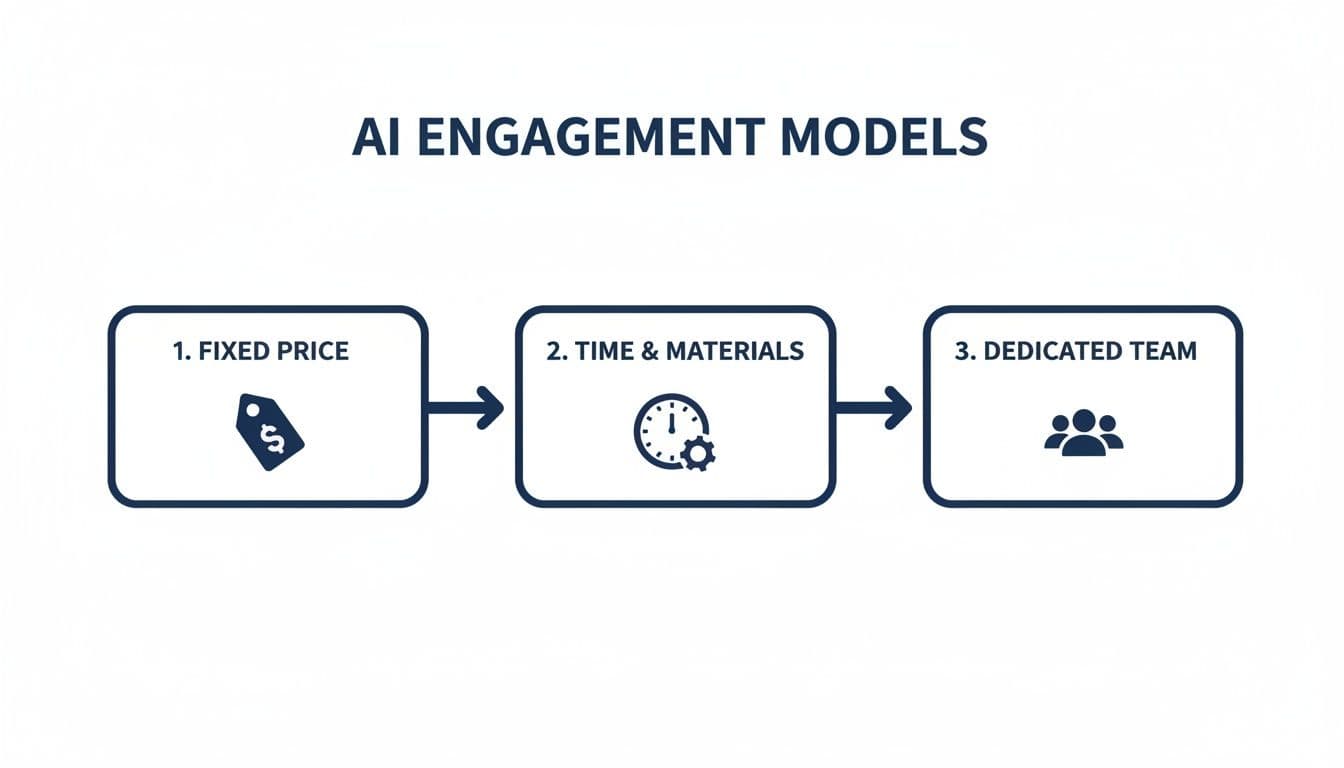
As you can see, while a Fixed Price model demands a rigid scope, the Time & Materials and Dedicated Team models are designed to embrace the iterative, flexible nature of AI development.
Integration, Deployment, and Beyond
After all the testing and validation, the model is ready for the real world. This means integrating it into your existing software, apps, or business workflows so it can start adding value. A good artificial intelligence development company will have been planning for this from day one, so the final solution slots into your tech stack.
But deployment isn’t the end of the story. AI models need ongoing monitoring to ensure their performance doesn't degrade over time, a phenomenon known as "model drift." Your partner should have a solid plan for maintaining the model, retraining it with new data when needed, and ensuring it continues to deliver accurate results long after the launch party.
Where to go from here?
Choosing an AI development company is one of those big decisions that can genuinely change the direction of your business. It’s a process that needs real thought, starting with a crystal-clear idea of what you want to achieve, moving through to proper vetting, and landing on the right kind of partnership.
The goal is a team that’s technically brilliant and also gets what you’re trying to do commercially. A true partner will guide you through all the technical complexities and turn that initial vision into something real and impactful. They should feel like an extension of your own team, obsessed with solving the same problems you are.
This journey is about setting your business up to win as well as plugging in new tech. The right AI partner is the catalyst that makes it happen, delivering results you can see and a clear competitive edge.
When you get the foundations right, with clear communication and a shared definition of success, you build a partnership that keeps delivering value long after the initial launch. That kind of collaboration opens up new opportunities and supports real growth.
Ready to put these ideas into action? Let's talk about how our human-centred approach to AI can help you build solutions that really work. Get in touch and we can start the conversation.
Frequently Asked Questions
How much does it cost to hire an AI development company?
There is no single price. A simple proof-of-concept could be in the tens of thousands, while a complex, custom AI solution often runs into six figures or more. Key cost drivers include data complexity, model training intensity, and integration requirements. A transparent partner will provide a detailed cost breakdown in their proposal, ensuring there are no hidden surprises. Vague pricing is a significant red flag when choosing a partner for your project.
What is a typical timeline for an AI project?
Timelines vary based on complexity. A straightforward project using existing models might take 3-6 months. However, a bespoke solution requiring extensive data engineering, research, and unique model development can easily extend to 9-12 months or longer. Factors like the clarity of the initial scope and the quality of your existing data significantly impact the schedule. An agile approach helps manage these variables and ensures consistent progress throughout the project lifecycle.
Do I need my own data to start an AI project?
Having high-quality, relevant data is a significant advantage, but it's not a deal-breaker. An experienced artificial intelligence development company can help you formulate a data strategy from scratch. This could involve identifying and sourcing public datasets, creating synthetic data to train models, or implementing a system to begin collecting the necessary information. The initial discovery phase is designed to assess your data readiness and map out the best path forward for your specific goals.
What are the biggest red flags when choosing an AI partner?
Be cautious of any company that cannot provide relevant case studies or offers vague proposals lacking concrete deliverables. Another warning sign is a partner who promises guaranteed results or uses excessive technical jargon without linking it back to tangible business value. A trustworthy partner communicates clearly, is transparent about their process, and focuses on solving your specific business problem rather than just showcasing their technical prowess. Your goal is a strategic ally, not just a vendor.
At Arch, we combine strategic discovery with solid engineering to help organisations build digital products users love. Ready to start your AI journey? Contact us today.
About the Author
“Hamish Kerry is the Marketing Manager at Arch, where he has spent the past six years shaping how digital products are positioned, launched, and understood. With over eight years in the tech industry, he has a deep understanding of accessible design and user-centred development, with a focus on delivering real impact to end users. His interests include AI, app and web development, and the transformative potential of emerging technologies. Outside campaigns, he follows how tech can drive meaningful change.”
Hamish’s LinkedIn: https://www.linkedin.com/in/hamish-kerry/
Arch works as an AI software development company for UK businesses, and the service page explains how we take a project from discovery to a working product.