



Scalable System Design: A Practical Guide for Growing Teams.
Scalable system design explained for scale-ups, SMEs and engineering leads. Core principles, architecture patterns, trade-offs and a step-by-step approach.
Scalable System Design: A Practical Guide for Growing Teams.
A product can feel effortless right up until demand changes. Pages start loading slowly, background jobs fall behind, deployments become risky, and cloud bills rise without making the service feel any faster. For a UK SME or scale-up, that first scaling wall isn't a sign that the product has failed. It's a prompt to make deliberate choices about what needs to grow, what must stay reliable, and what the business can afford to operate.
Key takeaways
- Scale the bottleneck, not the whole stack. Measure workload and user experience before adding capacity.
- Keep services loosely coupled. Stateless tiers, queues and modular data systems let teams scale constrained parts independently.
- Treat resilience as an operating decision. Map dependencies, set recovery expectations and test what happens when services fail.
- Manage cost alongside capacity. Rightsizing, autoscaling and scheduling help prevent elastic infrastructure from becoming an uncontrolled bill.
- Scale AI features with governance. Evaluation, monitoring, data controls and human escalation matter as much as serving capacity.
Scalable system design isn't reserved for technology giants. It's a practical discipline for any growing digital product, and it spans architecture, team workflows, cost management and recovery planning. This guide focuses on what works in production, where common patterns carry trade-offs, and how to turn scaling into a staged roadmap rather than a rushed rebuild. It also addresses the less-discussed challenges of resilience, cloud spend and AI-feature growth, where operational constraints can matter more than theoretical capacity.
For teams whose products depend on reliable, timely data, modern campaign data workflows offer useful context on organising information as activity grows.
When Growth Outgrows Your Architecture
An e-commerce team notices checkout slowing every lunchtime. They double the web tier and nothing improves, because the database is already saturated and the payment provider adds latency nobody has measured. Growth rarely announces itself as a clean capacity problem. It shows up as one journey degrading, one queue backing up, or a deployment that feels too risky during a busy period.
Adding servers relieves the pressure for a while. Then the symptoms return, because the constraint sits somewhere the extra capacity never touched: lock contention on a hot table, a synchronous call to a slow dependency, or a connection pool ceiling.
The first useful move is to follow the critical user journey across its dependencies and measure where time and work accumulate. A slow checkout might involve an API, a database write, a payment provider and a confirmation message. Scaling the API tier alone does nothing if the write path is saturated. In my experience, the constraint is rarely where the alert fires.
Symptoms and causes need separating too. A queue that keeps growing may mean workers need capacity, or that each job does unnecessary work, or that everything waits on a downstream service. A rising bill may reflect genuine growth, idle provisioned capacity, or the same data processed twice.
Resilience gets the same treatment. Research reported by ITBrief found UK businesses still face major IT resilience gaps despite increased investment, with 77% of SMBs lacking sufficient monitoring. What you cannot see, you cannot scale or trust under load.
Practical rule: If a component can't be measured, it's hard to scale confidently. Start by making the work visible.
Scalability is a product and operating-model decision as much as an infrastructure one. Product choices shape demand. Engineering practices determine how safely the system can change. Operational habits decide whether a failure stays contained or cascades.
Capacity planning alone will not carry a growing team. Engineering leads need patterns they can evaluate, trade-offs they can explain, recovery expectations set before incidents happen, and spend kept visible, especially when AI features change the workload profile. The goal is a system the team can understand, operate and adapt as the product grows.
For teams whose products depend on reliable, timely data, modern campaign data workflows offer useful context on organising information as activity grows.
What Scalable System Design Really Means
Scalable system design is the practice of increasing a system's capacity to handle demand while keeping performance, reliability and operating cost within acceptable limits. Think of a restaurant that can serve more customers by adding tables, kitchen capacity or another site without changing every recipe or rebuilding its operations from scratch. In software, the equivalent is a design that lets a team expand the constrained parts without forcing a redesign of the whole product.
There are three useful ways to think about scale. Vertical scaling gives a component more resources, such as a larger database instance. It's often the simplest first response, but it has practical limits and can increase cost. Horizontal scaling adds more instances, which works well when work can be distributed across independent services. Elasticity means capacity can increase or decrease as demand changes, rather than staying fixed at the busiest level.
Measure the work, not the server count
A useful capacity model describes what the system is doing. Track requests per second, concurrent sessions, queue depth, data-ingestion rate and processing time. For user-facing journeys, define latency objectives, including p95 or p99 where those measures are meaningful to the product. Also track error rates and cost in relation to the activity the business cares about, such as an active user or completed transaction.
Those measures help teams distinguish workload growth from inefficient design. If requests rise but latency stays within the product's objective, the system may be scaling appropriately. If queue depth grows while compute remains available, the bottleneck may be a downstream dependency, not worker capacity.
The UK Government's cloud strategy describes cloud infrastructure as an on-demand delivery model that should be dynamically scalable, agile and easy to move in and out of. It also supports separating application capacity from fixed hardware procurement, with stateless web and API tiers scaling horizontally and queues absorbing bursty work. The practical implication is straightforward: plan against workload dimensions, not server count alone. The UK Government's cloud strategy also makes portability part of the design conversation, through approaches such as infrastructure-as-code, containerised deployment, externalised configuration and documented data-export paths.
Scalability belongs to the whole system: code, data, infrastructure, deployment processes and the people operating them. A working definition for a planning meeting is: the system can handle changing demand by scaling the constrained work, while keeping user experience, cost and recovery within agreed limits.
Core Architecture Patterns That Enable Scale
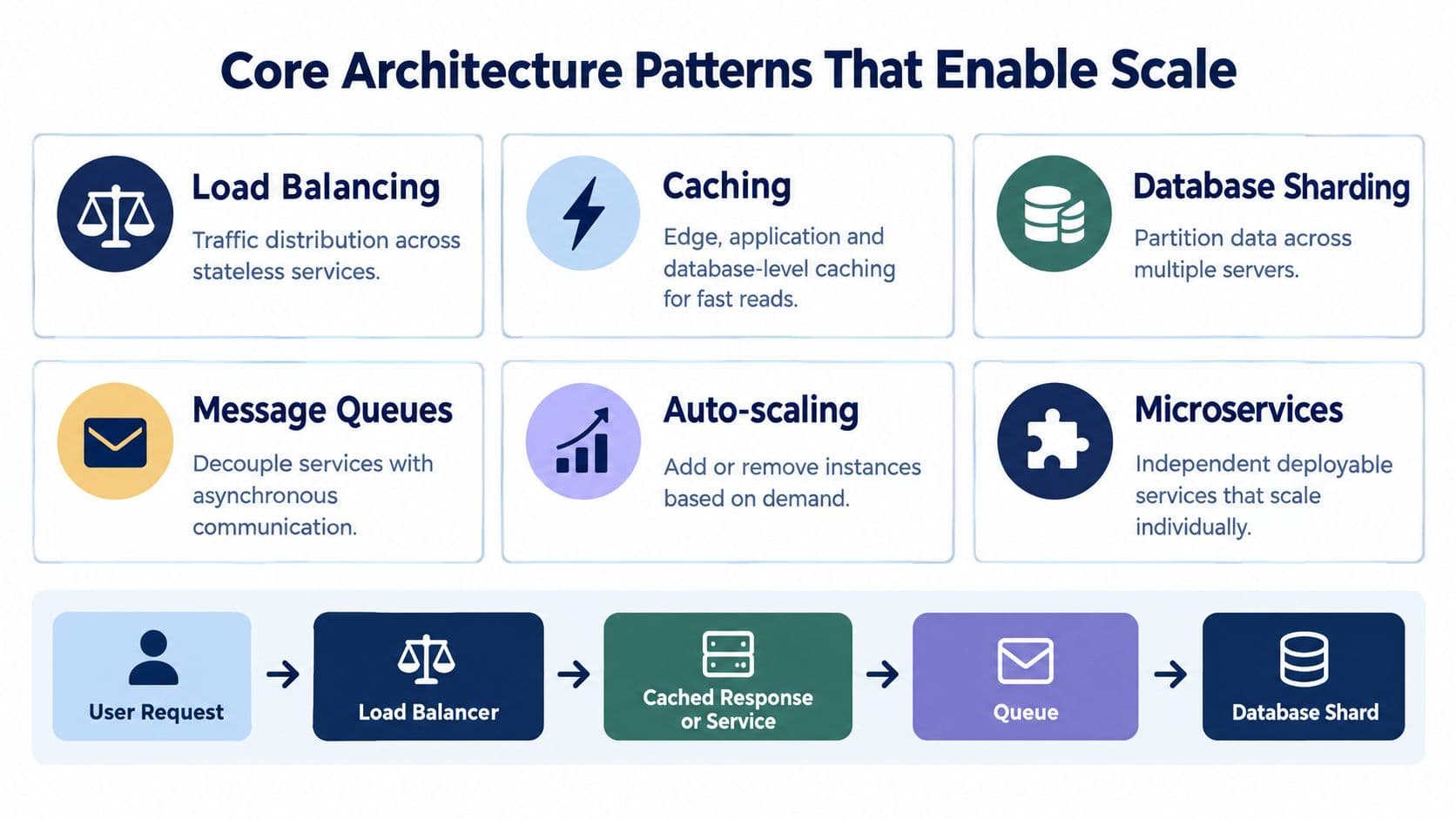
Patterns earn their place when they address a measured constraint. They don't make a system scalable by appearance alone. A team should know which failure or bottleneck each pattern is meant to prevent, and what complexity it introduces.
Distribute requests and reduce repeated work
Load balancing routes requests across service instances. It's most effective when those instances are stateless, so any healthy instance can handle the next request. This helps absorb uneven traffic, but the team still needs health checks and a plan for dependencies that don't scale with the service.
Caching reduces repeated reads by serving data from a closer or faster layer, such as an edge cache, application cache or database cache. It can protect a database from repeated lookups, but stale data and cache-miss surges are real risks. Define expiry and invalidation behaviour before relying on a cache for correctness-sensitive information.
Split work and data deliberately
Partitioning and sharding divide data across manageable units, often by a stable key such as a customer or tenant. This can relieve pressure on a single database, but it makes queries, transactions and data movement more involved. Don't shard just because growth is expected. First determine whether query design, indexing, connection management or vertical capacity can meet the need.
Queues and workers separate accepting a request from completing slower work. For example, a checkout can acknowledge an order and enqueue fulfilment tasks, letting workers process them independently. That keeps user response time from being tied to every downstream action, but introduces eventual consistency, retry behaviour and the need to handle duplicate messages safely.
Shape read and write paths
CQRS, or Command Query Responsibility Segregation, separates the models used to change data from those used to read it. A product might write an order to its authoritative store and build a read-optimised view for customer history. That can improve flexibility where read and write needs differ, but teams take on more moving parts and must explain how quickly views catch up.
Think of each pattern as a tool for a specific constraint, not a badge of architectural maturity.
These choices also affect integration boundaries and ownership. Teams designing those boundaries can use system integration patterns as a practical companion to architecture decisions. For organisations building reporting around those flows, how modern business intelligence works provides context on how operational information can support decisions.
Trade-offs and Anti-Patterns to Watch For
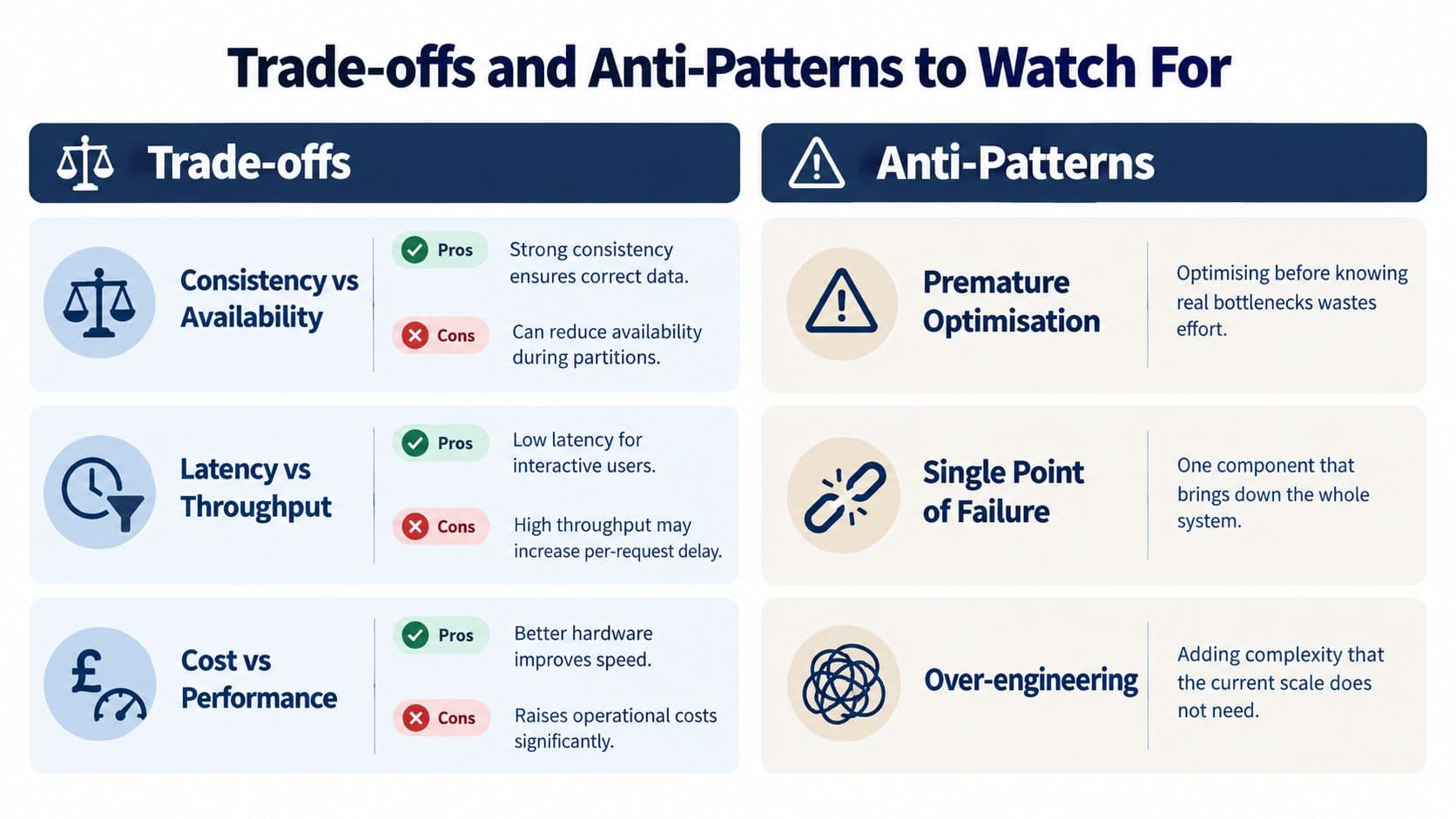
A good pattern applied in the wrong place makes a system harder to operate. A queue helps decouple work, but an unbounded queue hides a failure until the backlog becomes unmanageable. A cache cuts repeated reads, yet caching without a clear invalidation strategy can serve data that users shouldn't see as current. Horizontal scaling adds capacity, and it still won't rescue a database or third-party service that remains a single constrained dependency.
Consistency and availability pull in different directions when services lose contact with one another. The key question is what the user experiences during that failure: block a change until it can be confirmed, or accept a delay before all views agree. That is a product decision as much as a technical one, and it belongs in the objectives agreed for each journey. Low latency and high throughput aren't the same objective either. Batching raises how much work a system handles while making an individual request wait longer.
Managed services reduce the burden of running infrastructure, and they create dependence on a provider's interfaces and operating model. Portability measures, including infrastructure-as-code and documented data-export paths, reduce friction without making migration effortless. Choose based on the team's skills, compliance needs and ability to run the service well.
Complexity is an operating cost
Premature microservices are a familiar trap. Splitting a codebase into independently deployed services can help teams scale ownership or isolate workloads, but it introduces network calls, distributed tracing, service contracts and deployment coordination. When those services must always change together, the result is a distributed monolith with more failure modes and little autonomy. I have watched teams make that split because headcount grew, then spend more engineering time coordinating releases than they saved.
Other mistakes show up in operating habits rather than diagrams: multi-tenant workloads where one customer's activity crowds out another's, retries that amplify an outage, autoscaling policies with no cost ceiling that turn a traffic spike into a billing problem, and larger instances bought before anyone checked the bottleneck.
The UK resilience reporting cited earlier points the same way. Significant IT disruption is common, regularly tested recovery objectives are not, and cloud-service outages sit high on the list of operational risks. Resilience is not a cloud setting. It comes from dependency mapping, named recovery ownership, rehearsed procedures and explicit decisions about which journeys can degrade safely.
A Step-by-Step Approach to Designing for Scale
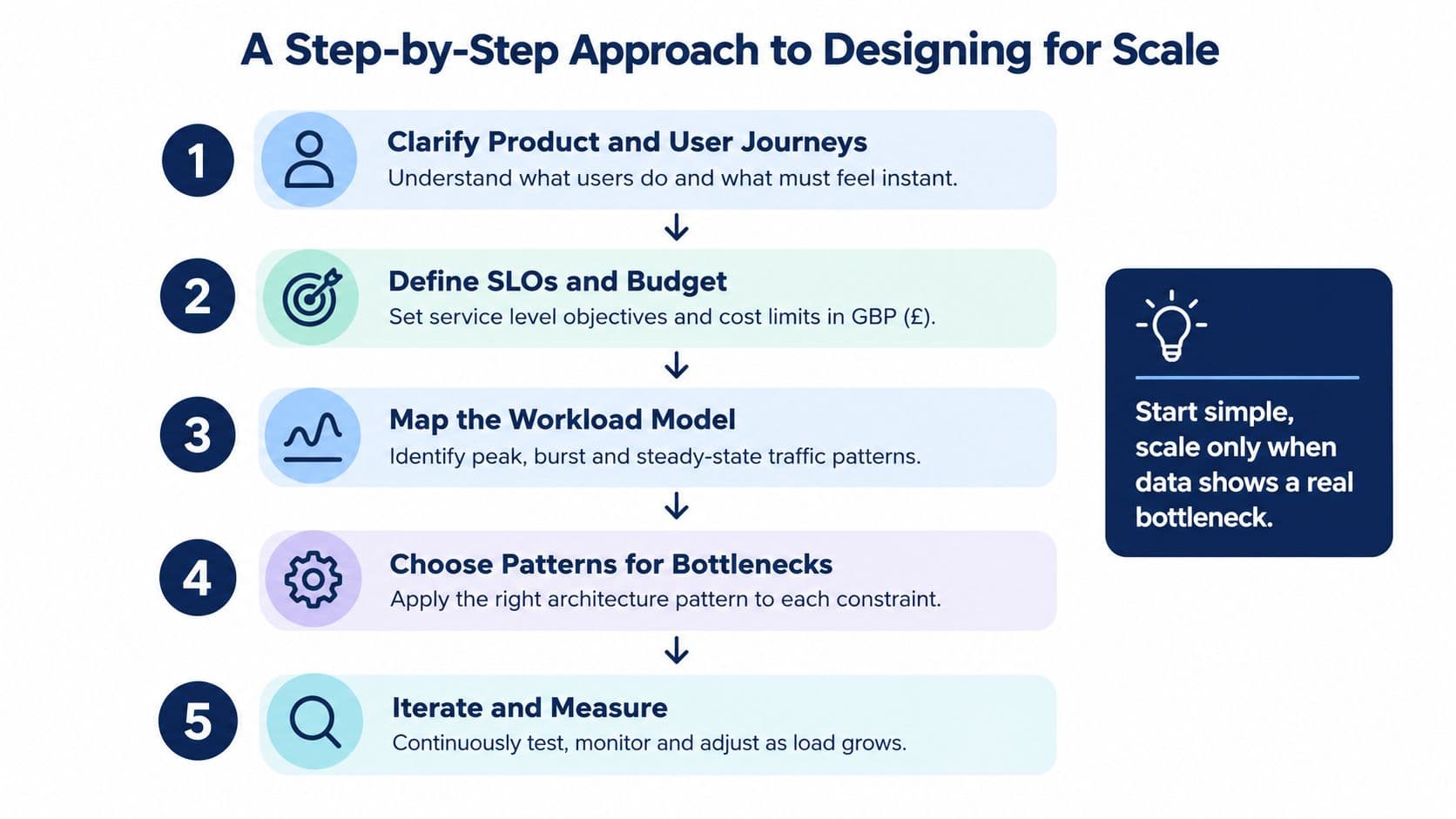
A scaling plan should start with the product, not the deployment diagram. A team needs to understand which journeys matter most, what users expect from them and which parts of the experience can tolerate delay. A user may need an immediate confirmation even if analytics or a notification can run later.
Work from user needs to verified behaviour
First, define the journeys and service objectives. Set latency, availability and recovery expectations for critical paths, and agree on the cost limits the business can support. A useful objective is specific enough to guide a decision: if the primary data store is unavailable, should the system accept a request for later processing, show read-only information or stop the journey?
Then map the workload. Separate steady traffic from peaks, bursts and background processing. Measure request volume, payloads, connection use, queue depth and dependency response times. Include network demand: moving services from private data centres to public cloud usually increases internet-bandwidth requirements, while restricting service locations can reduce available redundancy and resilience, as the NCSC's guidance on cloud service and deployment models explains.
Choose a deployment topology that fits users, data rules and recovery needs. For UK organisations handling sensitive information, a design review should cover location, operational controls, supportability and recovery, not just elastic capacity. GOV.UK also recommends loosely coupled, modular data systems that can connect to different tools and data sources, with architecture developed iteratively so each change can add value. Its guidance on choosing tools and infrastructure for data supports using cloud environments for live data products and considering software-as-a-service where it's more efficient than operating a dedicated data cluster.
Select patterns for the bottleneck you've observed. Add caching for repeated reads, queues for work that doesn't need to finish during the request, or horizontal capacity for stateless services. Don't add multiple patterns at once without a reason. Infrastructure-as-code helps teams provision changes consistently; this guide to infrastructure-as-code is relevant when turning that practice into a repeatable workflow.
Finally, validate the design under load and failure. Test scaling triggers, dependency timeouts, recovery procedures and graceful degradation. Keep observability, feature flags and repeatable provisioning in place so teams can see the effects of a change and reverse it safely.
Before approving the work, ask: Have we set latency targets for critical journeys? Do we know the most important failure modes? Can we add capacity to the critical path quickly and safely? The answers should be supported by a test, not just a diagram.
Scaling AI Features, Costs and Resilience Together
An AI feature can look like another API endpoint until it meets production usage. Conventional scaling work centres on request volume, concurrency and response time. Those measures still matter for AI, but they say nothing about prompt-injection risk, model drift, sensitive-data exposure or inference bills that move with user behaviour. A system can have spare capacity and still produce unsafe or unreliable outputs.
UK organisations are moving at different speeds. Government data reported AI adoption at 39% among digital-and-technology firms in December 2025, compared with 25% across the wider economy, in the AI adoption plan for digital and technology firms. As noted earlier, UK reporting on IT resilience gaps found that 77% of SMBs cannot continuously monitor cloud-data and container risks. For a smaller team, that gap is exactly why governance belongs inside the delivery pipeline, not in a review scheduled after the feature has become business-critical.
Treat AI controls as product design
Roll out AI capabilities in stages. Evaluate outputs against a domain-specific test set before release and after meaningful model or prompt changes. Keep audit trails for decisions that matter, minimise the sensitive data sent to suppliers, and give users a human escalation route when confidence or safety thresholds aren't met. Set rate and budget limits so a successful feature cannot turn into an unbounded inference bill.
Placement matters as much as volume. The NCSC identifies edge computing as appropriate where client-to-service latency must be extremely low, connectivity is unreliable, or raw data should be pre-processed before it reaches the cloud. A UK-facing product might validate, aggregate or cache near a user or site while keeping authoritative records and heavier analytics in regional cloud services. Measure latency across the device, access network, edge and core service before assuming more backend compute will fix a network-bound journey.
For an SME without a dedicated platform team, scalable system design has to join up resilience, cost controls and product governance. None of those problems disappears when capacity is elastic.
Resilience should match the consequences of failure. The NCSC recommends redundancy across hardware, network paths, storage and locations, alongside online and offline backups. It also advises separating management infrastructure from operational infrastructure, so a disruption doesn't prevent administrators from fixing the system. The NCSC's virtualisation security principles give teams concrete controls to work through. For AI features, the same principle means deciding how the product degrades when a model, data source or supplier is unavailable, and shipping that fallback deliberately rather than assuming the feature stays active at any cost.
Recommended Practices and Your Scaling Checklist
For scale-ups and SMEs, the strongest starting point is usually simple architecture with visible boundaries. Keep modules loosely coupled, make services stateless where practical, and use managed data or platform services when they reduce work the team can't support well. Don't adopt microservices or multi-region deployment as a proxy for maturity. Introduce complexity when a measured need or recovery objective justifies it.
Make cost part of the design review. The UK Government's cloud-cost guidance recommends rightsizing, autoscaling and scheduling as practical controls. It defines rightsizing as matching underused instances to actual demand, while automation can change instance sizes or active server counts as needs change. Hackney Council's architecture playbook also requires AWS services configured during provisioning to have an associated autoscaling policy. See UK Government guidance on managing cloud spending.
A planning checklist for your next review
- Define service objectives. Set latency, availability and recovery expectations for the user journeys that matter.
- Measure workload. Track request rates, concurrent sessions, queue depth, data ingestion and processing time.
- Automate provisioning. Keep infrastructure changes repeatable and reviewable.
- Design stateless services. Make horizontal scaling possible where the workload supports it.
- Cache with intent. Decide how expiry, invalidation and cache failures should behave.
- Partition hot data carefully. Address a real data constraint before taking on sharding complexity.
- Decouple slow work. Use queues where delayed processing is acceptable, with clear retry and failure handling.
- Test failure modes. Exercise dependency outages, recovery processes and safe degradation.
- Review cloud spend. Check utilisation and scaling policies regularly, then adjust capacity to observed demand.
Operating habits matter as much as platform choices. Run load tests before expected demand changes, hold game days to practise recovery, and review incidents for design or process changes rather than assigning blame. A useful guide to hosting and support can help teams consider who will maintain the service after launch.
Scalable system design is an ongoing discipline, not a one-off infrastructure project. Arch is a UK digital product studio that designs and builds apps, websites, software and AI solutions, with development and hosting support for products that need to grow. If you're planning a new product or reworking a system that's outgrown its foundations, visit Arch to discuss the architecture and delivery approach that fits your team.
FAQs
What's the first sign that a system needs to scale?
Look for a repeated mismatch between demand and user experience, such as slow critical journeys, growing queues, failed background work or deployments that become risky under load. Don't assume the answer is more servers. Trace the journey through its dependencies, measure where time and work accumulate, then test whether the constraint is compute, data, network or a third-party service.
Should a growing product start with microservices?
Not by default. A modular monolith can preserve clear boundaries without the operational overhead of independently deployed services. Microservices are useful when teams need separate deployment, ownership or scaling for distinct workloads. They also add network dependencies, monitoring needs and failure modes. Split a service when a real organisational or technical constraint justifies the cost, not because the product is growing.
How can a team control cloud costs while scaling?
Measure utilisation and relate spending to meaningful product activity. Rightsize underused resources, use autoscaling where demand varies, and schedule non-production environments when they aren't needed. Set cost limits for workloads that can grow unpredictably, including AI features. Review bills alongside performance and reliability measures, so cost reductions don't undermine the user experience or recovery capability.
How should teams scale AI features safely?
Treat AI as a product capability with operational and governance requirements, not just a serving endpoint. Roll out changes gradually, evaluate outputs against a domain-specific test set, log important decisions and minimise sensitive data sent to providers. Set usage and budget limits, monitor for quality changes, and define when a human should take over. Plan fallback behaviour for supplier or model failures before launch.
Does using cloud infrastructure make a system resilient?
No. Cloud services can provide elastic capacity and useful resilience options, but teams still need to understand dependencies, set recovery expectations and test failure scenarios. Identity, DNS, network connectivity, data services and outsourced SaaS can all affect a user journey. Resilience comes from the architecture, the operating model and rehearsed recovery procedures, not from the deployment location alone.
About the Author
Hamish Kerry is the Marketing Manager at Arch, where he's spent the past six years shaping how digital products are positioned, launched, and understood. With over eight years in the tech industry, Hamish brings a deep understanding of accessible design and user-centred development, always with a focus on delivering real impact to end users. His interests span AI, app and web development, and the potential of emerging technologies. When he's not strategising the next big campaign, he's keeping a close eye on how tech can drive meaningful change.
Hamish's LinkedIn: Hamish Kerry on LinkedIn