



Outsourcing vs in House: A 2026 Guide for CTOs.
Outsourcing vs in house? Get a side-by-side analysis of costs, speed & quality, plus a decision framework for UK leaders.
Outsourcing vs in House: A 2026 Guide for CTOs.
You're probably in the middle of a familiar decision. A roadmap is growing, stakeholders want delivery dates, recruitment is slow, and someone has suggested outsourcing as the faster, cheaper answer. At the same time, you know the wrong delivery model can create debt that sits with your business long after launch.
That's why the outsourcing vs in house decision comes down to where control matters, where speed matters, and where hidden costs tend to show up later.
The Build vs Buy Decision Every Leader Faces
Key takeaways
- Outsourcing often wins on short-term cost and speed: In 2025, 77% of UK businesses reported rising employment costs, while outsourcing functions instead of hiring a full-time employee can reduce spend materially, with potential labour savings of up to 70% for some scopes according to Quality Company Formations.
- In-house teams win where product knowledge and control are core: If the work defines your competitive edge, keeping strategy, architecture, and product ownership internal usually leads to better long-term outcomes.
- The biggest outsourcing risks are often ignored: Poor onboarding and weak documentation can create launch delays and maintenance inflation later.
- Hybrid models are often the strongest option: Keep business-critical knowledge in-house, and use external specialists for delivery spikes or niche capability.
- A good decision comes from total cost of ownership, not day-rate logic: If you only compare salary to agency fee, you'll miss vendor dependency, oversight effort, and post-launch support risk.
A lot of leaders frame this as a simple hiring question. It isn't. It's an operating model decision that affects delivery pace, architecture quality, internal capability, and how much influence your team keeps after launch.
For CTOs and Heads of Digital, the pressure is usually coming from both sides. Finance wants predictability. Product wants speed. Leadership wants confidence that what gets built can still evolve in a year's time. That's where the debate gets practical.
A useful outside perspective is this insourcing vs outsourcing guide, which lays out the broader staffing trade-offs well. In digital product work, though, the important point is simpler. You're not just choosing who writes code. You're choosing where knowledge lives.
Practical rule: If losing access to the team would materially weaken your product roadmap, keep the core thinking in-house.
Understanding The Core Trade-Off At A Glance
The central tension in outsourcing vs in house is straightforward. In-house gives you tighter control. Outsourcing gives you faster flexibility. Neither model is automatically better. The right answer depends on what kind of work you're trying to ship and what risks your business can absorb.
What in-house really buys you
An internal team usually gives you stronger alignment across product, engineering, design and commercial priorities. They sit closer to customers, internal systems, compliance needs and executive context. They also build up small pieces of operational knowledge that rarely make it into tickets or documentation.
That matters most when your roadmap depends on:
- Deep product context: Teams need constant access to domain decisions, user feedback, and evolving priorities.
- Sensitive information handling: Internal access controls and oversight are easier to enforce consistently.
- Long-horizon ownership: You expect the same team to refine, support, and extend the product over time.
What outsourcing really buys you
The main reason companies outsource is still cost. A Deloitte finding cited by Outsourced Staff says 70% of companies outsource primarily to cut costs. That lines up with what most digital leaders already see in practice. External partners can remove some hiring friction, reduce fixed overhead, and give access to skills you don't need full time.
That's particularly useful when you need:
- Specialist capability: Flutter, AI integration, platform migration, or rapid prototyping.
- Elastic capacity: A short-term delivery push without permanent headcount.
- Faster mobilisation: Starting a project before recruitment catches up.
For a broader view on team structures and delivery models, this piece on software development approaches is worth reading alongside the build decision.
In-house is usually better for strategic continuity. Outsourcing is usually better for tactical acceleration.
A Side-by-Side Comparison for Digital Leaders
A CTO signs off an outsourced build because the monthly rate looks manageable. Six months later, the invoice is still lower than an internal team would have cost on paper, but delivery has slowed, product decisions keep looping back for clarification, and a senior manager is spending half a week translating business context for people outside the company. That is the comparison that matters.
/u
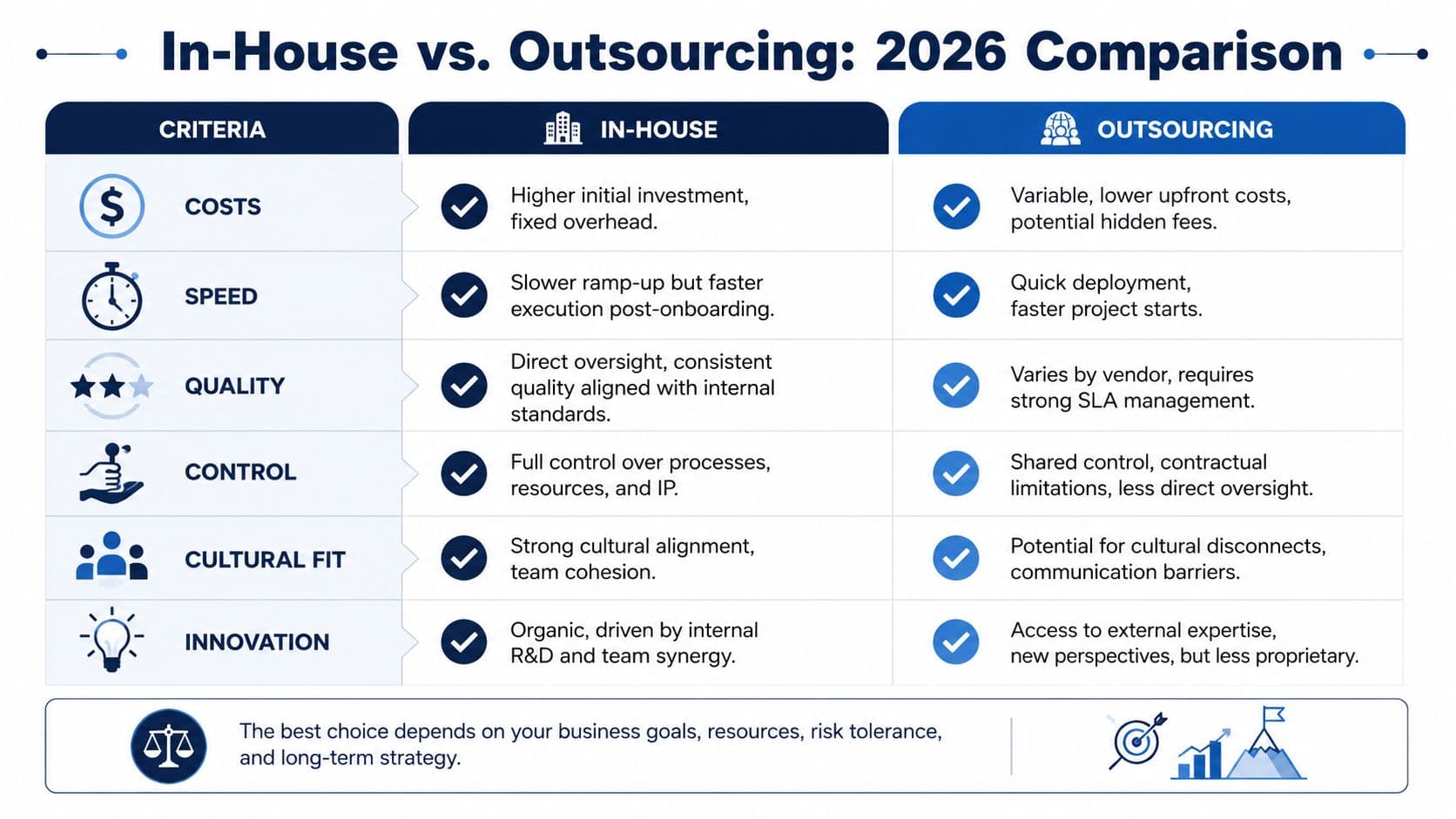
Cost profile. Rate card versus operating cost
Finance teams often compare salary against agency or supplier fees and stop there. For SMEs and scale-ups, that misses the cost that shows up later: internal product ownership, architecture review, supplier management, contract negotiation, knowledge transfer, and the time senior people spend correcting avoidable misunderstandings.
The UK cost gap between employees and contractors is still material. HMRC guidance on employer National Insurance contributions is a reminder that hiring carries costs beyond salary. Outsourcing can reduce some of that fixed overhead, especially if you need a short burst of specialist work, not a permanent team.
But low monthly spend is not the same as low total cost.
I have seen outsourced projects look efficient right up to the point where the business needed a second supplier, an internal rescue hire, or a rebuild of code that met the spec but missed the product intent.
Speed to start. Faster mobilisation, slower alignment
Outsourcing usually wins the first month. Recruitment cycles, notice periods and onboarding make an in-house team slower to assemble, and a good partner can put engineers, designers or QA into a project quickly.
For a digital leader, the better question is time to useful output. Teams only move quickly if they have access to the right people, the right systems, and clear decision rights. If those are missing, the supplier starts fast but waits often.
That pattern is common in scale-ups. The commercial pressure to launch is high, but product context is still held by a small group of founders, heads of function, or senior engineers. Every clarification becomes a queue.
Quality and accountability. Proximity still matters
In-house teams usually have an advantage on judgement. They understand the commercial edge cases, the customer complaints behind a feature request, and the hidden dependencies in a release. That context improves decisions before defects ever reach production.
Outsourced teams can deliver strong work, but quality depends more heavily on management discipline. You need clear acceptance criteria, regular demos, code review standards, and someone internally who can challenge decisions with authority. Without that, quality becomes harder to verify until the cost of fixing it is much higher.
This applies beyond engineering. If you also need to compare HR outsourcing options, the same test applies. Define ownership, service boundaries, escalation paths, and what good looks like before the contract is signed.
Control, IP, and resilience. Important for firms with a product edge
If the product contains proprietary workflows, pricing logic, sensitive customer data, or internal operational know-how, in-house usually gives you better control. Contracts can assign IP ownership. They cannot recreate day-to-day judgement or preserve context automatically when supplier staff change.
That matters more in the UK regulatory environment than many leaders expect. The Information Commissioner's Office sets out clear expectations on security responsibilities when using processors. If a supplier handles personal data, accountability does not disappear. The legal duty, reputational risk, and customer impact still sit with your business.
A supplier can be competent and still introduce fragility. One key developer leaves. A statement of work ends. Priorities shift. Suddenly knowledge about a business-critical integration sits outside your company.
Scaling and specialist access. Best where demand is uneven
Outsourcing often makes commercial sense. A growing company may need iOS support for one release, data engineering for a migration, and security input before an enterprise sale. Hiring each capability full time is hard to justify if demand comes in waves.
For larger internal teams, the balance changes. Once you have stable product leadership, engineering management and a core delivery function, selective outsourcing tends to work better than wholesale outsourcing. Keep product memory and decision-making inside the business, and use external specialists for narrow gaps, fixed-scope projects or temporary capacity.
That model is usually more durable than handing over an entire roadmap and hoping the contract will compensate for missing internal ownership.
The Hidden Risks Most Comparisons Ignore
Most outsourcing discussions stop at cost and speed. That's where many teams get caught. The underlying operational pain usually appears after kickoff, when an external team has to work inside systems, workflows, and decisions they didn't create.
.jpg&w=2048&q=75)
Knowledge transfer friction
This is one of the least discussed failure points in outsourcing vs in house. You can hire capable engineers and still lose months because they don't have enough context on your product logic, legacy decisions, internal terminology, or integration constraints.
A 2025 CCMA UK report found that 42% of UK companies delayed product launches by 3 to 6 months due to poor knowledge transfer in outsourcing deals, as reported by CCMA UK.
This problem shows up in predictable ways:
- Architecture assumptions break: External teams optimise for what they can see, so hidden business rules often get missed.
- Decision latency grows: Questions queue up because nobody internal has time to unblock them.
- Documentation gaps spread: Critical context stays in Slack threads, meetings and people's memory, with no usable delivery document to hold it.
The handover is part of the build. If you under-resource onboarding, you're not saving money. You're delaying delivery.
Maintenance inflation after launch
A product can launch on budget and still become expensive to own. That's the part many comparisons skip. If external developers move on after delivery, your business may inherit undocumented code, unclear release processes, and a support model built around the original vendor staying involved.
The result is a familiar pattern. Change requests take longer, bug fixes need extra interpretation, and the next partner spends too much time reverse-engineering decisions that should have been documented properly.
For CTOs, this is usually the dividing line between a good outsourcing relationship and a risky one. A partner needs to be able to build, and your team also needs to be able to steer the product cleanly later.
Your Decision Framework A Practical Checklist
A strong decision starts with the work itself, not with a preference for permanent staff or external partners. If you force everything into one model, you usually pay for it somewhere else.
.jpg&w=2048&q=75)
Start with strategic importance
Ask whether the function is core to your competitive advantage. If the answer is yes, keep product ownership, architecture direction, and key technical decisions close to the business.
That doesn't mean you need to build every line internally. It means your internal team should own:
- Product judgement: Prioritisation, trade-offs, and user impact.
- System direction: Architectural choices that affect future flexibility.
- Knowledge retention: Documentation, rationale, and roadmap continuity.
Test your true internal capacity
Many teams say they have internal capability when they really have internal responsibility. Those aren't the same thing. A senior engineer who is already stretched across incidents, releases, stakeholder meetings, and mentoring does not have spare delivery capacity.
Review three things:
- Capability depth: Do you have the exact skills needed now, including specialist areas such as AI services?
- Available bandwidth: Can the current team absorb the work without harming existing commitments?
- Management overhead: Who will own external coordination, backlog clarity, and technical assurance if you outsource?
Price the second year, not just the first
Many decisions unravel, with Procera BPO reporting that 58% of UK SMEs saw maintenance costs rise 22% in Year 2 due to vendor dependency and undocumented code, and only 12% of UK firms negotiate post-launch maintenance clauses upfront, according to Procera BPO.
Before choosing a model, ask:
- What happens after launch? Who handles defects, updates, security patches, and roadmap changes?
- What will we own directly? Repositories, documentation, infrastructure access, and deployment knowledge.
- What are the exit terms? If the relationship ends, can another team take over without major disruption?
A practical hiring-side lens is this guide on software developer hire decisions, especially when you're weighing permanent capability against specialist external input.
Decision test: If you can't explain how the product will be maintained, supported, and evolved after launch, you haven't finished evaluating the delivery model.
Match the model to the business stage
For SMEs, outsourcing often works well when the goal is to access specialist delivery without carrying permanent overhead.
For venture-backed scale-ups, hybrid tends to be strongest. Keep product leadership and technical ownership internal, then use external teams to accelerate roadmap delivery.
For established enterprises, the question is usually governance. Outsourcing can still work, but only when procurement, security, architecture review, and delivery ownership are tightly aligned.
If you want a structured view of the options against your roadmap, delivery risk, and internal capability, it's worth contacting Arch for a strategic conversation.
Choosing Your Path With Real-World Scenarios
A CTO in a 40-person scale-up has a launch date in eight weeks, one senior engineer tied up on platform work, and a board asking for proof that the new product line can generate revenue this quarter. In that situation, the wrong delivery model does not just slow the build. It creates costs that show up later in rework, support gaps, and leadership time spent fixing avoidable handover problems.
When in-house is the better call
Keep the work in-house when the product contains the logic that makes your business hard to copy. That usually includes pricing engines, operational workflows, internal data models, or systems that sit close to regulated processes.
Internal teams are also the stronger choice when direction changes every few weeks. If commercial feedback, compliance input, and stakeholder priorities are still shifting, an in-house team can usually absorb those changes with less friction because the context already sits inside the business.
This is often the less risky option for SMEs that plan to keep improving the product over several years. The salary line looks higher on paper, but the actual comparison is not day rate versus salary. It is salary versus supplier management, contract changes, slower knowledge transfer, and the cost of rebuilding technical understanding after a partner rolls off.
When outsourcing is the smarter move
Outsourcing works well when the outcome is clear, the capability is specialised, and you do not need that capability full-time once the project is done. MVP delivery, a complex migration and a short burst of senior mobile or AI expertise fit that description.
Used well, it gives a leadership team speed without committing to permanent headcount too early. Used badly, it creates a dependency that is expensive to unwind.
That is the trade-off many comparisons miss.
A practical example is a scale-up that needs to launch a customer app quickly but wants product ownership to stay internal. An external team can handle delivery, provided the business keeps control of priorities, acceptance standards, and technical decisions that affect the roadmap after launch. Work such as Boiler Juice, Findr, and Cultaholic shows where that model can work well across mobile and web products.
The long-term test is simple. If the partner disappeared after go-live, could your team still run, improve, and support the product without a six-month recovery exercise?
If the answer is no, the short-term speed benefit may not be worth it.
For leaders weighing that balance, this piece on building strong tech agency partnerships that hold up beyond delivery is a useful companion read. If hosting and operational ownership are part of the decision, these Monro Cloud reviews of top hosts can help you assess what good ongoing support looks like in practice.
Frequently Asked Questions
What about a hybrid model combining in-house and outsourced teams?
A hybrid model is often the strongest answer for digital products. Keep product strategy, architecture ownership, and core business knowledge in-house. Use external specialists for delivery acceleration, niche skills, or short-term roadmap pressure. This reduces the risk of losing control while still giving you flexibility. The model works best when one internal owner sets priorities, approves trade-offs, and makes sure knowledge is documented as work progresses.
How do I choose the right outsourcing partner?
Start with delivery fit, not pitch quality. Ask how the partner handles discovery, technical assurance, documentation, handover, and post-launch support. Review how they communicate risk, not just how they describe capability. You also want clarity on repository ownership, access to code, testing standards, and support expectations. A strong partner won't resist those questions. They'll usually answer them in detail because they've had to solve those issues before.
Is outsourcing only for large, long-term projects?
No. Outsourcing can be effective for short discovery phases, MVP builds, specialist feature delivery, rescue work on an existing product, or temporary capacity support. The key is whether the work can be scoped clearly enough and governed properly. Small projects can fail just as easily as large ones if decision rights are vague. Good outsourcing isn't defined by project size. It's defined by strong ownership, clean communication, and realistic expectations.
How do you ensure quality and communication with an outsourced team?
Quality improves when expectations are explicit. Define acceptance criteria, release standards, review points, and who signs off decisions. Weekly demos help, but they aren't enough on their own. You need named owners on both sides, documented architecture decisions, and a clear escalation path when blockers appear. Communication also improves when the internal team responds quickly. External teams can only move at pace if your business makes timely decisions and keeps priorities stable.
About the Author
Hamish Kerry is the Marketing Manager at Arch, where he has spent the past six years shaping how digital products are positioned, launched, and understood. With over eight years in the tech industry, he has a deep understanding of accessible design and user-centred development, with a focus on delivering real impact to end users. His interests include AI, app and web development, and the transformative potential of emerging technologies. Outside campaigns, he follows how tech can drive meaningful change.
Hamish's LinkedIn: Hamish Kerry on LinkedIn
If you're weighing outsourcing vs in house for an app, website, software platform, or AI product, Arch can help you pressure-test the decision, shape the right delivery model, and build with long-term ownership in mind.