



How to Choose a Web App Development Agency.
How to choose a web app development agency using a scoring method, not twelve criteria of equal weight. Written by one of them.
How to Choose a Web App Development Agency.
Key Takeaways
- Three things predict the outcome: who writes the code, whether the scope is costed before anyone commits, and what happens at handover. Price is not one of them.
- Ask every agency the same questions and score the proposals, because three proposals in different formats cannot be compared by reading them.
- A portfolio screenshot proves a design existed. It does not prove a product shipped, stayed up, or was maintainable.
- Four things belong in writing before work begins, code ownership and exit among them, because each becomes contentious exactly when the relationship has already soured.
- Your agency becomes part of your attack surface the day they get access to your systems.
Get those three right and a mediocre agency will still deliver something workable. Get them wrong and the best studio in the country will hand you a product nobody can maintain.
Most advice on how to choose a web app development agency gives you twelve criteria of equal weight, which is the same as giving you none. This guide gives you a scoring method instead, along with the questions that produce answers you can actually compare.
Arch is one of the agencies competing for this kind of work. That is worth stating plainly, because some of what follows should lose us jobs we would otherwise win, and a page that could not do that would just be another agency listicle. If you want the broader picture first, our post on what a web app design agency does covers the discipline before the selection.

The easy part. Everything that decides the outcome happens before this.
The Three Things That Actually Predict the Outcome
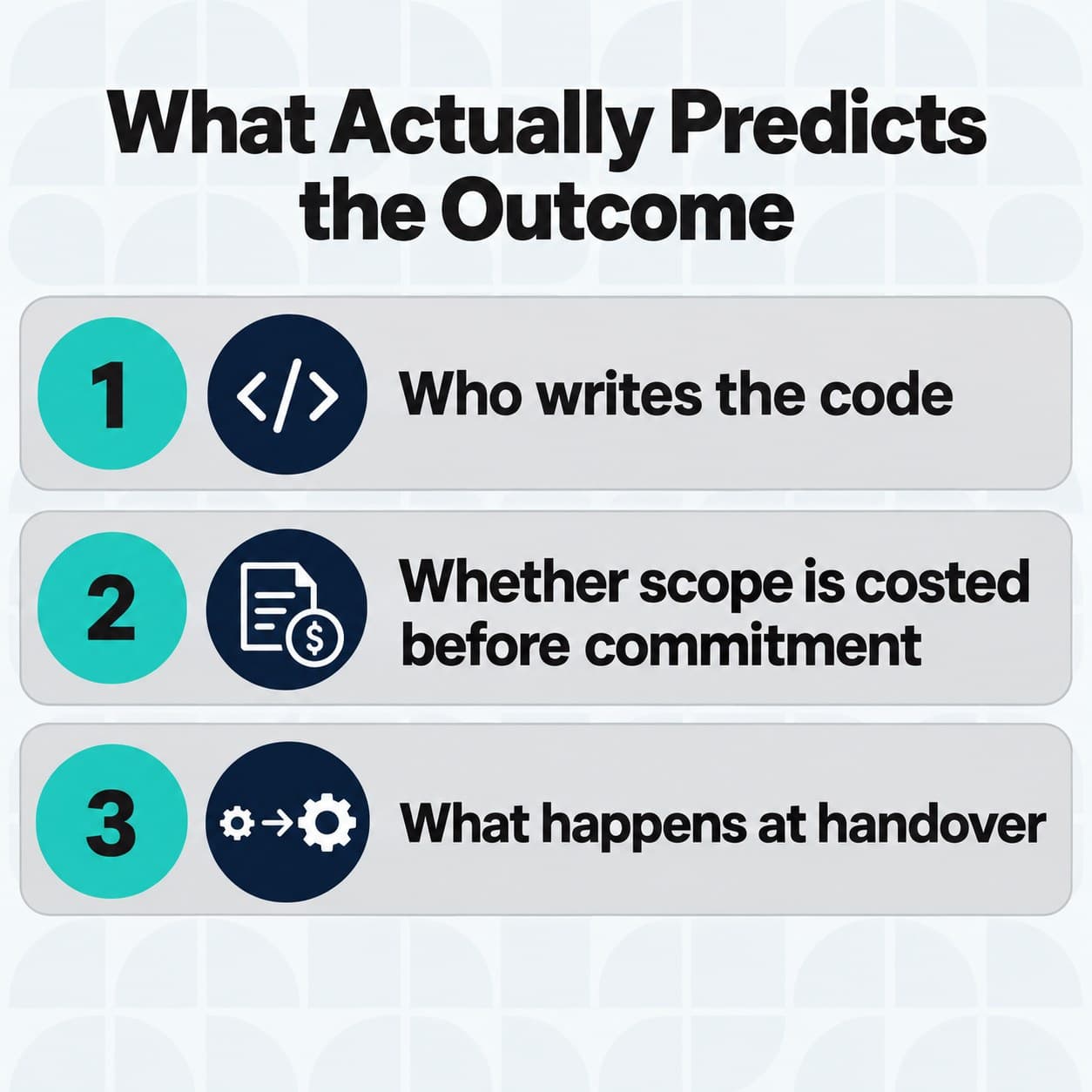
Three questions, asked early, that separate a good outcome from an expensive one.
The first is who writes the code, which is a different question from who pitches it. Agencies routinely sell with senior people and deliver with whoever is free.
Ask for the names, the seniority, and the percentage of their week your project actually gets.
The second is whether scope gets costed before anyone commits. A fixed price attached to a vague scope is a deferred argument with a number on it.
The scope should be a document you could hand to a different agency and get a comparable quote back.
The third is what happens at handover. Who owns the intellectual property, who holds the repository, what documentation exists, and whether another team could pick the work up.
It is an unglamorous question and it decides whether you are a client or a hostage.
Everything else, from technology preference to office location, is secondary to those three.
What to Ask Before You Shortlist
The purpose of a first call is not to be impressed. It is to gather comparable answers, which means asking every agency the same questions and writing down what they said.
Question | What a good answer sounds like | What should concern you |
|---|---|---|
Who specifically writes the code | Named people, seniority, allocation | "Our team", no names |
Is any of it subcontracted | Straight yes or no, and to whom | Evasion, or "partners" left undefined |
What does discovery produce | A costed scope and a clickable prototype | A proposal document |
Who owns the code | You, on payment, in writing | "We'll sort that out later" |
How is testing done | Named practice, automated coverage | "We test thoroughly" |
What happens if we leave | Repository handover, documentation, notice period | Never been asked before |
The last question is the most revealing, because a good agency has an answer ready and a bad one has never had to think about it.
Ask what a discovery phase produces as a deliverable rather than as an activity. Activity is billable. A deliverable is a thing you own and can take elsewhere.
Scoring Proposals Side by Side
Three proposals in different formats cannot be compared by reading them. They can be compared by scoring them, which forces you to state what you actually value before you see the prices.
Weight the criteria first, in a room, before any proposal is opened. Then score each agency one to five against each criterion and multiply through.
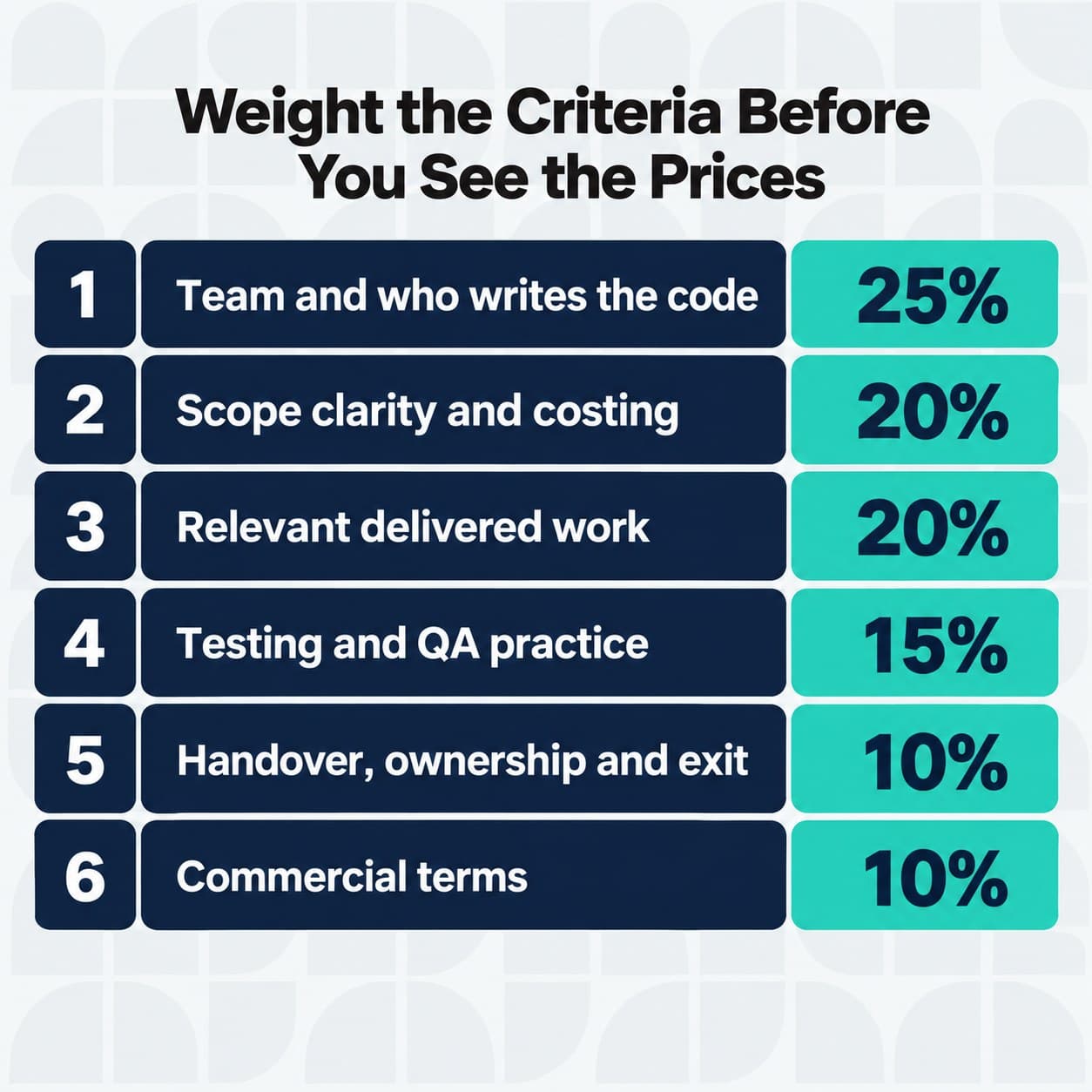
Weight the criteria before you see the prices, not after.
Criterion | Suggested weight | What you are scoring |
|---|---|---|
Team and who writes the code | 25% | Named people, seniority, availability |
Scope clarity and costing | 20% | Could another agency quote from this document |
Relevant delivered work | 20% | Shipped products, not portfolio screenshots |
Testing and QA practice | 15% | Named practice, evidence it is real |
Handover, ownership and exit | 10% | IP terms, repository, documentation |
Commercial terms | 10% | Payment structure, change control |
Price belongs inside commercial terms at ten percent, not at the top. If that seems low, consider that on the evidence below the cheapest option is routinely the most expensive one.
The weights are yours to set. The discipline is setting them before the numbers arrive, because a weighting chosen afterwards will always justify the decision you had already made.
Red Flags
Some warning signs are reliable enough to act on by themselves.
A quote materially below the others is rarely a bargain. It usually means a different scope, a less experienced team, or a plan to recover margin through change requests. Our post on agencies that quote low and bill high covers the mechanics.
Then there is the vanishing team, where the people in the pitch turn out not to be the people on the project and nobody mentioned it.
Watch for the discovery call that was really a sales call. If ninety minutes produced no written understanding of your problem, discovery is not what happened.
Worst of the four is a fixed price against an unfixed scope, which is the most expensive arrangement in the industry, because every ambiguity becomes a negotiation you have already committed to.
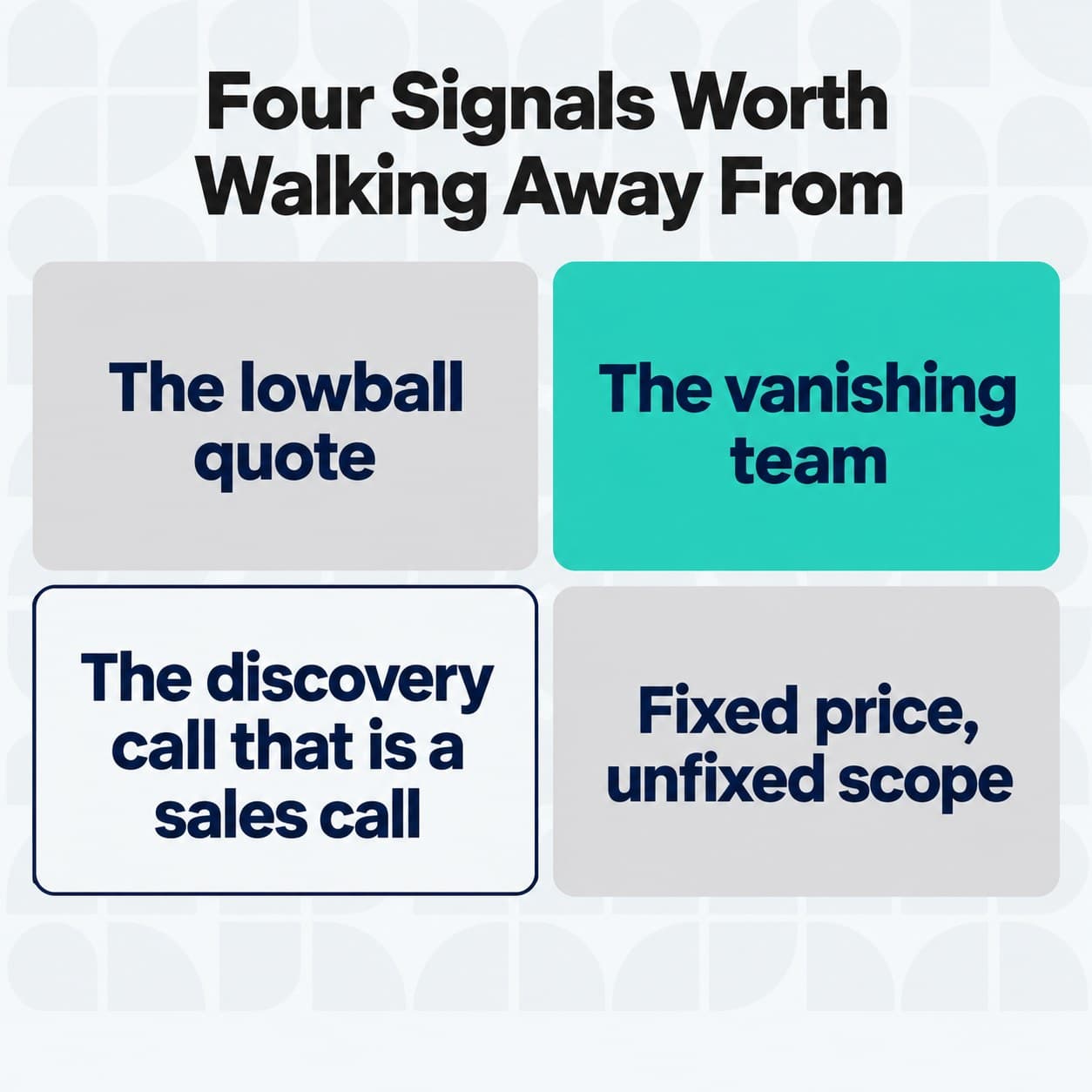
Four signals worth ending a conversation over.
Why the Cheapest Quote is Usually the Dearest
This is normally asserted by agencies who want you to spend more. It happens to be one of the better-evidenced claims in public procurement.
The Public Accounts Committee found that government spends at least 14 billion pounds a year on digital technology suppliers while having only 15 people dedicated to managing that market. The same committee reported that public bodies frequently lack the financial and commercial skills needed for major digital transformation, contributing to cost overruns and write-offs.
Read that as a warning about capability on the buying side rather than the selling side. The cost is not paid at procurement, it is paid over the following three years by whoever has to manage a supplier relationship nobody specified properly.
There is a supply-side pressure too. UK digital sector employment fell for the first time in a decade, with 120,000 fewer filled jobs between 2023 and 2024. Skills England projects the sector needs 488,000 additional workers by 2035, with software development professionals the single largest occupation in demand.
A market that is short of senior engineers does not produce cheap senior engineers. A quote that prices them cheaply is telling you something about who will actually be assigned.
None of which means the highest quote is right either. It means price is evidence about scope and staffing, and should be read that way rather than ranked. It is worth understanding what a build of this kind costs in general terms before you can judge whether any individual number is plausible.
Checking the Work and the References
A portfolio screenshot proves a design existed. It does not prove a product shipped, stayed up, or was maintainable.
Ask for products you can use. Then ask the reference three questions that are hard to answer with a platitude: what went wrong, how did you find out, and how long did it take to fix.
Every project has something in the first answer. A reference who says nothing went wrong is either not a real reference or was not paying attention.
What you are shown | What it proves | What to ask for instead |
|---|---|---|
Portfolio screenshot | A design was produced | A live URL you can use |
Case study with percentages | Someone wrote a case study | Who measured it, and against what baseline |
Client logo wall | A commercial relationship existed | Which of these can we speak to |
Awards | An entry was submitted | Nothing, this is not evidence |
If you are comparing this against a website rather than an application build, the criteria shift, and choosing a web design agency covers that distinction.
Contracts, Code Ownership and Exit
Settle four things in writing before work begins, because all four become contentious precisely when the relationship has already deteriorated.
Intellectual property assignment comes first. The code is yours on payment, and the contract should say so explicitly, including for third-party components and configuration.
Repository access is the second. You hold an account with administrative access from day one rather than at handover, and an agency that resists this is describing its retention strategy.
Third, documentation named in the contract as a deliverable, with a definition. Left unnamed, it gets written in the final week by whoever is still on the project.
Fourth, exit terms: the notice period, what gets handed over, in what format, and within how long.
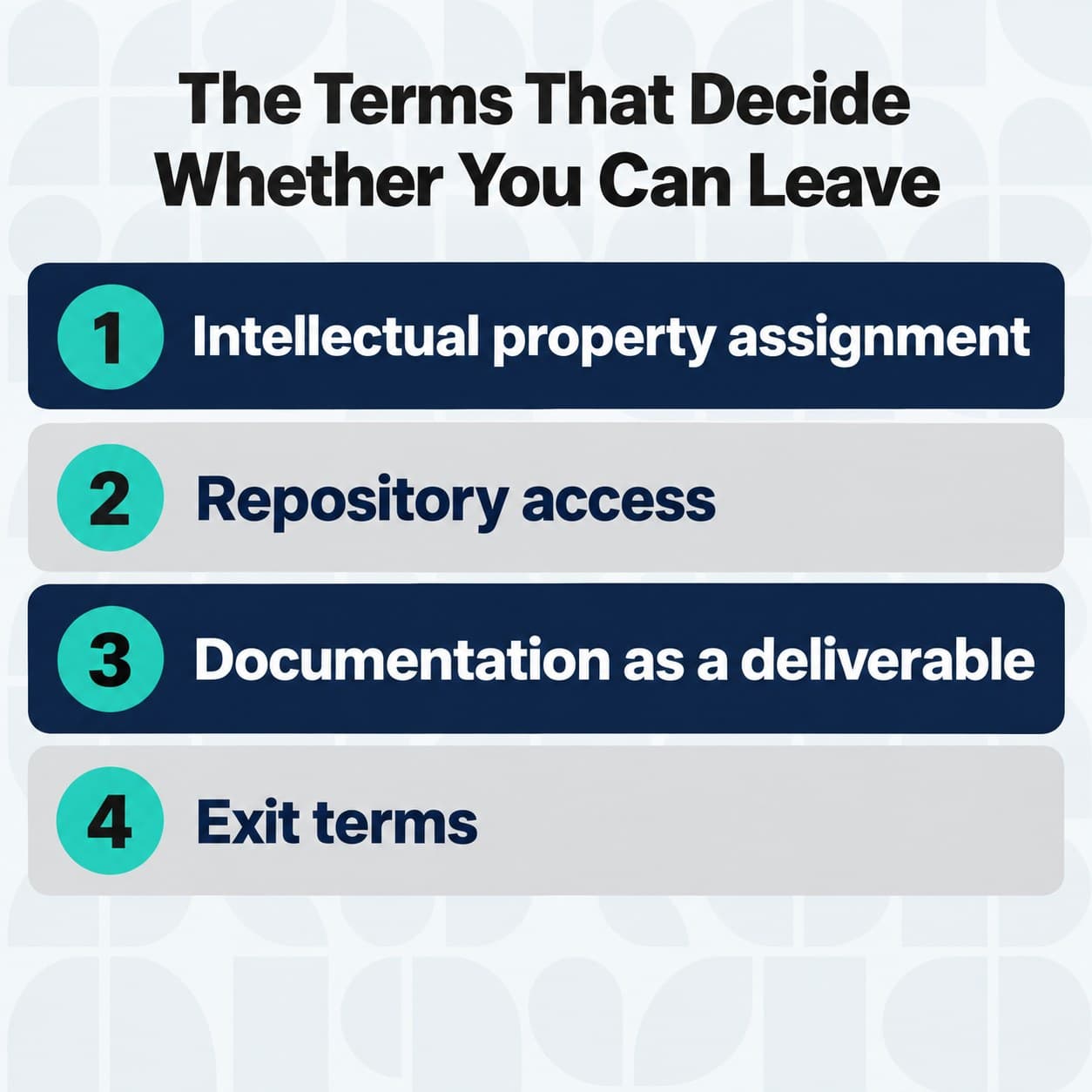
The four contract terms that decide whether you can leave.
None of this is adversarial. An agency confident in its work is relaxed about all four, because it expects to be retained on merit rather than through friction. Whether you are commissioning bespoke software built to a brief or a first release, these terms cost nothing to agree early and a great deal to argue later.
Security and Supply Chain Due Diligence
Your agency becomes part of your attack surface the day they get access to your systems.
The Cyber Security Breaches Survey found that 43 percent of UK businesses experienced a breach or attack in the past year, while only 14 percent review the risks posed by their immediate suppliers. That gap is the entire argument for asking.
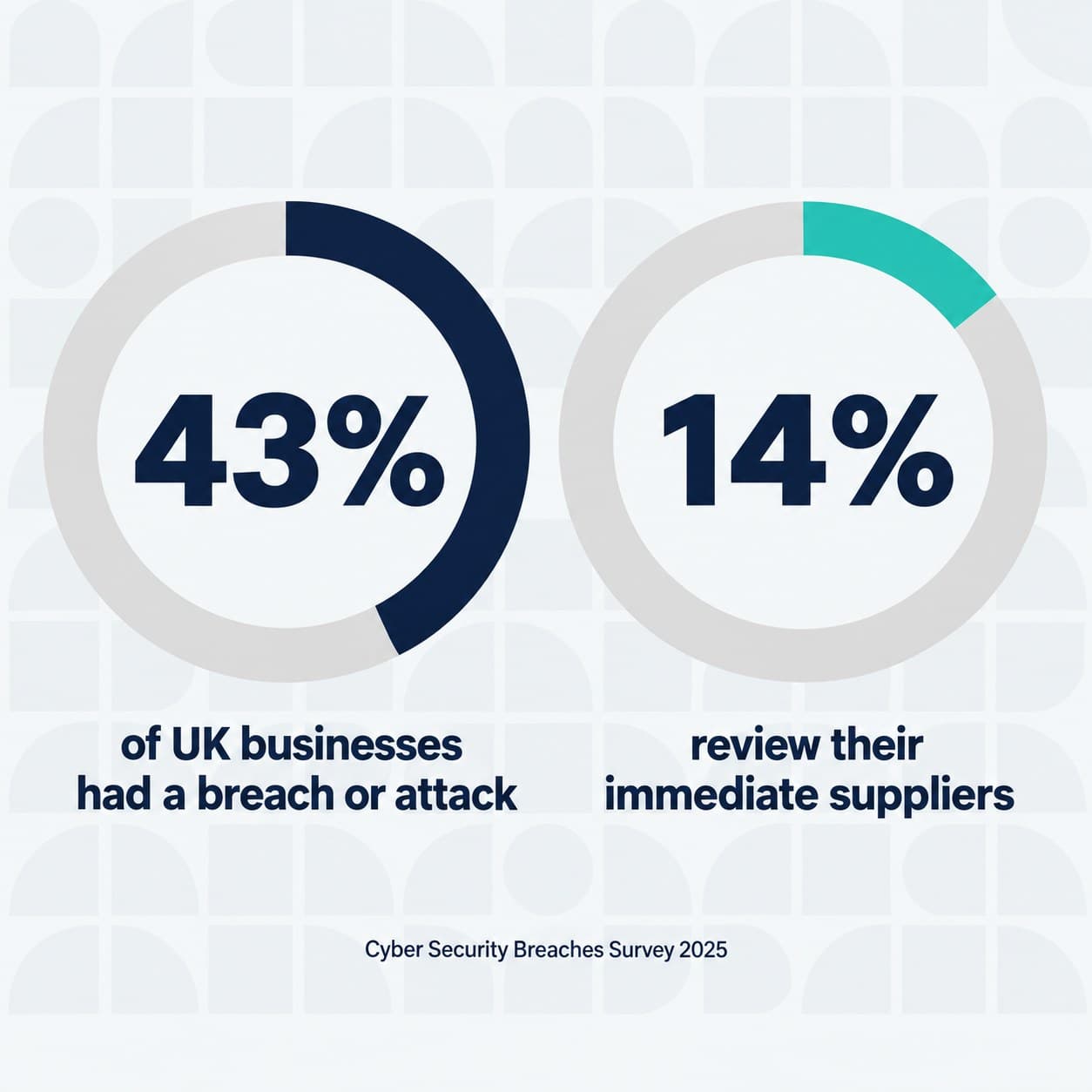
Breach rates against supplier review rates, which is the whole problem in one picture.
Ask three things. Do they hold Cyber Essentials or an equivalent, how do they handle credentials for your systems, and what is their process if they are breached while holding your access.
You are not auditing them. You are establishing whether anyone has ever asked, which is usually apparent within a sentence.
Frequently Asked Questions
Which Agency Should I Hire to Build a Custom Web App?
The one whose named engineers you have met, whose scope document another agency could quote from, and whose contract assigns you the code and repository access. Score at least three against weighted criteria set before you saw any prices.
Beyond that, sector familiarity matters less than most buyers expect, and proximity matters almost not at all.
What Web App Design Agency Do Teams Recommend for Shipping Clickable Prototypes Fast?
Recommendations are worth less here than a direct test. Ask each shortlisted agency what their discovery produces and by when, then ask to see a prototype from a recent project.
A clickable prototype before code is a normal part of discovery and is how Arch works, along with a costed scope and a named product lead. An agency that cannot show you one from previous work is describing an intention rather than a practice.
What Web App Design Service Under a Fixed Budget is Best for a First Release?
For a genuinely fixed budget, the right structure is fixed budget with variable scope, not fixed scope. You agree the money, then prioritise features against it and cut from the bottom as reality asserts itself.
Fixed scope against fixed budget only works when the scope is unusually well understood, which on a first release it almost never is.
Which Agency Can Support With a Website Replatforming in Leeds?
Replatforming is largely a data and integration problem rather than a location problem, so weight migration experience above geography. Most agencies capable of this work deliver remotely across the UK, Arch included.
If proximity genuinely matters to your governance, ask how often they will be on site and get it written into the contract rather than assumed.
How Many Agencies Should We Approach?
Up to five. Fewer and you have no comparison, more and the evaluation becomes the project.
Send all of them the same written brief. Proposals responding to different understandings of the problem cannot be scored against each other, which is the failure mode that makes most selection processes decorative.
Should We Pay for Discovery?
Usually yes, provided it produces something you own and could take elsewhere. Free discovery is a sales activity, and it is priced into the build whether or not you see it as a line.
You can judge an agency's work honestly by looking at the products we have shipped or any other agency's live products, which is a better use of an hour than a second pitch. The same goes for choosing a web app development company at any size.
About the Author
Hamish Kerry is the Marketing Manager at Arch, where he's spent the past six years shaping how digital products are positioned, launched, and understood. With over eight years in the tech industry, Hamish brings a deep understanding of accessible design and user-centred development, always with a focus on delivering real impact to end users. His interests span AI, app and web development, and the transformative potential of emerging technologies. When he's not strategising the next big campaign, he's keeping a close eye on how tech can drive meaningful change.
You can catch up with Hamish on LinkedIn
Sources
- Public Accounts Committee, Digital reforms: Government has mountain to climb but does not yet understand size of challenge, 2026. https://committees.parliament.uk/committee/127/public-accounts-committee/news/207232/digital-reforms-govt-has-mountain-to-climb-but-does-not-yet-understand-size-of-challenge
- Public Accounts Committee, Government's digital transformation: report, 2026. https://publications.parliament.uk/pa/cm5902/cmselect/cmpubacc/94/report.html
- Department for Science, Innovation and Technology, Cyber Security Breaches Survey 2025, 30 April 2025. https://www.gov.uk/government/statistics/cyber-security-breaches-survey-2025/cyber-security-breaches-survey-2025
- Department for Culture, Media and Sport, Economic estimates: employment in the digital sector, January 2024 to December 2024, 2026. https://www.gov.uk/government/statistics/economic-estimates-employment-in-the-digital-sector-january-2024-to-december-2024/economic-estimates-employment-in-the-digital-sector-january-2024-to-december-2024
- Skills England, Sector skills needs assessment: digital and technologies, 2026. https://www.gov.uk/government/publications/skills-england-annual-skills-report-and-sectoral-skills-needs-assessments-2026/sector-skills-needs-assessment-digital-and-technologies
- Arch, Discovery, 2026. https://wearearch.com/services/discovery
You can put the same questions to us: our web development services page shows how we scope, build and hand over.