



A Practical Guide to Funnel Analysis for Product Growth.
Learn how to use funnel analysis to understand user journeys, identify drop-offs, and optimise your app or website for better conversions.
A Practical Guide to Funnel Analysis for Product Growth.
A leaky funnel is usually a measurement problem before it is a traffic problem.
One industry guide says only about 3% to 10% of prospects complete the target action, which is why funnel analysis matters. Most users never reach the end, so the job is to find where people leave, why they leave, and what to change next, as noted in VWO's explanation of funnel analysis.
Key takeaways
- Funnel analysis shows where users drop out of a journey, from first visit to sign-up, purchase, or another target action.
- Good funnel analysis is stage-specific, not a single blended conversion rate. You need to measure each step separately.
- The most useful funnels support decisions, not reporting. A drop-off should lead to a hypothesis and a product change.
- Acquisition, activation, retention, and conversion funnels answer different business questions and should not be mixed together.
- Segmentation matters. Device, traffic source, and channel shape behaviour, especially in digital products with mobile-heavy usage.
- Single-session funnel thinking is too simplistic for many modern products. Web, app, CRM, phone, and assisted journeys often need to be stitched together.
- The strongest teams treat funnel analysis as an operating habit, not a one-off dashboard exercise.
Fixing a leak often means changing the product itself, and Arch's web app development work covers the sign-up and checkout flows a funnel report points to.
Introduction
It is generally known that products leak users. Fewer know exactly where the leak starts.
That's the difference between instinct and funnel analysis. A funnel is a defined journey made measurable. You pick a goal, break the path into steps, and track how people move through those steps. Done well, it stops teams making broad design changes based on opinion and helps them focus on the point of highest friction.
The leaky bucket analogy is useful because it keeps the discussion grounded. If water is escaping, you don't repaint the bucket. You find the hole. In product work, that means measuring the journey closely enough to see where users abandon it, then fixing the specific part that's failing.
What Is Funnel Analysis and Why Does It Matter
Funnel analysis is the process of measuring how users move through a sequence of actions towards a goal. That goal might be a completed checkout, an account registration, a loan application, a booked demo, or a successful onboarding flow.
The reason it matters is simple. If only a small minority of people finish the journey, your biggest opportunity usually sits in the middle of the process, not at the top. That's what makes funnel analysis practical. It replaces vague statements like “the UX feels clunky” with evidence such as “users start the form but abandon before document upload”.
Practical rule: If a team can't name the exact step where users drop off, it usually isn't ready to optimise the journey yet.
The core idea behind the method
A funnel is a sequence of user intent. Each stage should represent a meaningful milestone, not a random click. In a healthy setup, teams measure:
- Stage-by-stage progression
- Unique users at each step
- The relative drop between steps
- The time taken to move forward
That's what turns analytics into diagnosis.
The four questions funnels help answer
Not every funnel is trying to solve the same problem. The most useful way to think about funnel analysis is by the business question behind it.
- Acquisition funnel
This asks: how do people find us, and which sources bring the right intent? It's usually used by marketing and growth teams. - Activation funnel
This asks: do users experience value early enough to stay? It matters most in onboarding, trials, and first-use flows. - Retention funnel
This asks: do users come back and repeat the behaviour that matters? It's less about first conversion and more about habit or ongoing value. - Conversion funnel
This asks: what stops users from completing the target action right now? That's often a purchase, submission, booking, or upgrade.
A common mistake is to run one funnel and expect it to answer all four questions. It won't. A sign-up funnel might look healthy while activation is weak. Checkout might convert well while retention is poor. Different jobs need different funnel definitions.
The Four Core Funnels for Product Growth
Strong product teams don't talk about “the funnel” as if there's only one. They use several funnels because product growth happens across a lifecycle, not a single transaction.
Acquisition funnel
This is about entry quality as well as volume. You're looking at how users arrive and whether those sources produce meaningful downstream behaviour.
For a SaaS or subscription product, the acquisition funnel might start with ad click, landing page view, sign-up start, and completed registration. If you work in growth, Refgrow's guide for SaaS growth is useful because it frames acquisition as a system, not a campaign checklist.
A weak acquisition funnel often creates false confidence. Traffic looks healthy, but low-intent visitors distort the rest of the journey.
Activation funnel
Activation is where users first get value. That's the point many teams under-measure.
In practical terms, activation might mean completing onboarding, creating a first project, saving a preference, uploading a document, or finishing a guided setup. The important part is that the action reflects value.
If you're shaping an early product, this is also where MVP software development decisions matter. Poorly chosen onboarding steps can obscure the true signal.
Retention funnel
Retention funnels matter because a first conversion can be misleading. A user may sign up once and never return.
This funnel usually tracks repeat use around a core behaviour. That could be coming back to reorder, logging in again after setup, or using a key feature repeatedly. The goal is to see whether initial interest turns into ongoing behaviour.
A product that converts once but doesn't retain often has a positioning problem, a value problem, or both.
Funnels show where people drop out, and cohort analysis shows whether the ones who stay keep coming back.
Conversion funnel
This is the most familiar type. It measures how users move towards a commercial or transactional outcome.
A useful real example comes from Adobe Customer Journey Analytics. A financial services firm used funnel analysis to identify friction points in an application process and reduced application abandonment by 22% in under 30 days, according to Adobe's funnel metrics example. That matters because the method does more than describe: it can lead directly to better outcomes when teams act on what they find.
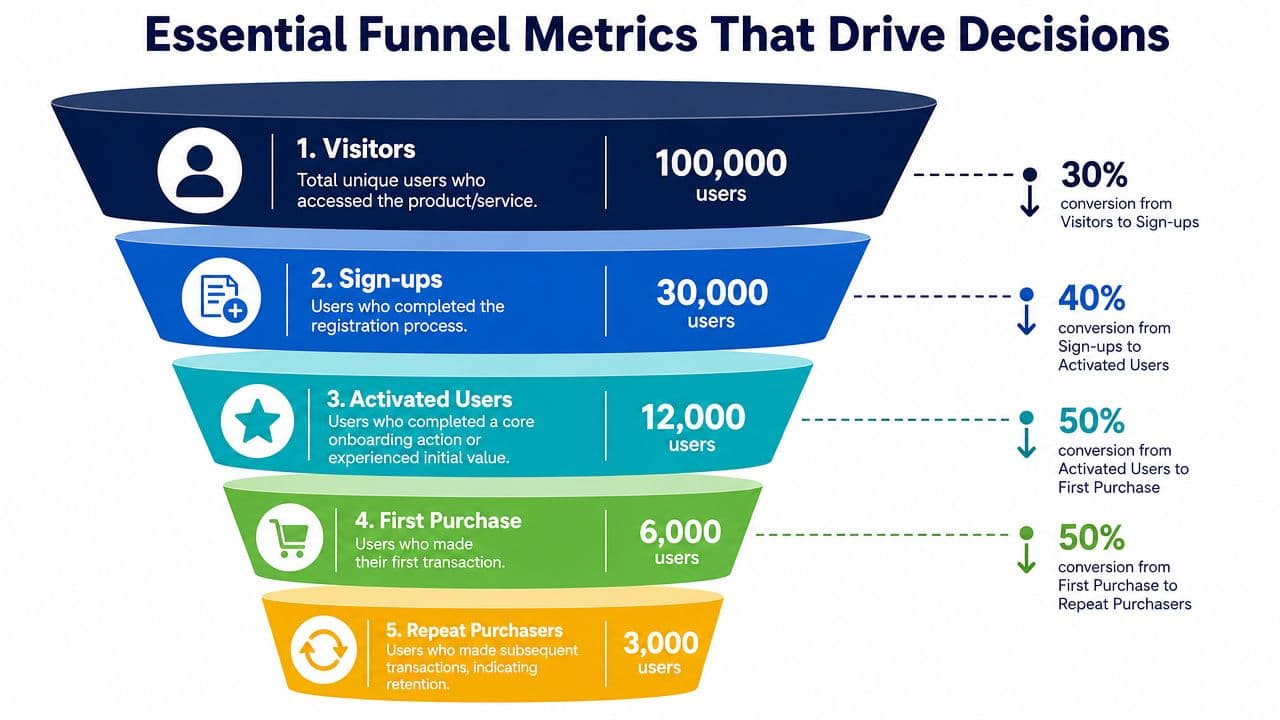
Essential Funnel Metrics That Drive Decisions
A funnel report becomes useful when it helps a team decide what to change first. That only happens when the underlying metrics are tied to action.
Measure the drop, not just the destination
Most weak reporting focuses on the final conversion rate. That tells you the outcome but not the cause.
In practice, teams need a tighter set of measures:
- Stage conversion rate
This shows how many users move from one step to the next. - Absolute drop-off volume
This shows how many users are lost at each stage. A modest percentage drop on a high-volume step can be more important than a dramatic drop later on. - Time to convert
This shows whether friction is immediate or delayed. Some journeys don't fail because users reject them. They fail because users pause, switch device, or return later. - Segment comparison
This shows whether the problem is universal or localised to a certain audience, source, or platform.
Set the funnel up so the numbers mean something
Teams usually get poor funnel data for one of three reasons. They track vague events, they skip segmentation, or they define steps based on pages rather than user intent.
A stronger setup follows a more disciplined sequence:
- Define the outcome clearly
Pick one target action. Don't merge multiple goals into one funnel. - Choose meaningful steps
“Visited pricing page” can be useful. “Scrolled 20 per cent” usually isn't, unless you're diagnosing something very specific. - Instrument discrete events
Each stage should map to a clean event with a clear definition. - Segment from the start
Device and traffic source should not be an afterthought.
For digital products in the UK, that segmentation is essential because user behaviour differs materially by device and source. ONS data shows 98% of UK households had internet access in 2024, which reinforces why funnel analysis needs to account for multi-device journeys, as discussed in InsiderOne's glossary entry on funnel analysis.
Useful design decisions rarely come from aggregate funnels. They come from comparing one segment against another.
For teams trying to bridge product metrics with design choices, Uxia's data-driven design insights offer a helpful companion view. They push the conversation away from taste and towards measurable interaction quality.
If your funnel points to a weak step in a buying journey, work like this usually pairs well with broader thinking about how to increase ecommerce conversion rate.
A Practical Methodology for Funnel Analysis
A useful funnel is simple enough to trust and specific enough to act on. Teams often miss this balance, either creating a vague high-level funnel that hides the problem or an overbuilt event maze nobody understands.
.jpg&w=2048&q=75)
Start with one journey that matters
Pick a journey with clear commercial or product value. Good starting points include:
- Checkout completion
- Lead form submission
- Account registration
- Onboarding completion
- Upgrade from free to paid
Then define the goal in one sentence. If the team can't agree on what counts as success, the analysis will drift.
Break the journey into measurable intent
The next step is choosing a small number of stages. In most cases, three to seven meaningful steps is enough. More than that often creates noise before it creates insight.
A good stage reflects a user decision or commitment. For example, “form started” is more useful than “page loaded” if the page contains several paths. “Payment submitted” is more useful than “checkout visited” if the issue is late-stage abandonment.
Instrument events properly
Product strategy converges with delivery. The events need to be implemented cleanly in the product, named consistently, and tied to the right user identity.
That's one reason analytics setup should be treated as part of product engineering, not an afterthought. Teams building complex digital products usually need this handled within the broader development process, whether that sits in web development delivery or mobile app development.
Analyse the biggest leak first
Don't start by fixing the most dramatic-looking percentage. Start by asking which drop-off combines scale, business importance, and plausible causes.
For UK digital products, segmentation by device and traffic source is essential. User behaviour differs materially, and with 98% of UK households having internet access in 2024, journeys frequently span devices rather than staying neatly on one screen, as described in InsiderOne's overview of multi-device funnel analysis. If mobile paid traffic struggles while desktop direct traffic doesn't, that points to a very different problem than an all-user drop.
Common mistakes that make funnel analysis weak
- Too many steps
The funnel becomes hard to read and easy to misinterpret. - Vague event definitions
If “engaged user” means different things to different teams, the data won't hold up. - No identity logic
Users appear as separate partial journeys instead of one connected path. - No action plan
Reporting without follow-up experiments is just theatre.
The point of funnel analysis is to decide what to change on Monday.
Turning Funnel Insights into Actionable Experiments
Finding a drop-off is the start of the work.
A lot of teams stop too early. They produce a clean funnel chart, present the weak step, and call it insight. But a drop-off only tells you where users leave. It does not tell you why. If you don't convert the finding into a testable hypothesis, you're still guessing.
A simple operating model that works
The most reliable sequence is:
- Identify the drop-off
- Write a hypothesis for why it happens
- Design a change that targets that cause
- Measure whether the change improves progression
That sounds obvious, but many teams skip step two and jump straight to redesign. That's how expensive changes get made for the wrong reasons.
A practical ecommerce example
In ecommerce, one of the most useful checkpoints is the move from product view to cart action. That transition often reveals whether the product page is doing its job. It matters even more in the UK because online sales accounted for 26.9% of total retail sales in January 2024, which means checkout and purchase-path improvements can affect a meaningful share of retail activity, as noted in Hex's discussion of funnel analysis in ecommerce.
If users view products but don't add to cart, the issue might be product clarity, trust, delivery expectations, pricing presentation, or mobile usability. The right response is to isolate one likely cause and test it, rather than “redesign the whole page”.
That's where product planning discipline matters. A change backlog built from funnel evidence is stronger than one built from stakeholder opinion. Teams doing this well usually connect analysis directly to roadmap prioritisation, which is why a clear product roadmap matters in practice.
What good experiments look like
Strong experiments are narrow, measurable, and tied to a single assumption.
- If the issue is trust, test stronger reassurance near the action point.
- If the issue is cognitive load, simplify the step and reduce choices.
- If the issue is mobile friction, redesign the interaction for smaller screens first.
- If the issue is delayed decision-making, adjust the measurement window before changing the interface.
A product such as Boiler Juice is a useful reference point for this way of thinking because strong journeys tend to feel simple on the surface while being tightly considered underneath. That's usually the result of repeated optimisation, not luck.
The next frontier is beyond the single session
Many teams still analyse funnels as if the whole journey happens in one visit. That's often false.
UK users spend significant time on mobile internet, and many journeys stretch across sessions, devices, and assisted touchpoints. Standard single-session funnels can make healthy but delayed journeys look broken. The harder question is whether low conversion is always a UX failure, or partly a measurement failure caused by journeys that aren't being stitched together properly.
Advanced Funnel Analysis for Modern Products
Basic funnel analysis assumes a neat sequence on one device in one channel. Real products rarely behave like that.
Users move from ad to mobile site, from mobile site to app, from app to support, from support to CRM follow-up, then convert later. If your funnel only sees one platform at a time, it doesn't show the journey. It shows fragments.
.jpg&w=2048&q=75)
Cross-channel stitching matters more than most guides admit
Many funnel guides explain drop-offs inside a single product surface. Fewer deal with journeys that span web, app, and CRM handoffs. That gap matters because customer journeys are becoming more operationally complex, not less. In the UK, 76% of businesses reported using at least one AI technology in 2024, a useful signal that automation and routing complexity are increasing across service and conversion journeys, as outlined in Funnel's article on business growth and funnel analysis.
If one system sees a lead, another sees an app user, and a third sees a customer record, you need a way to connect those identities or your abandonment figures will be distorted.
Time-lagged funnels need different thinking
Not every slow funnel is broken. Some are decision-heavy by nature.
That matters in products with applications, approvals, research-heavy purchases, or assisted service components. If a user starts on mobile, pauses, returns later on desktop, and converts after an email reminder, a rigid single-session funnel may classify the first interaction as abandonment when it was really part of a longer path.
Advanced funnel analysis asks two questions at once. Where do people stop, and what kind of journey are we actually measuring?
What teams should do differently
A more mature approach usually includes:
- Identity stitching
Connect users across devices and systems wherever possible. - Cross-channel event design
Use consistent event logic across web, app, and downstream systems. - Longer measurement windows
Give slower journeys enough time to complete before treating them as lost. - Operational context
Bring in CRM, support, or assisted-service milestones where they materially affect conversion.
AI is starting to help, mainly by helping teams process messy event streams, route interactions, and spot patterns across fragmented journeys, without magically solving attribution. For organisations exploring that direction, AI services for digital products are increasingly relevant.
If your funnel breaks the moment a customer leaves the website, that points to a measurement design problem. For more complex journey mapping, it's worth having a direct conversation through Arch's contact page.
Frequently Asked Questions about Funnel Analysis
What is the difference between funnel analysis and cohort analysis
Funnel analysis measures how users move through a defined sequence of actions and shows where they drop off. Cohort analysis groups users by a shared characteristic, often when they joined, and compares how those groups behave over time. In practice, funnel analysis helps diagnose process friction, while cohort analysis helps reveal whether changes improved behaviour for one group versus another. They work best together rather than as alternatives.
How many steps should a funnel have
Most useful funnels have between three and seven steps. That's usually enough to capture the journey clearly without burying the signal in noise. Too few steps hide the critical point of failure. Too many steps create analysis that looks detailed but doesn't improve decisions. Each stage should represent a meaningful user action or commitment, not just another page view or technical event that happens to be easy to track.
What are the best tools for funnel analysis
The best tool depends on the product, data model, and reporting maturity. Teams often use product analytics tools such as Mixpanel, Amplitude, Heap, or GA4 for core funnel reporting. Session replay tools can help interpret why users struggle at a step. For more complex products, teams may also need a customer data platform or warehouse layer so event definitions stay consistent across systems. Tool choice matters less than event quality and identity logic.
Can funnel analysis be used outside ecommerce
Yes. Funnel analysis is useful anywhere a user moves through a goal-based process. In SaaS, it can improve onboarding and activation. In financial services, it can reveal friction in applications or eligibility flows. In public-sector or service products, it can help diagnose where users abandon forms, bookings, or account creation. The method is flexible because it focuses on progression through intent, not on retail behaviour specifically.
Why do so many funnel reports fail to produce action
Most fail because they stop at description. A report shows a drop-off, but nobody forms a hypothesis, prioritises a change, or assigns an experiment. Another common issue is weak instrumentation. If steps are poorly defined, teams don't trust the result enough to act. Good funnel analysis produces a practical next move. Bad funnel analysis produces an interesting chart that sits in a deck and goes nowhere.
Conclusion
Funnel analysis is one of the most useful tools in product work because it forces clarity. It shows where users stop, which journeys need attention, and where effort is most likely to improve outcomes.
The important shift is to treat it as a decision system: measure the right journey, segment it properly, form hypotheses, run experiments, then revisit the funnel to see whether the product improved.
That's when funnel analysis stops being reporting and starts becoming product growth.
About the Author
Hamish Kerry is the Marketing Manager at Arch, where he has spent the past six years shaping how digital products are positioned, launched, and understood. He has over eight years in the tech industry and a deep understanding of accessible design and user-centred development, with a focus on delivering real impact to end users. His interests include AI, app and web development, and the potential of emerging technologies. Outside campaigns, he keeps a close eye on how tech can drive meaningful change.
Hamish's LinkedIn: Hamish Kerry on LinkedIn
If you're planning a product, fixing a weak conversion journey, or trying to make sense of cross-channel behaviour, Arch can help you design and build digital products with stronger measurement, clearer user journeys, and better commercial outcomes.