



How to Increase Ecommerce Conversion Rate for UK Businesses.
A practical guide on how to increase ecommerce conversion rate with actionable strategies for mobile, UX, and checkout optimisation.

how to increase ecommerce conversion rate.
Share Via:
Key Takeaways
- Diagnose First: Before making changes, use analytics tools like Google Analytics 4 to perform a funnel analysis and identify exactly where users are dropping off in the buying journey.
- Mobile is Everything: With over 75% of traffic coming from mobile, a fast, thumb-friendly mobile experience isn’t optional. Optimise for speed and ease of use on small screens.
- Streamline the Checkout: Reduce cart abandonment by offering guest checkout, being transparent with all costs upfront, and integrating trusted payment gateways like PayPal and Apple Pay.
- Build Trust and Urgency: Use social proof like customer reviews, security badges, and clear contact information to build confidence. Ethically use scarcity and urgency to encourage immediate action.
If you want to genuinely increase your ecommerce conversion rate, you need a systematic, data-driven plan. It’s all about spotting where users are dropping off, making sure your site works brilliantly for mobile shoppers, and smoothing out every bit of friction in your checkout process.
Your Playbook for Turning Clicks Into Customers
Getting traffic but not sales? It's a common frustration. While the average UK ecommerce conversion rate sits around 3.4%, the sites that really succeed are the ones obsessed with customer experience. This guide is a practical playbook for systematically lifting your performance.
Success in conversion rate optimisation (CRO) comes from digging into user behaviour and methodically removing the barriers they face.
For instance, if your analytics show a massive drop-off on product pages, the problem could be anything from unclear descriptions and poor-quality images to surprise shipping costs revealed too late. Tackling these specific pain points head-on is what actually moves the needle on sales. You can dive deeper into this with our insights on designing ecommerce that works.
The whole process is a continuous loop: diagnose, optimise, and then test. This simple workflow is the core of any effective CRO strategy.
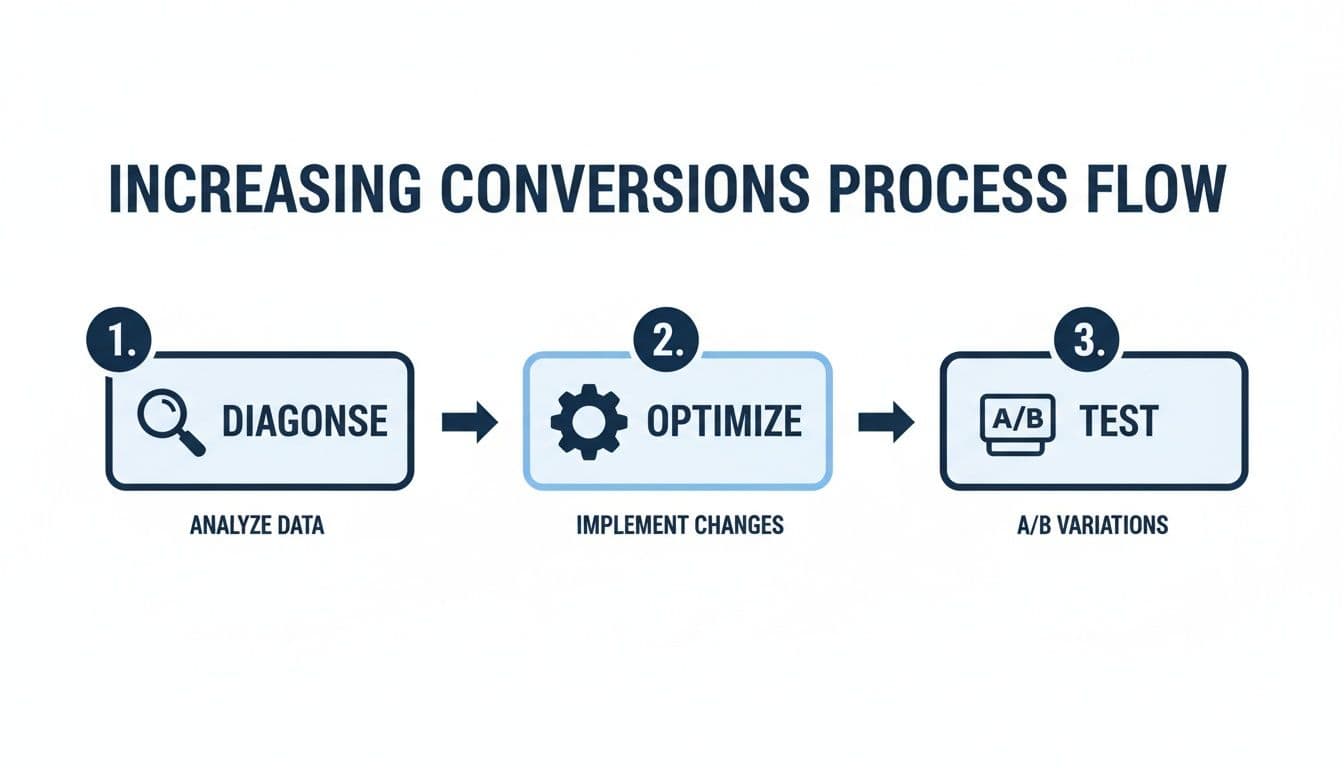
This framework keeps every change strategic. You start by identifying a real problem, implement a targeted fix, and then validate its impact through testing. It's a cycle that fuels constant improvement and sustainable growth for your business.
Finding the Leaks in Your Conversion Funnel
Before you can even think about increasing your ecommerce conversion rate, you need to play detective. Pouring more money into ads to drive traffic is a waste if your website is a leaky bucket, losing potential customers at every click. The first, most critical step is to find out exactly where people are dropping off.
This whole process starts with your analytics. Tools like Google Analytics 4 are a big help here, allowing you to map out the customer journey and perform a proper funnel analysis. That means looking at how users move through the critical stages of a purchase, not just at overall traffic.
Mapping the Customer Journey with Analytics
A typical ecommerce funnel has several key steps, and at each one, you're going to lose people. Your job is to measure the drop-off rate between each stage to pinpoint the weakest link in the chain.
Most funnels look something like this:
- Homepage/Landing Page Visit: The user arrives.
- Product Page View: They’ve shown interest in a specific item.
- Add to Basket: A clear signal they're considering a purchase.
- Initiate Checkout: They’re ready to hand over their details.
- Purchase Confirmation: The sale is made.
By setting up a funnel exploration report in GA4, you can visualise this journey and see, in stark numbers, where users are abandoning ship. You might discover, for example, that 90% of users who view a product page do not add anything to their basket. Suddenly, you know your product pages are the problem, not your checkout flow. This data-driven approach stops you from wasting time fixing things that aren't actually broken.
Don't ever assume you know where the problem is. A funnel analysis gives you cold, hard evidence, allowing you to focus your resources on the friction points that are costing you the most money.
Understanding the Why with Qualitative Data
The numbers from your analytics tell you what is happening, but they can't tell you why. To get inside the user's head and understand the behaviour behind the data, you need to layer in qualitative insights.
This is where you move beyond charts and graphs and start observing real people. Two of the most powerful tools for this are heatmaps and session recordings.
- Heatmaps give you a visual overview of where users click, how they move their mouse, and how far down a page they actually scroll. A heatmap might reveal that everyone is trying to click on a non-interactive image, or that nobody is scrolling far enough to even see your main call-to-action button.
- Session Recordings are like having a screen recording of a user's entire visit. You can see where they hesitate, where their mouse hovers, and what they struggle with. Watching a handful of these can be an eye-opener, revealing usability problems you might not have spotted yourself.
Pinpointing Mobile Friction Points
This diagnostic process is especially crucial for your mobile users. A decent add-to-cart rate in the UK might be around 10.0-10.5%, but sky-high cart abandonment often destroys that initial interest. For any business thinking about custom web development solutions, an obsessive focus on the mobile experience is non-negotiable.
Consider this: over 75% of retail site visits globally now come from smartphones, and those devices generate two-thirds of all orders. This trend is only accelerating in the UK. You can check out the latest ecommerce benchmarks to see how your site compares.
You must analyse your mobile funnel separately. Are mobile users battling with tiny buttons on your product pages? Is your checkout form a nightmare to complete on a small screen? Session recordings and mobile-specific funnels can give you clear, actionable answers. When you combine the quantitative data with these qualitative insights, you get a complete picture of your funnel's performance, so every optimisation you make is targeted, effective, and rooted in real user behaviour.
Mastering Mobile Commerce for Maximum Growth
The data tells a clear story: your customers are overwhelmingly shopping on their phones. Yet, this is precisely where the biggest drop-off in potential sales happens. That gap between desktop conversion rates (often hovering near 4%) and mobile rates (struggling below 2%) represents the single biggest opportunity you have to increase your revenue.
Closing this gap means going way beyond a simple responsive design. It requires a true mobile-first mindset.

This means designing every interaction, from product discovery to the final payment confirmation, with the small screen as your primary focus, not an afterthought.
Speed Is a Non-Negotiable Feature
On mobile, patience is in short supply. A slow-loading site is one of the fastest ways to lose a customer before they've even seen a product. A delay of just one second can send your conversion rate plummeting, especially since mobile users are often on less-than-perfect network connections.
Your optimisation efforts have to start with speed. This involves a few technical but absolutely essential steps:
- Compressing Images: Large, unoptimised images are the number one culprit for slow load times. Use modern formats like WebP and make sure every image is compressed without sacrificing too much quality.
- Minimising Code: Every unnecessary line of HTML, CSS, and JavaScript adds to the loading time. Keep it clean and lean.
- Leveraging Caching: Browser caching lets returning visitors load your site much faster by storing key assets locally on their device.
A fast site is a technical win and a powerful trust signal. It tells users your store is professional, reliable, and respects their time, which directly affects their confidence in making a purchase.
Designing for Thumbs, Not Cursors
Desktop experiences are built for the precision of a mouse click. Mobile is a world of thumbs and touchscreens. This fundamental difference has to guide your entire approach to user interface (UI) and user experience (UX) design. Frustration is a conversion killer, and nothing is more frustrating than fumbling to tap a tiny button.
Think about the ergonomics of how people actually hold their phones. Most use one hand, navigating with their thumb. This creates a natural "thumb-friendly zone" on the screen where it's easiest to interact.
Place your most important interactive elements—especially your ‘Add to Basket’ and ‘Proceed to Checkout’ buttons—smack in the middle of this easy-to-reach zone. This simple change reduces both physical and mental effort, paving a much smoother path to purchase.
This principle should apply to all your interactive elements:
- Button Size: Make sure all buttons and links are large enough to be tapped easily without zooming or hitting the wrong thing by mistake.
- Form Fields: Design forms for mobile entry from the ground up. Use larger text, leave ample space between fields, and trigger the right mobile keyboards (like the number pad for phone numbers).
- Navigation: Ditch complex, multi-level dropdown menus that are a nightmare on mobile. Go for simpler, clearer options like a sticky bottom bar or a clean, accessible hamburger menu.
The Superior Experience of a Dedicated App
While a brilliantly optimised mobile website is essential, a dedicated mobile app can deliver an even more powerful, conversion-focused experience. Native apps provide a level of performance, personalisation, and raw convenience that’s tough to replicate on the mobile web.
For instance, native apps can tap into device features like push notifications to re-engage users with timely offers or cart reminders. They can also offer a lightning-fast checkout using stored payment details and biometric authentication like Face ID or fingerprint scanning. The whole experience just feels smoother because it's built specifically for the device's operating system.
At Arch, we’ve seen first-hand how custom mobile app development can transform conversion rates. For our client Boiler Juice, we developed an app that simplified the complex process of ordering heating oil, resulting in a seamless user experience that customers loved. By focusing on a frictionless journey tailored to mobile, the app became a primary driver of sales and loyalty.
You can learn more by exploring our detailed guide to mobile optimisation for the web.
Mastering mobile commerce means attending to the details. That comes down to a fast, intuitive, and frictionless journey for your customers on the device they use most.
Optimising Pages from Product Discovery to Checkout
A high conversion rate isn't the result of a single magic bullet. It's built on a sequence of well-optimised user interactions, guiding a customer from the moment they land on a product to the final click of the “buy” button.
By refining each step of this journey, you methodically remove friction and build momentum towards a sale.
This process demands a deep focus on two key battlegrounds where most conversions are either won or lost: the product page and the checkout flow. Each requires a distinct set of tactics to guide users confidently toward their purchase.
Perfecting the Product Page
Think of your product page as your digital salesperson. This is where casual browsers become serious buyers, but only if the page gives them the right information, clearly and persuasively. If this page fails to convince, the rest of the journey is completely irrelevant.
To turn your product pages into conversion machines, concentrate on these core elements:
- High-Quality Visuals: Shoppers can't touch or feel your products online, so your images and videos have to do all the heavy lifting. Provide multiple high-resolution photos from every angle, show the product being used in a real-world context, and use video to demonstrate key features.
- Compelling Descriptions: Go beyond listing technical specs. Write copy that speaks to your customer's needs and desires, explaining how the product solves their problem or improves their life. Use scannable bullet points to show the most important benefits.
- Prominent Calls-to-Action (CTAs): Your "Add to Basket" button should be impossible to miss. Use a contrasting colour that really stands out from the rest of the page and make sure it's placed somewhere immediate and logical.
- Leverage Social Proof: Over 90% of consumers read reviews before making a purchase. Display customer ratings and testimonials prominently to build trust and give potential buyers the confidence to commit.
These optimisations work together to build desire and confidence, encouraging users to take the next step.
Streamlining the Checkout Process
The checkout is the final hurdle. At this point, you've already convinced the shopper to buy; your only job now is to get out of their way and make the process as painless as possible. Any friction here is a direct cause of abandoned baskets.
Your checkout flow should be ruthlessly efficient. Every extra field, every unexpected cost, and every confusing step is an open invitation for the customer to leave. Simplicity and transparency are your best tools for conversion.
Focus on getting rid of common frustrations with these strategies:
- Minimise Steps and Fields: Only ask for the absolute essential information needed to process the order. A multi-page checkout can feel daunting, so consider a single-page or accordion-style layout to keep things simple.
- Offer Guest Checkout: Forcing users to create an account is a well-known conversion killer. Provide a guest checkout option to remove this big barrier for new customers.
- Display All Costs Upfront: Unexpected shipping fees are the number one reason for cart abandonment. Be totally transparent about all costs, including delivery and taxes, on the basket page before the checkout even begins.
- Integrate Trusted Payment Gateways: Offer a variety of payment options to suit different preferences, including major credit cards, PayPal, and digital wallets like Apple Pay or Google Pay. Just displaying these familiar logos acts as a powerful trust signal.
By optimising these critical pages, you create a smooth, reassuring path from discovery to purchase. While the on-site experience is paramount, it's also worth remembering the power of qualified traffic. For example, referral traffic is a conversion powerhouse in the UK, averaging 3.6% and outperforming the national benchmark. Leveraging this through partnerships can bring highly motivated buyers directly into your optimised funnel. You can learn more about UK ecommerce statistics and trends to see the full picture.
Building Trust and Urgency to Drive Action
Getting traffic to your site is one thing; getting those visitors to buy something is another. It all comes down to a balance of psychology, and trust sits at the core of every transaction.
Without it, even the most interested shopper will hesitate at the final hurdle. They’ll abandon their basket, and you’ll lose the sale.
Establishing that credibility starts the second a user lands on your page. It comes from a collection of signals that tell the customer your business is legit, professional, and secure. Think of it as a digital handshake that puts shoppers at ease.
Cultivating Confidence with Trust Signals
Trust signals are the visual and written cues that reassure customers they’re making a safe choice. In an online world where shoppers can't physically see you or touch your products, these elements do all the heavy lifting to build confidence and lower any perceived risk.
Here are the key signals you should have woven throughout your site:
- Authentic Customer Reviews: Displaying genuine testimonials and star ratings is probably the most powerful form of social proof you can have. Over 90% of consumers read reviews before buying, which makes them absolutely essential for validating your product and your brand’s reputation.
- Security Certifications: Make sure logos from trusted gateways like PayPal, Visa, and Mastercard are featured prominently, along with any SSL certificate badges. These symbols instantly tell a visitor that their financial data is encrypted and their transaction will be secure.
- Clear Contact Information: A visible phone number, a physical address, and an easy-to-find customer service email show that there are real people behind the website. This kind of transparency helps break down any initial scepticism.
- Professional Design: A clean, modern, and error-free website subconsciously tells visitors you’re a serious and professional operation. Typos, broken links, and dated layouts are immediate red flags that scream amateur.
Creating Ethical Urgency and Scarcity
Once that foundation of trust is in place, you can start to introduce psychological triggers like urgency and scarcity to prompt immediate action. When used ethically, these tactics help overcome procrastination and the classic "I'll think about it" indecision, gently nudging hesitant buyers to commit.
The key word here is ethical. Fake scarcity timers or misleading stock levels will instantly destroy the very trust you’ve just worked so hard to build.
UK e-commerce conversion rates can swing wildly, from a national average of 3.4% all the way up to 11% in high-intent sectors like groceries. This huge variance shows that building trust and motivating action is what separates the average performers from the market leaders. You can find more insights into UK e-commerce transactions to see how different sectors perform.
Implementing Effective Scarcity and Urgency Tactics
To drive action without being deceptive, you need to focus on motivators that are both transparent and genuinely helpful. These tactics work because they tap into the natural human fear of missing out (FOMO).
Consider these proven strategies:
- Limited-Time Offers: Countdown timers for sales or promotions create a clear deadline, motivating shoppers to buy before the offer expires. Frame it as a genuine opportunity, like a "24-Hour Flash Sale" or "Offer ends Sunday".
- Low-Stock Indicators: Displaying messages like "Only 3 left in stock" can be incredibly effective for popular items. It signals high demand and encourages buyers to act quickly before the product is gone.
- Real-Time Activity Notifications: Showing small alerts like "Sarah from London just bought this" adds another layer of social proof. It creates a sense of a bustling, active store, which encourages others to jump on the bandwagon.
By layering these urgency tactics on top of a solid foundation of trust signals, you create a powerful conversion engine. You’re not just selling a product; you're building the confidence and motivation a customer needs to click that buy button.
Your Path to Continuous Conversion Improvement
Getting your ecommerce conversion rate up isn’t a one-and-done project. It’s a constant cycle of testing, learning, and refining what works. Real success doesn't come from a single flashy campaign or a website redesign; it's built by creating a culture of continuous optimisation, where every change is treated as a hypothesis worth testing.
The whole process kicks off with a solid diagnosis. You need to dive into both the hard numbers (quantitative data) and the user feedback (qualitative data) to find the real friction points in your funnel. Once you know where the problems are, the path forward is all about systematically knocking down those barriers, one by one. That means obsessing over the mobile experience, building unshakeable trust, and making your checkout so smooth it’s practically invisible.
Shifting from Guesswork to Growth
The big idea here is to stop making changes based on gut feelings and start making them based on data. Every decision should be an experiment. Each A/B test, whether it wins or loses, gives you priceless insight into what your customers actually want and how they behave.
This iterative process is the true engine of sustainable growth. It’s how small, incremental improvements stack up over time to create massive gains.
By embracing this mindset, you stop thinking of your website or app as a static shopfront. Instead, it becomes a dynamic system that constantly adapts to user behaviour. This is how you not only lift your conversion rate but also build a genuinely better, more responsive experience for your customers. A great next step is figuring out how to start leveraging buyer data to fuel your experiments with real insights.
If you’re ready to stop guessing and start building a data-driven path to growth, our team at Arch is here to help you transform your digital products and achieve real, measurable results. Feel free to contact us to discuss your project.
Frequently Asked Questions (FAQs)
What is a good ecommerce conversion rate in the UK?
A "good" rate is highly relative to your industry. While the UK average hovers around 3.4%, this varies significantly. Luxury goods may convert lower, while essentials convert higher. A better goal is to aim for consistent, month-on-month improvement. Focus on outperforming your own historical data and direct competitors rather than chasing a generic national average. A rate above 3% is a solid starting benchmark for many businesses.
How can I quickly reduce my cart abandonment rate?
The fastest way is to streamline your checkout. First, always offer a guest checkout option to eliminate the friction of creating an account. Second, be completely transparent with all costs, especially shipping, before the final payment step. Unexpected fees are the top reason for abandonment. Finally, ensure your checkout is fast, mobile-friendly, and supports popular payment methods like PayPal and digital wallets, which build trust and add convenience.
Which metrics are most important for CRO?
While the overall conversion rate is the main headline, you need to track several KPIs for a full picture. Your cart abandonment rate reveals checkout friction. Average Order Value (AOV) shows how much customers spend per transaction. Customer Lifetime Value (CLV) indicates long-term profitability. Also, monitor behavioural metrics like bounce rates on product pages and time on site. Analysing these together helps you pinpoint the exact stage where your biggest optimisation opportunities lie.
How important is page speed for ecommerce conversions?
It is absolutely critical. Research consistently shows that even a one-second delay in page load time can cause conversion rates to plummet. Slow sites lead directly to higher bounce rates and abandoned carts, particularly on mobile devices where user patience is extremely limited. A fast, responsive website is a core part of the user experience, building trust and signalling professionalism. Optimising image sizes and leveraging browser caching are non-negotiable first steps for any ecommerce store.
About the Author
Hamish Kerry is the Marketing Manager at Arch, where he has spent the past six years shaping how digital products are positioned, launched, and understood. With over eight years in the tech industry, he has a deep understanding of accessible design and user-centred development, with a focus on delivering real impact to end users. His interests include AI, app and web development, and the transformative potential of emerging technologies. Outside campaigns, he follows how tech can drive meaningful change.
You can catch up with Hamish on LinkedIn