



What Is Brand Strategy? a Guide for Digital Products.
What is brand strategy? Learn how a strong brand plan drives growth for apps & websites, from positioning to user experience.
What Is Brand Strategy? a Guide for Digital Products.
Most advice about brand strategy gets the order wrong. It starts with logos, colour palettes, and taglines, then hopes the business catches up later.
That's backwards for digital products.
If you're building an app, platform, or conversion-focused website, brand strategy isn't the decorative layer added after product decisions are made. It shapes what you build, how you describe it, which users trust it, and why anyone chooses it over a close substitute. In practice, it sits much closer to product strategy than most founders expect.
A weak strategy creates familiar problems. The homepage says one thing, the onboarding says another, sales demos promise a third, and the product experience does not quite confirm any of them. Teams then try to solve a positioning problem with more features, or a trust problem with a visual refresh. That rarely works.
Key takeaways
- Brand strategy is a long-term commercial plan for how your business should be perceived, remembered, and chosen.
- For apps and websites, it affects product decisions including onboarding, UX writing, feature emphasis, and release priorities.
- The core parts are purpose, positioning, messaging, identity, and experience.
- Strong brand strategy improves consistency, which matters because repeated exposure and recognition shape trust and conversion.
- It should be measured like a system, using awareness, sentiment, engagement, and conversion as well as aesthetics.
- For technical products, simpler narratives usually outperform feature-heavy messaging.
- AI is changing discovery, so brands now need to be clear to both people and machine-driven interfaces.
What Brand Strategy Really Means in 2026
Brand strategy is the long-term plan for how a business wants to be perceived, positioned, and differentiated. It's not the logo. It's not the homepage style. It's not the workshop output sitting in a slide deck no one uses.
For digital products, the simplest way to define brand strategy is this. It's the set of decisions that makes your app or website feel coherent to the people you want to serve. It tells your team what promises to make, what language to use, what to leave out, and what kind of experience should reinforce the product's value.
It sits upstream of design
A lot of founders ask “what is brand strategy?” when they're really asking whether they need a visual identity. Sometimes they do. More often, they need clarity first.
If your product helps people manage pensions, hire contractors, compare energy prices, or handle compliance, your brand strategy should answer practical questions before a designer opens Figma:
- Who are we for
- What problem do we solve most effectively
- Why should someone trust us
- How should the product feel when people use it
- What do we want to be known for, and what are we not trying to be
That's why brand strategy matters far beyond marketing. It shapes navigation labels, onboarding sequences, empty-state copy, support tone, and feature framing.
It's about market memory, not surface polish
Commercially, that matters. According to Fuel for Brands' analysis of branding ROI, businesses with well-defined brand strategies can expect 10-20% revenue growth, while consistent brand presentation across platforms can lift revenue by up to 23%. The same source notes that it usually takes 5 to 7 impressions to build brand awareness.
Practical rule: If your team can't explain the product the same way across the landing page, demo, sales deck, and in-product UI, you don't have a design problem yet. You have a brand strategy problem.
In 2026, brand strategy isn't a brand book on a shelf. It's a working operating layer for product, design, content, and growth.
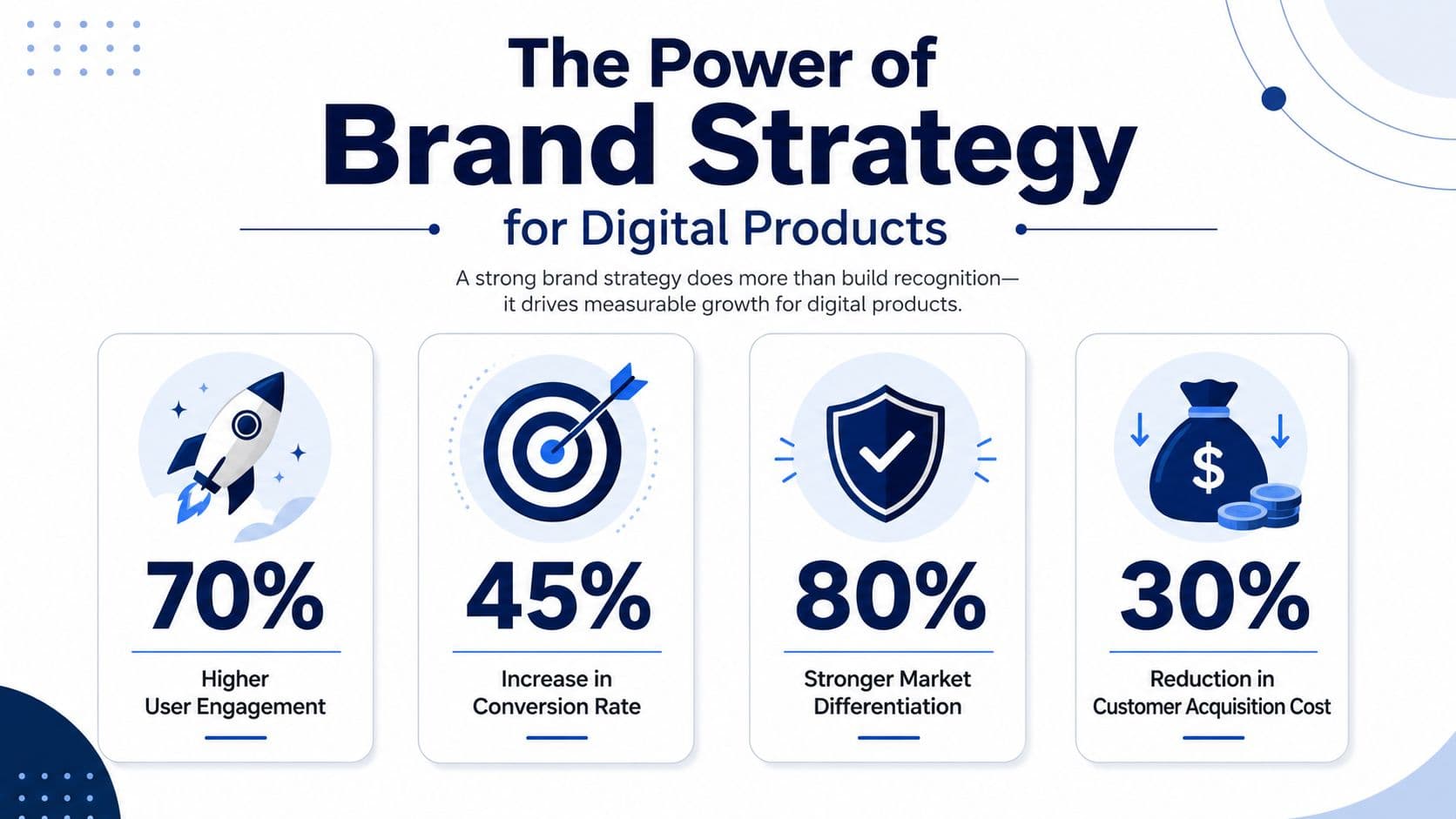
Why Brand Strategy Is Your Digital Product's Superpower
Founders often treat brand strategy as something to tidy up after launch. In product work, that sequence is expensive. By the time adoption stalls, conversion slips, or users describe the product inconsistently, the cost shows up in roadmap churn, rework, and slower growth.
A digital product wins or loses in small moments. A search result. An app store screenshot. A pricing page. A signup flow. A support reply after the first failure. Users stitch those fragments together fast and decide whether your product feels credible, useful, and safe enough to try.
Trust changes product economics
For apps and websites, trust is not a soft metric. It changes behaviour. It affects whether users finish onboarding, whether a buyer agrees to a demo, whether pricing feels acceptable, and whether a team gives you real data permissions or abandons the flow.
That has direct implications for product decisions:
- Reduce ambiguity: product names, feature labels, and calls to action should say what they do.
- Lower perceived risk: pricing, security signals, support access, and implementation expectations should be easy to verify.
- Keep the promise stable: the story on the landing page should match the product experience, sales narrative, and lifecycle messaging.
Brand strategy also earns its keep with technical teams. If the brand promise is speed, the product cannot feel slow. If the promise is clarity, the information architecture cannot be bloated. If the promise is control, permission settings and audit trails need to support that claim. Good strategy stops marketing from promising an experience the product stack cannot deliver.
A product like Boiler Juice shows the point clearly. In a category where users want confidence and quick action, the interface, messaging, and journey need to remove hesitation. If the proposition sounds simple but the path to purchase feels awkward, users read that gap as risk.
Consistency improves execution
Without a clear strategy, product teams improvise. New features get framed with new language. Marketing campaigns introduce new value claims. Sales decks drift from the website. Support teams explain the same capability three different ways. The result is not just inconsistency. It is slower decision-making across the business.
With a clear strategy, teams have a filter. They know which messages deserve repetition, which customer pains matter most, and which ideas do not fit the position. That shortens review cycles and makes design, copy, and feature prioritisation easier to align.
The same principle shows up in strong interface work. Teams that present information consistently make products easier to learn and easier to trust. If you want a useful reference point, this guide to a winning UI/UX design portfolio shows how coherent presentation shapes perceived quality.
A strong brand strategy helps a good product get understood faster, trusted sooner, and chosen with less friction.
For CTOs and founders, that is the commercial case. Better alignment reduces mixed signals, sharpens product choices, and shortens the path from first impression to meaningful action.
The Five Core Components of a Powerful Brand Strategy
Brand strategy breaks down when teams treat it as a visual exercise. For digital products, it works as an operating model for product decisions, go-to-market choices, and user experience. These five components do different jobs, but they need to agree with each other or the product starts sending mixed signals.
.jpg&w=2048&q=75)
Purpose
Purpose sets the standard for what the product is trying to change for a specific customer. In practice, it helps founders and product teams decide what belongs on the roadmap and what should stay out.
A strong purpose for a fintech app could be reducing financial anxiety through clearer decisions. For a workforce platform, it could be cutting the manual coordination that slows operations down. Those are useful because they shape product scope, onboarding priorities, and even the level of explanation the interface needs.
Weak purpose creates expensive drift. Teams add features that look commercially attractive in isolation, but make the product harder to explain and harder to adopt.
Positioning
Positioning is a market choice with consequences. It defines the category you want to win in, the buyer you serve most effectively, and the alternatives you expect to be judged against.
Founders often resist narrowing the position because it feels like giving up reach. Usually the opposite happens. A product that is clearly built for regulated workflows, internal operations, or high-trust purchases is easier to understand than one that claims to work for everyone.
Clear positioning also helps teams gain competitive marketing advantage because it gives sales, product, and marketing the same frame for differentiation. It sets the criteria for what to build, how to sell it, and which competitors matter.
Messaging
Messaging translates strategy into working language. That includes homepage copy, onboarding prompts, pricing pages, sales decks, lifecycle emails, and support content.
For apps and websites, messaging has to do more than sound polished. It has to remove friction at key decision points. If a founder says the product saves time, users should see that claim made concrete in feature naming, setup guidance, and proof near the point of conversion.
One quick test works well here. After a short visit, can a buyer explain what the product does, who it is for, and why they should trust it?
Identity
Identity is the system people can see and hear. It covers visual design, motion, tone, interface patterns, and the cues that make a product feel consistent across marketing and product surfaces.
This component matters because digital products are experienced in pieces. A user might meet the brand through an ad, a landing page, a signup flow, a dashboard, and a support email in the same week. If those touchpoints feel unrelated, trust drops and the product feels less mature than it is.
A documented design system for digital product consistency helps teams turn brand decisions into repeatable interface rules, especially once multiple designers and engineers are shipping at speed.
Experience
Experience proves whether the strategy is real. Users judge the brand through page speed, onboarding effort, error handling, support quality, billing clarity, and how quickly they reach value.
Brand strategy connects directly to product delivery. If the position is clarity, the information architecture needs to reduce cognitive load. If the promise is control, settings and permissions need to feel predictable. If the story is premium service, support cannot feel like an afterthought.
I have seen well-positioned products lose momentum because the experience contradicted the promise. The opposite is also true. When purpose, positioning, messaging, identity, and experience line up, adoption gets easier because the product feels coherent from first click to repeat use.
A Pragmatic Framework for Building Your Brand Strategy
Brand strategy should speed up product decisions, not sit in a slide deck while design and engineering move on without it.
The framework that works in practice has four stages: research, choice, translation, and review. The sequence stays the same whether you are shaping an MVP, repositioning a mature SaaS product, or preparing a website for a new market. The depth changes based on risk, budget, and how many teams need to align.
Research before language
Start with evidence from the product and the market. Interview users. Review sales calls. Read support tickets. Audit competitor sites and signup flows. Pull out the phrases customers already use when they explain the problem, compare options, or justify the purchase internally.
For digital products, this step protects teams from a common mistake. They describe what the software does instead of why it gets adopted. Technical buyers still care about proof, but proof works well when it supports a clear commercial story. Customer examples, implementation outcomes, and review patterns usually do more than a long feature page.
Focus discovery on four things:
- Repeated pain points: where users lose time, confidence, revenue, or control.
- Decision criteria: what buyers need to believe before they approve a trial or rollout.
- Language patterns: the words customers use naturally, not the ones the team prefers internally.
- Competitive sameness: where rival products make near-identical claims.
Define the choices
Research gives you options. Strategy is choosing between them.
Write down the decisions that will guide product, marketing, and sales. That includes your purpose, primary audience, category position, proof points, and personality. The useful test is whether two smart people on your team would make the same call after reading the document. If they would not, the strategy is still too vague.
There are trade-offs here. A startup usually benefits from a narrower position because clarity helps adoption. A larger company may need a broader structure that can hold multiple products without confusing the market. Both can work, but only if the team is honest about what it will not claim, who it is not for, and which strengths will stay in the background for now.
If you want these decisions to influence release planning, connect them to a product roadmap for sequencing launches and feature emphasis.
Turn strategy into assets and product behaviours
Next, turn the strategy into things teams can use. That means homepage messaging, pitch structure, UI copy rules, visual identity, onboarding prompts, case study templates, sales collateral, and support language.
For apps and websites, this step also needs product behaviour rules. A brand promise around speed should affect loading states, form length, and the number of steps to first value. A brand promise around control should affect permissions, settings clarity, and audit trails. Founders often treat these as UX details. They are brand decisions because users experience the promise through interaction, not theory.
A product studio can support this phase alongside design and build work. For example, Arch's development services cover the delivery side of websites and digital products, which is where strategic choices need to survive contact with real interfaces.
Implement and refine
A strategy proves itself under delivery pressure. Sprint trade-offs, launch deadlines, investor narratives, feature packaging, and sales objections all expose whether the brand is clear enough to guide real choices.
Use a review loop that checks both perception and execution:
- Does the product experience still support the position we chose
- Are new users understanding the value fast enough
- Have recent features strengthened the promise or blurred it
- What signals from demos, win-loss notes, support, and usage show trust or confusion
Brand work also needs to connect to planning and market pressure. If you are trying to gain competitive marketing advantage, the practical move is to tie brand decisions to launch priorities, content themes, and product packaging so the strategy changes how the company operates.
How to Measure the Success of Your Brand Strategy
A brand strategy that can't be measured usually gets deprioritised. Stakeholders will tolerate creative discussion for a while, but they fund systems that show movement.
A detailed view from Peter A. Mayer on data in brand strategy makes the right point. A modern brand strategy should be treated as a data system, using company, audience, and market data to define positioning, then tracking KPIs such as brand awareness, sentiment, engagement, and conversion to measure real-world impact.
Track perception and performance together
Brand metrics on their own can become abstract. Product metrics on their own can miss the reason movement happened. You need both.
Useful perception measures include:
- Brand awareness: whether more of the right audience knows you exist.
- Sentiment: whether people describe the brand in the terms you intended.
- Message recall: whether users repeat your core value proposition back in similar language.
- Engagement quality: whether content and product entry points attract the right intent.
Performance metrics bring the commercial layer in:
- Conversion: from landing page visit to signup, enquiry, or purchase.
- Activation: whether users reach the first meaningful outcome.
- Lead quality: whether marketing and sales are attracting better-fit prospects.
- Retention and loyalty: whether the product keeps the trust it earned.
Look for alignment, not isolated spikes
The most useful measurement pattern is correlation. If sentiment improves but activation falls, the strategy may be promising something the product doesn't deliver. If traffic rises but lead quality declines, the brand may be broadening in the wrong direction.
Brand strategy is working when the story users hear before signup matches the experience they have after signup.
For founders and heads of digital, brand stops being intangible. It becomes a set of assumptions you can test. If you need support defining those indicators or tying them to product delivery, you can contact the Arch team.
The Future of Brand Strategy in an AI-Driven World
The next shift in brand strategy covers machine-mediated discovery as well as human attention.
Les Roches' overview of brand strategy and AI-era visibility cites Ofcom's finding that 12 million UK adults used generative AI in the previous year. That matters because AI systems increasingly summarise, rank, recommend, and reinterpret brands before users ever reach your product directly.
That changes the brief. Your brand has to be clear enough for humans, but also structured enough for AI-driven systems to interpret accurately. Ambiguous positioning, inconsistent language, and weak proof signals won't just confuse buyers. They can also reduce visibility in AI-assisted journeys.
For digital products, the implication is simple. Clear positioning, consistent messaging, and evidence-backed claims aren't only persuasive. They're becoming discoverability infrastructure.
Frequently Asked Questions
What is brand strategy in simple terms
Brand strategy is the long-term plan for how your business should be understood and chosen. It defines your market position, core message, proof points, and the kind of experience users should have. For apps and websites, that affects more than marketing. It influences navigation, onboarding, product copy, and feature emphasis so the whole experience feels coherent rather than assembled by separate teams.
Is brand strategy different from brand identity
Yes. Brand identity is the visible expression of the strategy, such as colour, typography, imagery, and tone. Brand strategy comes first. It decides what the brand needs to stand for, who it serves, and how it should be differentiated. If a team starts with visuals before making those decisions, the result often looks polished but lacks focus, which shows up later in weak messaging and inconsistent product decisions.
When should a startup invest in brand strategy
Earlier than most founders think, but at the right depth. A startup doesn't need a heavy process before proving demand. It does need clarity on audience, positioning, message, and trust signals before launching an MVP or website. Without that, teams tend to over-explain features, attract the wrong leads, and revise copy repeatedly because no one has agreed what the product should be known for.
How does brand strategy affect product development
It gives product teams a decision filter. If the brand is built around simplicity, trust, or speed, the interface, onboarding, release priorities, and microcopy should support that promise. It also helps teams decide what not to build or promote. Products become confusing when every feature gets equal prominence and no strategic choice shapes the experience users move through.
Can a strong brand strategy help technical products
Yes, especially when the product solves a complex problem. Technical teams often default to feature-led communication because it feels precise. Buyers usually need the opposite first. They need a clear explanation of the problem solved, who the product is for, and why it's credible. Good strategy simplifies the narrative without dumbing it down, then uses proof such as testimonials, reviews, or case studies to support trust.
About the Author
Hamish Kerry is the Marketing Manager at Arch, where he's spent the past six years shaping how digital products are positioned, launched, and understood. With over eight years in the tech industry, Hamish brings a deep understanding of accessible design and user-centred development, with a focus on delivering real impact to end users. His interests span AI, app and web development, and the potential of emerging technologies. When he's not strategising the next big campaign, he's keeping a close eye on how tech can drive meaningful change.
Hamish's LinkedIn: Hamish Kerry on LinkedIn
If you're building a website, app, or software product and need sharper positioning before delivery starts, Arch works with teams on discovery, design, and development so strategy holds up in the finished product, not just in a slide deck.