



Sustainable Product Design: A Guide for Digital Leaders.
Learn how sustainable product design drives business value. Our guide covers principles, metrics, and practical steps for digital products.
Sustainable Product Design: A Guide for Digital Leaders.
Key Takeaways
- Sustainability in digital products is a quality issue. Lighter interfaces, efficient code and durable architecture usually improve speed, usability and maintainability.
- Early decisions matter most. Around 80% of a product's environmental impact is determined in the early design phase according to Ecochain's guide to sustainable product design.
- Compliance is moving upstream. The UK's Ecodesign for Energy-Related Products and Energy Information Regulations 2021 came into force on 1st December 2021, making design-stage sustainability a market-access issue for regulated products, as noted in aPriori's overview of sustainable product design metrics.
- Circular thinking applies to software too. Modular systems, reusable components and easier maintenance reduce wasteful rebuilds and shorten the path to improvement.
- Digital leaders should measure sustainability through product metrics. Performance, infrastructure efficiency, support lifespan and unnecessary feature growth are more useful than vague green claims.
- The strongest business case is practical. Sustainable product design lowers friction, reduces rework, strengthens resilience and gives teams a clearer standard for product quality.
Introduction Designing for Durability Not Just Disruption
Most advice on sustainable product design starts in the wrong place. It starts with packaging, recycled materials and end-of-life disposal. That matters for physical goods, but digital leaders need a broader view.
Apps, websites and AI products create impact through infrastructure, data transfer, device usage, software churn and the decisions teams make about product lifespan. Bloated front ends, excessive tracking, needless notifications, over-engineered features and short support windows all have a footprint. They also make products worse.
That's why sustainable product design in digital work isn't a niche concern. It's a practical standard for building products that are faster, clearer and easier to maintain. A lean product usually serves users better than a heavy one. A stable architecture usually outlasts a rushed one. A well-scoped release usually beats an overstuffed roadmap.
Practical rule: If a feature increases complexity, infrastructure load and support burden, it should earn its place with clear user value.
Digital teams often frame sustainability as an ethics layer added after launch. In practice, the strongest teams treat it as part of product strategy from day one. They ask whether the service reduces unnecessary user effort, whether the interface respects attention, whether the codebase can evolve without repeated rewrites and whether the hosting setup matches real demand.
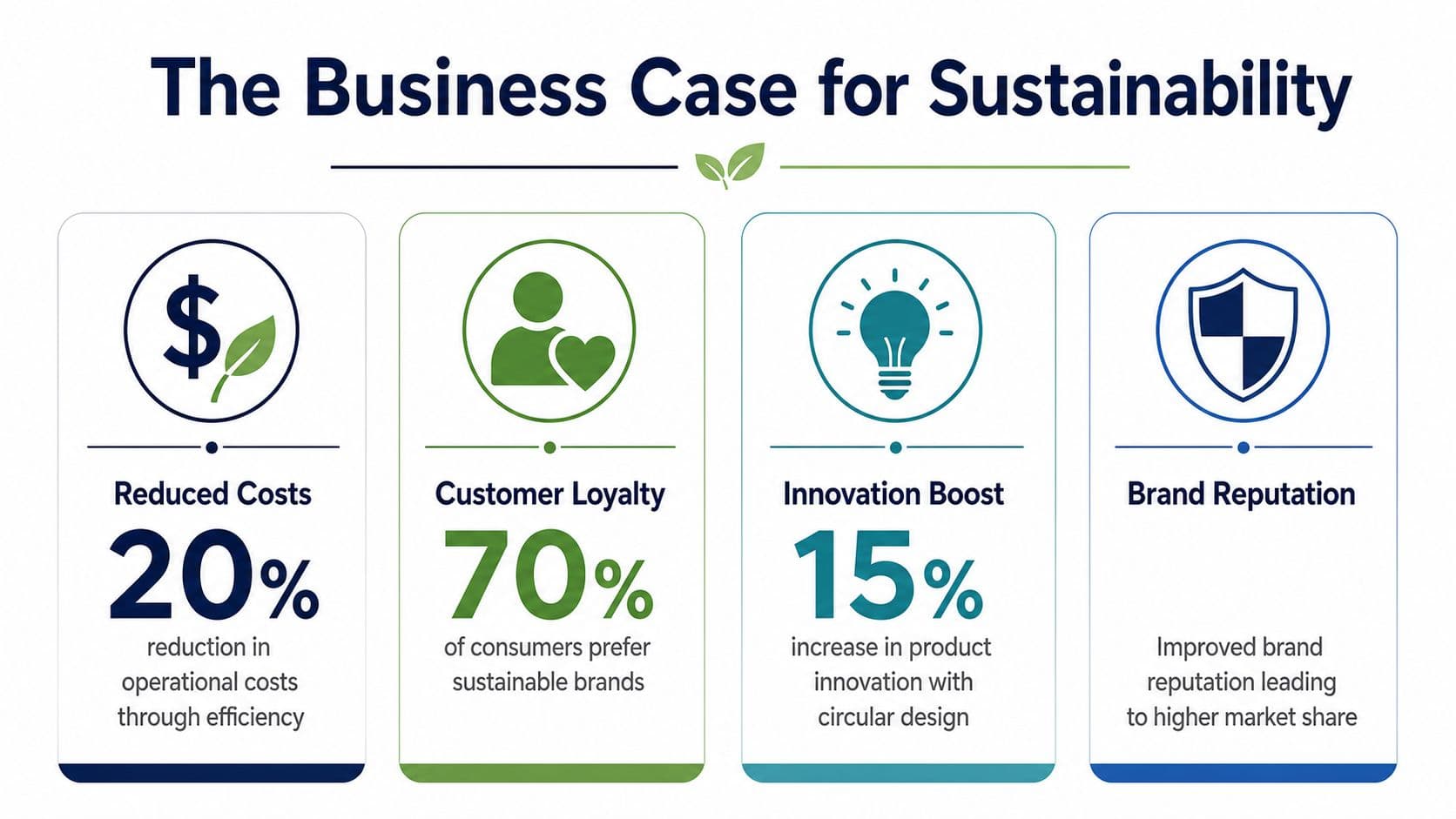
The Business Case for Sustainable Product Design
Sustainable design earns its budget when it improves the product and the P&L at the same time. In digital products, waste is rarely abstract. It shows up in cloud invoices, slow pages, support tickets, brittle releases and teams spending sprint after sprint maintaining decisions that should have been simpler from the start.
Better products cost less to carry
Digital teams often separate sustainability from product quality. In practice, they are closely linked. A lighter frontend loads faster. A clearer user journey reduces drop-off. A service with fewer unnecessary background jobs costs less to run and is easier to support.
The trade-off is real. Cutting assets, third-party scripts or high-volume data collection can limit short-term marketing ambition or delay a feature request that looks good in a roadmap review. But teams that make those calls early usually get a better operating model in return. They reduce infrastructure waste, lower maintenance effort and avoid the hidden tax of complexity.
I have seen the same pattern across redesigns, SaaS platforms and AI features. Products become expensive long before finance flags them. The warning signs appear earlier in engineering time, QA effort, performance regressions and workarounds added to protect a weak foundation.
The cost conversation is broader than energy
For physical products, sustainability is often discussed through materials, manufacturing and transport. Digital products have a different cost profile. Their impact comes through computation, storage, data transfer, model usage, device demand and how often teams force users into replacement behaviour through software churn.
That is why digital sustainability belongs in product strategy, not only in ESG reporting. A product that lasts longer, runs efficiently and avoids unnecessary feature sprawl creates commercial value. It keeps acquisition spend from being wasted on poor experiences. It protects margins as usage scales. It also gives teams more room to improve the parts customers notice.
There is a useful parallel in other markets. Brands that succeed with durable, lower-impact offers often win because they fit real user behaviour and long-term cost expectations, not because they lead with moral messaging alone. The same logic shows up in mobility products and services, including resources focused on understanding e-bike sustainability for commuters.
Risk is shifting upstream
Regulation has trained many firms to treat sustainability as a late-stage review. That model does not work well for digital products. By the time a team reaches procurement, hosting decisions, vendor selection or launch approval, many high-impact choices are already embedded in the service.
The better business response is to move these decisions upstream. Product managers should question whether a feature needs constant syncing. Designers should challenge media-heavy patterns that add weight without adding clarity. Engineers should test whether a simpler architecture can meet demand before the team commits to a more resource-intensive setup.
This approach also supports longer product life. Teams that design for modularity, maintainability and reuse are better placed to support evolving services, including products connected to technology that supports circular economy systems.
Sustainable product design works best when product, design and engineering make shared trade-offs early, with a clear view of cost, performance and long-term maintenance.
Competitive advantage comes from restraint
Users rarely reward a product for having the most features. They reward it for being fast, reliable and easy to trust. In crowded categories, restraint is often the sharper strategy.
A team that says no to unnecessary complexity usually ships a product that performs better and scales with less friction. That creates an advantage that competitors can feel but struggle to copy quickly. It sits in the codebase, the service architecture, the support model and the quality of day-to-day product decisions.
Sustainability, in that sense, is not a layer added for brand protection. It is a way to build digital products that age well, cost less to operate and stay useful for longer.
Core Principles of Sustainable Digital Design
Digital sustainability shows up in product quality long before it appears in a reporting deck. Teams see it in page weight, cloud spend, support burden, release velocity and how long a product stays useful without a rebuild.
.jpg&w=2048&q=75)
Start with lifecycle thinking
The biggest sustainability decisions in digital products are usually made before delivery starts. Scope, architecture, content models, data retention rules and third-party dependencies shape the product's long-term footprint and its operating cost.
For product teams, lifecycle thinking means designing beyond launch. A useful service should be cheap enough to run, simple enough to maintain and flexible enough to improve without repeated rework. That changes the questions asked in discovery:
- What is the smallest version of this product that creates clear value?
- Which systems need to scale, and which only need to be stable?
- What data do we need to collect, store and process?
- How will we retire features, content or integrations without creating failure points?
Teams that leave these questions until after UI approval usually inherit avoidable complexity.
Design for reuse, maintenance and retirement
Physical circularity focuses on repair, reuse and disassembly. In digital products, the parallel is easier maintenance, lower replacement rates and cleaner retirement paths.
That principle changes how software gets built. Services should be modular enough to update one part without destabilising the rest. Design systems should reduce duplicate patterns, not multiply them. Code should be readable enough that a new team can support it a year later without reverse-engineering every decision.
A sustainable digital product usually includes:
- Modular services: Independent updates are possible without rewriting the whole platform.
- Reusable components: Design and engineering teams avoid solving the same interface problem five times.
- Clear deprecation paths: Old features can be removed with planned migrations, not emergency fixes.
- Documented decisions: Teams know why something was built, not just what shipped.
The same logic supports wider service ecosystems. Products that connect with repair, resale, refurbishment or shared-use models depend on technology that supports circular economy systems.
Efficiency is product quality
Efficiency is often treated as a technical concern. It is a product principle.
A lighter site loads faster on weak connections. A restrained app uses less battery and fewer background processes. A smaller AI workflow reduces inference cost and can still deliver better user outcomes if the task is tightly defined. These choices lower environmental impact, but they also improve conversion, retention and margin.
Users feel waste immediately. They see it as lag, clutter, overheating phones, excessive permissions, confusing flows and features they did not ask for.
Physical transport offers a useful comparison. The same pattern appears in understanding e-bike sustainability for commuters. The option that gets used consistently tends to be the one that is efficient, practical and built around everyday constraints.
Design test: If a product works well on an older device, a poor connection or a tight attention span, it is usually becoming more sustainable and more competitive at the same time.
A Practical Guide to Building Sustainable Digital Products
Sustainable product design becomes real when teams apply it to the workflow they already have. Discovery, UX, engineering and hosting all shape whether a product becomes lean and durable or bloated and short-lived.
.jpg&w=2048&q=75)
Discovery and scope
Most waste enters digital products before a line of code is written. Teams create it when they define vague success criteria, accept every stakeholder request and confuse breadth with value.
A stronger discovery process sets limits.
- Define the core job first: Identify the smallest useful outcome for the user. Build around that.
- Challenge feature inflation: Ask which requests exist because of evidence, and which exist because nobody wants to say no.
- Write non-functional goals: Include performance, maintainability and support lifespan alongside product goals.
A product brief should say more than what the service does. It should also state what the team won't build, what level of device support matters and what kinds of complexity are unacceptable.
UX and interface design
Design teams often think about sustainability only in visual terms. The bigger opportunity is interaction efficiency.
Reduce unnecessary states. Remove duplicate paths. Avoid patterns that make users repeat work. Design forms that save progress sensibly. Use media with intent, not as decoration. A simpler user journey lowers cognitive load and often reduces backend activity too.
Good sustainable UX usually includes:
- Focused navigation: Fewer choices, clearer routes.
- Intentional media use: Compress assets, avoid autoplay where it adds little value.
- Accessible defaults: Readable layouts and clear interactions reduce user errors and retries.
Engineering and architecture
Principle translates into product quality. For UK products, one of the most practical engineering levers is design for circularity. Guidance highlighted by Siemens on sustainable design points to modular construction, standardised interchangeable parts and easy disassembly as ways to improve repairability and reuse. In digital systems, the closest parallel is modular architecture, serviceable components and cleaner replacement paths.
That translates into software practices such as:
- Break systems into maintainable modules: Don't weld every function into one brittle codebase.
- Reduce dependency sprawl: Every library adds update risk and maintenance load.
- Optimise payloads and queries: Serve less. Cache intelligently. Avoid duplicated requests.
- Design for removal: Features should be able to leave the product cleanly when they stop earning value.
There's a close connection here with AI too. Teams building AI-enabled features should think carefully about model choice, inference frequency and whether automation replaces effort or just adds computational overhead. For a deeper look, the article on AI for sustainability and energy is worth reading.
Hosting and operations
A well-designed front end can still become wasteful if the hosting setup is careless. Overprovisioned environments, poor caching and messy deployment practices turn good product decisions into operational drag.
Treat infrastructure as part of product design. Match environments to actual usage. Archive or retire what's no longer needed. Make observability useful enough that teams can spot waste quickly. Sustainable operations rely on routine housekeeping, not one-off audits.
Keep a running list of services, jobs, environments and integrations that nobody has reviewed in months. Hidden operational waste often lives there.
Post-launch governance
The launch isn't the finish line. Products become less sustainable when teams keep adding features without pruning. Legacy pathways stay live. Deprecated content remains indexed. Notification logic grows noisy. Admin tools multiply.
A better post-launch rhythm includes regular review of:
- Unused or low-value features
- Old content and dead user paths
- Support burden caused by avoidable UX issues
- Parts of the stack that are difficult to update safely
That maintenance mindset is what keeps digital products durable. It's also what separates a mature product organisation from one that keeps rebuilding the same service in different forms.
Measuring What Matters Sustainability Metrics and KPIs
Teams that say sustainability matters but cannot measure it are usually running a branding exercise. In digital product work, the useful question is simpler. Which metrics show whether the product is getting lighter, faster, easier to maintain, and cheaper to run as it scales?
That framing keeps the conversation grounded in product quality. A bloated app consumes more energy, but it also loads slower, breaks more often on weaker devices, and costs more to support. The same pattern shows up in AI products, where inefficient prompts, oversized models, and unnecessary inference calls increase compute spend long before anyone labels it a sustainability problem.
The UK context still matters. Research discussing UK waste statistics and sustainable product design makes clear that waste is a system issue, not a factory-only issue. Digital services shape device replacement, delivery behaviour, customer support demand, and the amount of infrastructure a business keeps alive in the background.
KPIs that are actually useful
A good sustainability scorecard for digital products mixes engineering signals with commercial ones. I would track a small set that product, design, and engineering can all act on.
- Page and screen weight: total bytes delivered, image payload, script size, font overhead
- Interaction cost: API calls per key journey, third-party requests, background polling, failed requests
- Performance on real devices: load time, input delay, render stability, battery drain where relevant
- Service longevity: supported device range, dependency age, release effort for routine updates, rewrite pressure
- User effort: time to complete a task, repeat steps, abandonment points, avoidable support contacts
- Operational efficiency: inactive environments, unused storage, duplicate tooling, stale data pipelines
- Commercial correlation: cloud spend per active user, support cost by journey, conversion impact of performance changes
The point is not to build a giant dashboard. The point is to identify where waste shows up as a product problem.
For example, a mobile service in construction or field operations often looks sustainable because it replaces paper. That is only half the story. If the app forces repeated uploads, constant sync attempts, or heavy media use on poor connections, it creates waste for users and for the business. Products built for green innovation in construction through mobile apps tend to work better when teams measure offline success rates, sync efficiency, and task completion in low-bandwidth conditions.
Use metrics to force trade-offs into the open
Useful KPIs change decisions. If page weight climbs release after release, design and engineering need to cut assets or simplify the interface. If one workflow creates a disproportionate share of support tickets, the team should fix the flow before adding new features. If an AI feature generates marginal user value but drives significant compute cost, it should be redesigned, rate-limited, or removed.
In this context, sustainable design becomes commercially credible. Better metrics help teams protect margin, improve retention, and extend product life.
One more metric is easy to miss. Track how well the product performs on older, lower-cost devices. That has sustainability value because it extends hardware life, and it has market value because it broadens access. For some users, including those shopping for cheap iPhones UK, device tolerance is not a niche concern. It determines whether your product feels reliable enough to keep.
Choose KPIs that can trigger a clear product decision within a sprint. If a number looks interesting but nobody knows what to change, drop it.
The strongest sustainability metrics do double duty. They reduce environmental waste and improve product quality at the same time. That is the standard worth holding.
Sustainable Design in Action Real World Examples
The biggest mistake teams make is thinking sustainable product design means adding a green message to an unchanged product. In practice, the stronger example is usually a service that removes waste from the user journey, the business model or the device lifecycle.
Take a common website rebuild. A traditional approach adds animation, large media files, third-party scripts and multiple content pathways because each one seems harmless on its own. The result feels modern for a short period, then performance slips, maintenance gets harder and content teams work around the design instead of with it.
A more sustainable approach makes tougher choices. It reduces dependencies, simplifies templates, limits script bloat and designs components that can survive future updates. The output often feels cleaner and more premium because the product has less friction.
Sustainable thinking often changes the model
One of the most useful UK-specific reminders is that sustainable product design is about more than materials. It is also about reducing total material throughput, extending product life, and designing service or return models that fit UK waste and reuse infrastructure, as discussed in iPoint's view of sustainable product design in the UK context.
That same logic applies to digital products linked to hardware. If a mobile service encourages reuse, repair, resale or lower-friction ownership transfer, it can support a more durable system overall. For example, anyone comparing refurbished device pathways might look at options for cheap iPhones UK as part of a wider strategy around extending device life rather than defaulting to new hardware.
Another practical angle appears in sectors like construction and field operations, where digital products can reduce unnecessary travel, paperwork and coordination waste if they're built around real workflows instead of administrative complexity. The piece on sustainable construction and how mobile apps are driving green innovations shows how that thinking translates into service design.
The pattern is consistent. Sustainable products don't win because they say less harm. They win because they work better, longer and with less waste around the edges.
Conclusion Your Next Step Towards a Greener Product
Sustainable product design has moved well beyond the old conversation about recycled materials and disposal. For digital leaders, it now sits much closer to the daily work of shaping roadmaps, defining architecture, improving UX and controlling operating costs.
The useful shift is this. Sustainability is not separate from product quality. It is one of the clearest signals of product quality. If a service is lighter, clearer, more maintainable and built to last, it's usually delivering a better result for users and a stronger return for the business.
That doesn't require a grand transformation programme. Start with one product. Audit the features that create complexity without clear value. Review page weight and third-party scripts. Tighten support policy. Reduce unnecessary data movement. Build a roadmap that rewards durability, not just release volume.
Digital teams don't need complete answers to begin. They need sharper standards. The firms that adopt those standards early are likely to build products that scale more reliably, age more gracefully and stand up better under commercial pressure.
Frequently Asked Questions
What is sustainable product design in a digital context
Sustainable product design for digital products means building apps, websites and AI services that use resources efficiently, stay useful for longer and avoid unnecessary complexity. In practice, that covers product scope, UX clarity, code quality, infrastructure choices and support lifespan. It's less about a marketing label and more about whether the product is lean, maintainable and resilient under real usage.
Is sustainable digital design only relevant for large enterprises
No. Smaller teams often benefit fastest because waste is more visible when budgets and headcount are tighter. A bloated release, fragile codebase or overcomplicated workflow hits a scale-up harder than a large enterprise with more internal buffers. Sustainable design helps smaller businesses stay focused, reduce rework and build products that don't need constant rescue work after launch.
How do you make an existing product more sustainable
Start with an audit. Look for heavy assets, duplicate journeys, low-value features, noisy integrations and maintenance bottlenecks. Then prioritise changes that improve both user experience and operational efficiency. A full rebuild is often unnecessary. Instead, the focus should be on disciplined pruning, better architecture decisions and clearer rules for what gets added, retained or retired across the product lifecycle.
Does sustainable product design conflict with innovation
It shouldn't. The conflict usually comes from weak prioritisation, not from sustainability itself. Teams can still experiment, launch new features and use AI creatively. The difference is that sustainable teams test ideas with more discipline. They ask whether innovation solves a real problem, whether it scales cleanly and whether the long-term support burden is justified by the value it creates.
What should digital leaders measure first
Start with metrics your team already understands and can influence quickly. Good first choices include page weight, unnecessary third-party scripts, support burden from poor UX, feature usage and infrastructure waste. The goal isn't to create a perfect sustainability index. It's to build a working view of where the product is consuming more effort, data, energy or maintenance than it needs to.
About the Author
Hamish Kerry is the Marketing Manager at Arch, where he has spent the past six years shaping how digital products are positioned, launched and understood. With more than eight years in tech, he focuses on accessible design, user-centred development and the commercial realities that determine whether a product gains traction or creates avoidable complexity.
His interests include AI, app and web development, and how emerging technologies can drive meaningful change. He pays close attention to the link between product quality, performance and long-term value, especially in digital products that need to scale without creating unnecessary operational drag.
Hamish's LinkedIn: Hamish Kerry on LinkedIn
If you're rethinking how your app, website or AI product should perform, scale and last, Arch can help you turn sustainable product design into practical delivery decisions.