



Mastering Stakeholder Communication in Digital Projects.
A practical guide to stakeholder communication for app & web projects. Learn mapping, messaging, templates, and KPIs to keep everyone aligned.
Mastering Stakeholder Communication in Digital Projects.
A digital project rarely slips because nobody worked hard. It slips because somebody important heard the wrong message, heard it too late, or never heard it at all.
You see the pattern everywhere. A launch date looks solid until legal raises a concern in the final week. A product owner thinks a feature is approved, while the sponsor thinks it was only being explored. A delivery team shares updates constantly, but customer support still feels blindsided by what's about to go live. None of that is a tooling problem first. It's a stakeholder communication problem.
Good project managers learn this fast. The strongest ones treat communication as part of delivery control, not as admin around the edges. They don't wait for confusion to appear. They create a system that surfaces disagreement early, forces clarity around decisions, and leaves a written trail people can trust.
That matters even more in digital product work, where app teams, web teams, operations, marketing, compliance, leadership, and users often want different things from the same release.
Introduction Why Most Digital Projects Need Better Conversations
Key takeaways
- Map stakeholders before delivery starts: Don't treat every stakeholder the same. Identify who decides, who influences, who contributes, and who only needs visibility.
- Build a communication plan on purpose: Define cadence, channel, content, and ownership instead of relying on ad hoc updates.
- Use repeatable templates: Weekly updates, risk escalations, and steering packs should follow a clear structure every time.
- Confirm understanding, not just delivery: A sent message isn't a received message. Close the loop and document outcomes.
- Measure communication quality: Track engagement, feedback, follow-up speed, and whether stakeholders are surprised late in the process.
- Communicate impact, not noise: Share what changed, what's blocked, and what the evidence means in plain English.
- Keep it operational: A communication framework works when your team can run it every week.
Most failing stakeholder communication looks busy from the outside. There are meetings. There are notes. There are status emails. Slack is active. Yet the project still drifts because the right people aren't aligned on the right decisions.
That's why I treat stakeholder communication as a delivery discipline. It sits alongside scope control, planning, and risk management. If your communication system is weak, every other part of delivery gets less reliable. Decisions get revisited. Trade-offs stay implicit. Teams build to assumptions instead of agreed direction.
A useful way to think about it is simple. Projects don't just need updates. They need managed understanding. That means deciding who needs what, when they need it, how detailed it should be, and how you'll verify they understood it.
Practical rule: If a stakeholder can still say “I didn't realise that” late in the project, the communication process failed long before the meeting where they said it.
The strongest delivery teams make this visible in the way they work. They maintain a decision trail. They know who owns each stakeholder relationship. They review communication as part of project governance. That discipline mirrors what you see in formal operating environments too. A good example is the way public sector teams structure engagement in the UK, where stakeholder management is handled as an ongoing management practice, with regular review and clear accountability in a defined delivery process.
That's the standard worth aiming for in digital product work: a clear operating model that reduces surprises and helps people make decisions at the right time.
Your First Step Stakeholder Mapping and Prioritisation
The first mistake new project managers make is assuming they already know who matters. They name the sponsor, the product owner, the engineering lead, and maybe marketing. Then the project reaches a sensitive point and another stakeholder suddenly appears with enough influence to slow everything down.
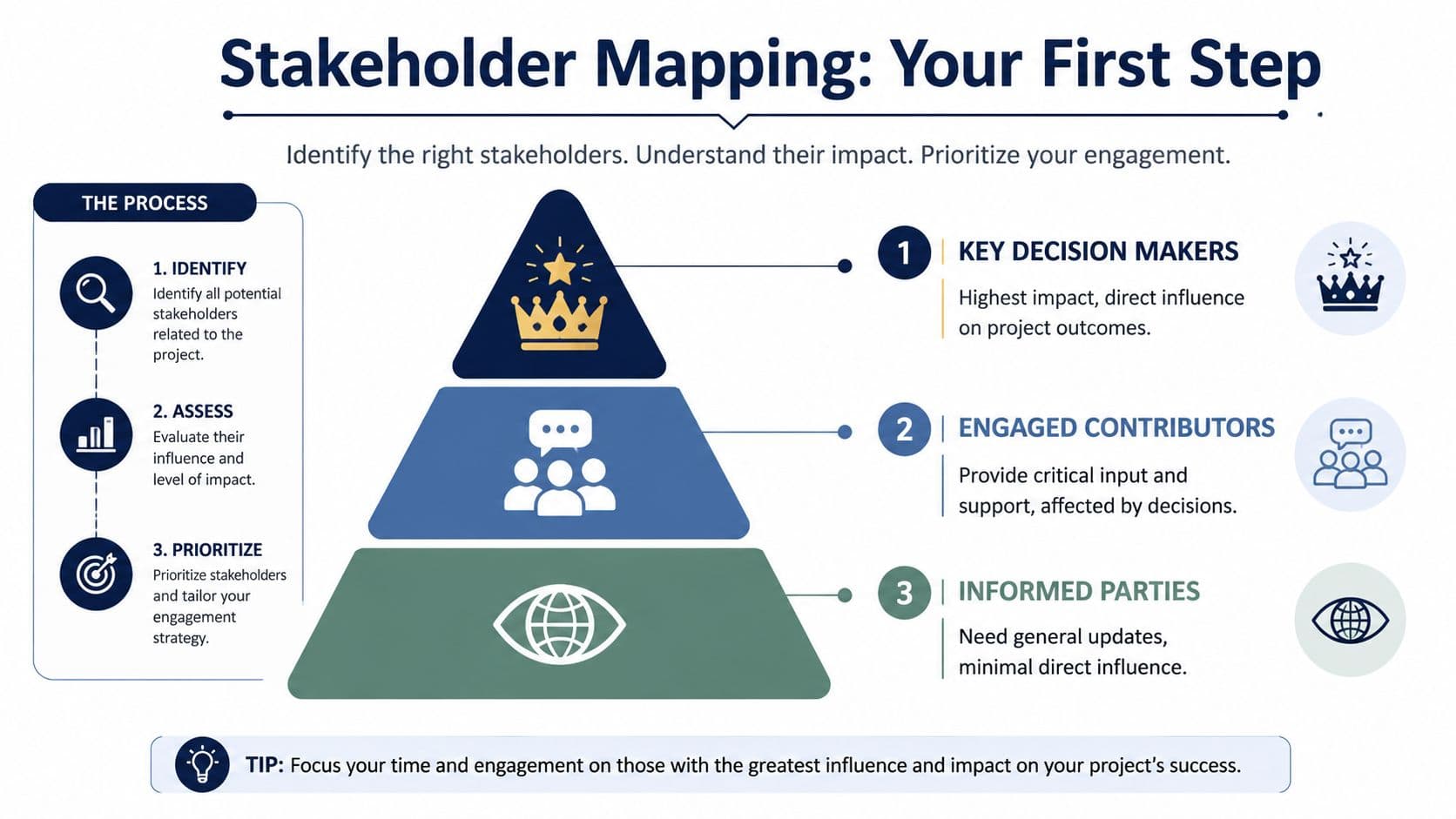
That's why stakeholder mapping comes first. Before you plan the rhythm of communication, you need a grounded view of the people around the work: their actual influence, their likely concerns, and their proximity to the outcome, as well as their job titles.
Start with influence and interest
A Power and Interest Grid is still one of the most useful ways to do this. It's simple enough to use on day one and practical enough to keep useful as the project evolves.
For a digital product team, the rough groups usually look like this:
- High influence, high interest: Executive sponsor, product lead, budget holder, senior client-side owner.
- High influence, lower day-to-day interest: Compliance lead, commercial lead, department head, steering group member.
- Lower influence, high interest: Customer support, sales team, operations users, internal subject matter experts, beta participants.
- Lower influence, lower interest: Wider business stakeholders who need awareness but won't shape core decisions.
The point isn't to rank people by importance as human beings. The point is to decide where your communication effort has to be most deliberate.
Map the real project, not the org chart
A stakeholder map based only on hierarchy misses the people who create friction or generate momentum. In app delivery, for example, the executive sponsor may sign off funding, but the operations manager might shape rollout readiness more than anyone else. In a website rebuild, the legal reviewer may only appear occasionally, yet still hold enough influence to block launch if they aren't brought in early.
That's why I ask four practical questions during mapping:
- Who can approve or block key decisions
- Who will feel the impact of launch most directly
- Who carries risk if something goes wrong
- Who will be asked for an opinion when pressure rises
If somebody appears in those answers, they belong on the map.
A useful checkpoint during early discovery work is to review the map with people from delivery, product, engineering, and client leadership together. No one person sees the full picture alone.
The stakeholder map is not a workshop artefact. It's an operating tool. If it doesn't change your meeting cadence, reporting style, and decision routes, it's just a diagram.
Prioritisation prevents burnout
Treating every stakeholder equally sounds fair. In practice, it usually produces generic updates that satisfy nobody. The sponsor gets too much detail. The delivery team gets too little context. Peripheral stakeholders get overloaded. Critical stakeholders don't get enough direct contact.
Prioritisation solves that. It gives you permission to go deep where alignment matters most and stay lighter where visibility is enough. That's not neglect. It's control.
Building Your Stakeholder Communication Plan
A stakeholder map tells you who matters. A communication plan tells your team what to do about it.
It is common for projects to remain vague. People say they'll “keep stakeholders updated” and “make sure everyone's aligned”. That language sounds sensible, but it doesn't survive a busy sprint, a delayed dependency, or a sponsor who changes direction midstream. A useful plan needs decisions.
.jpg&w=2048&q=75)
Build around cadence, channel, content, and owner
I use four fields for every stakeholder group.
Cadence decides the rhythm. Weekly, fortnightly, monthly, milestone-based, or exception-only. Pick one. If you leave cadence undefined, communication becomes reactive.
Channel decides where communication happens. Slack might work for the core team. A written report might be better for a steering group. Sensitive issues may need a live call first and written confirmation immediately after.
Content decides what they receive. Not everyone needs the same pack. Executives need movement, decisions, and risks. Delivery teams need specifics, ownership, and next actions. Wider business groups often need implications and timing.
Owner decides who is responsible. This matters more than is commonly understood. When no one owns the relationship, follow-up drifts and assumptions pile up.
This operational approach lines up with formal UK guidance. The UK Government Communication Service advises teams to tier stakeholders by influence, maintain a contact sheet, appoint a relationship lead, and make stakeholder management a regular agenda point in reporting, framing engagement as a proactive and continuous discipline with feedback mechanisms, as set out in its stakeholder engagement guidance.
Don't communicate the same message to everyone
Projects get messy when different groups define success differently. That's common in digital work.
A sponsor might care about strategic fit and delivery confidence. A customer support lead may care about training and issue readiness. A regulator or compliance stakeholder may care about traceability, plain language, and evidence. Frontline users may just want the product to solve a real problem without adding friction.
If you send one broad update trying to satisfy all of them, you usually create two problems. First, people miss the part that matters to them. Second, they infer priorities from what you chose to stress.
That's why message tailoring matters. The same project update can be framed several ways without becoming inconsistent:
- For executives: decision required, commercial implication, delivery confidence
- For delivery teams: scope movement, blockers, ownership, timing
- For affected business teams: operational change, support implications, readiness tasks
- For external or regulated audiences: context, evidence, plain-language explanation
A useful outside reference for shaping this into a practical framework is Carlos Alba Media's strategy guide, particularly if you need a clearer method for matching audience, purpose, and message.
More communication isn't always better
One of the most common mistakes is over-communicating in the wrong format. Teams dump every detail into one channel, assume transparency equals clarity, and then wonder why stakeholders still ask basic questions.
Information overload is real in complex programmes. If every stakeholder gets the same dense pack, understanding drops. Good stakeholder communication is selective. It uses manageable pieces, repeated where necessary, and adapted to the audience's actual role in the project.
A simple test helps. After writing an update, ask: what should this person know, feel, decide, or do after reading it? If the answer is fuzzy, the message is too.
Essential Communication Templates for Digital Teams
Most communication problems aren't caused by bad intentions. They're caused by inconsistency. One week the status update is crisp. The next week it's a wall of text. A risk gets mentioned in Slack but never escalated properly. A steering group sees progress but not the decision that's now blocking delivery.
Templates fix that. Not by making communication robotic, but by removing avoidable ambiguity.
The weekly status update
This is the workhorse template for sponsors, product owners, and the immediate team. It should be short enough to scan fast and structured enough to expose drift.
Use this outline:
- Overall status
- What changed this week
- Completed work
- Upcoming decisions
- Current risks or blockers
- Actions by owner
- Help needed from stakeholders
- Decision log updates
What makes this useful is restraint. Don't narrate everything. Pull out movement, risk, and decisions. If a stakeholder reads it and still can't tell whether the project is healthier or shakier than last week, rewrite it.
The risk escalation notice
This template exists for moments when a project issue needs a decision-maker's attention. It should remove emotion, reduce waffle, and force precision.
A solid structure looks like this:
- Issue summary
- Impact on scope, timing, quality, or compliance
- What caused it
- Options available
- Recommendation from the team
- Decision needed by when
- Named owner for follow-up
Poor stakeholder communication often becomes expensive. Teams hint at risk instead of escalating it properly. They soften the message. They bury the ask. Then leaders say they weren't told clearly enough to act.
The steering committee pack
Steering groups don't need sprint commentary. They need a strategic view. A good pack gives them enough context to make decisions without dragging them into delivery weeds.
Include:
- Progress against agreed outcomes
- Key decisions made since the last review
- Material risks and mitigations
- Trade-offs currently in play
- Decisions needed from the group
- Any changes to assumptions or dependencies
Send the pack before the meeting, then use the meeting to resolve issues. If people first see the material live in the room, you're using the committee as a reading session.
Add a closed-loop confirmation step
No template helps if people nod and leave with different interpretations. That's why closed-loop communication matters. PMI guidance highlights playback or reformulation, plus written summaries, as a control against ambiguity, so the message is sent, understood and recorded in an auditable way through a closed-loop confirmation cycle.
In practice, that means every important update should end with one of these moves:
- Ask for paraphrase: “Can you summarise the decision as you understand it?”
- Restate the action: “To confirm, legal will review copy by Thursday and product will hold release until sign-off.”
- Write it down immediately: email summary, meeting notes, Jira comment, or decision log entry
- Request validation: “Please reply if anything in this summary doesn't match your understanding.”
That final step catches a surprising amount of drift.
Measuring Success and Avoiding Common Pitfalls
A lot of teams say communication is going well because nobody is complaining loudly. That's not a measurement system. It's wishful thinking.
If you want stakeholder communication to improve, you need signals that tell you whether people are engaged, informed, and able to act. Some are quantitative. Others are qualitative. Both matter.
What to track in real projects
You don't need an elaborate dashboard. You do need a short list of indicators your team reviews.
Start with practical measures such as:
- Meeting participation: Are the right people attending and contributing?
- Follow-up speed: How quickly are questions acknowledged, decisions confirmed, and actions closed?
- Message retention: Can stakeholders accurately restate key decisions and risks?
- Reach signals: For digital updates, are emails opened, links viewed, and key documents accessed?
- Feedback quality: Are responses thoughtful and decision-oriented, or vague and late?
- Surprise levels: How often do material objections appear late that should have surfaced earlier?
The UK public sector guidance noted earlier also recommends tracking both qualitative and quantitative measures, including stakeholder feedback, media coverage, social media activity, and the number of stakeholders involved. The broader lesson for delivery teams is straightforward. Communication should be measured as an operating function, not judged by instinct alone.
Report impact, not just output
Stakeholders don't build trust because you held meetings and sent updates. They build trust when your communication helps them understand progress, issues, and implications transparently.
That's especially important when reporting difficult periods. Good practice in public service settings stresses regular communication of both successes and issues, using plain language and framing results in context so communication shows evidence of impact as well as activity, as described in guidance on transparent, data-informed engagement.
That principle applies cleanly to digital products. Don't write, “Workstream progressing well” if one dependency is threatening launch. Don't oversell a prototype as proof the problem is solved. Explain what changed, what remains uncertain, and what decision is needed next.
If your team wants better thinking on the reporting side, how to master campaign performance reporting is useful because it pushes beyond vanity metrics and focuses on context, interpretation, and action.
Three communication traps that hurt delivery
The echo chamber
Teams often over-index on stakeholders who are easy to work with. The supportive sponsor gets frequent updates. The sceptical operational lead gets less attention. That feels smoother in the short term and creates pain later.
The fire hose
Raw information is not clarity. A giant deck, a long Slack thread, or a meeting full of low-value detail usually hides the underlying issue instead of exposing it.
The radio silence
Some teams disappear when things go wrong because they want to return with a cleaner story. That makes trust harder to rebuild.
Strong stakeholder communication gets more visible when the news is bad, not less visible.
A good review habit is to assess whether your communication helped the project make better decisions this week. If not, change the system. That mindset sits close to the thinking behind focusing on measurable impact, which is a much more useful standard than asking whether the team “sent enough updates”.
Frequently Asked Questions About Stakeholder Communication
How often should I update stakeholders on a digital project?
Update frequency should match influence, risk, and decision proximity. Core decision-makers usually need a regular rhythm, while lower-impact groups may only need milestone updates. The mistake is setting one cadence for everyone. If a stakeholder can unblock delivery, don't wait for a monthly report. If they only need awareness, don't flood them with sprint detail. Predictable cadence matters more than volume because it builds trust and reduces last-minute surprises.
What's the best way to handle a difficult stakeholder who keeps changing direction?
Start by separating personality from decision mechanics. Most “difficult” stakeholders are reacting to unclear trade-offs, missing context, or low confidence in the process. Put decisions in writing, restate the agreed scope, and ask them to confirm priorities explicitly. If direction changes, document the impact on timing, cost, quality, or scope. That turns a vague debate into a concrete choice. It also makes pattern and accountability visible without becoming confrontational.
How does stakeholder communication help control scope creep?
Scope creep thrives in ambiguity. It appears when suggestions sound like approvals, when assumptions aren't written down, or when nobody confirms what a change means operationally. Good stakeholder communication creates a decision trail. New requests are logged, impact is explained, and approval is explicit. That doesn't stop change, and it shouldn't. Digital products evolve. But it stops uncontrolled change from sneaking into delivery under the banner of “small tweaks” or “quick additions”.
Should Agile projects communicate differently from Waterfall projects?
Yes, but the core discipline stays the same. Agile teams usually communicate in shorter loops, with more frequent touchpoints and a stronger need to clarify evolving priorities. Waterfall environments often rely on stage gates, formal approval points, and heavier documentation. The risk in Agile is informal drift. The risk in Waterfall is delayed escalation. In both cases, the essentials remain stakeholder mapping, named owners, written decisions, and communication suited to what each audience needs to know.
What tools should I use for stakeholder communication?
Use the fewest tools that create clarity. A shared task or delivery platform, a document space for decisions and reports, and one primary channel for day-to-day conversation are often essential. Problems usually come from fragmentation, not lack of software. If key decisions live across email, chat, slides, and verbal updates, people lose the thread. Pick tools that support traceability and make one place the source of truth. Process discipline matters more than any particular platform.
How do I stop stakeholders feeling overloaded by updates?
Cut detail before you cut frequency. Stakeholders usually complain about overload because the material isn't relevant to their role, not because communication exists. Tailor the message to their decisions, risks, and operational needs. A sponsor may want a concise summary and explicit asks. A delivery lead may need fuller context and action ownership. Shorter, sharper, role-specific communication beats one oversized update sent to everyone. If needed, provide a summary first and append detail separately.
If you need help shaping a communication approach around a live project, you can contact us.
Conclusion
Strong stakeholder communication isn't corporate polish. It's delivery infrastructure.
When teams map stakeholders properly, tailor communication by audience, document decisions, and verify understanding, projects get calmer. Risks surface earlier. Trade-offs become discussable. Stakeholders stop hearing different versions of the truth. That's how digital teams deliver with fewer surprises and better decisions, whether they're launching a service platform or shipping a product like Findr.
The project manager who masters this stops being seen as the person who sends updates. They become the person who keeps the whole system aligned.
About the Author
Hamish Kerry is the Marketing Manager at Arch, where he has spent the past six years shaping how digital products are positioned, launched, and understood. With over eight years in the tech industry, he has a deep understanding of accessible design and user-centred development, with a focus on delivering real impact to end users. His interests include AI, app and web development, and the transformative potential of emerging technologies. Outside campaigns, he follows how tech can drive meaningful change.
Hamish's LinkedIn: Hamish Kerry on LinkedIn
If you're planning a new digital product and want a team that can turn stakeholder complexity into a clear delivery process, Arch designs and builds apps, websites, software and AI products that move from discovery to launch with confidence.