



A Founder's Guide to the UK Pre Seed Fund in 2026.
Your UK-specific guide to securing a pre seed fund. Learn about deal sizes, valuations, investor types, and how to prepare your pitch.
A Founder's Guide to the UK Pre Seed Fund in 2026.
Most advice on pre-seed funding is too flattering to the headline number.
A founder says they've “raised £300k”, and everyone imagines a healthy runway, an engineering sprint, and a clean path to MVP. In practice, some UK pre seed fund deals mix actual cash with credits, perks, and investor-friendly structure that looks better in a LinkedIn post than it does in your bank account. If you need to pay engineers, designers, cloud bills you can't defer, or specialist product work, the only figure that matters is deployable cash.
That matters because the market is active. In the first half of 2025 alone, the UK saw £1.5 billion invested in pre-seed deals, with full-year volumes expected to match or exceed approximately 1,450 deals in 2024, according to UK pre-seed investment activity data. There is money moving. But founders still lose months by misunderstanding what kind of money they're raising, what investors expect in return, and what stage pre-seed is meant to fund.
If you're building a first product, especially a web platform, mobile app, or AI-enabled tool, realism is paramount. You need a round that gets you to evidence. Not just excitement. That usually means a tight use-of-funds plan, a credible product scope, and enough hiring firepower to ship something users can test. It also helps to understand adjacent resources, including specialist networks and leading staffing agencies for tech and AI when you need to map talent options around a lean founding team.
Founders stretching a pre-seed round can read about how we scope and build a first release on our MVP development page.
Your Essential Pre-Seed Funding Roadmap
- Pre-seed is for validation: It should get you from concept to something testable, not fund broad expansion.
- Cash matters more than headline value: Some rounds include vouchers or credits that don't pay for core product delivery.
- UK mechanics shape the round: SEIS rules, investor tax relief, and dilution discipline all affect what a sensible raise looks like.
- Timelines are shorter than later rounds: Pre-seed can move quickly, but only if your deck, story, and legal basics are already organised.
- The wrong investor can slow you down: Capital without relevant conviction, availability, or product understanding often creates drag.
- Your technical plan is part of the fundraise: Investors back founders who know exactly what they'll build, with whom, and why that scope is enough.
What Exactly Is a Pre-Seed Fund
A pre seed fund is the first meaningful pool of external capital a startup raises to turn a concept into evidence. In UK practice, that usually means funding enough work to prove the problem is real, the proposed solution is buildable, and early users will engage with it. The output is rarely a finished product. It's more often an MVP, prototype, pilot, or technical proof of concept.
Founders often confuse pre-seed with seed because both happen before strong revenue. The distinction is simpler than it sounds. Pre-seed pays for learning. Seed pays for scaling what you've learned. If you're still testing the proposition, narrowing the core feature set, and deciding what the first version should exclude, you're pre-seed.
What the money is actually for
Strong pre-seed rounds are tied to a short list of concrete outcomes:
- Product definition: founder interviews, workflow mapping, prototype decisions, and technical scoping
- MVP build: enough engineering and design to ship a usable first version
- Early validation: user testing, pilot conversations, and evidence that someone cares
- Core team formation: filling the minimum key gaps in product, technical, and commercial execution
For digital founders, a common use of capital is building the first product properly rather than stitching together a fragile demo. That might mean hiring a founding engineer, bringing in product design support, or using a specialist partner for mobile app development when the app itself is the business.
Practical rule: If you can't describe what changes between money-in and raise-next-round in plain English, you're not ready to raise pre-seed.
Before you set a raise target, our breakdown of UK app development costs can help you work out how much deployable cash the product needs.
What pre-seed isn't
It isn't a substitute for strategic thinking. It doesn't fix a vague customer problem, an undifferentiated offer, or a founder team with no delivery plan. It also isn't the same as friends-and-family money, though those rounds can overlap. Friends and family might back you on trust. Pre-seed investors expect a sharper case about market pain, product direction, and why this team can execute.
Seed comes after this stage. By then, investors usually want evidence that the product is working in the market and that extra capital will accelerate something already moving. At pre-seed, they're backing your ability to create that first proof.
UK Pre-Seed Deal Sizes Valuations and SEIS Rules
The UK market has become more disciplined. That's good news for founders who want realistic benchmarks and bad news for anyone pitching fantasy numbers.
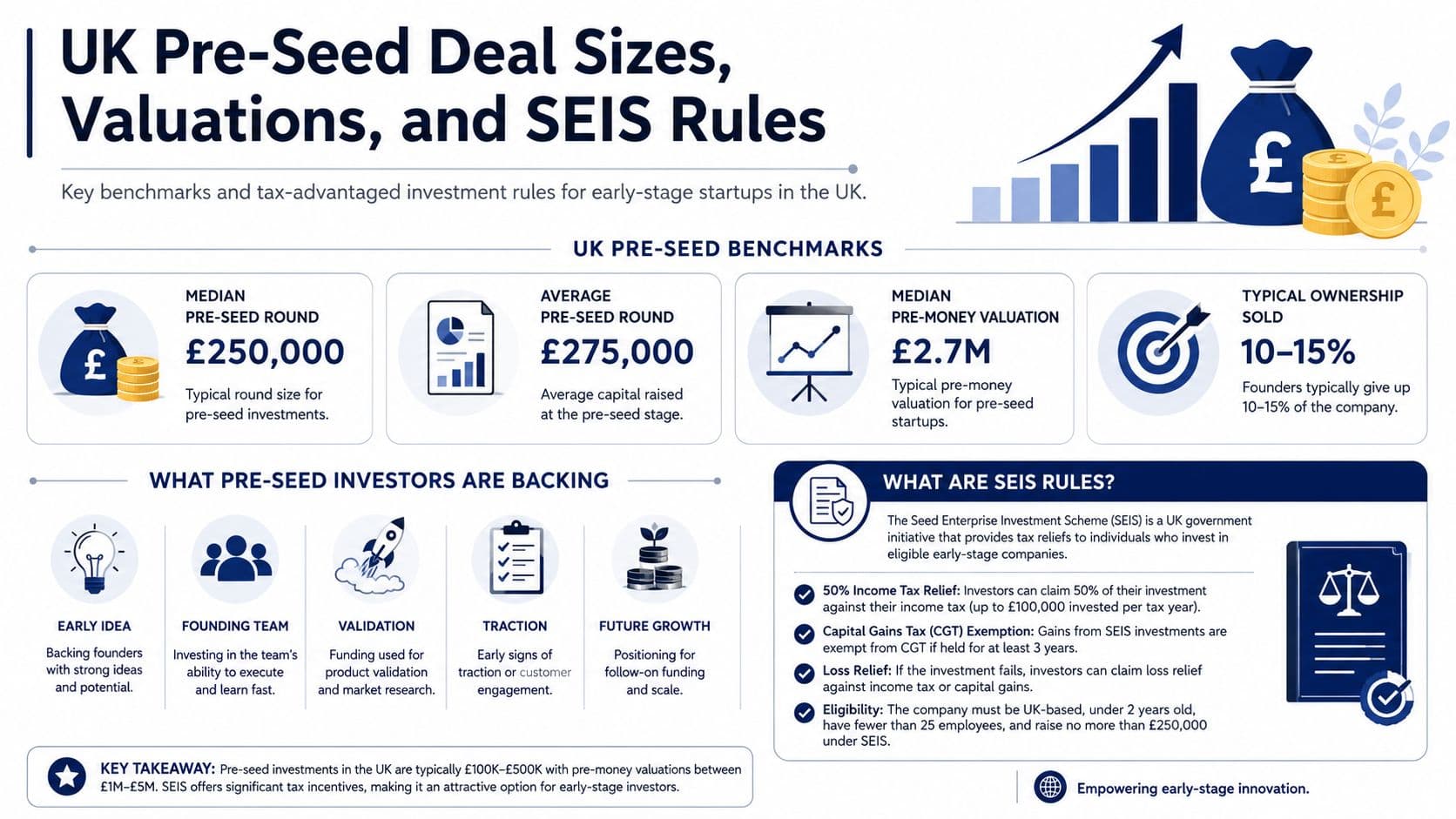
As of Q4 2025, the median UK pre-seed round settled at approximately £450,000, with a typical time-to-close of roughly 14 weeks, according to UK startup seed funding benchmarks. The same source distinguishes that figure from the broader seed median and frames pre-seed as capital for validation, MVP development, and forming an initial team.
What founders should make of the round size data
A median round around £450,000 is where the market has broadly settled for a typical deal, not a target every founder should aim for. Your raise should still map to the work required to reach the next financing milestone.
The trap is assuming the market median is the right ask for your company. Sometimes it is. Sometimes it's too much, which signals weak capital efficiency. Sometimes it's too little, which leaves you underfunded halfway through product development.
Another useful market signal is historical movement. SeedLegals data discussed in this UK founder commentary on pre-seed activity shows UK pre-seed valuations doubled between 2021 and 2022, average round size peaked at £500,000, and later declined to £400,000 while remaining above £375,000 in 2021. That tells you two things. First, early-stage pricing has been volatile. Second, investors still fund credible early propositions.
Valuations and the SEIS constraint
Current UK pre-seed valuations typically range between £750,000 and £1.4 million for standard rounds, with stronger propositions sometimes reaching £3 to 4 million, according to this guide for first-time UK founders. That same guidance also points founders towards giving away only 10 to 15% equity where possible.
SEIS is one of the biggest reasons UK pre-seed rounds look the way they do. The Seed Enterprise Investment Scheme limits total pre-seed lifetime raises to £250,000 per company, while giving investors 50% income tax relief on investments up to £200,000 per tax year, based on this overview of UK pre-seed and seed investors. Founders need to understand that these rules don't sit on the sidelines. They shape investor appetite, round construction, and how much room you keep for later.
If you're working through tax-efficient fundraising structure, it's also worth reviewing broader UK startup tax relief changes because investor incentives and company planning often intersect.
A clean pre-seed round is one that funds the next proof point without wrecking your cap table before seed.
The Three Main Types of Pre-Seed Investors
Not all pre-seed money behaves the same after it lands. That matters more than first-time founders expect. Some investors open doors, challenge assumptions, and help you hire. Others disappear after signing. A few become active in the least useful way possible.
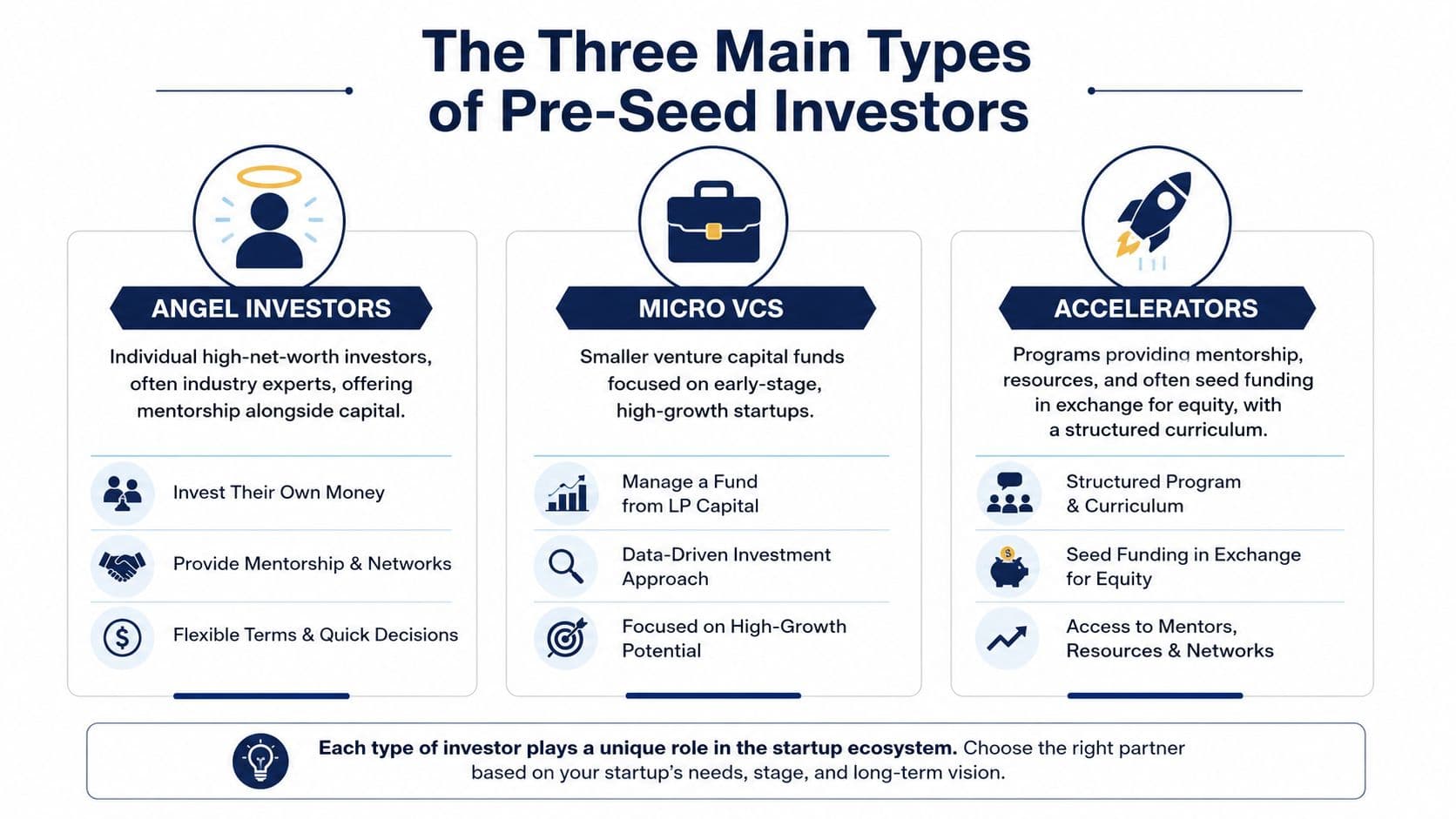
Angel investors
Angels are usually the most personal form of early capital. They often back founders before institutional investors are comfortable, especially when the market is emerging or the product still needs shaping. Good angels bring direct operating experience, fast judgement, and introductions that convert into meetings.
The downside is inconsistency. Some angels are sharp and available. Others invest on instinct, then vanish or create noise. Founder references matter here. Before taking money, ask how they behave after the round.
Micro VCs
Micro VCs are small funds built to invest early. They usually look more systematic than angels. Expect clearer process, stronger portfolio logic, and more structured follow-on thinking. If you want a pre-seed partner who can help frame the next round and signal quality to future investors, a good micro VC can be useful.
They can also be slower. Some need internal consensus. Some want enough evidence to feel institutional, which defeats the point of pre-seed. If you're already mid-build and need speed, ask direct questions about decision timelines and who approves the deal.
Accelerators
Accelerators bundle capital with a programme. That can help founders who need network access, fundraising discipline, and external pressure to sharpen the company story. The strongest programmes can improve your speed, confidence, and investor readiness.
But don't join one just because you want the badge. If the curriculum is generic, the mentor pool is weak, or the cohort isn't relevant, you may give up equity for very little practical value.
Some founders need money. Others need momentum, investor signalling, and a forcing function. Those are different problems.
A sensible way to build your target list is to separate these investor types by what they solve for you. If you need a hands-on sector expert, start with angels. If you need signalling and follow-on credibility, look at micro VCs. If you need a structured reset and network density, consider an accelerator.
For discovery work, a curated list of investors actively funding pre-seed can be a useful starting point, especially when you want current names rather than stale investor databases.
The Fundraising Process From First Pitch to Cash In Bank
Most founders underestimate how operational fundraising becomes once the first meetings start. Alongside storytelling, it involves pipeline management, document control, follow-up discipline, and legal coordination.
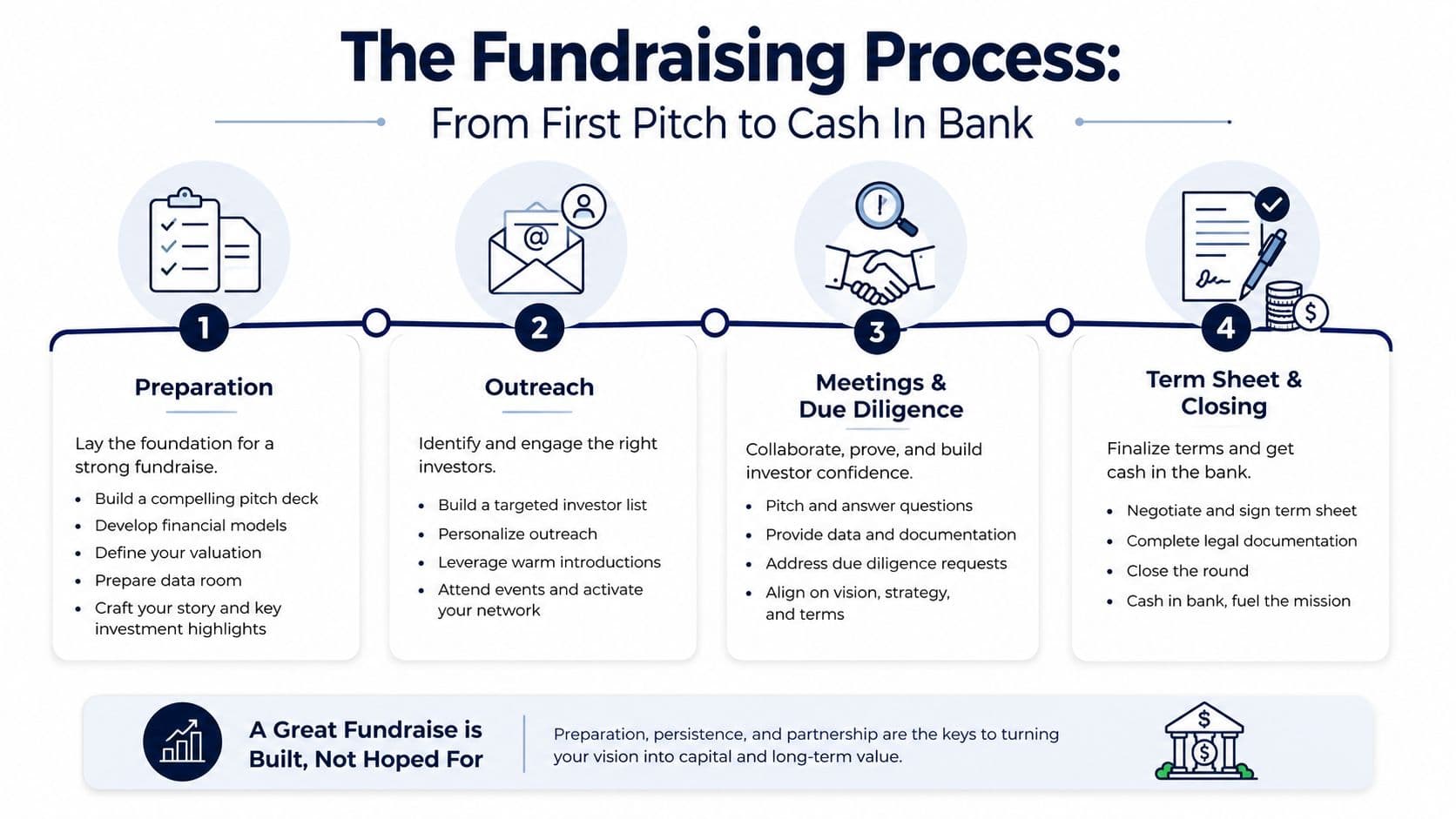
The UK pre-seed timeline is commonly 2 to 4 months from first pitch to funds arriving in the bank, and that's generally faster than a full seed round, according to this guide to securing seed funding in the UK.
Preparation and outreach
Start before you think you need to. Your deck should show the problem, why your approach is different, what you're building first, why now, and how the money changes the company. You also need a basic financial model and a use-of-funds plan that ties directly to product milestones.
Investor outreach works well when it's treated like sales. Build a list, qualify ruthlessly, prioritise warm introductions, and run meetings in batches. A scattered process creates false negatives because no investor feels urgency.
If you're still working out the commercial shape of the raise, this short guide to funding your project is a helpful practical reference.
Meetings, diligence, and closing
Early meetings test clarity. Later meetings test credibility. Investors will push on market understanding, founder fit, product scope, and whether you're asking for enough money to matter but not so much that the plan looks padded.
Due diligence at pre-seed is lighter than later rounds, but it still catches founders out. Expect requests around incorporation, cap table, technical plan, assumptions behind the financial model, and any material legal or IP issues. Closing then becomes a race between momentum and paperwork. Good founders keep both moving at once.
Common Pre-Seed Fundraising Mistakes to Avoid
The costliest pre-seed mistakes usually look reasonable in the moment. That's why founders repeat them.
Treating headline funding as usable runway
The voucher versus cash problem is one of the worst examples. Some UK rounds include non-cash components such as cloud credits or platform support. Those can be useful. They do not pay a product designer, a contract engineer, or the team building your first working release.
In some UK pre-seed deals, the immediate cash equity portion is typically only £70k to £150k for 7% to 12% equity, while the rest may include vouchers such as £250k in AWS or Stripe credits, as described in this founder account of raising in the UK. That's the number to sanity-check before you celebrate.
If you need to build product, ask one blunt question. “How much cash hits the bank, and when?”
Giving away too much equity too early
UK pre-seed dilution standardly sits between 10 and 20%, and the practical recommendation is to keep total dilution below 15% if possible. Once founders go above 20%, later fundraising becomes materially harder. That's the strategic reality noted earlier from UK market guidance.
Too many founders optimise for “getting the round done” rather than preserving future room. The better approach is to raise enough to hit a meaningful milestone while protecting your next two rounds from cumulative dilution pain.
Raising with a weak technical plan
Investors don't need a hundred-page product spec. They do need confidence that you know what version one is, why those features are first, and what the team can realistically ship inside the runway.
Weak plans usually show up as one of three things:
- Feature overload: the MVP is really a wish list
- No delivery ownership: nobody knows who is responsible for product decisions
- No milestone logic: the roadmap doesn't connect to user proof or the next raise
If your technical plan still feels fuzzy, get outside help before you start pitching. A focused product strategy session or build plan is often worth more than another month of speculative investor outreach. For direct support, you can contact a digital product team and pressure-test whether the scope matches the round.
Your Pre-Seed Readiness Checklist
Founders don't need more theory at this point. They need a short list they can act on.
/uploa
The pitch
- Deck finished: not half-built, not founder-brain chaos, not twenty slides of market excitement
- One-page summary ready: something you can send after a warm intro
- Narrative tested: you can explain the problem, solution, and first milestone without jargon
The numbers
- Use of funds mapped: every major spend category connects to a deliverable
- Runway assumptions checked: especially if any part of the round includes non-cash support
- Next milestone defined: investors should know what success looks like after this round
The product
- MVP scope fixed: what's in, what's out, and why
- Delivery route chosen: internal team, contractors, or product partner
- Technical unknowns identified: not hidden
A practical companion here is this guide to MVP software development, especially if you're translating a funding plan into an actual build sequence.
The legal and investor admin
- Company structure clean
- Cap table current
- SEIS planning underway
- Investor list qualified and prioritised
If any one of those areas is missing, fix it before the process starts. Pre-seed rounds don't usually fail because the idea is impossible. They fail because the founder presents a foggy execution path.
Frequently Asked Questions About Pre-Seed Funding
Can I raise a pre-seed round without a co-founder
Yes, you can, but solo founders need to compensate with clarity, speed, and visible execution strength. Investors worry about concentration risk, decision load, and whether one person can carry product, fundraising, and hiring at once. A solo founder with a strong technical plan, credible advisers, and a sharp MVP scope is usually in a stronger position than a mismatched co-founding pair held together by fundraising optics.
What if my startup isn't eligible for SEIS
You can still raise, but the investor conversation changes. In the UK, SEIS is a strong part of early-stage fundraising because it shapes risk and return for angels. If you're not eligible, expect more scrutiny on the fundamentals. Your product case, founder-market fit, and route to evidence need to be tighter. Some investors won't mind. Others will step back because the tax efficiency formed part of their original appetite.
How much progress do I need before approaching investors
You don't need a finished product, but you do need enough substance to make the risk legible. That usually means a clear problem definition, a grounded product thesis, and some proof that users recognise the pain. For technical products, a prototype, clickable flow, architecture decision, or narrow MVP plan can be enough. What investors dislike is ambiguity. They want to see what gets built first and why that version is investable.
Are vouchers and cloud credits ever worth taking
Yes, if they support a round that already contains enough real cash to fund core execution. Credits can reduce operating costs later, especially for infrastructure-heavy products. They become a problem when founders mentally count them as product budget. If your round relies on vouchers to cover delivery you cannot pay for, the structure is wrong. Treat credits as supplementary upside, not as the financial backbone of your first build.
Is bootstrapping a better option than raising pre-seed
Sometimes it is. If you can reach product evidence without external money, bootstrapping gives you more control and preserves equity. But it only works when the product can move forward at a pace the market will tolerate. If progress stalls because you can't build, test, or hire, bootstrapping becomes expensive in a different way. The right question isn't ideological. It's whether cash now creates momentum you can't generate alone.
About the Author
Hamish Kerry is the Marketing Manager at Arch, where he has spent the past six years shaping how digital products are positioned, launched, and understood. He has over eight years in the tech industry and a deep understanding of accessible design and user-centred development, with a focus on delivering real impact to end users. His interests include AI, app and web development, and the potential of emerging technologies. Outside campaigns, he keeps a close eye on how tech can drive meaningful change.
If you're turning a pre-seed round into a real product plan, Arch helps teams shape, design, and build apps, websites, software, and AI products that are ready for launch rather than stuck in pitch-deck form.