



Business Continuity Strategies: A CTO Playbook for 2026.
Learn practical business continuity strategies for digital products, hosting, and mobile/web apps. Secure your platform with actionable frameworks today.
Business Continuity Strategies: A CTO Playbook for 2026.
Share Via:
A payment provider has failed, your authentication service is timing out, and customer support is receiving messages faster than engineering can triage them. The application is still online, but users can't complete the action that pays your bills. Someone asks for the continuity plan, and the document describes priorities without naming the dependency that has failed.
That situation exposes the weakness in many continuity programmes. A plan can exist, pass a policy review and still leave a technical team guessing under pressure. Effective business continuity strategies connect critical business activities to named owners, practical alternatives and recovery targets that engineers have tested in conditions resembling a real incident.
Key Takeaways for Digital Leaders
A digital product outage rarely stays inside the technology team. A failed identity provider can block customers, staff and support agents at the same time. A compromised deployment account can turn a security incident into a data recovery problem. The useful question isn't whether your organisation has a continuity document. It's whether people can keep the most important service operating, or restore it predictably, when normal assumptions fail.
- Business continuity is an operational control: It links business priorities to decisions about people, suppliers, premises, data and technology. The UK government describes BCM as a process for managing risks to the smooth running of an organisation, maintaining critical functions during disruption and recovering afterwards. UK government BCM guidance provides the formal foundation.
- Adoption is high but uneven: UK organisations reporting a continuity plan rose from 49% in 2006 to 85% by 2025, while adoption stood at 97% among large organisations and 58% among smaller organisations. The UK government survey data shows why scale-ups and SMEs need a practical, not cosmetic, programme.
- Recovery needs measurable targets: RTO defines how quickly a service must return. RPO defines how much data loss the business can tolerate. Together, they constrain architecture, backup and failover choices.
- Cyber and continuity are one operating problem: Ransomware, stolen credentials and destructive automation can interrupt services just as severely as infrastructure failure. Treating security response and recovery as separate workstreams creates gaps.
- Testing keeps plans alive: Ownership, review dates and realistic exercises matter as much as the document itself. A recovery path that hasn't been exercised is an assumption, not evidence.
Understanding Business Continuity and Core Frameworks
Business continuity management defines how an organisation keeps priority work running during disruption and restores normal delivery afterwards. For a digital product, that means agreeing the minimum service customers can use, assigning decision rights, identifying dependencies and choosing workable alternatives before an incident begins.
Three disciplines must remain distinct.
Business continuity planning sets the management approach across people, processes, facilities, suppliers, communications, technology and customer commitments. Disaster recovery is the technical work of restoring systems, infrastructure and data. Crisis management covers leadership decisions, stakeholder communication, reputation, legal exposure and the wider effects of the event.
The boundaries matter during a live incident. Engineers can restore a database without deciding whether support should accept requests manually or whether delayed transactions need customer notification. Executives can approve a public statement without knowing whether the identity service has a tested recovery route. Cyber incidents make the overlap sharper, because containment actions such as disabling accounts or isolating networks can conflict with the fastest route to service restoration.
Practical rule: A continuity plan should tell the business what to protect and why. A recovery plan should tell engineers how to restore it. Crisis management should give leaders the authority and information to act.
A framework earns its place by converting broad intentions into operating decisions. It should assign an owner, define acceptable service degradation, record dependencies, set escalation rules and identify evidence that the recovery route works. Certification can support consistency, but it cannot choose between active-active hosting, a slower restore, manual workarounds or a temporary reduction in functionality. Those choices depend on customer promises, sector obligations, architecture and budget.
The historical gap between larger and smaller organisations is documented in The historical UK BCM survey. The practical lesson is clear: a smaller team may need fewer documents, but it still needs named owners, tested procedures and suppliers that will respond under pressure. A plan that exists only in a compliance folder will not compensate for limited staff or weak vendor influence.
Frameworks should clarify decisions
The UK government notes that BS 25999 provides BCM guidance, principles and terminology, and can support confidence in business-to-business and business-to-customer dealings. Teams can also compare operational approaches through Houston business continuity planning, particularly when reviewing hosting, supplier and communications dependencies.
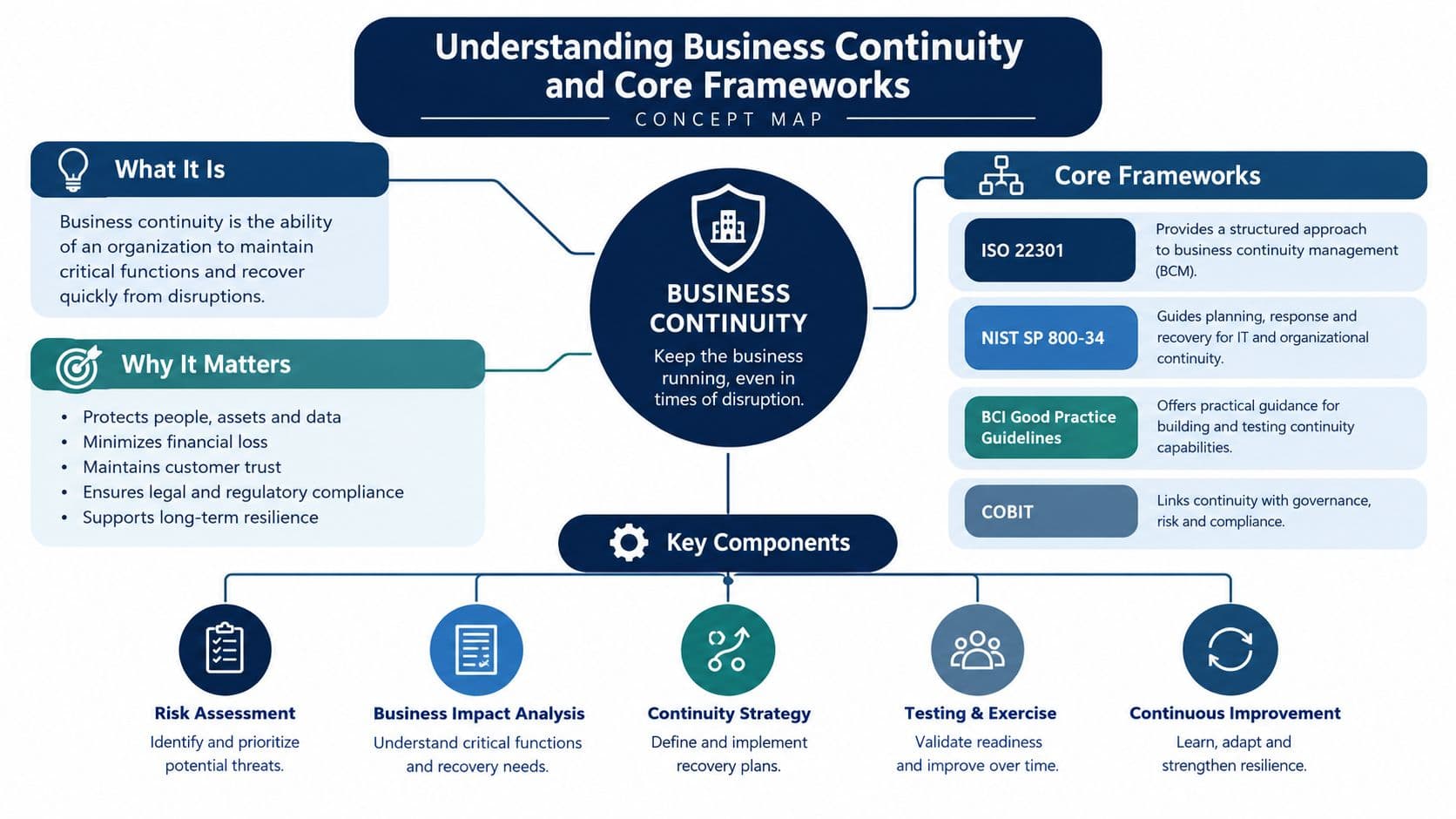
The right framework produces decisions people can execute, measurable recovery targets and test evidence. It should connect cyber response with operational recovery rather than treating them as separate programmes.
Risk Assessment and Identifying Critical Activities
A risk register that lists “cyberattack”, “flood” and “supplier outage” isn't enough for a CTO. It names threats, but it doesn't reveal what fails first, what customers notice or which service deserves recovery capacity before another.
Start with a Business Impact Analysis. For every significant activity, ask four questions:
- What stops first? Identify the customer journey, internal process or regulatory obligation that becomes unavailable.
- What depends on it? Map people, premises, utilities, suppliers, data, identity, hosting, payments and communications.
- What is the business consequence? Record operational, contractual, financial, regulatory and reputational effects in language leadership understands.
- What can operate differently? Define manual processing, reduced functionality, alternate suppliers or a queued service rather than assuming full restoration is the only option.
The UK government reported that nearly 1 in 5 businesses suffered a major disruption each year in the period covered by its guidance, while only 37% of managers with continuity plans rehearsed them at least once a year. The UK publication on business continuity in an uncertain world shows why risk assessment must lead to rehearsal, not just documentation.
Map the chain, not just the application
A mobile app may depend on an API gateway, an identity provider, a payment processor, notification services, a database, customer support tools and a release pipeline. A web platform can remain reachable while a single external API prevents users from completing its core task. An AI feature may depend on a model provider, prompt configuration, retrieval store, moderation service and usage controls.
Rank activities by the harm caused by interruption, then trace every dependency required to deliver them. Include the people who can approve a failover and the suppliers who can restore access. A dependency that has no owner is a recovery risk even if the service itself has excellent uptime.
Turn findings into priorities
Don't give every system the same protection. A low-priority reporting dashboard may tolerate a manual workaround, while order intake needs a resilient queue and a clear reconciliation process. Your assessment should produce a short list of critical activities, their dependencies and the recovery decisions that require funding.
The historical evidence also shows why risk categories must stay broad. UK managers reported disruption from IT loss, loss of people and extreme weather, while severe winter weather affected 93% of organisations in the survey covering December 2009 and January 2010. The same series recorded brand damage rising from 11% to 22%. Those findings support a multi-risk approach, not an IT-only plan.
Mobile apps need graceful degradation
A mobile app can continue to open while its backend is unavailable, but that doesn't mean the product is usable. Design the failure state deliberately. Cache safe, non-sensitive content where appropriate, queue actions that can be replayed, show clear status messages and prevent duplicate submissions when a user retries.
The app should distinguish between a temporary dependency failure and an action that must not be repeated. A payment or identity operation needs stronger safeguards than a content refresh. Push notifications, analytics and non-essential recommendations should have an explicit degraded mode so they don't block the primary journey.
The delivery team also needs a recovery path for app configuration, signing credentials, release tooling and backend compatibility. Restoring servers without being able to publish a safe client update leaves a product exposed to a failure that sits between engineering and distribution. Teams planning a new product can review Arch's mobile app development service as one example of a delivery partner that can contribute to product and engineering decisions.
Web platforms need dependency and traffic choices
For a web service, redundancy at the hosting layer is only useful if the application, database, identity path and operational access can recover together. Load balancing may distribute traffic, but it won't solve a corrupted data store or an unavailable payment provider.
Choose the degraded behaviour before choosing infrastructure. You might serve read-only content, pause writes into a durable queue, switch to a manual order process or redirect users to a status page. Each choice has different implications for consistency, customer communication and reconciliation.
Hosting teams should document how DNS, secrets, access policies, deployment artefacts, database replicas and observability return in the correct order. Hosting and support guidance is relevant here because ongoing maintenance is part of continuity, not an activity that begins after an outage.
AI services need bounded alternatives
AI features introduce failure modes that ordinary application runbooks often miss. A provider can be unavailable, a model can produce unsafe output, a usage limit can be reached or a retrieval index can become stale. The continuity strategy should define when to fall back to a smaller model, a rules-based workflow, human review or a temporary feature shutdown.
Don't promise identical behaviour during degradation if the business only needs a safe outcome. Preserve user control, record decisions that need later review and keep prompts, policies and evaluation fixtures recoverable. For infrastructure, use failover automation and warm standby only where the service objective justifies the operational burden.
The strongest approach maps each critical workflow to an explicit recovery objective and an alternative delivery path. That keeps architecture subordinate to business need rather than allowing available infrastructure to dictate the plan.
Setting Measurable Recovery Objectives RTO and RPO
A continuity strategy without measurable objectives is a preference. Recovery Time Objective defines the target time for restoring a service or activity. Recovery Point Objective defines the maximum acceptable period of data loss, expressed as the point in time to which data must be recovered.
These measures belong to business activities first, then flow down into technology. If order processing has a demanding RTO, the database, identity provider, payment integration, network path and operational access all inherit constraints. If one dependency takes longer than the stated objective, the objective isn't real yet.
A recent UK resilience survey found that 72% of organisations experienced significant IT disruption in the previous 12 months, while only 56% had fully defined and regularly tested RTOs. It also found 60% found returning to standard operations difficult after a major resilience issue, and 58% reported financial losses. The UK IT resilience survey demonstrates the cost of leaving recovery targets vague.
Define targets by service tier
Don't assign one RTO and RPO to the entire estate. Group services by business importance and write the target in operational language.
A customer portal might need to return with read-only access before full transaction processing. A background export may wait longer. A data store holding financial records may require a tighter RPO than an analytics cache. The right answer depends on the activity's consequences, not on what the infrastructure team can configure easily.
Then test the target against the actual recovery method:
- Backup and restore can suit services that tolerate a longer interruption, provided restore time is measured.
- Warm standby reduces recovery work but adds cost, monitoring and configuration drift risk.
- Automated failover can reduce manual delay, but it can also amplify a bad decision if health checks, data consistency or access controls are wrong.
- Manual workarounds may be affordable for short periods, but only when staff, instructions and reconciliation steps are available.
Include the dependency chain
Write down every dependency needed to meet the objective, including hosting, identity, payments, secrets, deployment artefacts and communication channels. A technically fast database restore doesn't meet the RTO if the restored service can't authenticate users or reach its payment provider.
Recovery testing should measure elapsed time, data loss, missing resources, manual intervention and the point at which customers can complete the critical journey. Record failures as remediation work with a named owner. Don't adjust the target to match the result.
For a deeper technical distinction between resilience planning and system restoration, see Arch's disaster recovery guidance. The important governance decision is to make each objective visible to both the business owner and the engineer responsible for delivering it.
Governance, Testing, and the Cyber Resilience Gap
Plans decay when nobody owns the review. Services change, suppliers alter their authentication requirements, engineers replace infrastructure and teams lose the people who understood an undocumented workaround. A continuity programme needs a named owner, a deputy, review dates and a route for escalating unfunded gaps.
Cyber resilience belongs inside that programme. Government-linked reporting for 2025/2026 states that 43% of UK businesses experienced a cyber breach or attack in the past year, while only 44% of small businesses had a continuity plan addressing cyber security, down from 53% the previous year. Just 25% of UK businesses had a formal incident response plan. The UK SME continuity reporting points to a recovery-playbook gap, not merely a lack of general advice.
Make cyber scenarios operational
A ransomware runbook should cover more than detection and containment. It needs decisions about isolating systems, preserving evidence, validating recovery copies, restoring identity, prioritising services, communicating with customers and reconciling data created during the incident.
Test destructive scenarios safely. Use an isolated recovery environment, controlled credentials and a clear stop condition. Include the people who approve business trade-offs, because technical recovery can conflict with legal, customer or regulatory decisions.
Test the assumptions people rely on
A useful exercise produces findings that can be assigned and closed. Combine a tabletop discussion with technical restoration, supplier contact checks and a review of offline recovery information. Vary the scenario so teams don't memorise a script.
Infrastructure as code can improve repeatability, but it isn't a complete continuity control. State, credentials, provider access and protected data still need independent recovery paths. Teams reviewing this area may find infrastructure as code guidance useful when deciding which environment configuration should be versioned, tested and recoverable.
The strongest governance model treats each exercise as evidence. Leadership should see which objectives were met, which dependencies failed, what remains exposed and what funding or ownership is required. That turns continuity from a document review into a living operational control.
Frequently Asked Questions
What is the difference between a continuity plan and a disaster recovery plan?
A business continuity plan covers the organisation's ability to maintain critical work, including people, processes, suppliers, facilities, communications and technology. A disaster recovery plan focuses on restoring IT systems, infrastructure and data. Disaster recovery sits inside continuity planning. Restoring a database won't decide how customer support handles requests, who communicates with users or whether a manual process should continue while the application remains unavailable.
How can an SME begin with limited resources?
Start with the few activities whose interruption would harm customers, cash flow, legal obligations or safety. Name one accountable owner, interview the people who perform the work, map the essential dependencies and document a realistic workaround. Protect the most important data, test one recovery path and record the gaps. A focused programme that produces evidence is more useful than an ambitious document nobody maintains.
What are the main UK legal obligations?
Requirements depend on sector and role. Under the Civil Contingencies Act 2004, Category 1 responders must maintain arrangements to continue their functions during an emergency as far as reasonably practicable, including exercises, training and review. The business continuity handbook explains those duties. NHS organisations also have continuity obligations under the Civil Contingencies Act 2004 and Health and Care Act 2022, described in the NHS England BCM toolkit.
How long does it take to build a mature BCM programme?
There isn't a reliable universal timeline. Maturity depends on scope, supplier complexity, technical debt, leadership attention and the quality of existing recovery controls. A sensible starting cycle identifies critical activities, sets initial objectives, assigns ownership and runs an exercise. Further cycles should close findings, test more dependencies and update plans as the product changes. Maturity is demonstrated by repeatable evidence, not by the age of the document.
About the Author
Hamish Kerry is the Marketing Manager at Arch, where he's spent the past six years shaping how digital products are positioned, launched, and understood. With over eight years in the tech industry, Hamish brings a deep understanding of accessible design and user-centred development, always with a focus on delivering real impact to end users. His interests span AI, app and web development, and the potential of emerging technologies. When he's not strategising the next big campaign, he's keeping a close eye on how tech can drive meaningful change.
Hamish's LinkedIn: https://www.linkedin.com/in/hamish-kerry/
Arch helps teams design, build, host and support digital products with continuity in mind, from dependency decisions and resilient architecture to ongoing maintenance and recovery planning. Visit Arch to discuss a product or platform that needs to keep working when conditions change.