



The Key Benefits of Bespoke Software for Business Growth.
Explore the key benefits of bespoke software. See how tailored solutions boost efficiency, scalability, and give you a competitive advantage.
Bespoke Software for Business Growth.
Key Takeaways
- Tailored Efficiency: Bespoke software is built around your specific workflows, eliminating manual workarounds and boosting productivity.
- Scalability: Custom solutions are designed to grow with your business, handling more users, data, and features without performance issues.
- Enhanced Security: Unique, custom-built systems are less vulnerable to common cyberattacks compared to widely used off-the-shelf products.
- Superior ROI: While the initial investment is higher, bespoke software eliminates recurring license fees and delivers long-term value through operational savings and increased efficiency.
- Integration: Custom software can be engineered to connect with your existing tools, breaking down data silos and creating a unified tech ecosystem.
When you're weighing up your software options, the big draws for a bespoke solution come down to how closely it fits your workflows, its ability to scale as you grow, and the long-term return it delivers. Off-the-shelf products can get you started, but a custom solution is about optimising your operations from the ground up, giving you better security, integrations, and a competitive edge.

If you're a busy decision-maker, you just need the highlights. Here’s a quick summary of the core advantages you get when you invest in software built specifically for your organisation.
- Unmatched Efficiency and Productivity: Custom software is moulded around your exact business processes. It automates your specific way of working and gets rid of all the awkward manual workarounds you’re forced to use with generic tools.
- Scalability: As your business takes off, bespoke software grows alongside you. It can be adapted and updated to handle more data, more users, and new features without hitting a performance ceiling.
- Enhanced Security: A custom-built system is a much smaller target for cyberattacks compared to widely used off-the-shelf products, which often have well-known vulnerabilities. With bespoke, security protocols are baked in from day one.
- Long-Term ROI: The initial investment might be higher, but you completely eliminate those recurring per-user licence fees that stack up over time. The real payoff comes from the significant gains in efficiency and productivity, delivering a powerful long-term return.
When you're ready to explore this route, a dedicated bespoke software development service can help turn your vision into a real asset. And if you want to dig deeper, you can find these custom software development services explained in more detail.
Why Off-The-Shelf Software Is Holding You Back
Ever tried to win a Grand Prix in a standard family saloon? It’ll get you around the track, sure, but it wasn't built for that kind of performance. That’s often the reality for businesses running on off-the-shelf software. These ready-made tools seem like a quick, easy fix, but they end up forcing your organisation into a box it wasn't meant to fit.
Think of it like buying a suit. A jacket off the rack might look fine from a distance, but it rarely fits well. The sleeves are a little too long, the shoulders a bit too tight. You end up adapting to its limitations. Bespoke software, on the other hand, is the tailored suit, made to your business’s exact measurements, processes, and ambitions. It works the way you work, not the other way around.
The Problem with One-Size-Fits-All
One of the biggest frustrations with generic software is paying for a mountain of features you rarely touch. Most off-the-shelf platforms are bloated with tools designed to appeal to the widest possible audience. This means a good chunk of your subscription fee is funding functionality that adds clutter and complexity without delivering real value to your team.
You’re left with a system that’s a jack-of-all-trades but a master of none. It does a lot of things adequately but excels at nothing your business truly needs to get right.
This inevitably forces your team to invent clunky, inefficient workarounds just to get their jobs done. They might have to dump data into a spreadsheet for proper analysis or fire up a separate tool for a critical function the main platform can't handle. These little friction points create frustrating bottlenecks and open the door to human error, slowly draining productivity day by day.
Hitting the Scalability Ceiling
Perhaps the most dangerous limitation is the scalability ceiling. Off-the-shelf software is engineered for a certain scale of operation. As your business grows (onboarding more users, processing more data, expanding your services), you are likely to hit a wall eventually. The software gets sluggish, unstable, or simply can’t support your new reality.
When that happens, you’re faced with a handful of bad options:
- Migrate to a new system: A notoriously costly, disruptive, and time-sucking process.
- Fork out for an expensive enterprise plan: This often comes with a huge price jump for features you still might not need.
- Just put up with it: A choice that directly hurts your team’s efficiency and your customers' experience.
This is where the real benefits of bespoke software become clear. A custom solution is a strategic investment in a foundation built to grow with you. Opting for one means you're building a business asset that supports your future, not a temporary fix that could one day hold you back.
Gaining an Edge with Custom-Engineered Functionality

One of the most powerful arguments for bespoke software is its ability to mirror and automate your organisation’s way of working. Off-the-shelf products force you to bend your processes to fit their rigid structure. Custom software, on the other hand, is built to become a digital extension of your team.
It’s the difference between using a generic multi-tool and crafting a specialised instrument for one very specific job.
This targeted approach gets rid of the tedious, manual workarounds that drain your team's time and energy. Instead of wrestling with spreadsheets or juggling a dozen disconnected apps, your staff can rely on a single, cohesive system that handles all the repetitive heavy lifting.
This shift frees your people from low-value tasks and lets them focus on what drives growth, such as innovation, customer engagement, and long-term strategy.
From Manual Workarounds to Automated Workflows
Every business has its own distinct workflows, quirks, and operational DNA. Bespoke software is designed to capture this uniqueness and embed it right into its core architecture. The goal is to create a tool so intuitive that it feels like a natural part of your daily operations, not another hurdle to overcome.
This process starts by mapping out how you work now, identifying the real bottlenecks, and pinpointing where automation can make the biggest difference. For instance, a custom system could:
- Automate complex client onboarding sequences so no steps are ever missed.
- Integrate directly with supplier APIs to keep inventory management smooth.
- Generate detailed, custom reports automatically, saving hours of manual data crunching.
- Create a central dashboard giving leaders a real-time, bird's-eye view of critical business metrics.
By engineering software around your actual needs, you build a system that actively accelerates your business instead of slowing it down. This digital efficiency translates directly into real-world outcomes, like faster service delivery, fewer human errors, and a much smoother internal operation.
The Financial Impact of Precise Functionality
These productivity gains have a measurable impact on the bottom line. Research shows that for UK SMEs, adopting bespoke tools is a driver of growth. Ambitious adopters have seen revenue jump by 14.8%, and it's estimated that even a marginal 1% efficiency gain across the board could boost GDP by £94 billion over five years.
This shows the economic weight of custom automation. You can discover more about how digital adoption is impacting UK businesses in this report from the UK government.
For scale-ups, this often translates to operational cost reductions of between 20-40% through workflow automation in custom-built web and mobile applications.
Real-world examples tell the story. A mid-sized electronics firm managed to cut equipment failures by 38% by implementing a custom predictive maintenance system tied directly to its inventory. It was designed specifically for their machinery and their processes, which no off-the-shelf product could offer.
When you invest in software that does exactly what you need and nothing you don’t, you create a leaner, more effective operation. This precision is a source of strong competitive advantage, letting you deliver more value to your customers, more efficiently than your rivals.
Future-Proofing Your Business with Scalable Solutions
When your business starts to grow, your software should be the engine, not the handbrake. Off-the-shelf products often have rigid, pre-defined limits. Once you hit those ceilings, whether it’s user numbers, data volume, or feature sets, you’re stuck. This is where bespoke software helps: it’s built to scale right alongside you.
Think of it like building a house. A ready-made home has a fixed layout and a set number of rooms. If your family grows, you eventually have to move. A custom-built home, however, is designed with the future in mind, its foundations ready to support new extensions whenever you need them. Bespoke software is built on the exact same principle.
This built-in adaptability is what sets you up for long-term success. It means you’re investing in an asset that supports your future ambitions, not just a tool that solves today’s problems.
Evolving with Your Business Needs
A major advantage of bespoke solutions is their ability to evolve. Your business isn't static, so why should your software be? Custom development lets you add new features, plug into third-party services, and adopt new technologies as your strategy shifts.
This level of agility is something generic software can rarely deliver. With a custom solution, the development roadmap is entirely yours. This proves its worth in a few key areas:
- Adding New Functionality: As you launch new products or services, you can build dedicated modules directly into your existing software, keeping everything in one cohesive system.
- Integrating with New Tools: Your business might adopt a new marketing platform or a different accounting system. A bespoke solution can be updated to connect with these new tools via APIs, so your data keeps flowing smoothly.
- Responding to Market Changes: If customer expectations or industry regulations shift, you can modify your software to meet those new demands quickly, keeping you a step ahead of the competition.
Investing in a scalable solution is about creating a digital foundation that supports growth. It helps keep your technology a competitive advantage instead of a legacy system holding you back.
This forward-thinking approach is a major driver behind the boom in the custom software market. The growth is a direct reflection of businesses prioritising long-term, adaptable solutions.
The Growing Demand for Scalable Software
The demand for custom-built, scalable systems is picking up serious pace. In the UK, the custom software development market was valued at USD 2,578.69 million and is projected to skyrocket to USD 27,215.14 million by 2035, growing at a blistering CAGR of 23.8%. This surge shows just how critical bespoke software has become for fuelling business scalability and staying competitive. You can dig into the numbers in this UK custom software development market report.
Unlike off-the-shelf products that lock you into their ecosystem, a custom solution is designed to play well with others from day one. This makes it far simpler to connect with other essential business systems, from your CRM to your inventory management platform. That flow of information gets rid of data silos and creates a single source of truth across your organisation, which is vital for making smart decisions as you scale. You can also explore how modular products are the key to scalability and flexibility in our related guide.
Choosing bespoke software is a strategic decision to build for tomorrow. It gives you the flexibility to adapt, innovate, and grow without being held back by the limitations of a one-size-fits-all product. This future-proofing is one of the main long-term returns you can get from a custom approach.
Understanding the True Return on Investment
When we talk about the cost of software, the conversation often gets stuck on the initial price tag. But to really get a grip on the financials, we need to shift our focus from upfront cost to long-term value. One of the biggest benefits of bespoke software is how it reshapes the economics of your tech stack, delivering a powerful return on investment (ROI) that goes far beyond the initial build.
Off-the-shelf software often looks tempting with its low initial subscription fee, but that’s just the tip of the iceberg. The real cost is hidden in the escalating, recurring per-user licences. As your team grows, so does your monthly bill, creating a perpetual expense that doesn't build any equity for your business.
Beyond the Upfront Cost
Bespoke software flips this model completely. Yes, the initial investment is higher, but it’s a predictable, one-time capital expenditure. You're building a tangible business asset that you own outright. There are no surprise price hikes, no extra charges for adding new team members, and no monthly fees that bleed your budget dry.
This ownership model means you can calculate the Total Cost of Ownership (TCO) with much greater accuracy. Instead of an unpredictable operational expense, you have a fixed investment with a clear path to profitability. The financial returns start stacking up in a few key ways:
- Elimination of Recurring Fees: You stop 'renting' your software and start owning it. This cuts a significant and constantly growing line item from your operational budget.
- Increased Team Productivity: By automating your unique workflows, you slash the time your team spends on manual, repetitive tasks, freeing them up for high-value work.
- Reduced Operational Inefficiencies: A system tailored to your exact processes minimises errors, cuts down on waste, and makes operations smoother, leading to direct cost savings.
This chart shows just how fast the UK's custom software market is set to grow, a clear signal that businesses are shifting towards these kinds of long-term, scalable investments.
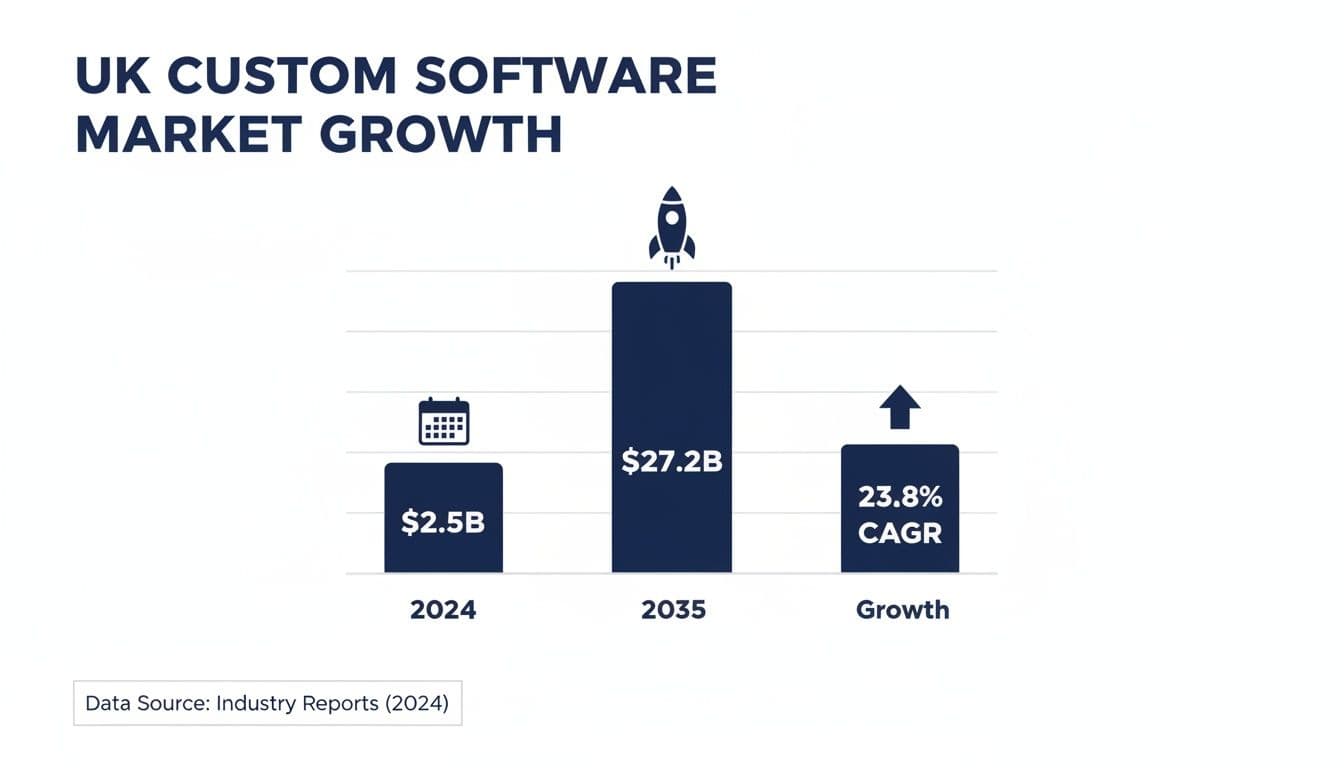
The numbers don't lie. More and more businesses are recognising bespoke solutions not as a cost, but as a strategic asset that’s essential for future growth.
Making Bespoke More Accessible
In the past, the high barrier to entry made custom solutions feel out of reach for many. Modern development practices have changed the financial landscape, making bespoke software more accessible and cost-effective than before.
The rise of cloud infrastructure and low-code platforms has democratised custom software development, providing a clear financial framework for decision-makers at every scale.
Cloud-based bespoke software is now set to dominate the UK market, poised to claim a 65% share. With SaaS volumes hitting £15.30 billion, custom solutions built on cloud platforms can slash infrastructure expenses by up to 60%.
On top of that, low-code platforms, now adopted by 60% of UK businesses, can accelerate development 5-10x while still delivering a custom fit. This even allows non-technical teams to iterate on solutions without budgets spiralling out of control. You can dig deeper into these trends with these UK software development statistics.
By using these technologies, businesses can develop and deploy powerful custom solutions faster and more affordably. This means you can start seeing the ROI from increased efficiency and productivity much sooner, making the business case for a custom build stronger. The value lies in the sustainable competitive advantage the software creates, as well as in the software itself.
Strengthening Security And Ensuring Compliance
In a world where a single data breach can ruin a company's reputation overnight, security can't be just another feature. It has to be part of the foundation. This is where bespoke software gives you a serious advantage over off-the-shelf alternatives.
Think about it: generic software products are used by thousands of companies, making them a large target for hackers. Once a vulnerability is found, it’s a skeleton key that can unlock countless systems. Custom-built software, on the other hand, is a one-off. Its unique codebase makes it a smaller, less appealing, and harder target.
This uniqueness is a powerful first line of defence. Hackers can’t just run pre-existing scripts or common exploits against your system, because it simply doesn't fit any standard mould.
Built-In, Not Bolted-On
Perhaps the most important security benefit of bespoke software is that protection and compliance are built in from day one. You're not trying to patch security holes in a generic system; your development team is building defences designed specifically for your data and your operational risks.
Security isn't an afterthought. It's a core part of the architecture. This ground-up approach allows for:
- Role-Based Access Control: You can precisely define who sees and does what, making sure employees only have access to the information they absolutely need for their job.
- Hardened Code: Your developers can implement coding practices to defend against common attack vectors like SQL injection or cross-site scripting from the outset.
- Custom Encryption: You can apply strong encryption standards to protect sensitive customer and company data, whether it’s sitting on a server or moving across the web.
With a bespoke build, you have total control. You decide on the architecture, the hosting environment, and the specific security protocols you need. There are no hidden backdoors or vulnerabilities inherited from a third-party vendor. For a deeper dive into your infrastructure choices, our guide comparing cloud vs on-premise solutions is a great place to start.
Navigating Compliance With Precision
Meeting industry-specific regulations like GDPR, HIPAA, or financial services standards can be a minefield with off-the-shelf software. You often end up trying to bend a generic tool to fit highly specific rules, which is both risky and inefficient.
Bespoke software, however, is engineered from the ground up to meet the exact compliance requirements of your industry. If your business has to follow stringent data handling protocols, those rules are built directly into the software's logic. Compliance becomes an automated, enforced part of your daily operations, not just a policy document gathering dust.
Your software can also be engineered to meet demanding security standards like ISO 27001, giving you a clear competitive edge and showing a commitment to data protection. Understanding the benefits of an ISO 27001 certification for your business can highlight the value here. This proactive approach reduces risk, builds lasting trust with your customers and gives you peace of mind.
Frequently Asked Questions About Bespoke Software
What are the main benefits of bespoke software?
The key benefits are tailored functionality that matches your exact workflows, enhanced security due to its unique codebase, and superior scalability that allows the software to grow with your business. It also offers a better long-term return on investment by eliminating recurring licence fees and boosting operational efficiency. This combination provides a significant competitive advantage over businesses using generic off-the-shelf solutions, which often require cumbersome workarounds and have rigid limitations on growth and customisation.
Is bespoke software more expensive than off-the-shelf options?
The initial investment for bespoke software is typically higher, but it often proves more cost-effective in the long run. You avoid perpetual subscription fees that increase as your team grows and you aren't paying for bloated features you'll never use. By perfectly matching your workflows, custom software boosts productivity and reduces operational inefficiencies, delivering a powerful return on investment. It’s an asset you own outright, rather than a recurring cost you rent.
How long does it take to develop a custom software solution?
The timeline depends entirely on the project's complexity. A Minimum Viable Product (MVP) with core features can often be delivered in three to six months, allowing for rapid deployment and user feedback. More comprehensive systems with advanced integrations and multiple modules will naturally take longer. A good development partner will begin with a thorough discovery phase to create a clear, realistic roadmap with defined milestones, ensuring transparency throughout the entire process.
Can bespoke software integrate with my current systems?
Absolutely. This is one of the primary advantages of custom development. While off-the-shelf products can have restrictive integration capabilities, bespoke software is designed to communicate seamlessly with your other essential business tools. Whether it's connecting to your CRM, an enterprise resource planning (ERP) system, or third-party APIs, a custom solution can be built to ensure a smooth and unified data flow across your entire organisation, effectively breaking down information silos.
What kind of support is available after the software is launched?
Reliable development partners provide ongoing support and maintenance as part of a long-term partnership. This typically includes managing hosting environments, applying critical security patches, resolving any bugs that emerge, and offering technical assistance. This ensures your software remains secure, stable, and high-performing as your business evolves. A good support agreement protects your investment and guarantees the software continues to deliver value for years to come, adapting to new challenges and opportunities.
About the Author
Hamish Kerry is the Marketing Manager at Arch, where he’s spent the past six years shaping how digital products are positioned, launched, and understood. With over eight years in the tech industry, Hamish brings a deep understanding of accessible design and user-centred development, with a focus on delivering real impact to end users. His interests span AI, app and web development, and the potential of emerging technologies. When he’s not strategising the next big campaign, he’s keeping a close eye on how tech can drive meaningful change.
Hamish’s LinkedIn: https://www.linkedin.com/in/hamish-kerry/
Want a solution built just for your business? The team at Arch specialises in creating high-performance, scalable software that delivers real results. Let's talk about your project.
Much bespoke software is now delivered in the browser, and Arch plans, designs and builds bespoke web applications for UK organisations.