

Application Development Models Explained for Modern Teams.
Compare the main application development models, from Waterfall to DevOps, with practical guidance on choosing the right approach for your team.
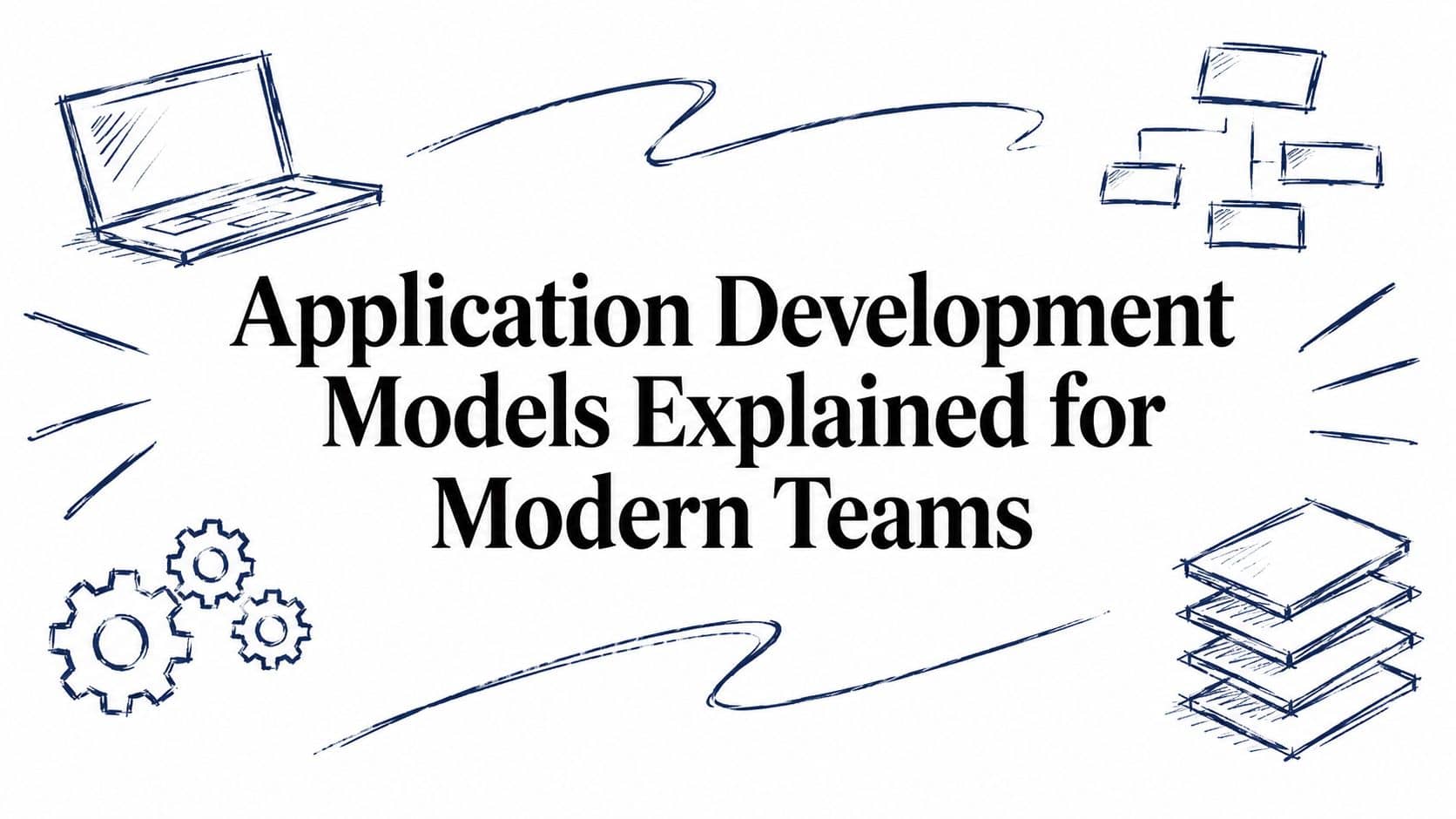
Application Development Models Explained for Modern Teams.
You're halfway through building a new application when the warning signs arrive. Requirements keep changing, the original architecture no longer fits, and the team is debating whether to add more people or rewrite the plan. Leadership wants a launch date. Developers want room to solve the genuine technical problems. Operations wants to know who'll support the product once the consultancy leaves.
That situation rarely comes from choosing the “wrong” methodology in isolation. It usually comes from treating development as a one-off project instead of a product lifecycle. Application development models shape how teams discover problems, make decisions, build software, release it and keep it reliable. The model that gets you to a first release may not be the model that keeps the product healthy afterwards.
A Quick Word Before We Start
A scale-up once came to me with a familiar problem. It had chosen a strict sequential approach because the board wanted certainty, but the product depended on user behaviour nobody had validated. Months of design created an impressive specification. It didn't create confidence. By the time users saw the working workflow, several assumptions were already wrong.
The answer wasn't to throw governance away and declare Agile the winner. The team needed staged discovery, technical architecture work, frequent user validation and clear release controls. In other words, it needed a model designed around the product's risks rather than a label chosen at the start.
Here are the points I'd want a leadership team to understand before committing:
- Choose for the full lifecycle: The model must cover discovery, delivery, operation, maintenance and eventual replacement, not just the first launch.
- Use hybrid practice deliberately: Most serious products combine sequential governance, iterative delivery, risk-led architecture and DevOps automation.
- Treat legacy and skills as design constraints: Existing platforms, integration boundaries and available expertise often matter more than methodological preference.
- Fund the operating model: A product without release ownership, observability, incident response and maintenance capacity is unfinished.
- Optimise for sustainability: The right approach is the one your team and partners can support when requirements, people, technology and policy change.
This guide cuts through the jargon. It compares eight established models, explains where each fits, and gives you a practical way to judge them against your context. Arch works across these approaches in practice, because clients need an answer that fits their product, not a methodology sales pitch.
What Application Development Models Actually Are
An application development model is the repeatable pattern a team uses to move from an identified problem to working software, then keep that software useful and dependable in production. It governs more than coding. It influences who makes decisions, when users provide feedback, how risk is handled and what happens when the original plan stops matching reality.
Every model combines four ingredients:
- Scope: What the team intends to build, and how much can change.
- Time: Whether work moves through fixed stages, short cycles or a continuous flow.
- Team shape: Whether specialists work in hand-offs, or a multidisciplinary group owns an outcome together.
- Feedback loop: How quickly evidence from users, tests, operations and stakeholders changes the next decision.
Think about cooking. A carefully planned banquet needs a different kitchen rhythm from a street-food menu being tested with customers. A fixed recipe helps when ingredients, portions and presentation are known. Small batches and constant tasting make more sense when the chef is still refining the dish. Neither approach is morally superior. The kitchen, dish and deadline decide.
The same principle applies to software. Waterfall and the V-Model control sequence and verification. Iterative and Spiral approaches refine solutions through repeated cycles, with Spiral putting risk analysis at the centre. RAD prioritises rapid prototyping. Agile organises adaptive delivery, Scrum provides a structured sprint framework, and DevOps connects development with operations and release automation.
These aren't competing religions. Scrum can operate inside an Agile product environment. DevOps can support iterative or sequential delivery. A microservices architecture can accompany several models, but it doesn't replace one. Splitting an application into services without strong release automation, ownership and integration discipline usually spreads complexity rather than removing it.
For a broader explanation of the trade-offs, see this guide to software development approaches. The useful question isn't “Which model is best?” It is “Which combination gives this team the strongest feedback, risk control and lifecycle ownership?”
The Eight Models Worth Knowing
The names are useful only when they help you make a better decision. Each model below solves a different delivery problem and creates a different failure mode.
Waterfall follows a sequence such as requirements, design, implementation, testing and release. It suits work with stable requirements, formal approvals and strong traceability needs. It becomes dangerous when teams mistake an approved specification for validated user understanding. Late feedback then arrives after expensive decisions have hardened.
The V-Model extends sequential thinking by pairing each development phase with a corresponding testing activity. Teams define verification and validation early, which can help in safety-conscious or regulated environments where evidence matters. The weakness is timing. If testing validates an assumption that users never wanted, excellent documentation won't rescue the product.
Iterative development breaks the solution into repeated refinement cycles. The team builds a workable slice, learns from it and improves the next version. This suits products where the problem is understood but the best interaction, workflow or technical shape still needs discovery. Its common failure is endless refinement without a disciplined release objective.
Spiral development makes risk analysis the organising principle of each loop. A team identifies the highest-risk assumption, investigates it, builds enough to learn and then decides whether to continue. It's valuable for complex systems, novel integrations and uncertain technical constraints. Without experienced risk ownership, however, the loops become analysis with a prototype attached.
Rapid Application Development, or RAD, uses workshops, prototypes and close user involvement to shorten the distance between an idea and something people can assess. It fits situations where user feedback is accessible and the team can make decisions quickly. Its failure mode is treating a prototype as production software. Speed without architecture, security and maintainability creates a fast route to a fragile system.
Agile is a broad approach based on adaptive planning, incremental delivery and continuous feedback. The UK study of software-development practices found that 68% of respondents using a defined process based it on an iterative and/or incremental lifecycle, while the remainder primarily used a sequential waterfall model, according to the Brunel University research. Agile fits uncertain products with accessible users and changing priorities, but teams often misuse it as permission to avoid decisions, architecture or accountability.
Scrum gives Agile delivery a more explicit operating rhythm, with roles, a prioritised backlog, sprint planning, reviews and retrospectives. It helps a team create focus when work is competing for attention. It doesn't solve unclear strategy or technical dependency risk. A team can complete every sprint goal and still build the wrong product.
DevOps unifies development and operations through shared ownership, automation, observability and reliable release practices. It matters when the application must evolve safely after launch, not only when the first version is being built. Its usual failure is buying tools without changing ownership. A pipeline doesn't create DevOps if nobody owns production reliability.
Microservices belongs beside these models, not in the same category. It describes an architectural approach, while the models above describe how teams discover, build and operate software. Microservices can support independent delivery, but only when the organisation can handle service ownership, contract testing, deployment automation, monitoring and distributed failure.
Most real products blend two or three approaches. A regulated platform might use Waterfall-style approval gates, V-Model evidence and iterative engineering. A consumer application might use discovery and RAD-style prototyping, Scrum for prioritisation and DevOps for operation. The label matters less than whether the combined system exposes risk early and keeps ownership clear.
Why the Model You Pick Is Only Half the Story
Most model comparisons stop at delivery. That's where they become least useful.
The harder question is what happens after launch. The original developers may move on. Cloud costs may rise. Security requirements may change. A new integration may expose a weakness in the data model. Users may ask for workflows nobody considered during discovery. If your model only explains how to reach release, it leaves the most expensive part of ownership undefined.
UK skills availability makes this a practical constraint, not an abstract concern. A UK digital skills study found that 72% of surveyed businesses had a vacancy for workers with digital skills, 68% struggled to hire the digital workers they needed, and only 11% of UK workers possessed advanced digital skills. Internal-only delivery can work, but leaders shouldn't assume they can always hire every specialist needed to build and operate a modern product.
Judge the model by lifecycle resilience
I use a lifecycle resilience test with teams before they commit to a delivery approach. It asks whether the product can remain understandable, releasable and supportable when people and conditions change.
- Knowledge transfer: Can a new engineer understand the important decisions?
- Documentation: Does documentation explain intent and operating constraints, rather than merely record old requirements?
- Observability: Can the team see failures, performance problems and unusual behaviour in production?
- Release ownership: Is someone accountable for deploying and validating changes?
- Incident response: Can the team diagnose and recover from problems without depending on one individual?
- Skills availability: Can the organisation obtain the expertise required for the chosen architecture and tooling?
- Support cost: Does the funding model include maintenance, security updates and ongoing product improvement?
Waterfall can score well on formal documentation and approval evidence, but poorly if production learning is excluded. Agile and Scrum can create strong feedback loops, but they need explicit architecture ownership and operational discipline. RAD can validate usability quickly, while DevOps strengthens release and support resilience. Spiral can reduce technical surprises when a capable team investigates risks.
Practical rule: If nobody can explain who owns the product six months after launch, the delivery model isn't complete.
The best model is therefore not the one that ships the first release fastest. It's the one your team, suppliers and future maintainers can sustain for years.
Choosing the Right Model for Your Stage
Start with five questions. Don't use them as a rigid scoring system. Use them to expose the risk your chosen model must manage.
How clear is the problem?
If users, outcomes and constraints are uncertain, begin with discovery, prototypes and direct observation. Iterative, RAD and Agile approaches make that learning visible sooner. If the problem is already well understood, more structured planning may be appropriate, especially where contracts or compliance depend on defined scope.
How stable are the requirements?
Stable requirements favour sequential planning and verification. Frequent change favours incremental prioritisation. The Brunel study found that 98% of respondents allowed requirements to change, including late in a project, but only 39% used dynamic prioritisation associated with iterative development, while 61% managed changes through traditional change-control requests. That split matters. A team can deliver iteratively while still using formal approval for change.
How regulated is the environment?
Regulation doesn't automatically require Waterfall. It requires evidence, controlled decisions, security, accessibility, privacy and operational readiness. Agile can accommodate those controls when governance sets decision points without freezing every product detail upfront. A regulated fintech integrating with a legacy core needs a different balance from a consumer app starting with a blank page.
What does the existing estate look like?
Legacy systems, data ownership, identity, APIs and non-functional requirements can dominate delivery risk. The National Audit Office warns that iteration alone doesn't solve missing architecture or infeasible back-office integration in large-scale programmes, as explained in its review of agile digital change programmes. Run technical spikes and record architecture decisions before promising user-facing increments.
Who supports the product afterwards?
Define handover, monitoring, release access, incident response and specialist support before development begins. Basic infrastructure choices matter too, so teams handling a smaller product can use practical small business web hosting tips as part of a wider operations conversation.
Two mistakes appear repeatedly. Teams choose Agile when the underlying risk is unresolved architecture, or choose Waterfall when customer needs shift regularly. The decision should follow the dominant risk, not the fashion of the delivery department. This stages of product development guide offers useful context for aligning model choice with product maturity.
How Arch Puts These Models into Practice
The strongest evidence for flexibility is seeing one studio change its approach from product to product. Arch's work includes different delivery conditions, so a single branded methodology would be a poor fit.
Boiler Juice represents a long-running product that began with a more plan-driven shape and has since moved towards continuous delivery. A small internal team and external support can work well when ownership, release knowledge and maintenance responsibilities remain explicit.
Findr shows a discovery-led build. The team front-loaded research and validation before committing to scale, reducing the risk of polishing an interaction that users didn't need. That is where iterative and RAD-style practices earn their place.
Deploy demonstrates a DevOps-shaped approach. Release cadence and operational reliability were product requirements from the start, not technical tasks postponed until launch. The team needed dependable delivery and support practices alongside the application itself.
My Pension ID required a more staged, evidence-led model because regulation, security, accessibility and integration assurance shaped the work. That doesn't mean every feature needed a long sequential process. It means the team placed stronger controls around the decisions where failure carried greater consequences.
AdaptWell extends the argument into health and social care. Close user feedback and iterative releases are responsible choices when the product must work for people with varied needs and real-world constraints. Here, user-centred development isn't decoration. It is part of risk management.
Arch offers application development services across discovery, design, engineering and ongoing support. Its process provides a way to turn model selection into practical decisions about research, architecture, delivery, release and ownership.
Key Takeaways and Frequently Asked Questions
The durable conclusions are straightforward:
- Make model choice a lifecycle decision: Include discovery, release, operation, maintenance and replacement.
- Expect a hybrid: Combine structured governance with iterative delivery where the risk profile demands it.
- Value resilience over velocity: A fast first release is weak if nobody can support it.
- Respect legacy and skills constraints: Architecture, integration and available expertise shape the feasible answer.
- Choose what you can sustain: The model must survive changing people, policy, technology and customer needs.
If you need help applying this thinking to a mobile product, web platform, prototype or long-term support plan, Arch can help you assess the problem before committing to a delivery shape.
Should a startup use Scrum or Kanban?
Use Scrum when the team benefits from a regular planning and review rhythm, especially while it is learning how to prioritise a product backlog. Use Kanban when work arrives continuously, priorities change often or operational requests compete with planned development. Neither method fixes a weak product strategy. Start with the lightest process that gives the team visibility, clear ownership and a reliable way to learn from released work.
Can Waterfall governance work with Agile delivery?
Yes. Keep formal approval around funding, security, privacy, architecture, accessibility and operational readiness, while allowing the product team to discover and deliver within those boundaries. The mistake is treating governance as a frozen specification. Set evidence-based decision points, then let teams iterate between them. This approach preserves accountability without forcing every user interaction and technical detail to be decided before learning begins.
Does DevOps replace Agile?
No. DevOps addresses how teams build, release and operate software, while Agile addresses adaptive product delivery and learning. They reinforce each other. An Agile team without operational ownership can create a queue of technically difficult releases. A DevOps team without product feedback can automate delivery of low-value changes. Combine incremental prioritisation with automated testing, deployment, observability and clear production responsibility.
How often should a development model be revisited?
Revisit the model when the product's dominant risk changes, not on an arbitrary calendar. A discovery project may need rapid prototyping first, then stronger architecture controls as integrations grow, followed by deeper DevOps practices once usage reaches production scale. Review ownership, support cost, feedback quality, release safety and unresolved dependencies. Change the operating model when evidence shows the current one is creating avoidable risk.
About the Author
Hamish Kerry is the Marketing Manager at Arch, where he's spent the past six years shaping how digital products are positioned, launched, and understood. With over eight years in the tech industry, Hamish brings a deep understanding of accessible design and user-centred development, always with a focus on delivering real impact to end users. His interests span AI, app and web development, and the potential of emerging technologies. When he's not strategising the next big campaign, he's keeping a close eye on how tech can drive meaningful change.
Hamish's LinkedIn
Arch helps teams choose a sustainable application development model, validate ideas through discovery, and build reliable mobile and web products with support beyond launch. Visit Arch to discuss your product risks, technical constraints and the delivery approach that will keep the software useful for the long term.