



Software Development: The Application Gap.
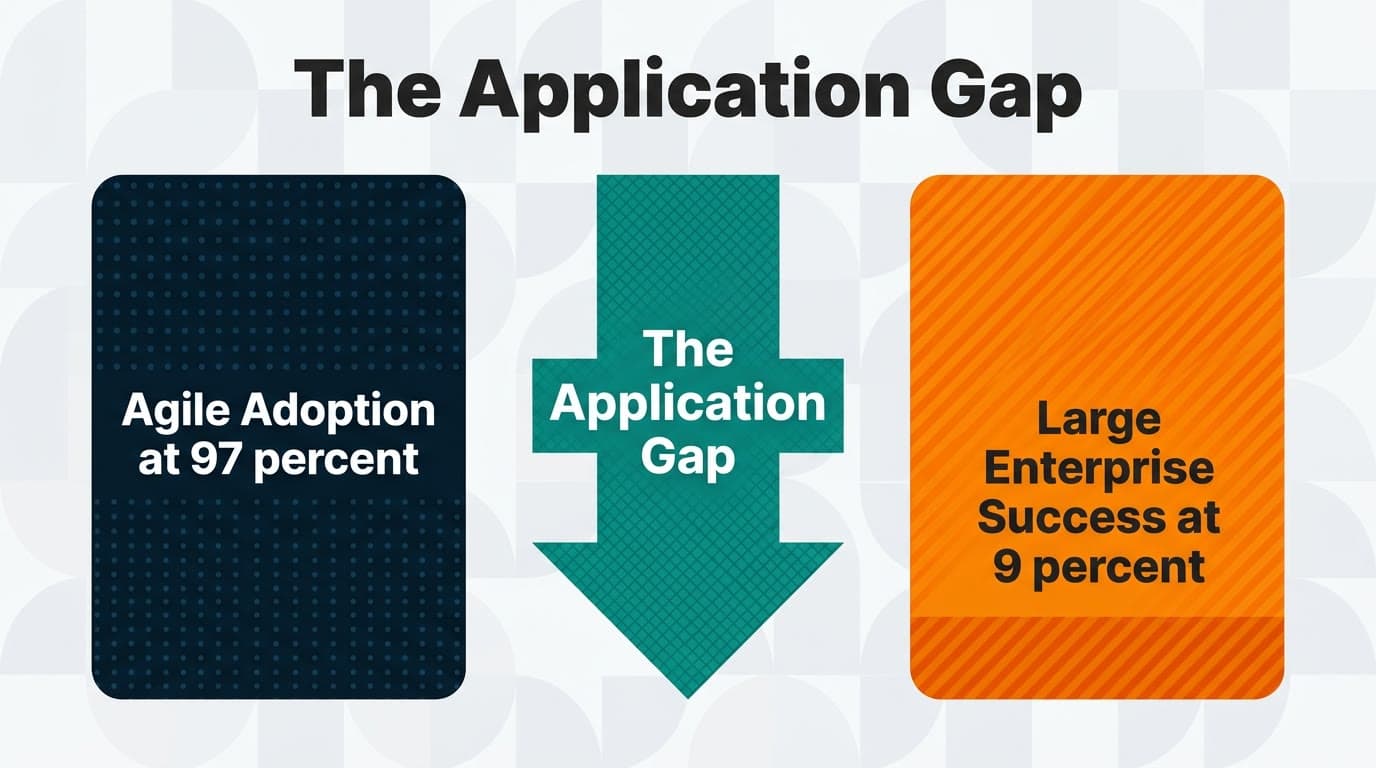
97% Agile adoption, 9% enterprise success. Why does the gap between software development knowledge and practice persist?

Software Development: The Application Gap .
Enterprise software projects fail because of habit, not ignorance.
While global software development services represent an $824 billion market staffed by over 28 million developers, the rates of systemic project failure remain catastrophic. The core challenge is a persistent gap in execution, not a lack of theoretical knowledge.
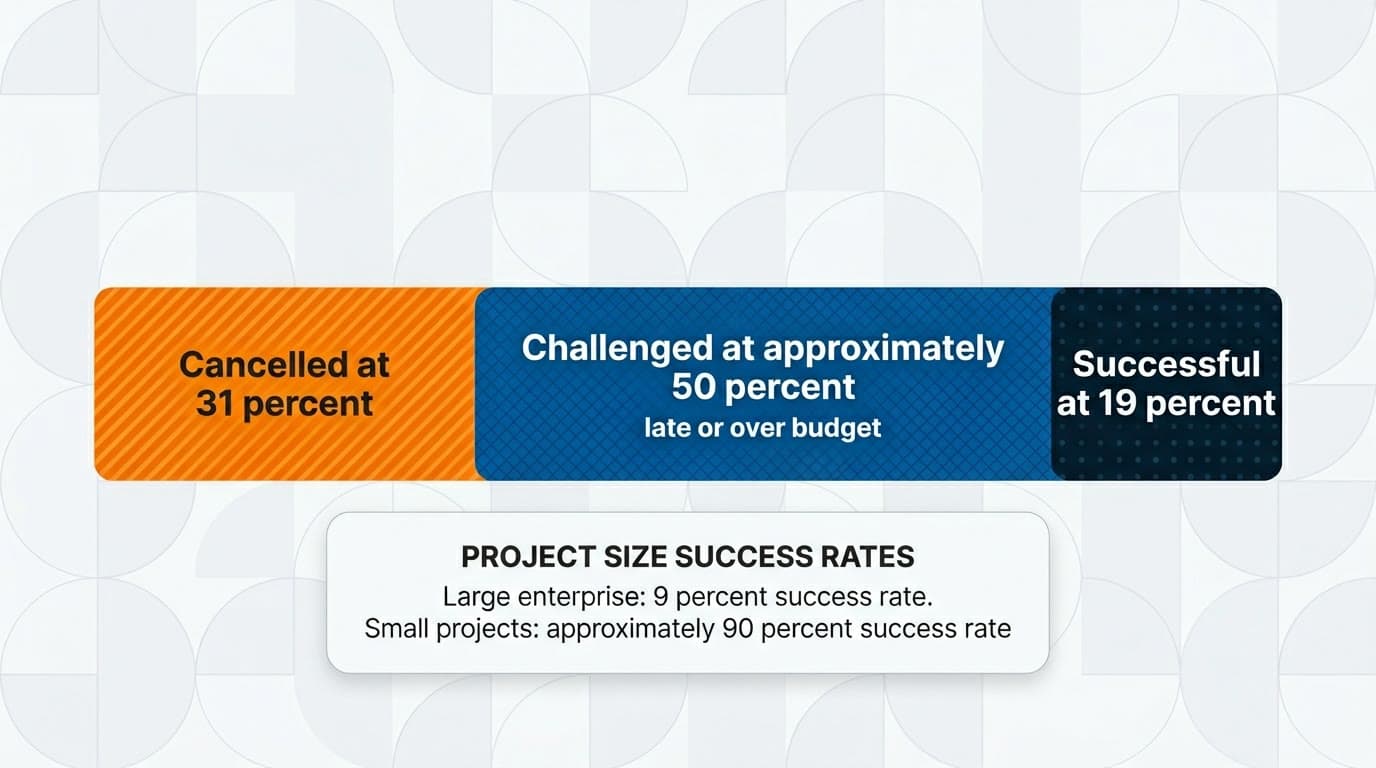
According to the Standish Group CHAOS report, only 9% of large enterprise software projects achieve true success, while over 31% are cancelled entirely before completion. This disparity persists despite a near-universal 97% adoption rate of Agile methodologies across modern organisations. The resulting financial toll is immense, with annual operational failures costing businesses an estimated $1.56 trillion globally.
This research paper examines the structural misalignment between modern software development methodology and actual day-to-day corporate practice. By evaluating real-world failures and underlying technical architectures, we equip decision-makers to diagnose their own delivery blockages. The goal is to move beyond superficial framework compliance and establish a reliable, evidence-first pathway to successful software delivery.
Key Findings at a Glance
A stark disconnect exists between established software engineering theory and daily operational reality. This research paper reports key empirical insights that expose why modern systems continue to fail despite decades of methodology refinement.
- Agile adoption stands at 97 per cent, yet enterprise success remains at just 9 per cent. This disparity shows that the core issue is a persistent application gap, not a lack of theoretical knowledge. The evidence regarding what works is widely available, but organisations frequently fail to establish the cultural preconditions, such as genuine customer collaboration and sustained executive sponsorship, required for success.
- Technical debt consumes an average of 42 per cent of the development week. This waste equates to an estimated eighty-five billion US dollars lost annually worldwide. Because these costs are deferred and diffuse, organisations systematically deprioritise remediation in favour of immediate feature delivery.
- Inadequate executive sponsorship is a major, yet frequently ignored, driver of project failure. This deficiency is cited in 30 per cent of all failed software initiatives, according to the 2020 CHAOS Report. Any organisation unable to secure active, informed leadership involvement throughout the lifecycle should reconsider making a software investment.
- Catastrophic project failures are rarely isolated anomalies. Structural patterns such as architecture by accretion and fragmented vendor management recur across public and private sectors alike. High-profile examples, including the Healthcare.gov failure and the scrapped FBI Virtual Case File initiative, show the systemic nature of these risks.
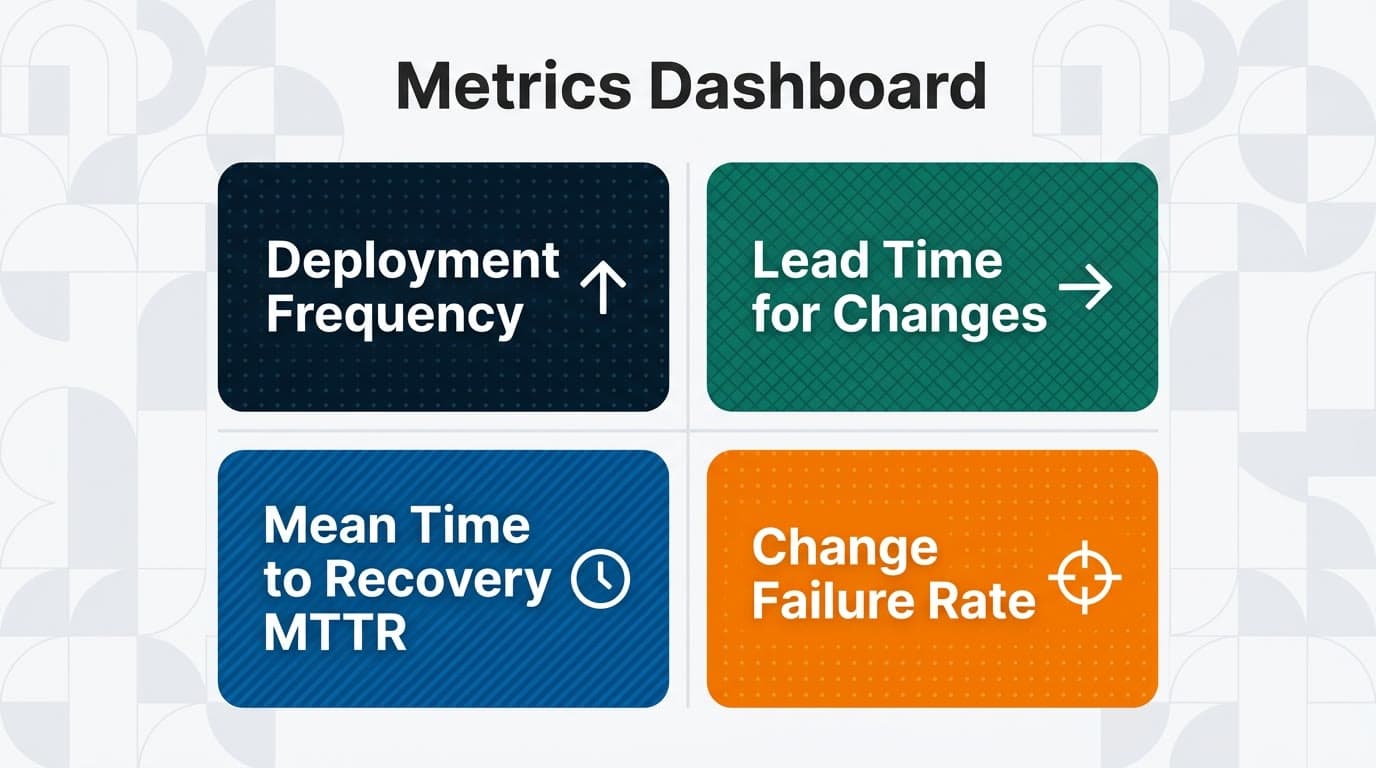
- DORA metrics serve as exceptionally reliable proxies for evaluating team performance. These four industry standards measure deployment frequency, lead time for changes, mean time to recovery, and change failure rate. Conversely, measuring individual developer productivity is widely rejected by practitioners as a counterproductive exercise.
- While 84 per cent of developers use AI tools, trust in their accuracy is declining. Survey data shows a fifteen percentage point drop in trust in just one year, falling to 54 per cent. Empirical research also indicates that developers using AI assistants can take up to 19 per cent longer to resolve issues, necessitating a rigorous, evidence-first approach to tool selection.
Introduction
The software application gap is not a knowledge problem. For decades, clear evidence has demonstrated what makes software projects succeed, yet execution lags far behind awareness. Organisations routinely pour capital into development initiatives that default to predictable failure modes.
In 2026, the global software development market reached a valuation of USD 823.92 billion. This vast commercial ecosystem is sustained by approximately 28.7 million developers worldwide, a workforce larger than the population of the Netherlands. Yet, despite this immense scale, structural inefficiency remains the defining characteristic of modern delivery.
Long-term research by the Standish Group reveals a sobering reality for enterprise-scale software projects. Within this sector, only 9% of large-scale initiatives are delivered on time, within budget, and with their original scope intact. Conversely, more than 31% of these projects face outright cancellation before completion.
The remaining initiatives usually fall into the challenged category, plagued by delayed timelines, inflated budgets, or reduced functional scope. Paradoxically, this high rate of failure coexists with a near-universal embrace of modern workflows. Approximately 97% of organisations now report using agile software development practices in some form.
Agile is no longer a selective software development methodology; it has become the ambient operating model of the digital economy. The fundamental disconnect lies in execution, not intention. Teams adopt the superficial rituals of the framework while failing to embed the rigorous technical practices required to sustain it.
This paper examines this structural tension through an evidence-first exploration of the delivery lifecycle. We trace the scale of the market and examine high-profile historical failures, including Healthcare.gov and the FBI Virtual Case File. From there, we evaluate the architectural foundations, technical debt carrying costs, and the realities of developer recruitment and retention.
Finally, the analysis addresses emerging AI development dynamics alongside the operational metrics that define high-performing teams. By confronting these persistent friction points, this paper establishes a practical framework for capital allocation in software engineering. The goal is to move beyond superficial compliance and address the actual root causes of project distress.
The Agile Majority and Its Discontents
Agile is everywhere, yet enterprise software projects still fail. The 18th State of Agile Report (Digital.ai, 2025) indicates that approximately 97% of organisations report using these development practices in some form. The methodology is no longer a strategic choice, but has instead become the ambient condition of the software industry.
Beneath this surface level of consensus lies a highly fragmented operational reality. Indeed, the 17th State of Agile Report (Digital.ai, 2024) revealed that 42% of organisations rely on a hybrid model that blends elements of Agile with DevOps or traditional processes. Over the same period, the usage of heavy enterprise-scale frameworks like SAFe, LeSS, and the Spotify model declined collectively by 23%.
Simultaneously, the proportion of software teams reporting that they do not use any formal framework at all continues to grow. This shift shows a broader disillusionment with rigid structures that fail to deliver expected speed and flexibility. Organisations are increasingly stepping back from commercial scaling frameworks in search of simpler, more direct delivery mechanisms.
This shift has created a hybrid majority operating in what research literature frequently labels as 'Agile in name only'. While organisations eagerly adopt the terminology, they rarely sustain the technical and operational discipline required to make the methodology work. Core practices such as daily stand-ups, self-organising teams, stable definitions of done, and continuous integration are often abandoned or hollowed out in practice.
These structural indicators point to a consistent conclusion across the industry. Genuine, faithful Agile implementation has become a minority practice, overshadowed by superficial ceremonies. Consequently, the gap between what organisations believe they are doing and what they actually execute remains wide.
The Waterfall Presence
Agile's near-universal claimed adoption does not mean Waterfall has disappeared from modern engineering. The sequential design model remains in use at rates around 49% across the industry overall, with particularly high concentrations in highly regulated sectors. This linear approach is frequently formalised through the V Model software dev framework, which maps testing phases directly to corresponding development stages.
Industries such as defence, aerospace, healthcare, and finance frequently require rigorous audit trails plus sequential sign-offs. Traditional v model software development accommodates these regulatory mandates more naturally than iterative frameworks. For these safety-critical systems, documented phase gates are not bureaucratic obstacles but essential legal requirements.
The core debate is not Waterfall versus Agile in the abstract, but rather the fit between methodology and operating context. When requirements are genuinely stable and the cost of late-stage structural changes is low, a sequential path remains a defensible choice. These conditions are particularly common when physical infrastructure or hardware limits the feasibility of continuous deployment.
However, these highly stable parameters do not describe the environment of the majority of modern software projects. Rapidly shifting user needs and competitive pressures demand continuous iteration, making rigid phase gates a bottleneck, not a safeguard. When applied to dynamic digital products, sequential rigidity often widens the application gap and increases project risk.
Healthcare.gov (USA, 2013)
When the US federal health insurance exchange launched on 1 October 2013, the platform crashed almost immediately. Millions of citizens attempting to enrol were locked out of the system, exposing severe architectural and management failures. The initial CGI Federal contract cost approximately USD 840 million, with substantial crisis funding required after the launch failure.
The catastrophe stemmed from employing a rigid Waterfall methodology in an environment that demanded rapid, iterative adjustments. A highly fragmented vendor structure split accountability across multiple service providers, leaving CGI Federal to coordinate numerous sub-contractors without unified governance. Furthermore, the entire system was deployed without undergoing realistic load-testing under projected peak user volumes.
Continuous legislative amendments to the Patient Protection and Affordable Care Act during development forced late-stage database and software redesigns. These rushed alterations led to significant security vulnerabilities that emerged shortly after the public launch. In response to these systemic failures, the federal government established the US Digital Service in 2014 to prevent similar patterns in future public sector software initiatives.
FBI Virtual Case File (USA, 2000–2005)
The Virtual Case File initiative consumed USD 170 million over five years of development before its eventual cancellation. The replacement software initiative, named Sentinel, had to be commissioned as an entirely new programme of work. This costly pivot highlighted the severe consequences of starting a major build without establishing a stable technical foundation.
At its inception, the project suffered from the absence of a coherent technical architecture. This lack of blueprint meant that requirements shifted repeatedly, which continuously destabilised delivery throughout the development lifecycle. Basic systems engineering practices were omitted, leaving teams without a reliable framework to manage complexity.
Consequently, the broader Trilogy initiative, of which the Virtual Case File was a core component, overran its original budget by 89 per cent. This financial strain translated to approximately USD 200 million in excess expenditure before the project was abandoned. What was designed as a three-year delivery window stretched into five years of uncoordinated effort and eventual collapse.
UK Universal Credit (UK, 2013–present)
The UK Department for Work and Pensions' flagship welfare reform programme has cost billions of pounds more than its original budgets. Both the National Audit Office and the Public Accounts Committee have documented repeated, severe cost escalations over several years.
The project fell victim to a highly rigid monolithic architecture that attempted to replace multiple complex legacy systems simultaneously. This structural fragility was worsened by rapid staff turnover in senior leadership, which repeatedly disrupted programme continuity. The initial design assumptions also ignored the reality that many claimants lacked reliable internet access or basic digital literacy.
This mismatch generated high levels of what practitioners term failure demand, with claimants forced to seek manual intervention because the system could not process claims correctly. This compounding volume heavily burdened an already-strained administrative infrastructure. By 2018, the Public Accounts Committee officially noted that the entire platform had been on the brink of complete failure in 2013.
NSW RISC (Australia, 2018–present)
The New South Wales Register of Confidential Commercial Information (RISC) is a government cloud infrastructure programme that has suffered from severe cost escalation and delivery delays. Official reports from the NSW Auditor-General and the NSW Parliament's Public Accounts Committee have highlighted systemic governance failures and poor financial oversight. Industry analysis estimates the potential failure cost of this initiative at approximately USD 2.3 billion.
The underlying structural issues directly mirror international failures and include extreme vendor fragmentation, the absence of a single technical authority, and critical architectural decisions made without proper oversight. This case demonstrates that the destructive software development methodology patterns observed in global failures like Healthcare.gov and the UK Universal Credit initiative are not confined to any single jurisdiction.
Cross-Cutting Failure Patterns
Six distinct failure patterns consistently recur across major software delivery collapses, which are systemic execution breakdowns, not a lack of technical knowledge. These structural, architectural, and governance failures reveal how easily standard methodologies derail when practical discipline is absent. Addressing these core weaknesses remains the primary challenge for engineering teams seeking long-term operational stability.
Unstable requirements represent the first critical failure point, where project scope is never successfully baselined at the outset. Instead, feature creep and shifting goals proceed without formal governance, dragging teams into perpetual cycles of redesign. Without a stable definition of the minimum viable product, delivery teams cannot maintain momentum or control budgets.
Architectural failure occurs when engineering teams proceed without a coherent technical blueprint, so the system structure emerges by accretion, not deliberate design. This ad-hoc construction quickly generates unmanageable technical debt, crippling future scale and system stability. A sound software architecture is essential to prevent early development decisions from becoming permanent, costly liabilities.
Vendor and governance fragmentation routinely diffuses accountability across complex networks of external contractors and internal teams. When multiple suppliers operate without a single point of technical authority, integration interfaces become battlegrounds of blame. Clear ownership and unified technical leadership are necessary to align disparate delivery partners toward a single objective.
Methodology mismatch occurs when rigid waterfall approaches are forced onto complex projects that demand highly velocity-driven feedback loops. Teams attempt to plan volatile requirements years in advance, rendering them incapable of adapting to inevitable market or technical changes. Aligning the methodology to the actual profile of uncertainty is a fundamental prerequisite for success.
Insufficient load testing routinely exposes the vast gulf between a controlled staging environment and live production realities. Many platforms launch without undergoing realistic stress testing, resulting in immediate collapse under real-world volume. A working prototype operating under ideal conditions must never be mistaken for a resilient, production-ready system.
Executive sponsorship failure remains a primary institutional contributor to project abandonment, often triggered by leadership turnover. Indeed, industry data attributes roughly 30% of all software project failures to disengaged or absent business ownership. Without sustained, active sponsorship to clear administrative roadblocks, technical teams lack the organisational support required to navigate complex deployments.
The Pilot-to-Product Gap
Healthcare.gov was not load-tested under realistic user volumes before launch, making its launch-day crash a predictable consequence of a recurring software development pattern, not a random misfortune. A prototype built for a controlled environment with twenty concurrent users cannot handle twenty thousand users in a live environment without a production-ready architecture. Transitioning from a pilot system to a scalable deployment requires testing under actual traffic conditions and operational resilience, which are rarely specified in a standard development mandate.
This pattern regularly disrupts commercial ventures. Teams frequently present a functional prototype, celebrate an early milestone, and advance straight to launch without the extensive hardening phase required for genuine system stability. The resulting launch-day failures are structurally predictable, exposing the false assumption that a working demonstration is equivalent to a fully resilient product.
This pilot-to-product gap stems from a governance failure, not a technical oversight. Non-technical stakeholders often authorise production releases based on visual demos, lacking the context to evaluate unrepresented metrics like load performance, degradation patterns, or error-logging efficacy. Without evaluating how a system behaves under partial failure, organisations fail to address silent operational risks.
This division explains why DevOps Research and Assessment (DORA) metrics serve as vital benchmarks. Metric categories like lead time for changes and change failure rate reveal how reliably an enterprise manages the boundary between pilot and production. High-performing software engineering teams treat every commit as a production candidate through continuous automated deployment, whereas struggling organisations treat releases as isolated ceremonies.
To bridge this gap, organisations must establish production readiness as a distinct deliverable with dedicated acceptance criteria and budget allocations. Teams need to execute rigorous load tests, verify rollback procedures, and establish solid telemetry to monitor live system health. The systemic risk of software project failure decreases only when production readiness is treated as an upfront architectural requirement, not a downstream operational problem.
What the Manifesto Actually Says
In 2001, seventeen software practitioners gathered in Snowbird, Utah, to publish the Manifesto for Agile Software Development. This historic document sought to restore human agency to an industry that was increasingly bogged down by bureaucratic, heavyweight methodologies. It codified an alternative philosophy built on collaborative delivery instead of proposing entirely new techniques.
The foundation of this philosophy rests upon four central trade-offs. The authors valued individuals and interactions over rigid processes, whilst prioritising working software over exhaustive documentation. They also championed close customer collaboration over adversarial contracts, plus responsive adaptation over unyielding adherence to a fixed plan.
Supporting these values are twelve core principles that advocate for early, continuous delivery and welcoming changing requirements throughout the lifecycle. This model demands frequent releases of functional systems alongside daily cooperation between business stakeholders and developers. It also mandates maintaining a sustainable development pace, which is reinforced by regular team reflection to adjust and improve efficiency.
The manifesto did not invent these practices out of thin air. It consolidated methodologies that many organisations were already using imperfectly, providing a cohesive vocabulary for what was already happening on the ground. By formalising these shared experiences, it named and structured a movement that had already begun.
The Dominant Frameworks
The software development methodology market is crowded with frameworks that promise structural discipline but frequently suffer from diluted execution. While these frameworks aim to bridge the gap between business objectives and technical delivery, organisations often adopt the ceremonies without the underlying cultural shifts. Consequently, the transition to Agile remains a superficial exercise for many enterprise teams.
Scrum and the Cadence of Delivery
Scrum structures development into fixed-length sprints, typically lasting two weeks, to establish a predictable operational rhythm. Guided by defined roles such as the Scrum Master and Product Owner, teams participate in structured ceremonies designed to encourage continuous inspection. However, when velocity metrics are weaponised by management, sprints degenerate into arbitrary quotas that compromise code quality.
Kanban Software Dev and Flow Optimisation
Originating from Toyota's manufacturing principles, Kanban software dev focuses on visualising work in progress and removing systemic bottlenecks. By strictly limiting active tasks, this approach establishes a continuous flow of value without enforcing rigid, time-boxed iterations. It proves highly effective for maintenance and operational environments where priorities shift rapidly.
XP Software Dev and Technical Discipline
In contrast to purely administrative frameworks, XP software dev prioritises engineering excellence through rigorous, hands-on practices. It integrates test-driven development, pair programming, continuous integration, and frequent refactoring directly into the daily workflow. This technical focus ensures that code quality remains high, mitigating the long-term compounding of technical debt.
The Software Dev Spike and Alternative Pathways
When teams encounter high architectural uncertainty, they often employ a software dev spike to perform rapid, time-boxed research. This exploratory practice contrasts with the highly structured V model software dev approach, which remains common in safety-critical sectors requiring rigid verification phases. Modern delivery teams must balance these structured models with active TDD software dev practices to maintain agility.
Two Foundational Axioms
In Software Architecture in Practice, Bass, Clements, and Kazman articulated the twin foundational axioms that govern modern systems. They argued that every architectural choice represents a trade-off, and understanding why a decision is made remains far more important than how it is implemented. This conceptual framework establishes that code-level execution must always serve strategic architectural requirements.
These architectural decisions predate and inevitably shape every subsequent phase of the software engineering process. Quality attributes, capacity for change, failure modes, and long-term maintenance costs are substantially determined at this foundational stage. Consequently, structural integrity is established long before developers write the first lines of application code.
This early determination explains why structural choices are notoriously difficult and expensive to reverse. By the time the practical consequences of a flawed blueprint become visible in a production environment, those patterns are already deeply embedded in the codebase. Resolving these legacy issues later introduces severe technical debt in software development, compounding both system complexity and operational risk.
The Three Primary Styles
Monolithic architecture organises all components of an application within a single deployable unit where all functionality lives in the same process space. This unified structure offers simplicity in deployment, testing, and initial development speed. It remains highly effective for systems with stable boundaries and teams small enough to co-ordinate without formalised interface contracts.
The principal limitation of this model is tight coupling, meaning changes to a single component can inadvertently affect the entire system. As applications expand, this structural dependency compounds and increases cognitive load on developers. Consequently, scaling individual components independently becomes highly challenging under a single codebase.
Microservices architecture decomposes an application into highly independent services that communicate through well-defined application programming interfaces. Each service manages its own database, allowing teams to choose distinct technology stacks tailored to specific business needs. This structural isolation ensures that a localised failure does not trigger a system-wide outage.
However, these benefits introduce substantial operational complexity because distributed systems are inherently difficult to test, monitor, and debug. Establishing clean service boundaries requires rigorous design, whilst network latency between remote services adds inescapable performance overhead. Landmark texts such as Sam Newman's Building Microservices and Chris Richardson's pattern analyses remain standard references for navigating these architectural transitions.
Serverless architecture shifts the unit of deployment from an entire service to individual, ephemeral functions. Under this framework, commonly executed via platforms like AWS Lambda, cloud providers automatically handle underlying infrastructure and dynamic resource scaling. This approach eliminates server maintenance overhead and ensures organisations only pay for active execution time.
Despite these efficiencies, serverless systems introduce distinct operational constraints, including cold start latency, potential vendor lock-in, and strict execution duration limits. Co-ordinating complex, stateful workflows also demands significant engineering workarounds. For these reasons, serverless suits event-driven, highly variable workloads and is not a general replacement for service-oriented designs.
Conway's Law
Conway's Law dictates that organisations inevitably design systems that mirror their own internal communication structures. This principle is an active tool for organisational design, not a passive observation. If technical architecture naturally aligns with team boundaries, then selecting an architecture is fundamentally an act of structural planning.
When siloed, functionally partitioned departments attempt to adopt microservices, the resulting interfaces frequently become bureaucratic, not technical. The decoupled benefits of such an architecture fail to materialise because the underlying communication patterns remain rigid and centralised. Instead of software components operating independently, the development cycle stalls as teams negotiate across political boundaries.
To avoid this mismatch, technical decision-makers must evaluate corporate communication flows before committing to a technical framework. Aligning organisational topology with target software architecture prevents the friction of what is known as the inverse Conway manoeuvre. This strategic synchronisation ensures that the technical division of labour supports the intended system design instead of undermining it.
Technical Debt as an Architecture Problem
Ward Cunningham introduced the technical debt metaphor in 1992 to describe the compounding cost of rework when choosing expedient engineering shortcuts. In modern engineering, the systemic accumulation of technical debt in software development projects represents a significant operational bottleneck. The most substantial liabilities do not stem from isolated coding shortcuts, but rather from foundational architectural flaws that constrain every subsequent modification.
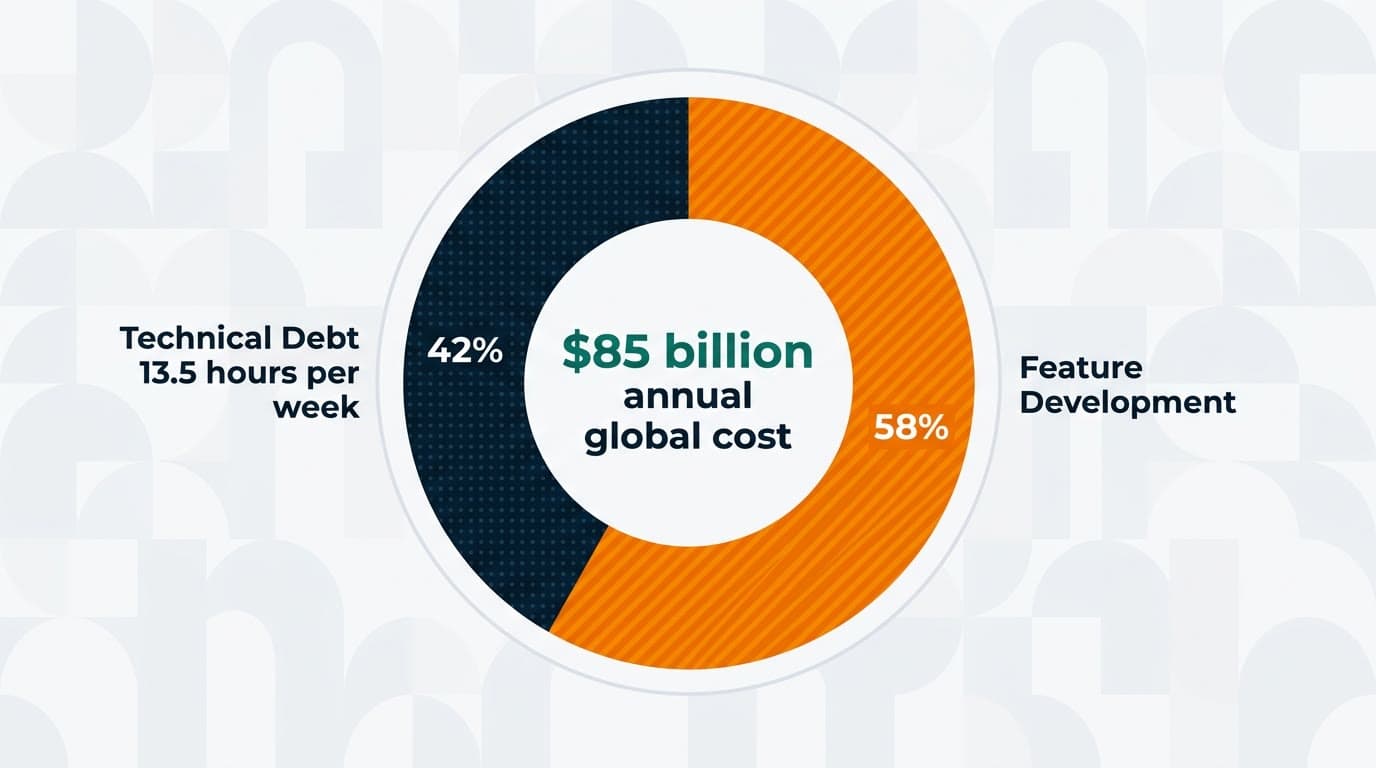
According to the TinyMCE Technical Debt White Paper, developers spend approximately 42% of their working week dealing with technical debt and bad code. This administrative drag translates to roughly 13.5 hours per week per developer, culminating in an estimated global annual cost of USD 85 billion. These figures show the severe commercial consequences of ignoring structural code quality over successive release cycles.
The vast majority of these costly inefficiencies trace back to unstable software architecture decisions, such as tight coupling and the absence of clear modular boundaries. When systems lack explicit structural divisions, engineers cannot implement changes without risking unintended side effects across the codebase. Furthermore, because design choices are frequently made without documenting the accepted trade-offs, subsequent development teams must work blindly through legacy systems.
Managing Architecture Knowledge
Architecture Decision Records (ADRs) are structured documents that capture the context, rationale, and consequences of significant design choices. By formalising these decisions, teams can maintain a clear history of their software development methodology and avoid structural degradation over time. This practice ensures that subsequent engineering decisions align with the original architectural vision.
To guide this process, several foundational frameworks provide the necessary vocabulary and analytical tools. Martin Fowler’s Patterns of Enterprise Application Architecture establishes standard vocabulary for discussing design trade-offs, while Eric Evans’s Domain-Driven Design offers frameworks to identify correct system boundaries. The Architecture Tradeoff Analysis Method (ATAM) also provides a structured evaluation methodology to ensure proposed architectures satisfy quality requirements.
The persistent lessons from historical project failures, including Healthcare.gov, the FBI Virtual Case File, and the UK Universal Credit system, demonstrate that architecture by accretion produces structural complexity that project management cannot salvage. By the time a software initiative reaches active development, the architecture has already determined the boundaries of success. Remediation therefore requires sound decisions made at the outset, not frantic corrections during execution.
The Estimation Problem
Software estimation has a secret: estimates are inherently random.
This is not a defeatist posture but rather a structural observation of the engineering process.
Until a piece of code is actually written, there is no empirical data to determine how long its construction will take.
Consequently, the figures produced by engineering teams rely heavily on analogy, scope decomposition, and subjective expert judgment.
These values function well as communication and planning frameworks, yet they remain deeply flawed when treated as precision instruments.
This creates immediate tension for organisations attempting to manage complex projects or coordinate offshore software development.
Traditional frameworks such as the Constructive Cost Model (COCOMO), Function Point Analysis, and Three-Point Estimation (PERT) attempt to bring mathematical rigour to the process.
Agile environments introduced lightweight alternatives like Planning Poker and Delphi methods to assist with software development cost estimation.
However, these methods are bounded by a fundamental epistemological constraint because they assume stable parameters that rarely exist in practice.
A 2025 analytical study published in the International Journal of Computer Applications confirmed that planning-based and expert-based estimations still dominate standard practice.
The research demonstrated that the discrepancy between estimated and actual development effort is persistent, systemic, and deeply rooted.
This is a structural reality that better tooling cannot correct. It requires adaptive management instead of rigid schedules.
The Planning Fallacy
The planning fallacy represents a documented tendency for organisations to underestimate task completion times despite being fully aware of the phenomenon. This cognitive bias operates with acute force within software development, where complexity is non-linear. Consequently, early-stage project timelines are frequently treated as commitments, not speculative forecasts.
Practitioner discussions on Stack Exchange show that estimates made long in advance of actual development are systematically over-optimistic. This optimism bias is rarely corrected by historical experience because teams tend to view every software project as an entirely unique endeavour. As a result, historical delays are dismissed as anomalies, not warnings.
This discrepancy creates a severe structural dysfunction within software project management. Organisations frequently demand precise timeline estimates despite knowing the underlying figures are unreliable, subsequently holding technical teams accountable to these arbitrary targets. The pressure to meet these artificial deadlines often forces developers to compromise on core architectural standards.
Data from the Standish Group's CHAOS Report consistently shows schedule overrun as a primary symptom of project failure. This initial estimation dysfunction compounds because it misallocates human and financial resources long before any actual programming begins. These early structural miscalculations establish a trajectory that is almost impossible to correct during the active build phase.
The Hidden 42%
Software teams routinely pay a silent, compounding tax. This friction, known as technical debt in software development, consumes approximately 42% of a developer's working week. According to data from the TinyMCE Technical Debt White Paper, this waste translates to an estimated 13.5 hours per developer weekly and an annual global cost of USD 85 billion.
This structural drag does not represent idle hours, but rather active engineering effort redirected from feature delivery to managing legacy compromises. Because these compromises never appear as explicit line items, they remain functionally invisible to commercial budget holders. Instead, the debt manifests indirectly through delayed shipping schedules, compounding defects, and severe developer burnout.
Analysis by the Software Improvement Group shows that this structural debt directly inflates IT operational budgets by compounding maintenance costs over time. Systems built on hasty architectural shortcuts demand increasingly complex and expensive workarounds for every subsequent modification.
This ongoing penalty represents the compounding interest paid on initial architectural compromises. While the initial developer may escape the immediate consequences of a shortcut, subsequent engineering teams and future budgets inevitably bear the full operational burden.
Hidden Costs Beyond Estimation
Software budgeting consistently fails because traditional estimates ignore the friction of human systems. Beyond writing code, systemic inefficiencies systematically erode developer focus and inflate real expenditures. These hidden overheads are rarely captured in standard software development cost estimation templates, yet they dictate the ultimate financial outcome.
Context-switching. Atlassian DevEx (2025) research identifies tool fragmentation and excessive meeting load as primary productivity barriers. The average developer moves between tasks 2.3 times per hour according to University of California Irvine research. Each switch carries a severe cognitive overhead that compounds across the working day, reducing overall engineering velocity.
Onboarding and interviewing. Industry models estimate the cost of hiring and integration at twenty to thirty per cent of the initial development spend. This resource drain remains largely invisible to technical leaders because it is typically allocated to recruitment budgets, not project-specific ledger lines. Consequently, organisations consistently underestimate the capital required to build momentum on new initiatives.
Staff turnover. Replacing an engineer costs between fifty and two hundred per cent of their annual salary according to Human Capital Alliance research. This calculation covers recruitment costs, interviewing hours, onboarding materials, plus the lost productivity during the ramp-up phase. For specialised engineering roles, these attrition expenses escalate further due to the scarcity of niche talent.
Organisational friction. Analysis of developer forums indicates that unclear priorities and complex internal politics are the primary drivers of engineer burnout, more than long working hours. This systemic frustration directly translates into silent attrition and reduced cognitive focus on daily coding tasks. The cost of a chaotic work environment manifests as compounding technical debt, not a clear line item on a budget sheet.
The Structural Answers
The structural answer to the software development estimation problem lies in range-based forecasting and continuous scope negotiation instead of rigid point estimates. By moving away from binary commitment targets, teams can focus on real-world variability and adapt to emerging requirements. This approach ensures that technical parameters remain aligned with business expectations throughout the life cycle.
Similarly, addressing technical debt requires explicit tracking and the deliberate allocation of engineering capacity to codebase maintenance. Teams should treat debt remediation as a standard budget item, tracking historical liabilities with the same rigour applied to new feature delivery. This shift prevents hidden costs from compounding and destabilising future deployment cycles.
Both structural changes require organisations to accept that software development is fundamentally adaptive, not precisely predictable. The corporate preference for false precision over realistic ranges remains the primary driver of systemic planning and budgeting dysfunction. Grounding decisions in empirical evidence is the only way to narrow the application gap.
DevOps, DORA, and Keeping Software Alive
While a software development methodology describes how work begins, DevOps defines how a digital product survives over time. Writing code is merely the initial step in a long operational cycle. The ongoing challenge is keeping the application running, updated, and healthy within live production environments.
This operational discipline is where the distinction between high-performing engineering teams and struggling ones becomes highly measurable. By using empirical frameworks like DORA metrics, organisations can assess deployment frequency and change failure rates with high precision. This structural focus helps software launch and then keep performing.
DORA: The Metrics That Matter
Measuring engineering throughput requires objective criteria. The DevOps Research and Assessment framework establishes a strong benchmark for software team performance by analysing quantitative delivery characteristics. First defined in foundational research by Forsgren, Humble, and Kim, these industry benchmarks correlate deployment behaviour directly with broader organisational stability.
Deployment frequency measures how often an organisation releases software to production. High-performing teams deploy on-demand multiple times per day, whereas lower performers limit releases to monthly or quarterly cycles. This cadence dictates how quickly value reaches the end-user.
Lead time for changes tracks the duration from code commit merge to production deployment. While elite teams measure this pipeline journey in mere hours, struggling organisations frequently experience delays spanning weeks. Shortening this loop relies heavily on automated testing led by a software development engineer in test.
Mean time to recovery monitors how quickly service is restored following an operational incident. High-performing teams resolve production outages in under an hour through mature monitoring and automated rollbacks. Conversely, less mature teams require days to restore normal operations, escalating the cost of downtime.
The change failure rate measures the percentage of deployments that result in production failures or require immediate remediation. Successful teams maintain this rate below fifteen per cent, so rapid deployment does not compromise stability. Lower performers see failure rates exceed forty-five per cent, which triggers extensive unplanned work.
The SPACE framework complements these metrics by evaluating developer satisfaction alongside perceived productivity. This dual approach addresses both objective delivery outcomes and the underlying developer experience. By combining both frameworks, organisations gain a complete view of engineering capability without relying on single-metric fallacies.
DevOps as the Operational Mainstream
Hybrid development models now dominate software delivery. The 17th State of Agile Report (Digital.ai, 2024) found that 42% of respondents combined Agile with DevOps. This indicates that the plurality of organisations describing themselves as practising Agile are, in reality, operating DevOps by default.
The distinction between these concepts matters because Agile is a delivery philosophy, while DevOps is the delivery engine. One defines the values that govern work prioritisation, whereas the other provides the infrastructure required to sustain automated deployments. This structural division prevents process improvements from stalling at the production gate.
Data from the KnowledgeHut survey (February 2025) supports this shift, showing that 69% of respondents rated DevOps transformation as highly important to their organisation. This demonstrates that DevOps is no longer a niche practice restricted to cloud-native startups, but rather the operational substrate on which enterprise delivery depends. Consequently, roles like the SDET (software development engineer in test) have become central to maintaining deployment pipelines.
The 18th State of Agile Report (Digital.ai, 2025) reinforces this, noting that 64% of Agile teams now have visibility into DevOps pipelines, and 65% report planning tool alignment. However, visibility without the authority to act produces a distinct operational paradox. When teams receive real-time delivery data but lack the power to change what they see, more data often leads to frustration, not improvement.
Where Technical Debt Accumulates in Production
Technical debt does not only accumulate in the codebase. It also builds up in the deployment pipeline, the monitoring infrastructure, the incident response runbooks, and the automated test coverage that protects production from regression.
Research from the TinyMCE Technical Debt White Paper estimates the global annual cost of technical debt at approximately USD 85 billion, with 42% of a developer's working week lost to bad code. This drain extends far into production environments, manifesting as hours spent diagnosing incidents rooted in legacy shortcuts and fragile deployment scripts. The cumulative cost of running poorly instrumented monitoring systems further inflates this operational tax.
Data from the Software Improvement Group confirms that technical debt directly burdens IT budgets by compounding maintenance costs over time. Systems relying on structural shortcuts require increasingly expensive workarounds to implement basic changes. This friction in production mirrors the decay found within the application codebase itself.
The divergence between teams that sustain long-term delivery velocity and those that slow down is rarely about the initial architectural design. Instead, the determining factor is the discipline of continuous investment in production infrastructure. Organisations must actively manage these invisible liabilities to prevent systemic operational failure.
The Discipline of Continuous Delivery
Continuous Delivery translates Agile methodology into a predictable, daily operational reality. It ensures that every code change is thoroughly validated and immediately ready for production deployment at any given moment. This systematic practice closes the gap between software development theory and functional execution.
To sustain this cadence, organisations rely on automated deployment pipelines alongside a dedicated software development engineer in test (SDET) to embed quality early. This technical infrastructure must be supported by a blameless engineering culture that treats production incidents as learning opportunities, not failures. By shifting the focus from individual blame to systemic resilience, engineering teams can maintain a rapid, stable release cycle.
Teams with mature continuous delivery practices consistently excel across key DORA metrics, such as deployment frequency and change failure rate. Releasing software becomes a routine, low-risk activity instead of a disruptive event requiring weeks of coordination. Automated gates also catch regressions early, which dramatically reduces lead times and improves the mean time to restore services.
Security and quality must be treated as continuous, parallel disciplines, not final gates. This aligns directly with the NIST Secure Software Development Framework (SP 800-218), which integrates security protocols into every phase of the engineering process. This continuous oversight ensures that software architecture remains secure from the initial line of code to the live production environment.
What the Production Problem Tells Us
Production is a running engine, not a final destination. Treating launch as an end point represents a fundamental category error in software project management. The running system requires the same rigorous investment discipline as the initial development process itself.
Evidence from DevOps Research and Assessment (DORA) frameworks reveals that production maturity exposes the gap between adoption and performance. High-performing organisations maintain this maturity by employing a dedicated software development engineer in test (SDET) to establish reliable continuous integration pipelines. This strategic alignment ensures that software quality is verified automatically before code ever reaches live environments.
While a chosen software development methodology gets an application started, DevOps practices keep it functioning. The teams that integrate both disciplines successfully avoid the operational failures that drain enterprise budgets. Closing the application gap requires a sustained commitment to modern infrastructure, not temporary post-launch patches.
Startup Chaos and the Resource Constraint
Enterprise software failure and early-stage startup failure share surface similarities, as both result in broken systems and wasted capital. However, the underlying mechanisms that drive these failures are different in kind, not degree. Understanding this distinction is essential for technical leaders when evaluating their software development methodology.
Enterprise failure is predominantly a governance failure occurring within organisations bound by rigid procurement processes. The dysfunction that stalls these projects is rarely a lack of structured process, but rather a failure of execution. Unstable requirements, incoherent software architecture, and diluted accountability across multiple contractors combine to derail the delivery phase.
Startups operate under contrasting constraints, characterised by extreme resource scarcity and highly compressed timelines. Where large enterprises suffer from over-governed systems, early-stage firms are often under-resourced and under-architected simultaneously. This combination creates compounding risks where the departure of a single individual can completely halt operations.
When attempting to fill urgent software development vacancies, early-stage companies often make critical hiring errors. Out of budget panic, a firm might task a software dev intern with building core software architecture. While internships provide good learning opportunities, relying on junior talent to design foundational systems often results in severe technical debt.
The Standish Group's 9% success rate for large enterprise projects represents a specific corporate population. This dataset tracks mature organisations with formal project management offices, dedicated budgets, and extensive procurement gates. Consequently, these metrics do not directly map to small teams of fewer than ten engineers working with survival timelines measured in weeks.
The Bus Factor in Practice
Single-point failure risks often hide in plain sight. In software development, the bus factor measures how many practitioners must leave before a project completely collapses. A metric of one means that the departure of a single engineer will precipitate a near-total failure of technical capability.
Within a typical ten-person team, critical technical knowledge often clusters within just one or two individuals. These specialists hold exclusive understanding of authentication architectures, databases, third-party integrations, and deployment pipelines. While this concentration seems efficient when capital is constrained, letting an individual become the sole gatekeeper of a subsystem introduces extreme operational vulnerability.
This short-term efficiency play quickly transforms into a long-term systemic threat when key individuals burn out or depart. Empirical data from Initialized Capital indicates that co-founder departures are driven by skills failing to scale (30%), performance issues (20%), burnout (20%), and interpersonal friction. When these departures occur, they frequently become existential corporate events due to the sudden loss of concentrated technical knowledge.
An organisation operating with a bus factor of one remains structurally fragile. Such businesses face greater friction during funding rounds or acquisitions and are highly susceptible to sudden project failures when key personnel exit. Securing long-term resilience requires moving beyond reliance on isolated individual contributors.
Resolving this vulnerability is not a matter of recruiting more developers but rather of distributing knowledge systematically. Teams can mitigate risks through structured pair programming, documented architecture decision records, and regular rotation of feature ownership. This deliberate distribution transforms critical knowledge from an individual dependency into a resilient team asset.
The Cheap Hiring Trap
A consistent pattern in early-stage corporate failures is the decision to hire below-market developers to conserve capital, only to discover that the apparent savings are heavily offset by hidden operational costs. Often, when organisations seek to fill software development vacancies under tight budgets, they default to basic cost-cutting measures without calculating the downstream impact. This superficial calculation fails to account for the true, non-linear cost structure of software engineering.
The immediate mathematics seem straightforward when a developer commanding the market rate of GBP 80,000 is bypassed for an alternative resource available at GBP 45,000, theoretically saving the business GBP 35,000 per annum. However, developer output is not a uniform commodity that scales linearly with salary. The gap in architectural judgement and delivery reliability between these two tiers typically results in lower-cost engineers producing fragile code that carries a disproportionately high maintenance burden.
This structural fragility directly compounds technical debt, which already exacts a severe toll on engineering capacity. The TinyMCE Technical Debt White Paper documents that 42% of an average developer's working week is consumed by managing legacy compromises and remediation. When an organisation relies on an unsupervised software dev intern or junior developers to build core features, this debt percentage spirals.
The hidden cost of cheap hiring manifests as compounding remediation time, requiring senior peers to explain requirements that experienced developers would have anticipated. It also leads to expensive cycles of rebuilding architectural decisions that should have been made correctly in the first instance. The Software Improvement Group's analysis reinforces this reality, demonstrating that systems built with structural shortcuts require increasingly complex workarounds to modify.
The interest payments on this architectural debt are eventually paid by future budgets, long after the original developer has departed. While some argue that exceptional engineering talent can be found cheaply due to market inefficiencies, identifying these rare individuals requires sophisticated technical evaluation. Organisations that choose hiring based purely on immediate cost are usually the least equipped to exercise that precise judgement.
Speed-Over-Quality as a Survival Strategy That Becomes a Liability
The speed-over-quality culture that serves an early-stage venture prior to product-market fit rapidly becomes a structural liability once validation is achieved. Before this milestone, the existential threat is market irrelevance through slow delivery, meaning the accumulation of technical debt remains a secondary concern. Under these conditions, the product might not survive long enough for those early compromises to come due.
Once market validation is achieved, the core existential risk shifts from speed to scale. The engineering team must transition from prioritising shipping velocity to maintaining long-term software stability and system reliability. Consequently, any accumulated technical debt must be systematically managed, not ignored.
Martin Fowler's analysis of growth bottlenecks identifies this neglected debt as the primary scaling impediment encountered by expanding enterprises. Without deliberate intervention, the rapid-prototyping habits that enabled initial survival become the very barriers that prevent operational growth.
This transition requires a conscious cultural shift that many growing teams fail to execute. Organisations must explicitly allocate structured engineering time to debt reduction, introduce formal architectural reviews, and move from prototype thinking to production-grade discipline. Failing to establish these practices means teams carry early prototype decisions into a mature environment where they are no longer fit for purpose.
Technical execution failure during organisational growth is rarely caused by a lack of developer talent or effort. Instead, it represents a fundamental failure of engineering governance, characterised by an absence of structural decision-making frameworks. This mismatch between the high-velocity habits of the early stage and the rigorous architectural demands of a scaling platform ultimately halts expansion.
Warning Signs for Startup Software Decisions
When organisations evaluate a software development methodology within a startup context, early-stage decisions frequently introduce hidden, systemic risks. Recognising these indicators early prevents catastrophic failure during subsequent scaling phases.
A common structural vulnerability is the concentration of critical technical knowledge within a single developer. When system architecture, deployment processes, and integration dependencies are understood by only one person, the project inherits an unsustainable risk profile. This exposure requires a structured mitigation plan, not passive acceptance.
Hiring decisions made primarily on cost, not technical alignment, represent another severe risk. Organisations often attempt to fill critical software development vacancies with inexpensive resources, sometimes expecting an intern software development hire to construct core architectural layers. Selecting delivery partners solely on low rates ignores downstream costs like code remediation, velocity reduction, and compounding technical debt.
An absence of documented technical decisions also signals long-term instability for the codebase. If the rationale for architectural choices exists only in the minds of the original creators, the organisation lacks institutional memory. Whilst this informal approach may suffice during prototyping, it becomes a severe constraint as the product scales.
Operating with speed as the sole value represents a dangerous long-term strategy for growing teams. Although rapid iteration is essential prior to establishing product-market fit, organisations must actively plan the transition to a reliability-first model. Failure to manage this transition allows technical debt to compound long before the business has the capital to resolve it.
Why the 9% Enterprise Success Rate Does Not Directly Map to Startups
Enterprise failure metrics tell a misleading story for early-stage ventures. While the Standish CHAOS data reflects bureaucratic IT environments, startups operate in a structurally distinct reality. They function without project management offices or complex procurement cycles, working instead with compressed timelines measured in months, not years.
These young companies face entirely different failure modes to their corporate counterparts. They succumb to rapid resource starvation and critical single-point-of-failure exposure, not governance breakdowns. Early compromises such as cheap hiring decisions also quickly compound into technical debt that a small, overstretched team cannot service.
When an early-stage venture operates with a bus factor of one, it faces a stark, binary risk. The sudden departure of a sole key developer can instantly collapse the entire technical capability of the business. By contrast, large enterprises face probabilistic risks where governance failures accumulate slowly over time before a project is eventually cancelled.
Systematic data on startup software failure is scarce because defunct ventures rarely commission formal post-mortems. However, independent sources demonstrate that technical execution issues account for a substantial portion of early-stage business collapses. These challenges, ranging from sudden key-person departures to runaway technical debt, represent highly predictable and manageable risks.
AI Tooling and the Illusion of Developer Velocity
A distinct category of anxiety has recently emerged within modern developer communities regarding AI-assisted tools. This concern does not stem from speculative theories about full automation or machine consciousness. Instead, it focuses on the immediate, daily friction generated by AI coding assistants in live environments.
Data from the Stack Overflow Developer Survey, capturing insights from over 49,000 respondents, outlines this tension clearly. While 84% of developers have integrated these assistants into their workflows, confidence in their output has declined rapidly. Indeed, trust in AI accuracy dropped by 15 percentage points in a single year, falling from 69% to 54%.
This combination of widespread adoption and eroding confidence defines the current developer experience. Teams find themselves using these automation systems more frequently while trusting them less. The resulting dynamic is one of reluctant dependency, not confident, strategic adoption.
This scepticism is reinforced by empirical research from the METR study published in July 2025. Researchers observed that experienced open-source developers took 19% longer to complete complex issues when permitted to use AI tools. This measurable slowdown directly challenges prevailing commercial narratives about effortless productivity gains.
The Specific Anxieties
AI-Generated Code Correctness
Technical leaders frequently express concern that code generated by artificial intelligence appears correct on the surface while containing deep structural flaws. These defects often bypass initial reviews, manifesting later in production environments as logic errors, boundary failures, or unhandled exceptions. This operational hazard is particularly problematic for teams relying on automated triage, where subtle mistakes easily escape detection.
This pattern aligns with the "AI slop" phenomenon noted within practitioner communities, including discussions on platforms like Reddit. For example, a prominent testimony from a technical lead detailed how the sheer volume of automated code submissions quickly outpaced the review capacity of senior staff. As a result, low-quality machine output accumulated within the primary repository faster than manual audits could isolate and resolve the errors.
The 2025 DORA report on AI-assisted software development, which is a major systematic study of machine learning on engineering metrics, noted mixed outcomes. Whilst teams utilising automated tools achieved shorter lead times for code changes, their deployment stability varied significantly. A notable subset of these organisations experienced a sharp rise in change failure rates, showing how easily automated pipelines can introduce defects.
Security Implications
Security risks represent a critical sub-category of the correctness challenge in modern engineering workflows. Practitioners frequently warn that automated assistants can produce functional code that simultaneously introduces serious architectural vulnerabilities. These flaws typically involve common hazards such as SQL injection, insecure deserialisation, and hardcoded credentials, not complex or obscure exploits.
The fundamental issue does not stem from malicious design but rather from statistical probability. AI models generate syntax that replicates patterns found within historical training data, which often includes legacy or insecure examples. Consequently, the tool lacks the contextual awareness required to distinguish between safe programming methods and vulnerable configurations.
Dependency on AI Tooling Vendors
Senior engineers and technical leads face a deeper structural anxiety regarding long-term vendor lock-in. Because a small group of providers dominates the machine learning market, standardising a workflow around one specific tool creates a deep operational dependency. This commitment introduces strategic risks that extend far beyond standard enterprise software procurement.
Key concerns include sudden shifts in licencing structures as vendors consolidate their market power, alongside unpredictable changes to model capabilities. Processing proprietary source code through external infrastructure also raises serious compliance and data privacy issues. Over time, reliance on these automated systems can also lead to skill degradation, as engineers bypass the challenging problem-solving exercises that build genuine expertise.
The Reluctant Adoption Pattern
The combination of 84% AI tool usage alongside 54% trust in their accuracy is not a paradox. It shows a clear pattern of mandated integration, where developers adopted these systems because organisations embedded them into the workflow, not out of genuine confidence in their reliability.
In practitioner discussions on r/ExperiencedDevs, the dominant characterisation of AI tools was as a force multiplier. This capability is valued not for raw code generation, but for accelerating the comprehension of unfamiliar codebases and learning new software development methodologies.
The utility lies in speeding up initial comprehension, not producing production-ready implementation. Consequently, developers frequently advise their peers that automated code generation remains too unreliable for deployment without rigorous human review.
AI Tooling and Technical Debt Acceleration
AI-assisted code generation has the potential to accelerate technical debt accumulation through two discrete mechanisms. First, it introduces high code volume without deep developer comprehension, resulting in an unfamiliar codebase that cannot be reliably maintained. This resembles historical issues with copy-paste solutions, but automated generation scales the volume of these issues rapidly.
Second, this paradigm reduces scrutiny at the exact point of creation, as developers under delivery pressure frequently accept automated suggestions without thorough review. The traditional discipline of writing code manually forces an immediate level of technical comprehension that automated tools easily bypass. This lack of rigorous inspection leaves silent architectural flaws in the code that are difficult to diagnose later.
This acceleration of debt directly exacerbates the existing burden, especially since industry data indicates that 42% of development time is already lost to technical debt. If AI tools boost initial velocity metrics in DORA assessments without corresponding investments in review capacity, the long-term reliability cost will inevitably outweigh the short-term gains. Organisations must balance the speed of automated output with rigorous code governance to prevent systemic operational failures.
Warning Signs for Teams Adopting AI Tooling
Research from sources such as the DevOps Research and Assessment (DORA) programme identifies specific warning signs when an organisation adopts AI tooling without adequate governance. Deploying these assistants without adjusting surrounding safeguards often introduces silent systemic risks. Technical decision-makers must monitor these indicators to prevent systemic quality degradation.
Process stagnation under rapid deployment. If an enterprise rolls out AI programming assistants without modifying its established code review workflows, it applies a new capability to an unchanged process. This misalignment means the existing verification gate is not configured to identify AI-specific failure modes, such as hallucinated package dependencies or subtle logic flaws.
Uncalibrated trust in automated output. Accepting AI-generated code with the same confidence level as contributions from experienced human developers indicates a critical lack of governance. This practice ignores industry baselines, such as the 54% trust figure in the Stack Overflow developer survey, which stresses the necessity of human verification. Over-reliance on unverified synthetic code rapidly compounds architectural complexity and technical debt.
Velocity prioritised over system stability. When delivery metrics improve without corresponding reliability monitoring, teams risk accelerating their rate of failure. If the DORA change failure rate is not tracked alongside deployment frequency, organisations remain blind to the long-term trade-offs of automated generation. Speed is meaningless if it merely increases the volume of defect-ridden code reaching production.
The untracked synthetic footprint. Operating without an active inventory of AI-generated components makes targeted codebase maintenance impossible. Without clear metadata indicating which modules were produced by machine assistants, engineering leaders cannot allocate appropriate review resources or conduct focused security audits. This lack of visibility turns the repository into a black box during future system upgrades.
Cost-driven rather than capability-led adoption. Selecting tooling primarily to reduce headcount, instead of integrating human-machine capabilities, leads to severe downstream failures. The empirical data indicates that teams achieving positive outcomes are those that expand human review capacity alongside automated tools, and do not replace developers. Governance must remain focused on capability enhancement, not short-sighted cost-cutting.
Section Summary
AI tooling is the defining anxiety category of the 2025 to 2026 software development market. Quantitative evidence, including 84% adoption and a 15 percentage point trust decline within one year, establishes this tension as an operational reality, not speculation. This is further validated by DORA change failure rate variability and the 19% software development slowdown identified by METR.
This reluctant adoption pattern, characterised by high usage alongside low trust, is the dominant operational reality for most development teams. Either trust recovers as teams establish better governance practices, or distrust may consolidate into active resistance. The research suggests that the long-term outcome depends entirely on whether organisations invest in the review and governance infrastructure that makes AI tooling safe, not on the tools themselves.
The DORA State of AI-Assisted Software Development Report is the primary benchmark reference for organisations evaluating or managing AI tool adoption. Similarly, the 2025 Stack Overflow Developer Survey provides a comprehensive annual dataset on developer tool usage and sentiment. Together, these publications offer the necessary evidence base for making informed, objective deployment decisions.
Section 09: An Evidence-First Framework and Research-Grounded Decision Guide
Most software investment decisions fail not because the decision-makers lack intelligence, but because they lack a structured evaluation framework. The standard question regarding which software development methodology to deploy remains unanswerable without first resolving three upstream operational factors. These considerations are not philosophical, but strictly empirical.
The Three-Question Filter
Before writing code, teams must apply a diagnostic filter. This mechanism evaluates upstream variables to ensure that the chosen delivery framework aligns with practical realities, not theoretical ideals.
The first variable is the maturity level of the engineering team. A newly assembled team lacking shared conventions or established trust is rarely equipped to implement highly structured frameworks like Scrum.
Such frameworks require teams to self-organise, estimate collaboratively, and maintain a sustainable pace from day one. Instead, teams at an early stage of operational maturity often benefit from a lightweight Kanban approach that exposes bottlenecks without the overhead of complex sprint ceremonies.
This adaptive approach matches global deployment patterns, where forty-two per cent of organisations adopt hybrid methodologies to match their specific team capabilities. Forcing a rigid framework onto an unprepared team typically results in superficial adoption, not genuine agility.
The second variable concerns the specific nature and scale of the project. The Standish Group CHAOS database indicates that whilst small initiatives achieve success rates of around ninety per cent, large enterprise projects succeed only nine per cent of the time. This massive disparity demonstrates that scale fundamentally alters the project risk profile.
Consequently, the architectural and governance requirements for a simple internal tool cannot be applied to a public-facing system. A three-person utility application and a complex national digital service require entirely different levels of structural verification and oversight.
The final variable is the regulatory and compliance environment. Sectors such as finance, healthcare, and public administration require rigorous documentation, comprehensive audits, and formal approvals that remain non-negotiable.
While agile principles prioritise working software over comprehensive documentation, this preference is a guideline, not a licence to bypass statutory mandates. In highly regulated environments, traditional sequential models remain a necessary and logical response to strict verification requirements.
Evaluating team maturity, project scale, and regulatory constraints allows organisations to establish an evidence-first delivery framework. Resolving these upstream questions ensures that the chosen software development methodology fits the operational environment instead of opposing it.
Executive Sponsorship: The Make-or-Break Factor
The Standish Group CHAOS Report (2020) found that a lack of executive sponsorship was cited in 30% of software project failures. This finding is reinforced by high-profile failure cases where executive disengagement or rapid leadership turnover acted as a primary driver of collapse. Examples such as the FBI Virtual Case File, Healthcare.gov, and the UK Universal Credit programme demonstrate that absent leadership neutralises even well-funded technical delivery.
Effective executive sponsorship is far more than a rubber-stamp exercise or passive oversight. It requires an active commitment to remove organisational roadblocks that sit beyond the delivery team's sphere of influence. Sponsors must remain sufficiently engaged with progress metrics to clear bureaucratic path blocks and enable rapid, early course correction.
Published in direct response to the Healthcare.gov failure, the US Digital Service Playbook (2014) names assembling the right team and structuring budgets to align funding with delivery milestones as foundational plays. Executing these plays requires continuous strategic engagement, not a single approval at procurement. Without this ongoing guidance, projects quickly lose alignment with broader business objectives.
An organisation that cannot secure sustained, informed executive sponsorship for a software investment should not proceed. This restriction applies regardless of how compelling the initial business case appears to stakeholders. Without active board-level advocacy, the application gap will almost certainly swallow the project.
Falsifiable Tests for Each Choice
Every methodology and architecture choice must be testable against the conditions that would make it incorrect. This represents a highly practical application of evidence-first thinking to software investment decisions.
Methodology Selection Criteria
To evaluate an Agile implementation, decision-makers must assess if the organisation possesses the cultural preconditions for genuine collaboration and cross-functional teams. When these elements are absent, the adoption produces empty ceremonies that fail to deliver the underlying principles of the framework. This disparity explains why the global 97 per cent adoption rate contrastingly yields only a 9 per cent success rate in large enterprises.
A classic Waterfall selection remains appropriate if the regulatory environment strictly demands a complete, pre-determined specification before engineering begins. Outside of these compliance-driven sectors, the model introduces excessive governance overhead that slows delivery without providing clear risk mitigation. Teams must determine whether their constraints truly dictate this sequential path or if they are simply defaulting to legacy habits.
When employing a hybrid model, organisations must distinguish between deliberate design and accidental methodology confusion. A structured hybrid approach integrates specific elements of different frameworks to address unique project demands. If these choices are not actively documented and justified, the team risks operating under an incoherent default that hampers productivity.
Architectural Selection Criteria
Monolith selection is highly effective when a team is small enough that Conway's Law does not yet work against coordination. Keeping the codebase unified is often the rational choice for teams of four to eight people working within a single, clearly bounded domain. This approach minimises initial operational complexity while the product-market fit is established.
A transition to microservices requires that the existing organisational structure already maps cleanly to independent service boundaries. Without this alignment, microservices impose substantial operational overhead, such as distributed tracing and complex deployment pipelines, without yielding practical benefits. This architectural pattern should only be adopted when a domain genuinely decomposes into services that require independent scaling.
Serverless architecture is optimal when workloads are sufficiently bursty to make paying for on-demand compute more economical than maintaining reserved capacity. However, engineering teams must be prepared for the increased debugging complexity and vendor lock-in risks that serverless environments introduce. Decision-makers must weigh these operational trade-offs against potential infrastructure cost savings before committing to this model.
The question of what would make a choice incorrect is far more useful than asking which framework is inherently superior. This framing forces technical leadership to define the exact parameters under which they intend to pivot before project failure occurs. Operating with these explicit boundaries ensures that software investments remain aligned with empirical realities, not dogmatic preferences.
Warning Signs Before Commitment
The evidence from developer forums and documented project failures reveals clear, recurring warning signs that precede catastrophic software delivery collapses. These systemic indicators warn technical leaders that a project is structurally compromised long before any code is written.
Non-technical decision-makers setting technical commitments. When business-side stakeholders dictate timelines or architecture choices without developer input, the organisation builds commitment around an unexamined technical reality. This disconnect inevitably forces teams to compromise on engineering standards to meet arbitrary deadlines.
No executive sponsor with sufficient authority. A sponsor who expresses interest but lacks budget authority, organisational influence, or time to engage is not a true sponsor. They are a well-meaning bystander, leaving the delivery team exposed when cross-functional friction arises.
Estimation treated as commitment. When organisations demand that initial estimates be treated as fixed promises, not probabilistic ranges, they incentivise defensive estimation and velocity gaming. This dysfunction is rooted in the planning fallacy, which has been documented by researchers for decades. Structuring delivery expectations around arbitrary dates, not range-based projections, actively manufactures project failure.
Technical debt treated as optional. Regarding debt remediation as a discretionary activity to be cut under schedule pressure defers compounding costs that eventually paralyse development. Empirical data shows that developers lose an average of 42% of their working week to technical debt, costing organisations billions annually. This loss of productivity is a highly predictable tax on future feature delivery.
Vendor and contractor fragmentation without a single technical authority. Multiple external contractors operating without a unified technical leadership structure produce severe coordination failures. This structural pattern directly contributed to high-profile failures like Healthcare.gov and the FBI Virtual Case File. Establishing a single, internal technical authority is an essential prerequisite for multi-vendor integration.
Monitoring and Migration Triggers
An evidence-first framework requires the strategic discipline to change course when indicators warrant it. This necessitates defining quantitative triggers before any code is written. Establishing these thresholds early prevents emotional attachment to failing strategies and ensures objective governance.
Methodology migration becomes necessary when teams consistently miss sprint commitments or when story points degenerate into arbitrary productivity quotas. This mismatch is reflected in the 17th State of Agile Report, which documented a 23% decline in the usage of rigid enterprise-scale frameworks. Instead, the growth of custom, framework-free approaches shows that teams are actively adapting to real-world delivery pressures.
Architecture migration triggers must be tied to systemic delivery bottlenecks, not aesthetic preferences. A monolithic system requires restructuring when concurrent team contributions cause continuous deployment blockages. Conversely, a microservices environment demands consolidation if the overhead of distributed systems consistently outpaces the benefits of domain decomposition.
Vendor and partner relationships require renegotiation if the external team lacks a named technical authority to own the architecture. Recurring rework and stagnant communication patterns are clear indicators that the partner has failed to internalise the business domain. Addressing these alignment issues early prevents projects from slowly drifting into catastrophic failure.
The evidence accumulated across this paper supports a single, definitive conclusion: the gap between 97% Agile adoption and a 9% enterprise success rate is not a deficit of knowledge. The industry understands what causes project failure, yet organisations struggle to apply these lessons systematically. Closing this gap requires establishing rigorous upstream governance before committing capital to development.
The evidence-first framework operationalises this by forcing decision-makers to answer critical upstream questions regarding team maturity and regulatory constraints. It demands falsifiable tests for every architectural and methodology choice, prompting teams to define what would make their choice wrong before they begin. Continuous monitoring against these triggers replaces marketing-driven selection with structured empirical discipline.
How Clients Describe Software Development Challenges in Their Own Words
The forums where developers and decision-makers congregate, including Quora, Reddit, and StackExchange, are not interchangeable conversation spaces. They correspond to distinct stages of the buyer journey and unique anxiety registers. Quora is where budget holders stand before committing, while Reddit and StackExchange host execution-level and problem-solving debates.
This progression is documented and follows a recognisable pattern mapping directly to the buyer journey. Understanding these distinct conversations allows organisations to anticipate technical debt and cost concerns before they impact delivery.
Stage 1, and Pre-Commitment (Quora)
The inquiries raised on platforms like Quora are frequently abstract and evaluative. They consistently focus on risk, cost, and the critical choice of delivery partners. Decision-makers at this pre-commitment stage seek clarity before making substantial investments.
Cost Uncertainty
The foundational anxiety before any project begins is whether the financial investment is genuinely worth making. Stakeholders often focus heavily on the initial build phase, fearing unexpected overruns or hidden fees. This narrow focus can obscure the long-term realities of software ownership.
A critical reframe for advisors at this stage is that software expenditures are heavily dominated by maintenance, not initial development. Standard industry figures indicate that the initial build generally accounts for only 20% to 30% of the lifetime cost of custom software. The remaining 70% to 80% represents ongoing maintenance, meaning that selecting a partner solely on low development estimates is a fundamental category error.
Hiring Developers vs. Outsourcing vs. In-House
The second major pre-commitment anxiety centres on resourcing and deciding who will actually build the product. Decision-makers frequently struggle to choose between hiring an internal team, outsourcing to an agency, or utilising offshore resource. Each path carries distinct implications for control, velocity, and institutional knowledge.
When evaluating individual talent, the core criteria remain remarkably straightforward. Capable professionals are those who are highly intelligent and consistently deliver completed work. Stripping away corporate jargon reveals that project momentum depends entirely on finding engineers who combine technical problem-solving with a bias for action.
Methodology Selection
The third pre-commitment anxiety involves selecting an appropriate software development methodology. Many organisations face a paralysis of choice when confronted with conflicting advice on frameworks. They are frequently pressured to adopt specific agile software development practices without understanding the underlying structural requirements.
A prominent Quora observation from 2017 captures this ambiguity, noting that the arguments supporting Agile are often balanced by the numerous instances where it fails to replace traditional Waterfall methods. This shows the gap between methodology theory and actual organisational execution. Decision-makers at this stage require objective guidance to navigate the noise, not dogmatic adherence to a single development philosophy.
Stage 2, and In-Execution (Reddit)
Reddit exposes the visceral realities of modern software engineering. It is a digital confessional where practitioners process daily frustrations, seek peer validation, and navigate organisational dysfunction. These raw exchanges offer an unvarnished window into the application gap as it is lived in real time.
Technical Debt Dread
Technical debt represents a dominant source of anxiety within practitioner communities. The language used to describe this phenomenon is striking and deeply physical.
> "tech debt is just a polite way to say we're about to slap something together that'll haunt the next developer for years" (r/webdevelopment, November 2025)
> "I can feel it in my bones that this tech debt is like a ball and chain around our ankles, making every change slow, painful and demoralising" (r/ExperiencedDevs, April 2024)
> "I warned my manager and her managers about the amount of technical debt we were accruing. The product collapsed. Senior management wants an explanation" (r/ExperiencedDevs, June 2024)
This dynamic represents a profound form of moral injury within software project management. Practitioners routinely identify and warn against compounding technical debt, only to have their concerns dismissed by non-technical leadership. When the inevitable system failure occurs, the accountability is frequently shifted back onto the very developers who raised the alarm.
Estimation Failure
The planning fallacy remains a highly persistent structural defect in modern software development. Despite decades of evidence showing that upfront software estimation is speculative, organisations continue to treat estimates as binding commercial contracts. This systemic error creates an adversarial dynamic between delivery teams and commercial stakeholders.
> "The point is to understand that estimations are inherently random and should not be used to plan detailed timelines. It's also a complete myth" (r/ExperiencedDevs, October 2025)
> "The problem is that humans are predisposed to fall victim to the planning fallacy. This has been widely documented for several decades" (r/programming, September 2013)
This disconnect forces developers into an impossible position where speculative calculations are weaponised as hard performance metrics. When these unpredictable timelines inevitably slip, practitioners are held accountable for a systemic variance they explicitly flagged. The resulting friction erodes trust and derails delivery momentum.
Sprint Dysfunction
The tactical utility of Scrum is frequently undermined by its translation into administrative surveillance. Metrics meant for collaborative estimation are often repurposed by management to track individual developer output. This shift in focus actively encourages teams to game the system instead of delivering genuine business value.
> "Story points are driving our team crazy. Half the team thinks they're useless, the other half can't let go of them" (r/agile, June 2025)
> "My workplace uses story points as a measure of productivity and each developer should complete x amount of story points each sprint" (r/ExperiencedDevs, November 2025)
The original intent of Agile metrics was to facilitate communication regarding complexity without anchoring estimates to calendar time. When velocity is transformed into a rigid production target, it ceases to be an emergent metric of team capability. Consequently, the methodology is hollowed out, leaving behind a performative ritual that prioritises speed over software quality.
Burnout and Exit
Discussions surrounding industry attrition reveal a stark departure from conventional explanations of developer fatigue. While popular narratives focus on long working hours and intense technical workloads, practitioners trace their exhaustion to organisational friction. This distinction suggests that burnout is primarily a structural problem, not an individual limitation.
> "Burnout in tech is misunderstood. It's usually not about long hours, work life balance and hard coding grind. It's more about the stress of navigating org politics, unclear priorities, and constant context switching" (r/cscareerquestions, August 2025)
> "At this point, I'm seriously considering quitting without an offer in hand. I'd gladly take a 10 to 20 per cent pay cut if it meant being free by 5 or 6 PM" (r/developersIndia, September 2025)
Constant context switching, shifting institutional priorities, and navigation of internal politics represent the primary drivers of developer exhaustion. These systemic inefficiencies are entirely fixable through disciplined engineering leadership and clear operational boundaries. Addressing these root causes is essential for sustaining long-term engineering productivity and team retention.
Management Communication Failure
A fundamental disconnect persists when non-technical stakeholders dictate complex architectural decisions without engineering input. This hierarchical approach inevitably compromises system integrity and leads to operational delays. The resulting friction is compounded when those same decision-makers express frustration over subsequent technical failures.
> "At work I have non-technical business managers dictating what softwares to make. And these same people get frustrated when the software doesn't work as expected" (r/ExperiencedDevs, October 2025)
> "Management at my organisation keeps pressuring developers with 'hard' deadlines that said developers were never involved in setting" (r/ExperiencedDevs, November 2023)
The root of this communication failure is the systematic exclusion of delivery teams from early-stage planning. Developers are routinely held accountable for delivery outcomes while being denied a voice in the estimates and timelines that shape them. True collaboration requires aligning decision-making authority with technical execution capability.
Stage 3, and Practitioners (StackExchange)
On practitioner-led platforms like Stack Exchange, technical queries reflect a deep anxiety regarding architectural correctness and operational efficiency. Developers consistently seek concrete validation for professional standards, not abstract methodologies. This focus on pragmatic execution shows the divide between theoretical frameworks and daily production realities.
Architecture Decisions and Technical Debt
The pressure to balance immediate delivery with long-term codebase health frequently triggers intense debate over software architecture. Contributors on the Software Engineering Stack Exchange stress that principles like YAGNI (You Aren't Gonna Need It) are primarily about avoiding unnecessary future-proofing. Instead, sustainable design focuses on making the current behaviour of the software transparent and maintainable.
Similarly, discussions on Stack Overflow suggest that documenting decisions through Architecture Decision Records is an established practice in software engineering. This systematic documentation prevents the compounding of technical debt in software development by capturing the context behind historical engineering choices.
Project Failure Accountability
When projects falter, the post-mortem discussions on Project Management Stack Exchange focus heavily on structural and leadership failures. Common catalysts include shifting objectives, unrealistic resource estimates, and a critical lack of active executive sponsorship. Without strong governance, projects frequently succumb to sunk cost syndrome, where teams continue investing in failing initiatives despite clear warning signs.
A contributor on the platform notes that failing to perform these essential management responsibilities accounts for why the majority of troubled projects collapse. This leadership gap explains why many enterprise initiatives fail long before the first line of code is written.
Developer Productivity Measurement and DevOps Metrics
Practitioners within the Software Engineering community widely reject the practice of measuring individual developer productivity. Attempts to track personal output frequently result in gamified metrics that undermine collaboration and damage team morale. Instead, engineering leaders advocate for team-level performance indicators that reflect collective delivery value.
This perspective matches standard DevOps frameworks that focus on high-level operational outcomes. Mature teams evaluate success using DORA metrics, which include deployment frequency, change lead times, change failure rates, and mean time to recovery, instead of tracking individual lines of code. These metrics provide a system-wide view of software delivery capability without incentivising counterproductive behaviour.
The Structural Insight
The progression across technical communities and platforms maps directly to a structured buyer journey where different stakeholders require distinct forms of evidence. For instance, decision-makers operating at the early research stage require clear frameworks for evaluating total cost of ownership and engineering recruitment criteria.
Practitioners navigating mid-stage project challenges seek practical methods to communicate technical debt and influence leadership decisions. Meanwhile, those at the execution stage demand concrete architecture templates, methodology selection guides, and outcome measurement frameworks.
Targeted material addressing the specific anxieties and vocabulary of each stage provides far more utility than content focusing solely on isolated technical details. Organisations that accurately decode these informational needs are far better positioned to make sound software investment decisions.
What This Paper Has Shown
Software development is a strategic business decision, not a purely technical choice. The comprehensive evidence compiled across this paper confirms this commercial reality at every stage. For example, historical data from the Standish Group CHAOS studies directly links project failure to systemic governance issues, not engineering shortfalls.
Similarly, industry forum research demonstrates that the primary anxieties driving software investments concern risk, long-term costs, and organisational sustainability, not programming languages. Real-world case studies further reveal that catastrophic failures stem from managerial and architectural misalignment, not the selection of a specific methodology.
The core diagnostic finding of this research is the persistence of the application gap. While ninety-seven percent of organisations have formally adopted Agile practices, only nine percent of large enterprise software projects achieve success on time and within budget. This stark disparity proves that the primary barrier is not a lack of theoretical knowledge.
The evidence defining successful delivery is both mature and widely accessible. Instead, the failure lies in the execution of the cultural conditions and governance disciplines required to make these frameworks function. Success depends on the faithful application of these principles, regardless of the methodology brand selected.
The Underlying Reality
Software development is a discipline that rewards honesty about uncertainty, precision about constraints, and sustained commitment to quality. Empirical research indicates that successful organisations are not those that simply adopt a fashionable methodology brand. Instead, they understand their specific operating conditions, align their technical choices with those parameters, and remain willing to pivot as new evidence emerges.
The application gap closes when decision-makers stop asking which methodology is optimal and begin assessing their actual environmental constraints. The structured framework required to resolve these delivery uncertainties is already well documented. Leaders who approach their digital investments with evidence-first rigour will be the ones who successfully bridge this divide.
---
Frequently Asked Questions
Why are software development costs so high?
Initial development typically accounts for only 20% to 30% of the lifetime cost of custom software, with the remainder dedicated to long-term maintenance. Evaluating software investments solely on upfront build costs represents a fundamental misunderstanding of software project management. True budget planning must anchor itself in this substantial post-launch operational commitment.
Agile or Waterfall: which is right for our organisation?
Selecting a software development methodology depends on team maturity, project type, and the regulatory environment. Agile frameworks demand active customer collaboration and high tolerance for change, whereas the traditional V-model software development structure suits highly regulated environments requiring upfront specifications. Evidence demonstrates that success is determined by the fidelity of implementation rather than the specific methodology label adopted.
Why do software development estimates frequently prove incorrect?
Software estimation is inherently highly variable because it attempts to forecast unique, unbuilt systems. Scepticism is justified by the well-documented planning fallacy, which causes organisations to underestimate complexity consistently despite historical evidence. Pragmatic teams mitigate this risk by using range-based estimations and continuous scope negotiation rather than relying on false precision.
Why does team dysfunction persist despite adopting Agile frameworks?
While 97% of organisations report agile software development adoption, many merely practice ceremonies without establishing the necessary cultural foundations. Real agility requires self-organising teams, empowered product owners, and strict protection from external scope changes mid-sprint. The decline of rigid enterprise-scale frameworks indicates a healthy industry shift towards organic, pragmatic methodology matching.
What are the primary drivers of software project failure?
Industry analysis indicates that 30% of failures stem directly from a lack of active executive sponsorship during delivery. Historical post-mortems reveal consistent structural patterns including fragmented vendor alignment, architecture built by accretion, and unstable requirements. These factors compound to create significant technical debt, demonstrating that structural failure modes outweigh simple developer error.
How can we objectively measure the performance of a software team?
The DORA framework offers robust team-level metrics by tracking deployment frequency, lead time for changes, recovery times, and change failure rates. In contrast, attempts to measure individual developer productivity are widely rejected by experienced practitioners due to systemic gaming. High-performing engineering teams separate themselves by deploying multiple times per day and resolving production incidents in under an hour.
What is technical debt and why does it matter?
Technical debt represents the compounding cost of rework created by choosing expedient, short-term engineering solutions over robust architecture. This friction is highly costly, consuming approximately 42% of the average developer's weekly capacity and stalling overall feature velocity. Because these deferred engineering liabilities accumulate silently, they eventually degrade system stability and inflate future maintenance budgets.
Is generative AI making software development more efficient?
Quantitative research reveals a pattern of high usage but declining trust, with developers noting increased variability in software quality. While code generation tools can reduce initial delivery times, studies indicate that integration and debugging work can actually extend total task duration. Highly successful teams treat AI tools as assistants requiring rigorous human review rather than autonomous replacements for skilled engineers.
Should we hire developers, outsource, or adopt a hybrid model?
Sourcing decisions should prioritise demonstrable delivery outcomes rather than arbitrary hiring credentials. While outsourcing offers rapid capacity scaling, its efficiency depends heavily on the technical maturity of the chosen provider. Decision-makers must explicitly model the hidden costs of cheap engineering, including extended remediation cycles and rapid debt accumulation.
How should we choose between monolith, microservices, and serverless architectures?
According to Conway's Law, software architectures naturally mirror the communication structures of the organisations that build them. Microservices introduce severe distributed systems complexity, which is rarely justified unless the engineering domain naturally divides into highly independent teams and deployable services. Serverless models offer cost efficiency for bursty workloads but require careful trade-offs against cold-start latency and proprietary vendor lock-in.
About the Author
Hamish Kerry is the Marketing Manager at Arch, where he has spent the past six years shaping how digital products are positioned, launched, and understood. With over eight years of experience in the technology sector, he brings a deep understanding of accessible design and user-centred development to his work. His focus remains on delivering tangible impact to end users across diverse industries.
His professional interests span artificial intelligence, application and website development, and the long-term potential of emerging technologies. When not orchestrating campaigns, he monitors how technical shifts can drive meaningful social and organisational change. You can connect with him directly on LinkedIn to discuss the evolving digital landscape.
Research Methodology
This paper draws on an extensive research architecture compiled across five distinct operational phases. Every retrieved source was processed, enriched, and subsequently stored within a centralised Pinecone vector database to ensure rigorous traceability. This structural foundation combines academic databases, industry benchmarks, and direct practitioner insights to address the industry application gap.
Phase A established the foundational context by auditing university syllabi, key reference texts, and citation networks. Phase B expanded this academic grounding through systematic queries of scholarly databases, including OpenAlex, CORE, arXiv, Wikidata, and Semantic Scholar. Multi-agent search layers executed parallel query combinations across these databases, enriching all metadata before final database ingestion.
Phase C executed a four-witness synthesis to cross-validate empirical evidence across disparate academic and commercial sources. To capture real-world practitioner realities, Phase D analysed discussions across developer networks such as Reddit, Quora, and StackExchange. Five automated search routines systematically swept these forums to identify deep-seated anxieties regarding estimation failures and technical debt.
Phase E integrated grey literature, public sector datasets, and historical project failure reports from government audits. At the writing stage, every assertion in this paper was verified by querying the specific vector database namespace assigned to this topic. As a result, only sources with verifiable records in the index are referenced throughout this work.
References
[1] The Manifesto for Agile Software Development (2001) by Kent Beck et al. remains the core text for adaptive methodologies. It establishes the foundational values that modern teams continue to implement. The full text is available at https://agilemanifesto.org/.
[2] The Scrum Guide (2020) by Ken Schwaber and Jeff Sutherland defines the rules of the popular agile framework. It outlines the specific roles, events, and artefacts that govern sprint delivery. The official documentation can be accessed at https://scrumguides.org/docs/scrumguide/v2020/2020-Scrum-Guide-US.pdf.
[3] Accelerate: The Science of Lean Software and DevOps (2018) by Nicole Forsgren, Jez Humble, and Gene Kim provides the empirical basis for high-performance software engineering. It utilises rigorous statistical analysis to connect technical practices with organisational performance. The work is published by IT Revolution and detailed at https://itrevolution.com/product/accelerate/.
[4] Building Microservices (2nd ed., 2021) by Sam Newman offers a comprehensive guide to distributed systems architecture. It covers the evolution of service boundaries, integration patterns, and operational complexities. This edition is published by O'Reilly and is hosted at https://www.oreilly.com/library/view/building-microservices-2nd/9781492034018/.
[5] Domain-Driven Design (2003) by Eric Evans introduced the software engineering community to strategic design and ubiquitous language. It provides the framework for aligning software architecture with complex business domains. Further information is available via https://www.domainlanguage.com/ddd/.
[6] Patterns of Enterprise Application Architecture (2002) by Martin Fowler remains an essential reference for building robust systems. It documents common solutions to recurring structural challenges in corporate development. The companion resource can be found at https://martinfowler.com/books/eaa.html.
[7] Software Architecture in Practice (3rd ed., 2021) by Len Bass, Paul Clements, and Rick Kazman details the evaluation of architectural decisions. It explains how to align technical designs with strict quality attribute requirements. This work by the Software Engineering Institute is hosted at https://www.sei.cmu.edu/library/software-architecture-in-practice-third-edition/.
[8] The Technical Debt White Paper by TinyMCE provides a pragmatic look at code decay and maintenance costs. It illustrates how unaddressed architectural shortcuts erode long-term developer velocity. The original analysis is accessible at https://www.tiny.cloud/blog/developer-velocity-and-technical-debt/.
[9] The State of Agile 17th Edition (2024) by Digital.ai tracks global adoption trends across various industries. It highlights the persistence of execution challenges despite high initial adoption rates. The complete industry report is hosted at https://digital.ai/resource-center/analyst-reports/state-of-agile-report/.
[10] The State of Agile 18th Edition (2025) by Digital.ai offers recent benchmark data on agile methodology maturity. It reveals the persistent gap between theoretical process adoption and actual organisational success. This document is available at https://digital.ai/resource-center/analyst-reports/state-of-agile-report/.
[11] The CHAOS Report (2020) by The Standish Group provides the statistical foundation for enterprise software failure rates. It documents the low percentage of successful projects within large organisations. The research details can be found at https://www.standishgroup.com/.
[12] The Standish Report: Does It Really Describe a Software Crisis? provides an academic critique of the CHAOS methodology. It challenges some of the standardised assumptions used in traditional project classification. This paper is indexed in the ACM Digital Library at https://dl.acm.org/doi/10.1145/1145287.1145301.
[13] The DORA State of AI-Assisted Software Development Report (2025) by Google Cloud and DORA analyses the impact of generative tools on engineering teams. It explores both the productivity gains and the potential for increased technical debt. The full findings are published at https://dora.dev/research/2025/dora-report/.
[14] The Developer Experience Framework (2025) by Atlassian focuses on the human factors that influence software engineering efficiency. It details how organisational friction impacts motivation and technical delivery. The guide is published at https://www.atlassian.com/teams/software-development/state-of-developer-experience-2025.
[15] The NIST Secure Software Development Framework (SP 800-218) (2021) by the National Institute of Standards and Technology outlines essential security standards. It offers structured guidance for mitigating risk across the software life cycle. The official publication is hosted at https://csrc.nist.gov/publications/detail/sp/800-218/final.
[16] A systematic review in the Journal of Systems and Software (2024) synthesises seventy-four independent studies on agile team effectiveness. It identifies the critical factors that drive performance and collaboration in modern engineering. This academic paper is hosted at https://www.sciencedirect.com/science/article/pii/S1053482224000469.
[17] Certain proprietary market data from analyst sources has been excluded to maintain strict methodological transparency. Relevant claims have been verified through alternative, publicly accessible channels instead. This approach ensures all cited metrics are fully referenceable.
[18] The Software Improvement Group (SIG) discusses the compounding costs of technical debt and budget inflation in their industry briefings. Their work demonstrates how code rot directly drains operational capital. The original commentary can be read at https://www.softwareimprovementgroup.com/blog/technical-debt-and-it-budgets/.
[19] The Stack Overflow Developer Survey (2025) captures responses from over forty-nine thousand software practitioners. It provides deep insight into current tooling preferences, language adoption, and work-life sentiments. The full survey results are hosted at https://survey.stackoverflow.co/2025/.
[20] The METR study (July 2025) investigates the direct impact of artificial intelligence tools on experienced open-source developer productivity. It measures actual output differences when using advanced automated assistants. The primary research paper is available at https://metr.org/.
[21] The US Digital Service Playbook (2014) was published in direct response to the Healthcare.gov deployment failure. It outlines thirteen key plays designed to improve government digital services. The archived playbook is accessible at https://web.archive.org/web/20240124145305/https://playbook.cio.gov/.
[22] The National Audit Office and the Public Accounts Committee (UK) document the severe cost escalations of the UK Universal Credit programme. These official reports analyse the risks of monolithic software architecture and failure demand. The publications are archived at https://www.nao.org.uk/.
[23] The Architecture Tradeoff Analysis Method (ATAM) by the Software Engineering Institute offers a structured approach to evaluating architectural decisions. It helps teams identify risks and trade-offs before code is written. The framework documentation is hosted at https://www.sei.cmu.edu/library/atam-method-for-architecture-evaluation/.
[24] A study in the International Journal of Computer Applications (2025) provides an analytical comparison of software estimation techniques. It highlights the systemic unreliability of traditional planning models. The article is accessible at https://ijcaonline.org/archives/volume187/number1/mehta-2025-ijca-924599.pdf.
[25] Keyhole Software (February 2026) provides current figures on the global developer population and overall software market size. This data helps establish the scale of modern engineering activities. The updated statistics are available at https://keyholesoftware.com/software-development-statistics-2026-market-size-developer-trends-technology-adoption/.
[26] Research from the University of California, Irvine, analyses the high cognitive cost of workplace context-switching. It demonstrates how frequent interruptions degrade engineering efficiency and focus. The original study can be found at https://ics.uci.edu/~gmark/chi08-mark.pdf.